CCSD code A2720: Proximal gastric vagotomy billing guide
What is CCSD code A2720? CCSD code A2720 is the procedure billing code assigned ...

Last Updated: Oct 8, 2026
V2310 is the HCPCS Level II code for spherocylinder, trifocal, plus or minus 4.25 to plus or minus 7.00d sphere, over 6.00d cylinder, per lens. It is billed per lens, so a complete pair takes two claim lines.
Most denials on this code trace to one of three causes. The prescription on file may be missing or mis-specified. The modifier may not match the eye dispensed, or the payer may exclude routine vision supply. Sorting out which one applies before submission is faster than chasing a remittance.
Let Pabau's smart automation suggest the right codes, reduce claim denials, and keep your practice compliant—effortlessly.
Automate repetitive tasks and focus on what matters most—your patients.
Reduce coding errors and ensure compliance with the latest regulations.
Clean claims, fewer denials, and faster reimbursements.
Powerful insights and reporting to help your practice thrive.
HIPAA compliant SOC 2 certified GDPR-compliant Trusted by 4,000+ clinics worldwide

HCPCS code V2310 covers one spherocylinder trifocal spectacle lens dispensed as a supply item, separate from the fitting or exam service.
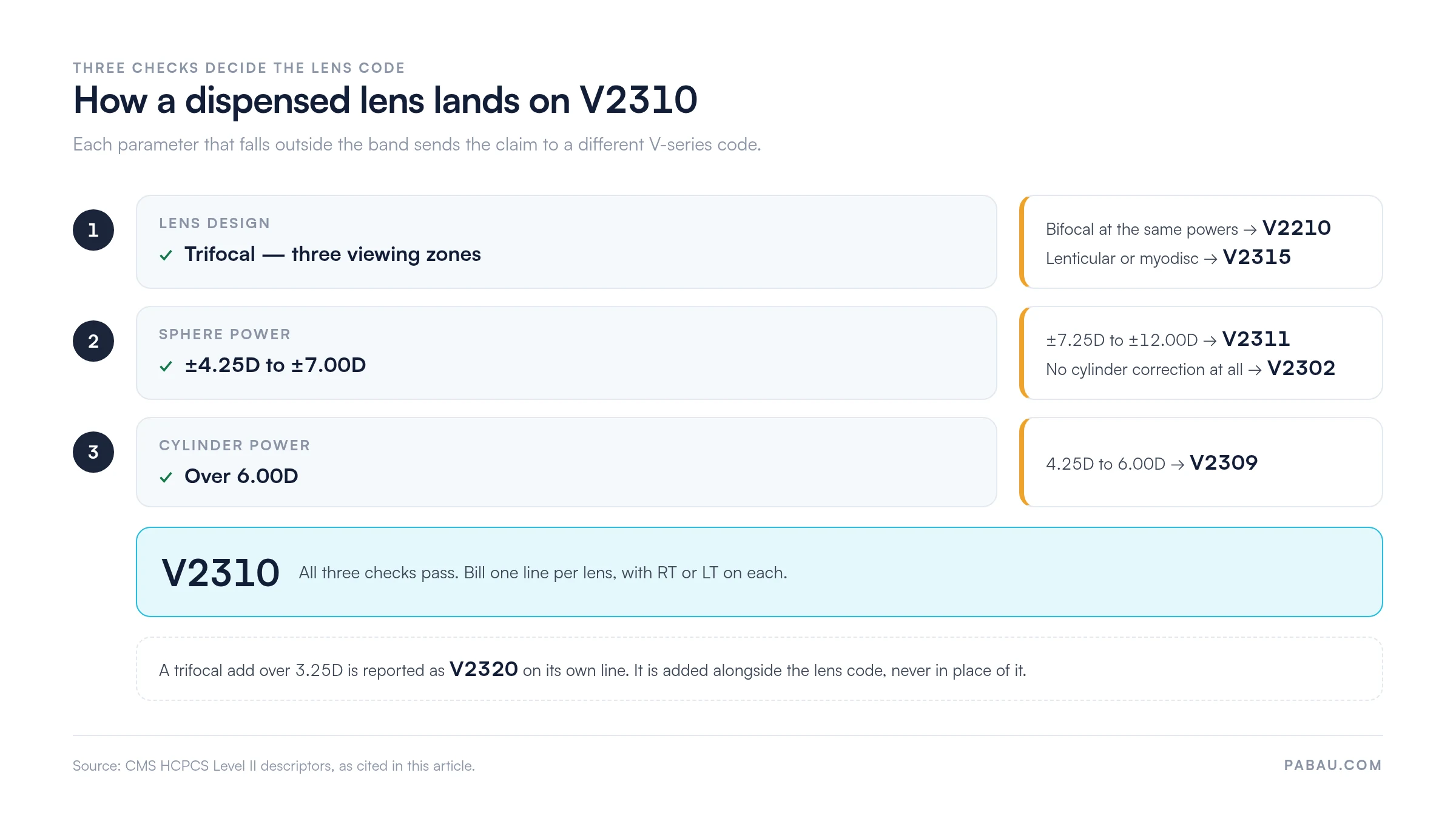
Three prescription values choose this code. The design must be trifocal, the sphere must sit between 4.25 and 7.00D, and the cylinder must exceed 6.00D.
A bifocal at the same powers bills under V2210. V2320 is a trifocal add-power code reported alongside V2310, not instead of it.
Medicare Part B covers V2310 only after cataract surgery with an intraocular lens implant. Routine eyeglass supply falls under the statutory vision exclusion.
Modifiers RT and LT identify the eye. RA marks a full replacement lens, and RB marks a part supplied during a repair.
Pabau’s claims management software validates V-series modifiers and checks payer eligibility, so fewer V2310 lines come back denied.
HCPCS code V2310 sits in the HCPCS Level II V-series as a supply code for a single spectacle lens. The official descriptor comes from the Centers for Medicare and Medicaid Services (CMS). It reads “spherocylinder, trifocal, plus or minus 4.25 to plus or minus 7.00D sphere, over 6.00D cylinder, per lens”.
The code pays for the lens and for nothing else around it. The frame, the fitting service, and a lenticular design each carry their own separate codes.
That one line holds three separate selection criteria. The lens design is trifocal, so it carries three viewing zones for distance, intermediate, and near vision. The lens is a spherocylinder, so it corrects astigmatism alongside spherical error. The power bands are narrow, with sphere between plus or minus 4.25 and plus or minus 7.00D and cylinder above 6.00D.
The code structure follows standard HCPCS Level II logic. The “V” prefix designates vision services and supplies. The V2300 to V2314 block covers trifocal spectacle lenses, subdivided first by sphere power band and then by cylinder power band. V2310 marks the highest cylinder tier inside the plus or minus 4.25 to plus or minus 7.00D sphere range.
The lowest cylinder tier inside that same sphere range is V2307, which covers .12 to 2.00D. On a trifocal in this sphere band, the cylinder reading alone decides which code applies.
V2310 is billed per lens, not per pair. Dispensing both lenses of one pair takes two line items, one for the right eye and one for the left. Each line carries its own laterality modifier. Billing a single unit for a pair of trifocals halves the reimbursement.
The V-series covers vision services and supplies from V2100 through V2999. Spectacle lenses occupy V2100 to roughly V2615, organized first by lens design, then by sphere power, then by cylinder power. V2310 sits at the far end of all three grids, so each neighboring code differs from it by a single parameter.
The pairing that causes most of the confusion is V2310 and V2320, because the two are not alternatives. V2310 is the base lens code, chosen by design, sphere power, and cylinder power. V2320 describes a trifocal add above 3.25D and is reported on its own line in addition to the lens. Leaving V2320 off a high-add claim gives away revenue, and substituting it for V2310 leaves the lens itself unbilled.
The substitution risk that matters sits with V2210, the bifocal entry at the same sphere and cylinder bands. Billing V2310 for a dispensed bifocal overstates the lens design, and billing V2210 for a trifocal understates it. Either direction invites post-payment audit. Single vision lenses at those same powers have their own entry, V2110.
Read as a sequence rather than a grid, the selection comes down to three checks against the prescription. The chart below shows which neighboring code catches the claim when one of them falls outside the band.
Medicare Part B does not routinely cover eyeglasses or spectacle lenses for standard vision correction needs. The statutory exclusion under Section 1862(a)(7) of the Social Security Act broadly bars coverage for routine vision care. One important exception applies, and that is post-cataract surgery lens supply.
One exception covers the beneficiary who has had cataract surgery and now lacks the natural crystalline lens. For aphakia or pseudophakia, CMS allows one pair of eyeglasses or contact lenses after each cataract surgery that inserts an intraocular lens.
The benefit attaches to the surgery rather than to the beneficiary’s lifetime. A patient who later has a qualifying operation on the second eye can be supplied a second pair under the same exception.
HCPCS code V2310 can be billed under this exception, subject to the relevant Local Coverage Determination (LCD) for the Medicare Administrative Contractor (MAC) jurisdiction. Coverage rules, documentation requirements, and allowed amounts vary by MAC region. Confirm the applicable LCD before submitting.
Proactive insurance eligibility verification before the patient’s appointment catches the post-cataract eligibility status. It also prevents billing a non-covered supply to a Medicare beneficiary with no secondary payer in place.
Billing V2310 correctly means matching the clinical documentation to the claim line before submission. A claim with the right code but the wrong modifier or a missing prescription on file will deny on first touch.
Practices handling a steady volume of vision supply billing lean on claims management software that validates HCPCS modifiers and payer requirements before transmission. It catches the laterality and replacement-modifier omissions behind routine denials.
Modifiers on V-series supply codes serve two functions. They identify laterality, meaning which eye received the lens, and they explain the reason for supply, meaning a new pair versus a replacement. Submitting V2310 without any modifier is a near-universal denial trigger for most payers, including Medicare Advantage plans and commercial vision insurers.
What separates RA from RB is the extent of the replacement, not the reason behind it. RA belongs on a claim that replaces the whole item, whether it was lost, stolen, or damaged beyond repair. RB belongs on a claim that supplies one part during a repair.
A lens replaced outright therefore never takes RB, however it came to be replaced. Reading the pair as “lost versus broken” is the mistake that puts the wrong modifier on a V2310 line.
Laterality modifiers (RT/LT) and replacement modifiers (RA/RB) can be stacked on the same claim line when both apply. A replacement right-eye lens, for example, would carry both RT and RA.
V2320 is sometimes mistaken for a modifier because it so often accompanies a trifocal claim. It is a separate HCPCS code for a trifocal add over 3.25D and needs its own claim line, never a position in the modifier fields.
Confirm modifier stacking rules with the specific payer, as some MACs have sequencing requirements of their own. Verify all modifier usage against current CMS guidance and the applicable LCD. Modifier policies shift with the annual updates tracked in the AAPC HCPCS code reference.
Payers auditing V2310 claims look for four categories of documentation. Missing any one of them is grounds for full claim denial or post-payment recoupment. Assembling the record at the point of dispensing, rather than after the remittance arrives, is standard practice.
Practices that keep structured dispensing records recover from payer audits far faster than those relying on paper logs. The difference shows up in how quickly the file can be retrieved on request.
Build a V2310 checklist into your optical dispensing workflow. Confirm the trifocal design, the sphere and cylinder bands, the laterality modifier, and the diagnosis code linked to the clinical indication. Checking those four before submission catches the majority of preventable denials.
V2310 denials cluster around a small number of repeating errors. Identifying which one applies to a denied claim is the first step toward a clean corrected submission.
Treating V2310 denials as one data set rather than as separate claim problems changes what you end up fixing. Tracking which reason recurs most often shows whether the answer is a documentation workflow change, a modifier-validation step, or a payer-policy clarification.
Read the remittance codes after each payment run rather than claim by claim. The CARC and RARC codes on a denied V2310 line name the denial category precisely and point to the resolution path. A broader review of denial codes gives you the framework for reading them across your full claim volume.
In most optical practices the V2310 line gets assembled twice. The dispensing optician records the lens parameters in one place, and a biller later retypes the code, the units, and the modifiers into the claim. Each retype is a chance to drop a laterality modifier.
Pabau is practice management software that holds the prescription, the dispensing record, and the claim in one patient file. Parameters captured at the bench carry straight through to the claim line, so nobody is reading powers off a separate optical log.
Eligibility runs before the appointment instead of after the remittance, which surfaces a patient’s post-cataract status while there is still time to act on it. Claims are then checked against modifier and payer requirements before transmission.
What the team feels is a shorter denial queue. Fewer V2310 lines come back for a missing RT or LT, and the ones that do arrive already carrying the remittance codes that explain why.

Pabau’s claims management tools validate HCPCS modifiers and check payer eligibility before submission. Vision supply billing runs cleaner, so your team spends less time chasing denials and more time seeing patients.

V2310 rewards a practice that settles the code at the dispensing bench rather than at the billing desk. All three parameters that choose it sit on the prescription already in front of the optician. Confirming them there costs a minute, and confirming them after a denial costs a month.
The trade-off worth holding onto is that this lens sits inside a supply category Medicare mostly excludes. Confirming the post-cataract exception before you dispense protects the patient from a surprise balance as much as it protects the receivable.
Book a demo to see how Pabau validates V-series modifiers and eligibility before your vision supply claims leave the practice.

Need a framework for managing claim denials across your practice? Denial management in healthcare covers the systematic approach to tracking, appealing, and preventing recurring denials.
Want to understand how clearinghouse submissions work for supply codes? Medical claims clearinghouse explains the role of clearinghouses in validating and transmitting HCPCS claims.
Looking to strengthen your overall billing compliance posture? Medical billing compliance outlines the documentation and process standards that reduce audit exposure across all claim types.
HCPCS code V2310 is a Level II supply code for one spherocylinder trifocal spectacle lens. The official descriptor covers a sphere power of plus or minus 4.25 to plus or minus 7.00D with cylinder over 6.00D. It sits inside the CMS V-series vision supply codes and is billed per lens, not per pair.
No. V2310 is a trifocal code. The official CMS descriptor reads spherocylinder, trifocal, plus or minus 4.25 to plus or minus 7.00D sphere, over 6.00D cylinder, per lens. The bifocal entry at the same sphere and cylinder bands is V2210, and that is the code to use when a bifocal is dispensed.
Medicare Part B does not cover routine eyeglass lenses, including V2310, for standard vision correction. The exception is post-cataract surgery. Medicare covers one pair of eyeglasses or contact lenses after each cataract surgery that inserts an intraocular lens. The benefit attaches to the surgery rather than to the beneficiary’s lifetime. Coverage is subject to the applicable Local Coverage Determination for the MAC jurisdiction.
The most common modifiers for V2310 are RT (right eye) and LT (left eye) to indicate laterality. Both are typically required, with one claim line per eye. For a replacement, RA covers the whole item and RB covers a part supplied during a repair. Submitting V2310 without a laterality modifier is one of the most frequent denial triggers on this code.
Bill two separate claim lines. One V2310 carries modifier RT for the right-eye lens, and one carries LT for the left-eye lens, each with a quantity of 1. Where the trifocal add exceeds 3.25D, report V2320 on its own line as well. Billing a single unit for a complete pair is an undercoding error that halves the reimbursement.
Required documentation includes a current signed eyeglass prescription showing sphere power, cylinder power, axis, and the add powers for each eye. Add a dispensing record confirming the lens delivered matches the prescription, plus patient confirmation of receipt. For Medicare post-cataract claims, an operative note and the linking diagnosis codes are also needed.
The two are not alternatives, so the choice is rarely either/or. V2310 is the base lens code for a spherocylinder trifocal within a defined sphere and cylinder range. V2320 is an add-power code for a trifocal add over 3.25D, reported on a separate line alongside the lens. The code that gets billed in error instead is V2210, the bifocal entry at the same powers.