HCPCS code G0124: Physician-read Pap screening billing guide
HCPCS code G0124 covers a Pap test a physician reads HCPCS code G0124 is a Level...

Last Updated: Oct 19, 2026
V2300 is the HCPCS Level II code for sphere, trifocal, plano to plus or minus 4.00d, per lens.
It covers a trifocal lens with sphere power only, so the prescription has no cylinder. Stronger spheres, from 4.12d to 7.00d, move to V2301. Lenses with a cylinder component use the spherocylinder codes V2303 to V2314.
Because the code is billed per lens, a pair is reported as two claim lines of one unit each, marked RT and LT. Lens material and features, such as high-index or tint, are billed separately.
Let Pabau's smart automation suggest the right codes, reduce claim denials, and keep your practice compliant—effortlessly.
Automate repetitive tasks and focus on what matters most—your patients.
Reduce coding errors and ensure compliance with the latest regulations.
Clean claims, fewer denials, and faster reimbursements.
Powerful insights and reporting to help your practice thrive.
HIPAA compliant SOC 2 certified GDPR-compliant Trusted by 4,000+ clinics worldwide

V2300 covers one sphere-only trifocal lens from plano to plus or minus 4.00D, and spheres from 4.12D up move to V2301 or V2302.
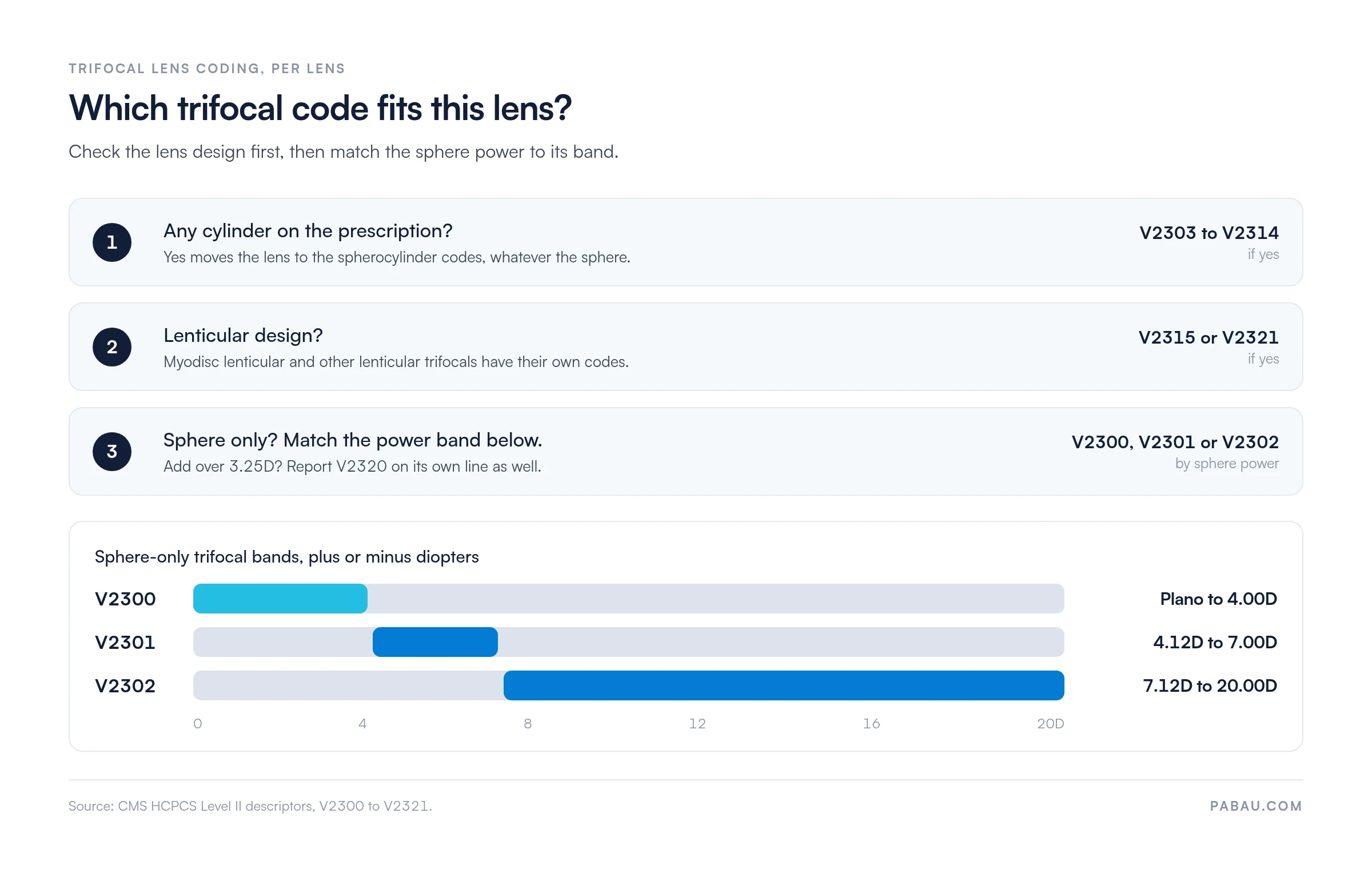
Any cylinder on the prescription moves the lens to the spherocylinder codes, V2303 to V2314, whatever the sphere power.
The code is billed per lens, so a pair goes on two claim lines, one marked RT and one marked LT.
Traditional Medicare pays for V2300 only under the post-cataract eyeglass benefit, never for routine lenses.
High-index material, tints, and coatings go on their own add-on V-code lines, separate from V2300.
HCPCS code V2300 is the Level II supply code for one sphere trifocal spectacle lens, from plano to plus or minus 4.00 diopters. It applies only when the lens has no cylinder, so the sphere field decides the code.
The detail that trips claims up is the unit. V2300 is billed per lens, so a pair becomes two claim lines, one marked RT and one marked LT. Miss the power band or the unit, and the claim comes back weeks after the patient has their glasses.
Below, you’ll find the code boundaries, Medicare’s post-cataract rule, the records payers expect, and a checklist to run before you submit.
V2300 opens the trifocal family (V2300-V2321 and related codes), which sorts lenses by design first and sphere power second. Each sphere-only code above it starts where V2300 stops, so 4.00D is the first number to check.
V2300 describes a narrow product. Knowing what sits outside it is the quickest way to avoid billing the wrong code.
Lens material and features (high-index, tint, coatings) are billed with separate add-on V-codes. For example, V2782 and V2783 cover high-index plastic or glass, and V2744 or V2745 cover tints. Anti-reflective coating is V2750, and scratch-resistant coating is V2760.
Most misclassifications happen at the 4.00D line. A sphere of exactly 4.00D stays in V2300, while 4.12D to 7.00D moves to V2301. Check the cylinder field first, though, because any cylinder value takes the lens out of V2300 altogether.
Trifocal codes sort lenses by design before power, so the order of your checks matters. The decision path below shows that order, and the table gives the official distinction for each code.
Take a prescription with a right sphere of -3.75D, a left sphere of -4.25D, and an add of +2.50D. Neither eye has cylinder.
The right lens bills as V2300-RT and the left as V2301-LT, one unit each. The add is under 3.25D, so V2320 doesn’t apply. Mixed pairs like this are common, which is why each eye gets coded on its own.
When a sphere reads exactly 4.00D, compare it with the refraction record before coding, since one transcription slip changes the code. The AAPC HCPCS Level II code lookup helps you cross-check neighboring descriptors during training or audits.
Traditional Medicare Part B doesn’t cover routine eyeglass lenses. So a V2300 claim for a routine refraction and dispense denies as non-covered. That’s why every medical billing workflow for vision supplies starts by confirming which payer is primary for the pair.
Medicare covers one pair of eyeglasses after each cataract surgery with an intraocular lens (IOL) implanted. V2300 is payable under this benefit when the new sphere sits between plano and 4.00D. Patients with aphakia, meaning no lens in the eye, are covered under the same refractive lens policy.
For the post-cataract benefit, the supplier bills on a CMS-1500 and keeps proof of the surgery on file. The routine eyeglass exclusion sits in the Medicare Benefit Policy Manual, Chapter 16. Confirm current code details on the CMS HCPCS code information page.
V2300 is priced on the CMS DMEPOS fee schedule, not the physician fee schedule. No single national rate applies, because CMS sets allowables by state.
Because V2300 is billed per lens, the allowable applies to each line. A bilateral pair produces two lines, each paid at the lens rate. Rate aggregators can show fees that don’t match your contract, so quote patients from the payer’s own schedule.
Build a rate card for V2300 and V2301 covering your top five payers. Refresh it after the January DMEPOS update and whenever a payer contract renews. Quoting from last year’s rate is how patients end up with surprise balances.
Payers can request records long after they pay, so gather them at dispensing. Medical billing compliance for vision supplies rests on six records:
Never bill V2300 as one line with two units. Since March 2019, the DME MACs reject a bilateral lens billed as RTLT on a single line. Bill two lines instead, each with one unit and its own RT or LT modifier.
Prior authorization for V2300 varies by payer and plan year. Traditional Medicare doesn’t require it for the post-cataract benefit, but the records above still need to be complete before dispensing.
Many Medicare Advantage plans cover routine eyeglass lenses as a supplemental benefit, and some require prior authorization before the lab order goes in. A request usually needs the prescription, the date of service, and the dispensing provider’s NPI. Record the authorization number before you dispense.
VSP, EyeMed, and Davis Vision each run their own authorization workflow through a provider portal. The authorization number has to appear on the claim. Many plans tie it to the exam date rather than the dispense date, which matters when a patient collects lenses weeks later.
State Medicaid programs that cover trifocal lenses may require prior authorization and cap how often lenses are replaced. Rules differ from state to state, so check that state’s provider manual before dispensing.
Keep a prior authorization checklist for your top five vision payers and update it each plan year. Include the portal link, required fields, typical turnaround, and whether authorization follows the exam date or the dispense date.
Most V2300 denials repeat a handful of patterns. Grouping them with the medical billing denial codes on the remittance lets you fix one root cause across many claims.
With the denial patterns in mind, run this sequence for every V2300 claim before it leaves the practice.
A lot of V2300 rework starts with data entry. A lens line gets keyed by hand, a modifier slips, or an authorization number never reaches the claim.
Pabau, the practice management platform we build, supports cleaner claims management for vision supplies. It pre-fills the CMS-1500 from the patient record, offers HCPCS lookup and checks required claim fields before you send.
In the US, claims go out through Claim.MD, so your team can follow each claim’s status without a separate portal. Your billers still choose the code and the modifiers. Pabau makes sure the form around them is complete.

Pabau’s claims management software pre-fills the CMS-1500, offers HCPCS lookup and checks required claim fields before you send. Fewer lens claims come back for missing details.

V2300 rewards a fixed routine more than deep coding knowledge. Rule out cylinder and lenticular design, match the sphere band, then give each lens its own line.
The payer question deserves the same discipline. Traditional Medicare pays only after cataract surgery, while vision and Advantage plans set their own authorization rules. Settle that before the lab order, and the claim has far fewer ways to fail.
Still keying lens claims by hand? Book a demo to see how Pabau pre-fills each line and checks the claim before it goes out.

Need a reference for denial codes across all HCPCS claims? Denial codes in medical billing covers the most common CARC and RARC reason codes with resolution steps.
Want to understand what sits behind a clean claim? What is medical billing explains the full claim lifecycle from charge entry through remittance posting.
Looking for compliance guidance for your billing team? Medical billing compliance outlines the documentation and audit-readiness requirements that apply across code sets.
Working with a stronger prescription? HCPCS code V2302 covers sphere trifocal lenses from 7.12D to 20.00D.
Is the reading add above 3.25D? HCPCS code V2320 explains how to report a high trifocal add alongside the lens.
Medicare’s refractive lens policy, LCD L33793, ties post-cataract lenses to pseudophakia or aphakia. Pseudophakia is Z96.1, and aphakia codes sit under H27.0-. Point each lens line to that diagnosis in box 21.
Yes. V2300 covers the lens only, so the frame goes on its own line. Medicare pays for a standard frame, V2020, but not a deluxe frame, V2025.
No. A progressive lens has no visible segments, so it’s coded V2781, progressive lens, per lens. Medicare treats it as an upgrade the patient pays for.
Use V2399, specialty trifocal (by report), only when no fixed trifocal code describes the lens. Send a written description, and expect the payer to price it manually.
Not for traditional Medicare. Routine eyeglasses are a statutory exclusion, so an ABN is optional. Append the GY modifier if a secondary plan needs a Medicare denial first.
Usually, yes. The exam is a professional service, while the lens is a supply on its own claim line. Check the payer’s bundling policy and any applicable edits before you submit.