CPT code 28615: Open Lisfranc dislocation billing guide
What CPT code 28615 means, in plain terms CPT code 28615 is the code for open tr...

Last Updated: Oct 20, 2026
V2314 is the HCPCS Level II code for spherocylinder, trifocal, sphere over plus or minus 12.00d, per lens. It is billed one unit per lens, so a bilateral pair takes two units with RT and LT modifiers.
The code starts at 12.25D. A sphere from 7.25D to 12.00D belongs in V2311, V2312 or V2313, chosen by cylinder power. A lenticular (myodisc) design is V2315 at any power. Medicare covers V2314 only as a prosthetic lens after cataract surgery.
Let Pabau's smart automation suggest the right codes, reduce claim denials, and keep your practice compliant—effortlessly.
Automate repetitive tasks and focus on what matters most—your patients.
Reduce coding errors and ensure compliance with the latest regulations.
Clean claims, fewer denials, and faster reimbursements.
Powerful insights and reporting to help your practice thrive.
HIPAA compliant SOC 2 certified GDPR-compliant Trusted by 4,000+ clinics worldwide

HCPCS code V2314 covers one spherocylinder trifocal lens with sphere power over plus or minus 12.00D, billed per lens (one unit per eye).
The most common coding error is billing V2314 at 12.00D or lower, where V2311, V2312 or V2313 applies by cylinder power. Always read the sphere power from the written prescription.
Medicare Part B covers V2314 as a prosthetic lens after cataract surgery, whether the patient has aphakia or an implanted intraocular lens (Z96.1). Routine vision correction is excluded.
Practice management software like Pabau helps practices track lens prescriptions, apply correct modifiers, and reduce V-code claim denials before submission.
HCPCS code V2314 sits within the V2300 to V2399 trifocal lens series. Inside that series, spherocylinder trifocals are sorted by sphere power band first, then by cylinder power. Knowing where V2314 falls in that grid is the first step to coding it correctly.
The official descriptor reads: Spherocylinder, trifocal, sphere over plus or minus 12.00D, per lens. It sets a floor on sphere power and nothing else. There is no upper sphere limit and no cylinder qualifier. Per CMS’s HCPCS Level II guidelines, this is a per-lens code. One unit equals one lens. Bilateral dispensing requires two units or two separate line items.
Up to 12.00D, the series splits each sphere band by cylinder power. Lower in the same series, a plano to +/- 4.00D sphere with 2.25D to 4.00D of cylinder is V2304. Above 12.00D, V2314 takes every spherocylinder trifocal in a standard lens design, whatever the cylinder.
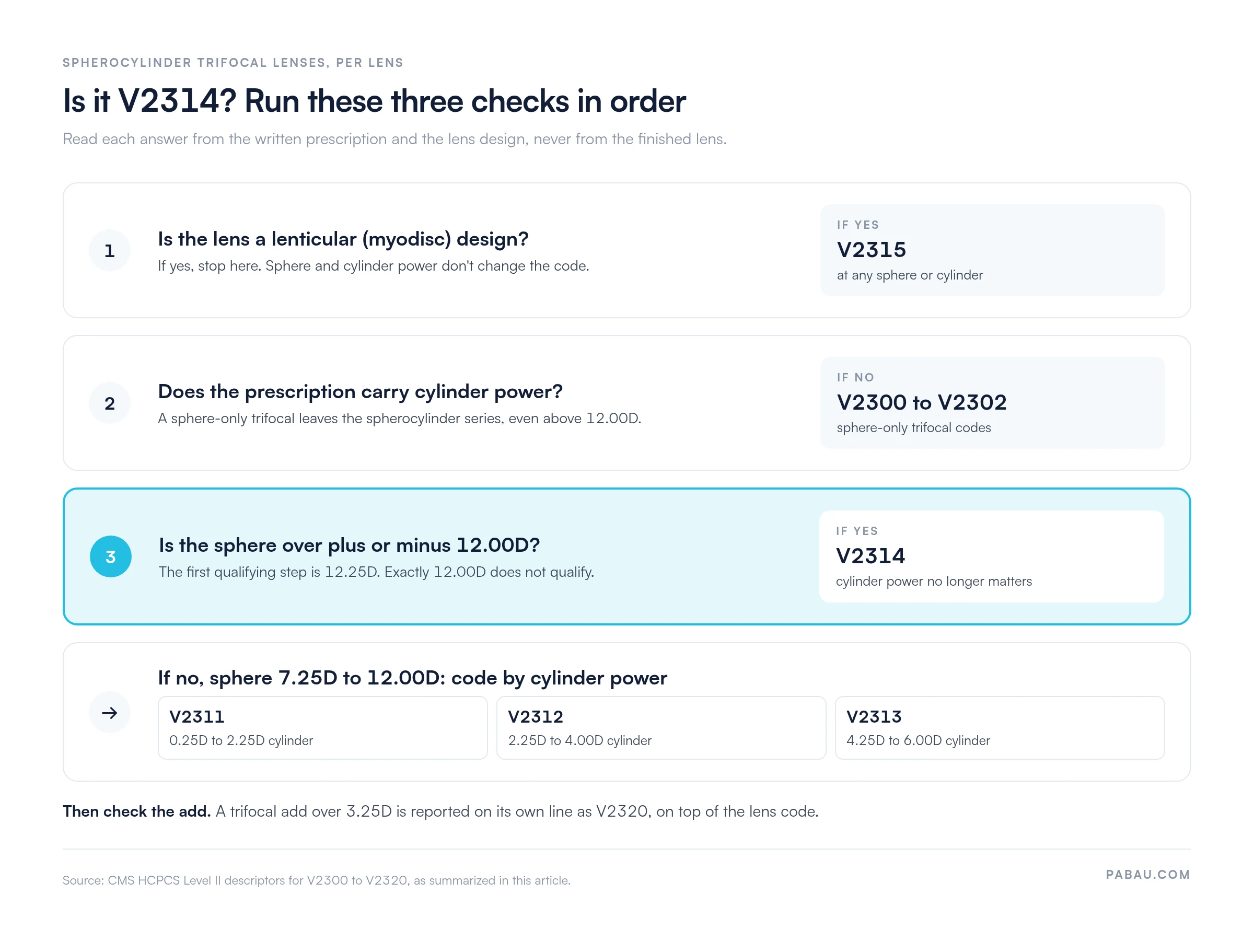
The critical boundary is the +/- 12.00D threshold. A lens with sphere power of exactly 12.00D stays in the V2311 to V2313 band, chosen by its cylinder power. V2314 begins strictly over 12.00D, so the first qualifying sphere step is 12.25D. Rounding up on the prescription is an upcoding error that triggers denial or recoupment during a payer audit.
V2314 covers a single spherocylinder trifocal lens with sphere power over +/- 12.00D. The lens must have three focal zones (near, intermediate, and distance) and a cylinder component. That combination separates it from the sphere-only trifocal codes, V2300 to V2302.
The following are explicitly outside the scope of this code:
V2314 is a per-lens code. Billing one unit for a pair of lenses is incorrect and will typically result in a partial denial or underpayment. For bilateral dispensing, submit two units or two line items, using the RT (right eye) and LT (left eye) modifiers to identify each lens.
Two miscodings account for most errors in this part of the series. The first is billing V2314 when V2311, V2312 or V2313 applies. Of those, HCPCS code V2311 carries the lowest cylinder, 0.25D to 2.25D. The second is billing V2314 for a lens design that calls for V2315. Each code has one defining characteristic, so the decision logic is short.
V2313 vs V2314: Sphere power is the first test. V2313 covers sphere from 7.25D to 12.00D with 4.25D to 6.00D of cylinder. V2314 covers any sphere over 12.00D, and cylinder power no longer changes the code. A prescription reading 12.00D stays in V2311 to V2313, depending on the cylinder. A reading of 12.25D or higher is V2314. Review the written prescription rather than estimating from the fabricated lens.
V2314 vs V2315: Use V2314 for a standard spherocylinder trifocal with sphere >12.00D. Use V2315 for lenticular or myodisc designs at any power; myodisc lenses have a small optical zone surrounded by a carrier lens and are typically used for very high prescriptions. Confirm the lens design with the dispensing optician before coding. The flow below shows all three checks in order.
Medicare Part B covers spherocylinder trifocal lenses as prosthetic lenses after cataract surgery. That covers patients left with aphakia (no natural lens and no implant). It also covers pseudophakia, where an intraocular lens (IOL) was implanted during the surgery.
Coverage runs through the durable medical equipment, prosthetics, orthotics and supplies (DMEPOS) benefit rather than a vision benefit.
The covered diagnoses are set out in CMS Policy Article A52499 for refractive lenses. Medicare does not cover routine vision correction, including standard trifocal lenses prescribed for refractive error.
To qualify for Medicare coverage of HCPCS code V2314, the claim must show cataract extraction in the affected eye or eyes. The diagnosis code carries that.
Use an aphakia code (H27.00-H27.03), or Z96.1 (presence of intraocular lens) for a post-cataract patient with an IOL. Check eligibility before dispensing to confirm whether the patient’s plan includes the prosthetic lens benefit.
Key Medicare coverage points for optical practices billing V2314:
A complete documentation package is the single strongest defense against V2314 claim denials. Sphere and cylinder powers must be written on the prescription itself, never estimated from the fabricated lens.
Required documentation for a V2314 claim includes:
Capturing sphere and cylinder values digitally at the point of entry cuts transcription errors. It also shows at a glance whether the documented sphere supports V2314 rather than V2311 to V2313. Optical practices with several providers or locations should hold every site to the same documentation standard. Inconsistent records are a common audit trigger and invite recoupment during post-payment reviews.
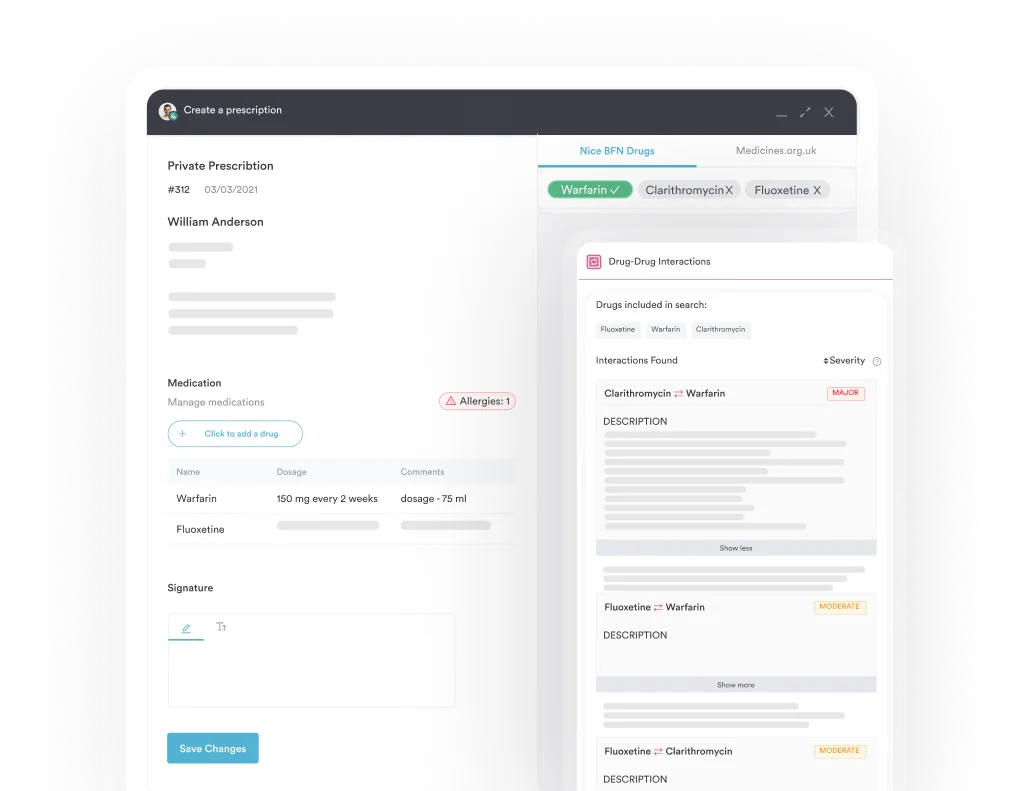
Accurate claim submission for HCPCS code V2314 requires the right code, the right quantity, the right modifiers, and a paired ICD-10 diagnosis. Missing any one of them produces a denial or underpayment. The billing workflow for optical V-codes follows the same CMS-1500 or 837P process as other DMEPOS claims.
For practices billing Medicare, the optical supplier’s DMEPOS enrollment must be current and the supplier number must appear on the claim. Billing under a provider number that is not DMEPOS-enrolled will result in an automatic denial regardless of clinical documentation quality.
CMS updates DMEPOS fee schedules annually. The allowed amount for V2314 under Medicare is published in the CMS DMEPOS fee schedule. Rates vary by geographic region (fee schedule area) and are typically expressed as a single purchase allowance for lenses classified as DMEPOS items.
Rates change each January, so dollar figures in third-party references age quickly. CMS excludes prosthetic eyeglass lens V-codes from the DMEPOS competitive bidding program, so no bid-area price replaces the fee schedule amount. Verify the current allowed amount in the CMS DMEPOS fee schedule before quoting patients on expected Medicare reimbursement.
Check the allowed amount for each code from V2311 to V2315 in your fee schedule area. A lens miscoded across the 12.00D line changes the payment as well as the compliance exposure.
After payment posts, review the electronic remittance advice (ERA) for each V2314 claim. The ERA will show the allowed amount, any patient cost-sharing applied, and adjustment reason codes if the paid amount differs from the billed amount. Patterns in adjustment reason codes often reveal systemic billing issues. Repeated CO-4 codes (modifier required), for example, point to a missing or incorrect modifier on V2314 line items.
Bill V2314 at your practice’s standard fee (not the Medicare allowed amount) for all payers. Payers apply their own contracted rate or allowed amount at adjudication. Billing commercial patients at the Medicare rate is a common revenue leak in optical practices. Payers that reimburse more than the DMEPOS allowed amount will simply pay less.
V2314 denials follow predictable patterns, and most can be prevented with a short pre-submission check. The table pairs each denial type with its trigger and the fix.
For practices with a high volume of V-code claims, tracking denial patterns by code is faster than reviewing each denial on its own. Our guide to medical billing denial codes explains the adjustment reason codes that appear on ERAs when V2314 claims are partially or fully denied.
The ICD-10 diagnosis code on a V2314 claim signals the clinical reason for the high-power trifocal lens. Payers use the diagnosis code to determine whether the claim meets their coverage criteria. This pairing table covers the most common diagnostic pairings, including the conditions where Medicare coverage is most defensible.
Check each diagnosis code against the current CMS ICD-10 code files before submission. ICD-10-CM codes are updated every October 1, and a retired code triggers a claim edit that delays or denies payment. A non-billable parent code such as H52.1 is rejected the same way, so always code to the full laterality.
Practices that process a high volume of optical DMEPOS claims should audit the diagnosis codes in their billing templates periodically. A template still carrying a retired or parent code repeats the same denial on every claim built from it.
In many optical practices the V2314 line gets assembled twice. The dispensing optician records the lens parameters in one place, and a biller later retypes the code, units and modifiers into the claim. Each retype is a chance to key 12.00D as 12.25D, or to drop a laterality modifier.
Pabau is practice management software that holds the prescription, the dispensing record and the claim in one patient file. Sphere and cylinder values captured at the bench carry straight through to the superbill and the claim line.
Claims management software in Pabau checks each line against modifier and payer rules before transmission. Eligibility runs before the appointment, which surfaces a patient’s post-cataract status while there is still time to act on it.
The result is a shorter denial queue. Fewer V2314 lines come back for a wrong sphere band or a missing RT or LT modifier.
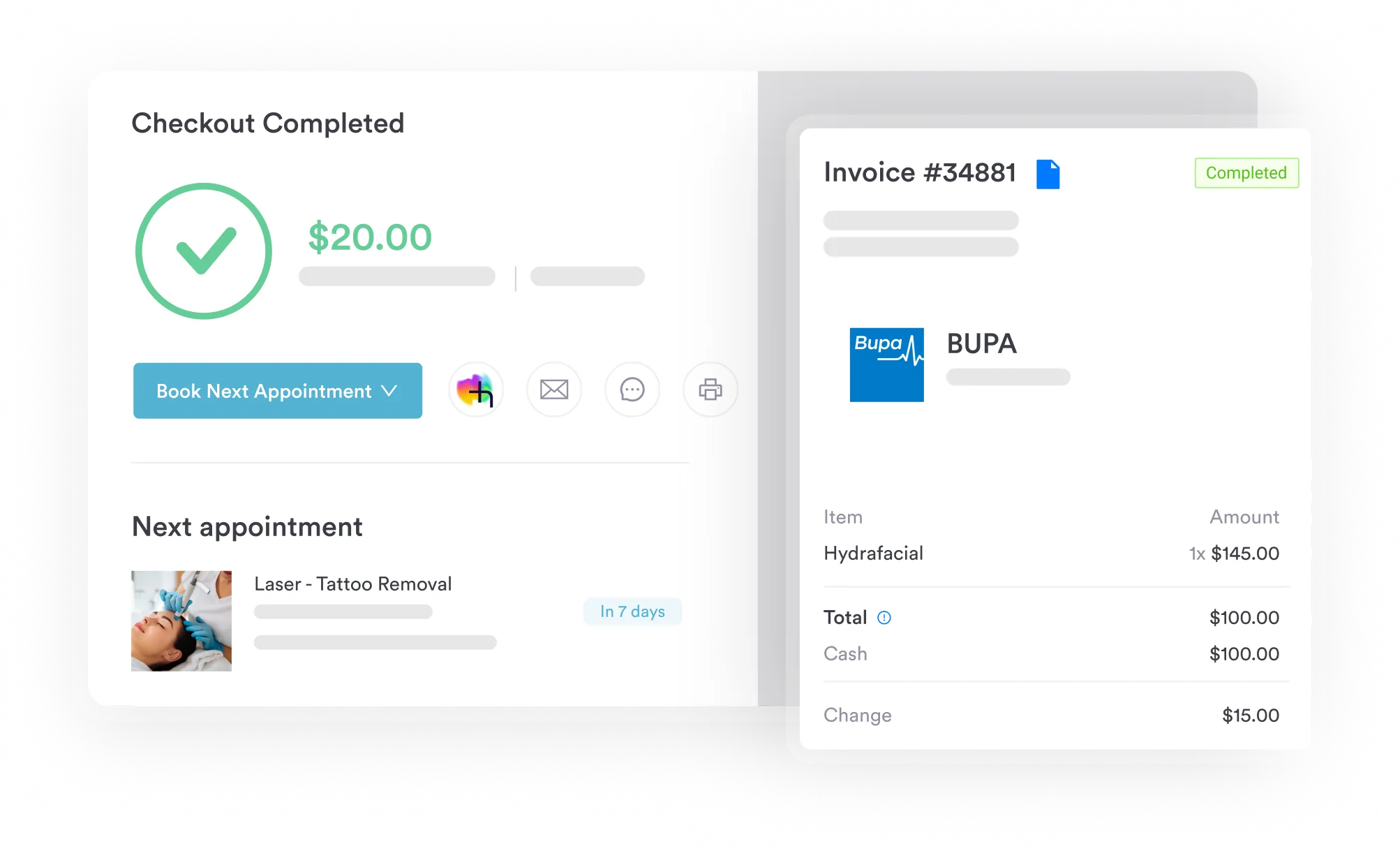

Pabau’s claims management tools help optometry and ophthalmology practices track lens prescriptions, apply correct HCPCS codes, and submit cleaner claims. See how it works for your practice.

HCPCS code V2314 has one threshold to get right. It starts where the V2311 to V2313 band ends, at sphere power over plus or minus 12.00D. From there, cylinder power no longer changes the code.
The costly errors sit on either side of that line. One is billing V2314 at exactly 12.00D, and the other is billing it for a lenticular design that belongs under V2315. Settle the code at the dispensing bench and pair it with the right diagnosis and RT or LT modifier. Then confirm the post-cataract exception before billing Medicare.
Book a demo to see how Pabau checks V-series codes, modifiers and eligibility before your vision supply claims leave the practice.

Need to understand how denied claims are categorized? Medical billing denial codes explains the adjustment reason codes that appear on ERAs when HCPCS claims are partially or fully denied.
Want a step-by-step overview of the full billing cycle? What is revenue cycle management covers how claims move from dispensing through adjudication and payment posting.
Want more V-code claims paid on the first pass? What is a clean claim covers the fields and checks that keep a claim out of the rejection queue.
Coding other vision supplies? HCPCS codes collects the Level II code guides, including the V-series lens and frame codes.
HCPCS code V2314 covers a spherocylinder trifocal spectacle lens with sphere power over plus or minus 12.00D, billed per lens. Its descriptor carries no upper sphere limit and no cylinder qualifier. It applies to lenses with a cylinder component and three focal segments (near, intermediate, and distance). Bifocal, single-vision, contact and lenticular (myodisc) lenses are billed under separate HCPCS codes.
V2314 applies to standard spherocylinder trifocal lenses with sphere power over plus or minus 12.00D. V2315 applies to lenticular (myodisc) trifocal lenses, and its descriptor carries no sphere or cylinder qualifier. A myodisc lens has a small optical disc surrounded by a carrier portion. It is used when a standard lens design would be too thick and heavy. If the lens design is lenticular, bill V2315 whatever the sphere power.
Yes, but only as a prosthetic lens after cataract surgery. Medicare Part B covers V2314 for patients left with aphakia and for patients who had an intraocular lens implanted. Routine vision correction is excluded, including high-power trifocals for myopia, hyperopia or astigmatism unrelated to cataract surgery. The claim needs an aphakia code (H27.00-H27.03) or Z96.1 (presence of intraocular lens). The supplier must also be enrolled as a DMEPOS supplier.
V2314 covers sphere power strictly over plus or minus 12.00D, with no upper limit. A lens with sphere power of exactly 12.00D is coded as V2311, V2312 or V2313, depending on its cylinder power. Only sphere power above 12.00D, such as 12.25D or higher, places a spherocylinder trifocal in V2314.
Medicaid coverage of V2314 varies by state. Each state Medicaid program sets its own vision benefit rules, including which lens types are covered, applicable sphere power limits, and frequency restrictions. Some states cover trifocal lenses as part of a routine optical benefit. Others restrict coverage to lower-power lenses or post-cataract scenarios only. Verify coverage with the specific state Medicaid program before billing.
Bill one unit of V2314 per lens. For bilateral dispensing, submit two line items, one with the RT modifier (right eye) and one with the LT modifier (left eye). Submitting a single line item with quantity 1 for a bilateral pair is incorrect and may result in a partial denial. For Medicare DMEPOS claims, include the NU modifier on each line item to indicate new equipment.
Yes. Spectacle frames are billed separately under V2020 (frames, purchase) or V2025 (deluxe frames, purchase) on distinct line items from the V2314 lens codes. Frames and lenses are not bundled together under HCPCS coding conventions. Still, verify NCCI edit status for the specific payer when lens and frame codes share a claim. Each item requires its own line with the appropriate code and quantity.