

HCPCS code E0198: Water pressure pad billing guide
HCPCS code E0198 is a water pad for a standard mattress HCPCS code E0198 is the ...

Last Updated: Oct 13, 2026
V2302 is the HCPCS Level II code for sphere, trifocal, plus or minus 7.12 to plus or minus 20.00, per lens.
It sits above V2300 and V2301 in the trifocal sphere series. A trifocal lens stronger than plus or minus 7.00 diopters with no cylinder lands here. Most denials trace to cylinder billed under a sphere code, a missing RT or LT modifier, or no aphakia or pseudophakia diagnosis.
Let Pabau's smart automation suggest the right codes, reduce claim denials, and keep your practice compliant—effortlessly.
Automate repetitive tasks and focus on what matters most—your patients.
Reduce coding errors and ensure compliance with the latest regulations.
Clean claims, fewer denials, and faster reimbursements.
Powerful insights and reporting to help your practice thrive.
HIPAA compliant SOC 2 certified GDPR-compliant Trusted by 4,000+ clinics worldwide

V2302 bills one high-power trifocal lens with a sphere of plus or minus 7.12 to 20.00 diopters and no cylinder, per lens.
A weaker sphere drops to V2300 or V2301, and any cylinder moves the lens into the spherocylinder codes from V2303 onward.
Medicare covers V2302 only for aphakia, congenital aphakia, or pseudophakia, and pays one pair after each cataract surgery with an IOL.
Bill each lens on its own line with RT or LT, because a missing laterality modifier gets the claim rejected as incomplete.
Pabau, the practice software we build, tracks each lens line from submission to payment, so a rejected V2302 claim surfaces the day it comes back.
HCPCS code V2302 describes one trifocal spectacle lens with a high-power spherical prescription. The official CMS descriptor reads: Sphere, trifocal, plus or minus 7.12 to plus or minus 20.00, per lens. The code has been effective since October 1, 2003.
Each part of that descriptor narrows which lenses qualify. “Sphere” means the prescription carries no cylinder, so the lens corrects no astigmatism. “Trifocal” means three viewing zones in one lens, for distance, intermediate, and near vision. “Per lens” means a pair takes two claim lines, one for each eye.
The power band of plus or minus 7.12 to 20.00 diopters covers strong prescriptions in both directions. Many patients in it are aphakic, meaning their natural lens was removed without an implant, and they need high plus power to see at distance.
HCPCS code V2302 covers the lens itself, made to a trifocal sphere prescription in the band above. It does not bundle in the frame, coatings, tints, or professional services, which are billed with their own codes.
The code covers:
HCPCS code V2302 does not cover:
Trifocal code selection starts with one question: does the prescription carry cylinder? If it does, the lens belongs in the spherocylinder codes from V2303 onward, whatever the sphere power. If it does not, the sphere power alone picks the code.
At the dispensing desk, read the cylinder first. If any cylinder is present, move to the spherocylinder codes and match both powers. With no cylinder, take the sphere power of each eye and pick V2300, V2301, or V2302. The diagram below runs the same check.
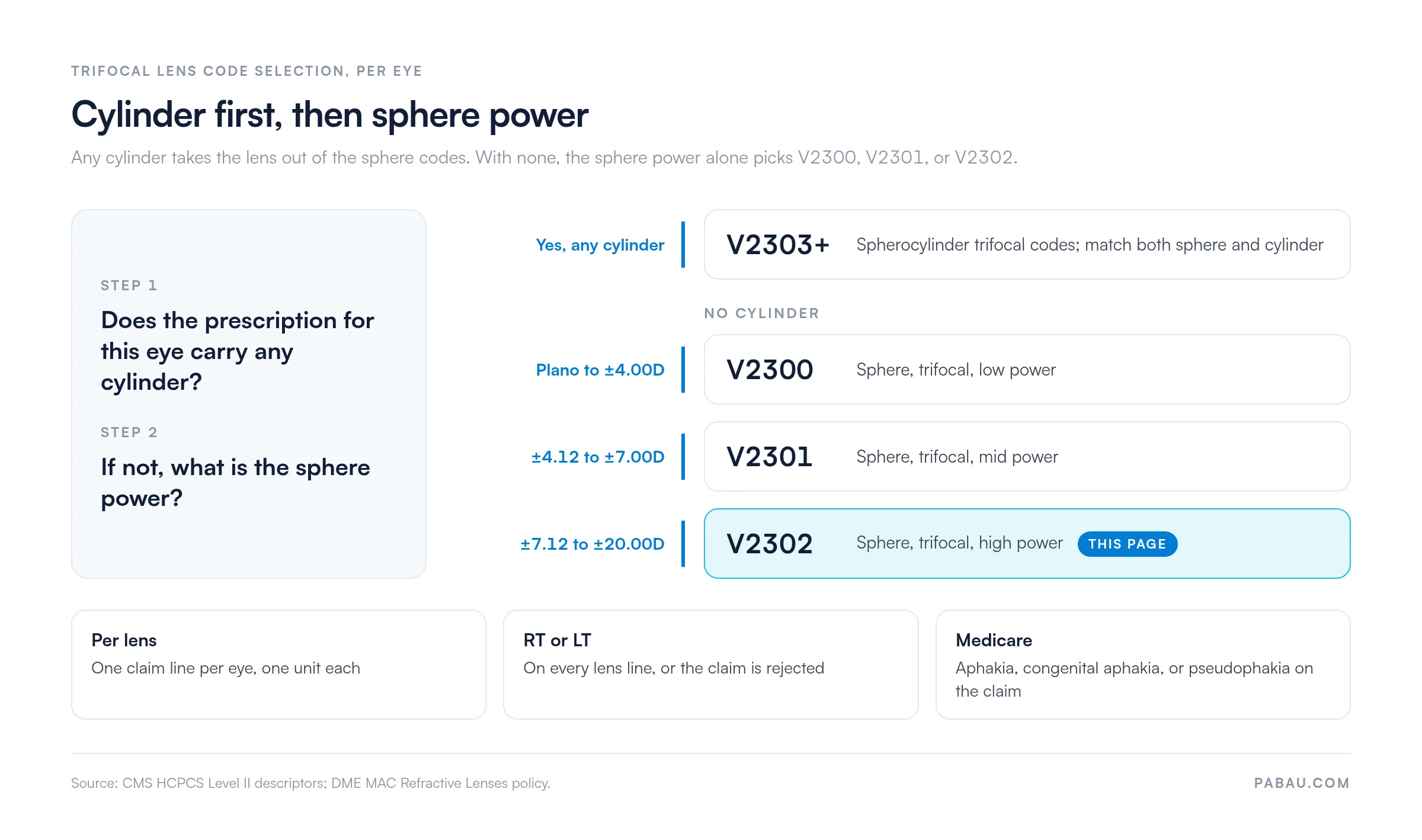
Each eye is coded on its own, so one pair of glasses can carry two different codes. Check the current CMS HCPCS Level II file for your billing year before you lock in a code.
Code each eye from its own sphere value. A patient with +7.50D in the right eye and +6.75D in the left needs V2302-RT on one line and V2301-LT on the other.
Medicare Part B does not cover eyeglasses for ordinary refractive error. That exclusion is statutory, so V2302 is noncovered for most Medicare patients who simply need stronger glasses.
The exception sits under the prosthetic devices benefit in the Medicare Benefit Policy Manual, Chapter 15, section 120. It covers lenses for patients who lack the natural lens of the eye. The DME MAC Refractive Lenses policy names three qualifying conditions: aphakia, congenital aphakia, and pseudophakia.
Frequency depends on which condition applies. A pseudophakic patient, who has an intraocular lens (IOL), gets one pair of eyeglasses or contact lenses after each cataract surgery. Replacement lenses for that patient are noncovered.
An aphakic patient has no IOL, and replacement lenses are covered whenever they are medically necessary. The V2302 power band fits many aphakic prescriptions, so this rule often applies to it.
The optical supplier must be enrolled as a Medicare DMEPOS supplier and bills the DME MAC under its own NPI. The surgeon bills the cataract surgery separately.
Prior authorization for HCPCS code V2302 depends on the payer, not a universal rule. Medicare does not require it for refractive lenses, but state Medicaid programs often do. Commercial vision plans usually handle authorization during benefit verification rather than through a separate request.
When a Medicaid program does require prior authorization, the request generally needs the current prescription and the prescriber’s NPI. It also needs a frequency check, since many programs cover lenses once every one or two years. Some states ask for a letter of medical necessity, so check the state provider manual before billing.
Medicare requires the diagnosis that justifies the lens on every refractive lens claim. For V2302, that means a code showing the patient lacks the natural lens of the eye.
Use the laterality code that matches the eye, rather than H27.00 for an unspecified eye. Check the current DME MAC policy article for the full list of accepted diagnoses.
Medicare pays HCPCS code V2302 from the CMS DMEPOS fee schedule, which updates each January with quarterly revisions. Amounts are set by state, so this guide does not quote a dollar figure. Download the current file from the CMS DMEPOS fee schedule page to find the allowable for your state.
A few practical points on reimbursement:
Optical suppliers billing HCPCS code V2302 need a clear paper trail, and the prescription is the foundation. A licensed optometrist or ophthalmologist must write and sign it, with the patient’s name and the date. It must show a sphere power within +/-7.12 to +/-20.00D, no cylinder, and the trifocal add.
A verbal order or a prescription with incomplete power data cannot support the claim. In Pabau, signed prescriptions are stored in the patient record with audit-ready timestamps, so the order behind each lens line is on file.

Beyond the prescription, retain:
Laterality modifiers drive most V2302 rejections. The DME MAC policy requires RT or LT on every lens code, with each lens on its own line at one unit. Claims missing them are rejected as missing information.
The KX modifier does not belong on the lens line. The DME MAC policy ties it to five add-ons, covering anti-reflective coating, tints, oversize lenses, and polycarbonate, when the record shows medical need. The same policy limits GA and GZ to those add-ons, so a noncovered V2302 line takes GY instead.
For guidance on building a clean claim with correct modifier logic, review CMS Claims Processing Manual Chapter 20 alongside the DME MAC Refractive Lenses policy.
The table below lists the denial reasons optical billing teams see most often on HCPCS code V2302, with the fix for each. Systematic denial management on vision supply codes focuses on the first three rows, where most preventable rejections start.
Not every denial is a billing error. When a denial is incorrect, a structured appeal recovers the payment. The process varies by payer, but the steps below apply to most Medicare and Medicaid denials.
Log appeal deadlines the day a denial arrives. A Medicare redetermination request is due within 120 days of receiving the initial determination. Late requests need a good-cause explanation, so do not count on an extension.
Several free and commercial tools let billers verify the current V2302 descriptor and look up related trifocal codes. The CMS HCPCS overview page publishes the annual Level II code file, the authoritative source for descriptors and code boundaries. Our HCPCS guides for billers cover the neighboring V-codes, including the single vision and bifocal lens series.
For a searchable interface, the AAPC Codify HCPCS lookup and the PGM Billing HCPCS lookup tool both pull from CMS data. New optical billers can start with this overview of medical billing fundamentals, which explains how DMEPOS supplier claims fit into the revenue cycle.
Trifocal lens claims fail on small details. A sphere power gets read off the wrong line, a laterality modifier goes missing, or the diagnosis never reaches the claim. Many optical teams still catch these by checking paper prescriptions against the claim form, one line at a time.
In Pabau’s billing and practice software, the signed prescription, the patient’s diagnosis, and the claim sit in the same patient record. Pabau’s claims management software submits each claim and tracks it through to payment or denial. Your team sees a rejected lens line the day it comes back.
That means fewer resubmissions, and a clear record if a DME MAC asks why a lens was billed as V2302.

Pabau keeps the prescription, the diagnosis, and the claim in one patient record, and tracks every V2302 lens line from submission to payment.

Like every refractive lens code, V2302 pays under Medicare only when the diagnosis supports it. Its power band of +/-7.12 to +/-20.00D points to patients who often have no natural lens, and Medicare coverage follows that same line.
Three checks keep this code paying. The sphere sits in the V2302 band with no cylinder, each lens carries RT or LT, and Medicare claims show aphakia or pseudophakia. Book a demo to see how Pabau tracks vision supply claims from submission to payment.

Need a structured approach to reducing claim denials across all code types? Denial management in healthcare covers the full denial prevention and appeal framework for practice billing teams.
Unsure how HCPCS supply codes fit into the broader billing workflow? What is medical billing walks through how DMEPOS supplier claims, fee schedules, and payer contracts connect in the revenue cycle.
Want to build cleaner claims from the start? Clean claim best practices outlines the pre-submission checks that prevent modifier and documentation errors before they reach the payer.
Is the sphere just under 7.12 diopters? HCPCS code V2301 covers the mid-power trifocal sphere band, from plus or minus 4.12 to 7.00 diopters.
Does the trifocal prescription carry cylinder? HCPCS code V2304 explains how to bill a trifocal spherocylinder lens and avoid the sphere-code mistake.
HCPCS code V2302 covers one trifocal spectacle lens with a sphere of plus or minus 7.12 to 20.00 diopters and no cylinder, per lens. It covers the lens alone, not the frame, coatings, fitting, or professional services.
Only for patients who lack the natural lens of the eye. Medicare covers V2302 for aphakia, congenital aphakia, or pseudophakia, and pays one pair after each cataract surgery with an IOL. Aphakic patients also get replacements when medically necessary.
It depends on the payer. Medicare does not require prior authorization for refractive lenses. Many state Medicaid programs do require it, as do some managed care and commercial vision plans. Always verify with the specific payer before dispensing.
Every V2302 line needs RT or LT, with each lens billed as one unit on its own line. Add GY when Medicare excludes the lens by statute, such as a second pair for a pseudophakic patient. KX belongs only on qualifying add-ons, never on the lens line.
Reimbursement varies by payer and state. Medicare pays V2302 from the DMEPOS fee schedule, which CMS updates each January and publishes as downloadable files. Medicaid and commercial plans set their own rates.



