CPT code 48152: Whipple procedure without pancreatojejunostomy
CPT code 48152: Official description and procedure overview CPT code 48152 descr...

Last Updated: Nov 13, 2026
V2303 is the HCPCS Level II code for spherocylinder, trifocal, plano to plus or minus 4.00d sphere, .12-2.00d cylinder, per lens.
Within the plano to ±4.00 D sphere band, the cylinder power decides the code. Cylinder of 2.25 D or more moves the lens to V2304, V2305, or V2306. A sphere-only lens with no cylinder is V2300. Progressive lenses are not spherocylinder trifocals and cannot be billed under V2303.
Let Pabau's smart automation suggest the right codes, reduce claim denials, and keep your practice compliant—effortlessly.
Automate repetitive tasks and focus on what matters most—your patients.
Reduce coding errors and ensure compliance with the latest regulations.
Clean claims, fewer denials, and faster reimbursements.
Powerful insights and reporting to help your practice thrive.
HIPAA compliant SOC 2 certified GDPR-compliant Trusted by 4,000+ clinics worldwide

HCPCS code V2303 covers one trifocal spherocylinder lens with plano to ±4.00 D sphere and 0.12 to 2.00 D cylinder, billed per lens.
Within the plano to ±4.00 D sphere band, the cylinder decides the code. Cylinder from 2.25 D upward moves the lens to V2304, V2305, or V2306.
A sphere-only trifocal with no cylinder is V2300, V2301, or V2302, never V2303.
V2303 is billable under Medicare Part B only as a prosthetic lens after cataract extraction, not for routine vision care.
Progressive lenses cannot be billed as V2303. Doing so is a coding error and a potential compliance risk.
Use RT or LT modifiers to indicate laterality, and bill one unit per lens dispensed.
Pabau, the practice platform we build, keeps the lens order, the V-code claim, and any denial in one patient record.
HCPCS code V2303 is a Level II code maintained by the Centers for Medicare and Medicaid Services (CMS) for one trifocal spherocylinder ophthalmic lens. The sphere power runs from plano (zero) to plus or minus 4.00 diopters. The cylinder power runs from 0.12 to 2.00 diopters. HCPCS Level II covers supplies, equipment, and services that CPT does not represent.
Opticians, optical dispensaries, and ophthalmology practices bill V2303 when a trifocal lens corrects both sphere and astigmatism within those two bands. Both powers have to fit. If either one falls outside its band, or the lens has no cylinder at all, another code in the V2300 to V2315 trifocal family applies.
Each element of the official CMS descriptor for V2303 has to match the lens on the lab order. The descriptor reads: “Spherocylinder, trifocal, plano to plus or minus 4.00d sphere, .12-2.00d cylinder, per lens.”
“Plano” means zero sphere power. A plano V2303 lens has no spherical correction, but it still carries 0.12 to 2.00 D of cylinder and a trifocal reading segment. Plano describes the sphere only, so a plano lens can still correct astigmatism.
V2303 fits one lens configuration only. The two lists below set its boundaries, and most wrong-code denials come from a lens that falls just outside them.
The trifocal lens family runs from V2300 to V2315. Sphere-only lenses use V2300 to V2302, and spherocylinder lenses use V2303 to V2314. Within the plano to ±4.00 D sphere band, the cylinder power decides between V2303, V2304, V2305, and V2306.
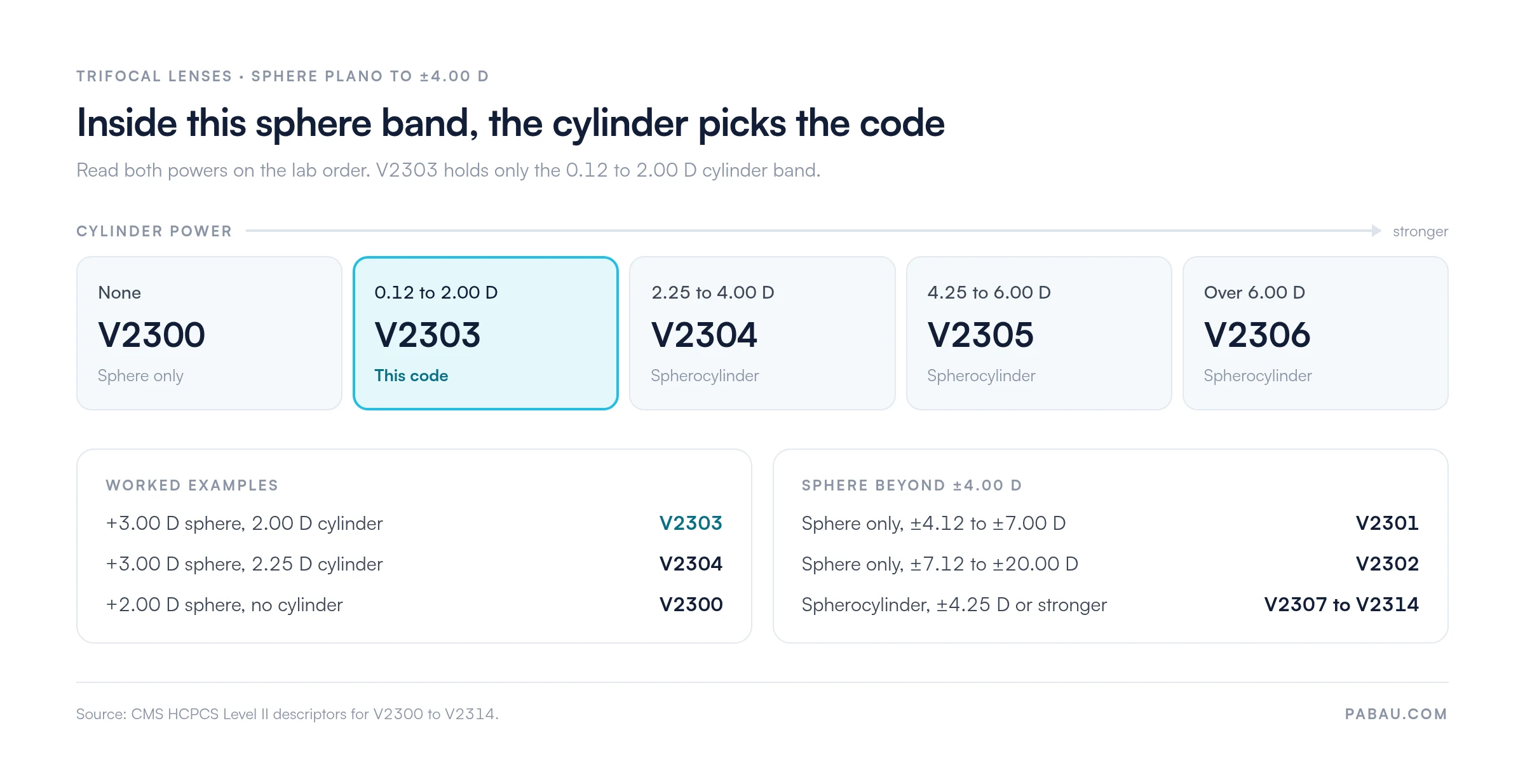
Ranges come from the CMS HCPCS descriptors. Read the full descriptor in the current CMS file before you bill a code above V2306.
Common mix-up: A trifocal with +3.00 D sphere and 2.50 D cylinder is V2304, not V2303. The sphere fits the V2303 band, but the cylinder does not. Coders who check only the sphere submit V2303, and the fix takes a corrected claim plus the lab order.
The reverse error is billing V2303 for a lens with no cylinder. A +2.00 D sphere-only trifocal is V2300, and a +4.12 D sphere-only trifocal is V2301.
Before selecting V2303, read both powers on the lab order, not just the sphere. A +3.00 D sphere with 2.00 D cylinder stays in V2303. The same sphere with 2.25 D cylinder moves to V2304. Confirm that the prescription, the lab order, and the claim carry the same sphere, cylinder, and axis.
Medicare Part B covers prosthetic lenses, including trifocal designs, when a patient has had cataract extraction surgery. This is a narrow covered indication. Part B excludes routine eyeglasses that correct ordinary refractive error when no surgery came first.
The 2026 Medicare allowable for HCPCS code V2303 varies by geographic locality. CMS publishes the DMEPOS fee schedule every year, and you can look up your locality’s rate in the CMS DMEPOS fee schedule files. Keep fixed dollar amounts out of patient-facing materials, because the allowable changes each year and differs across jurisdictions.
Thorough medical billing documentation for V2303 needs six elements, kept in the patient record and on the claim or attached to it.
Correct modifiers are part of submitting a clean claim, and they prevent laterality denials. Submit HCPCS code V2303 on a CMS-1500 claim form or its electronic equivalent (the 837P transaction). The place of service is typically the optical dispensary or physician office where the lens is dispensed.
Bilateral billing: When both eyes receive new lenses at the same encounter, bill two separate line items. Put modifier RT on one and modifier LT on the other, each with one unit of service. Do not bill a quantity of two on a single line, because that pattern frequently triggers an edit.
Pabau’s medical billing software supports HCPCS V-code submissions. Optical practices can check modifiers, units, and dispense dates against the patient record before the claim goes out electronically.
Denials for HCPCS code V2303 follow predictable patterns. Building denial management workflows around these triggers reduces rework significantly.
Medicare fee-for-service does not require prior authorization for HCPCS code V2303. The claim is adjudicated post-service against the DMEPOS fee schedule. Medicare Advantage plans set their own authorization rules, so check the plan’s requirements before dispensing.
Medicaid coverage and prior-authorization requirements vary significantly by state. Some states reimburse trifocal lenses for Medicaid beneficiaries under a prosthetic lens benefit. Others limit coverage to single-vision lenses. Conduct insurance eligibility verification before the encounter to confirm the specific beneficiary’s benefit and any authorization requirements.
Commercial insurers often apply their own coverage rules. Some require a specific diagnosis code, proof of surgery, or prior authorization before covering trifocal lenses. The CMS rules described in this article apply to traditional Medicare only.
For Medicare Advantage and commercial plans, call the plan’s provider line or check their online portal before dispensing high-cost trifocal lenses. Document the authorization number, the date of approval, and the representative’s name in the patient file. A short call before dispensing saves weeks of denial follow-up later.
The diagnosis code on the claim must establish medical necessity for a prosthetic lens. These are the ICD-10 codes most commonly accepted with V2303 under Medicare Part B. Verify them against your MAC’s local coverage determination (LCD) before submitting.
Diagnoses that do not support V2303 under Medicare: Standard refractive error codes (H52.x, covering hypermetropia, myopia, and astigmatism) indicate routine vision care. They will cause a non-covered-indication denial. Do not submit these as the primary diagnosis when billing V2303 to Medicare.
In many optical practices, the prescription sits in one system and the claim is keyed in another. Someone at the billing desk reads the sphere power and picks a code. The cylinder band is easy to skip at that point, which is how a V2304 lens goes out as V2303.
Pabau keeps the prescription, the dispensing record, and the claim in one patient record. Billing staff can check sphere and cylinder against the code before the claim leaves. Any denial that comes back is tracked against the same record.
The result is a claim that describes the lens the patient received. Your team spends less time rebuilding lens details for a payer weeks after dispensing.

Pabau links optical dispensing records to billing, so each V-code line goes out with its modifier, diagnosis, and documentation attached.

HCPCS code V2303 is right only when two numbers fit. The sphere must sit within plano to ±4.00 D, and the cylinder must sit within 0.12 to 2.00 diopters. Check both on the lab order, and confirm the cataract surgery is documented, before the claim goes out. A wrong band, a missing operative report, or a progressive lens billed as a trifocal is what turns a covered lens into a denial.
Pabau helps optical and ophthalmology practices attach the right documentation to V-code claims and spot denial patterns early. Book a demo to see how it fits your dispensing workflow.

Need a broader overview of HCPCS coding for optical supplies? Medical billing fundamentals explains how HCPCS Level II fits into the claims lifecycle from intake to payment.
Seeing high denial rates across your optical claims? Denial codes in medical billing breaks down the most common CARC codes and how to address each one systematically.
Want to verify patient eligibility before dispensing? Insurance eligibility verification outlines the steps to confirm coverage, deductible status, and authorization requirements before the patient leaves your chair.
Billing the cataract surgery behind the lens claim? CPT code 66984 covers extracapsular cataract removal with intraocular lens insertion, the procedure that often precedes a prosthetic lens claim.
Dispensing frames with the trifocal lenses? HCPCS code V2025 covers billing for a deluxe frame dispensed with prescription lenses.
HCPCS code V2303 covers one trifocal spherocylinder ophthalmic lens, billed per lens. The sphere power runs from plano to plus or minus 4.00 diopters, and the cylinder runs from 0.12 to 2.00 diopters. It applies to prosthetic lens dispensing after cataract extraction. It does not cover routine vision eyeglasses, progressive lenses, bifocal lenses, or single-vision lenses.
V2303 to V2306 share the plano to ±4.00 D sphere band and differ by cylinder. V2303 covers 0.12 to 2.00 D of cylinder, V2304 covers 2.25 to 4.00 D, and V2305 covers 4.25 to 6.00 D of cylinder. V2300 is the sphere-only trifocal in the same sphere band, with no cylinder. V2301 is a sphere-only trifocal from ±4.12 to ±7.00 D.
The Medicare allowable for V2303 varies by geographic locality and is updated annually in the CMS DMEPOS fee schedule. Look up your current locality rate in the CMS DMEPOS fee schedule files at cms.gov. No single national dollar figure applies to every supplier.
No. Progressive lenses are not spherocylinder trifocal lenses and cannot be submitted under V2303. Submitting a progressive lens under this code is a coding error that constitutes a potential compliance risk. Progressive lenses dispensed as a prosthetic replacement need to be matched to the correct V-code for their optical design.
Use modifier RT for the right-eye lens and modifier LT for the left-eye lens. When dispensing both lenses at the same encounter, bill two separate line items (one RT, one LT), each with one unit of service. Some MACs also require modifier KX to confirm that the medical necessity documentation is on file.
No. Medicare Part B does not cover eyeglasses or contact lenses for routine refractive error. V2303 is covered only as a prosthetic lens following cataract extraction surgery. If the patient has not had cataract surgery, the claim will be denied as a non-covered item under Medicare Part B.