HCPCS code V2300: Sphere trifocal lens billing guide
HCPCS code V2300 covers one sphere trifocal lens up to 4.00D HCPCS code V2300 is...

Last Updated: Oct 19, 2026
V2221 is the HCPCS Level II code for a lenticular lens, per lens, bifocal. It covers a bifocal spectacle lens built with a small central optic on a thin carrier. Practices use it mostly for very high plus prescriptions after cataract surgery (aphakia).
The key rule is the unit: one unit per lens, so a pair goes on two lines with RT and LT. Medicare covers the lens as a prosthetic when aphakia is documented. Coding it as V2220, or billing a pair as one unit, is what gets these claims denied. Below, we cover the code choice, the claim file and the denial fixes.
Let Pabau's smart automation suggest the right codes, reduce claim denials, and keep your practice compliant—effortlessly.
Automate repetitive tasks and focus on what matters most—your patients.
Reduce coding errors and ensure compliance with the latest regulations.
Clean claims, fewer denials, and faster reimbursements.
Powerful insights and reporting to help your practice thrive.
HIPAA compliant SOC 2 certified GDPR-compliant Trusted by 4,000+ clinics worldwide

HCPCS code V2221 bills one lenticular bifocal lens per unit, so a pair goes on two lines with RT and LT.
Lens construction decides the code. A lenticular bifocal is V2221, while a standard bifocal with an add over +3.25D is V2220.
Medicare covers V2221 under the prosthetic lens benefit, mainly for aphakia after cataract surgery, not for routine vision correction.
High-minus myodisc bifocals take V2215, and single-vision lenticular lenses take V2121 or V2115.
Most denials trace back to the wrong code, a missing aphakia diagnosis, or a pair billed as one unit.
HCPCS code V2221 describes a lenticular lens, per lens, bifocal. You report it when a patient’s bifocal spectacle lens has lenticular construction, with one unit for each lens dispensed.
A lenticular lens puts the corrective power in a small central zone, called the lenticule. A thinner, flat carrier surrounds it. That design cuts edge thickness and weight where a full-aperture lens would be too heavy or distort too much.
V2221 sits in the V2200 bifocal range of HCPCS Level II, which the Centers for Medicare and Medicaid Services (CMS) maintains. These vision V-codes cover lenses and other optical supplies, not the eye exam. If a lens on the order doesn’t fit V2221, our HCPCS guides for billers cover the neighboring vision codes.
Three facts shape every V2221 claim:
V2221 applies when a patient receives a bifocal spectacle lens with lenticular construction. In practice, that usually means a very high plus prescription after cataract surgery removed the natural lens (aphakia). These patients often can’t tolerate contact lenses.
The code doesn’t cover standard bifocals, whatever the power. A high add above +3.25 diopters without lenticular construction belongs to V2220. A routine low-power bifocal is usually V2200. Progressive lenses, single-vision lenses and add-ons such as coatings each have their own codes.
V2220 covers a standard bifocal with an add over +3.25 diopters. V2221 covers a lenticular bifocal lens. Both show up on high prescriptions and both bill per lens, so they get swapped. The deciding factor is how the lab builds the lens.
Here’s how that plays out. A patient with aphakia in both eyes after cataract surgery orders new bifocals. The lab order specifies a lenticular blank for each lens. You bill V2221 on two lines, one with RT and one with LT, each with one unit.
Now change one detail. If the lab ground a standard full-aperture bifocal with a +3.50 add instead, both lines would be V2220. The prescription barely changed, but the code did.
So the test is short. Does the prescription need lenticular construction to be wearable? If yes, bill V2221. If not, and the add is high, bill V2220. Either way, the lab’s fabrication order should name the lens design, and your records should match it.
The V-code range holds lens types that look alike on paper. Coders who go by power alone, rather than design, tend to land on a neighbor. The grid below sorts the lenticular codes by build and vision type.
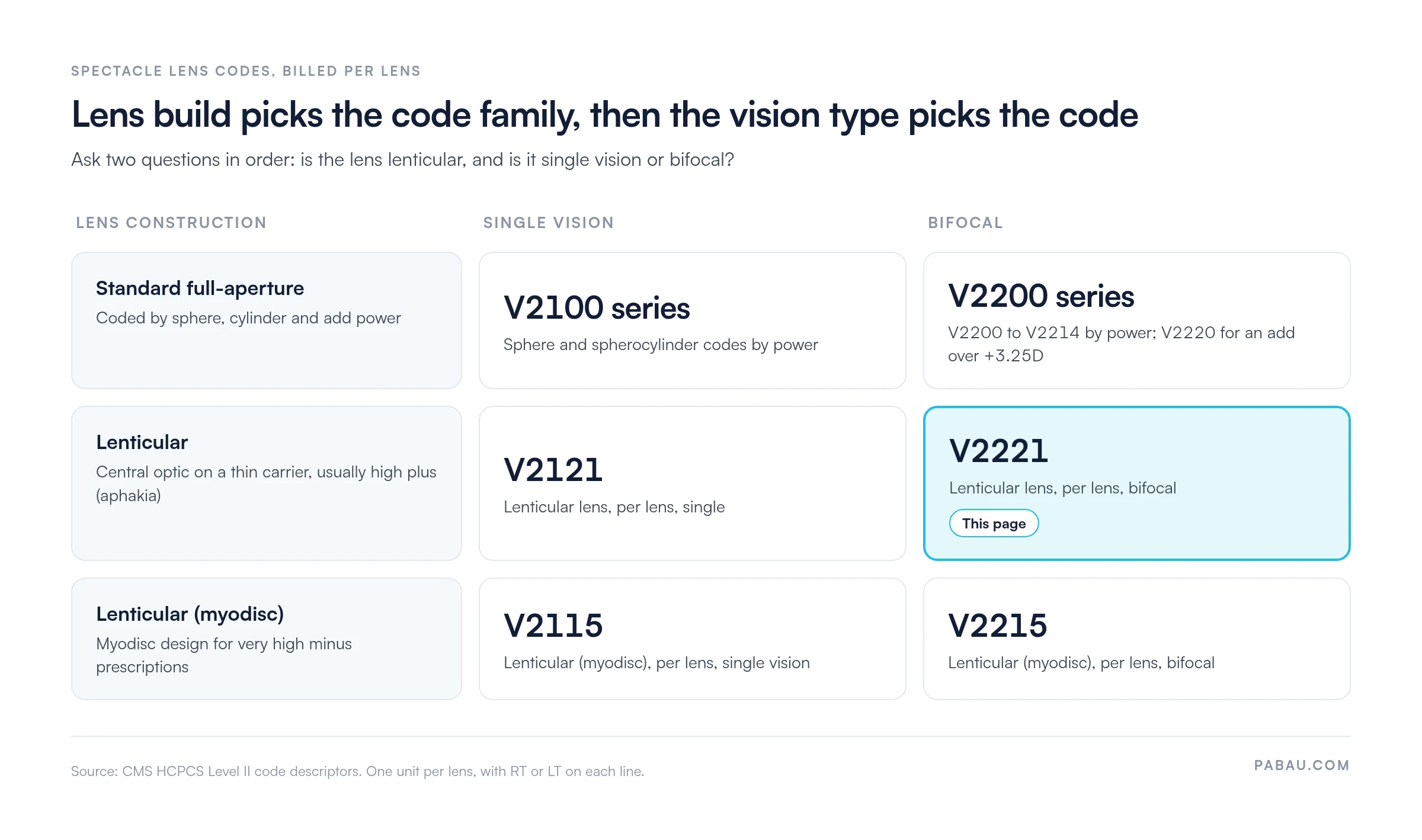
The myodisc pair causes the most confusion. If the order is for a high-minus myodisc bifocal, bill V2215 instead. The single-vision version of that lens is V2115.
When the lab order specifies a lenticular blank for a high-plus bifocal, that is your documentation anchor for V2221. Keep the fabrication order on file with the written prescription and the dispensing record.
Medicare Part B pays for lenticular lenses as prosthetic devices when they’re medically necessary. Aphakia after cataract extraction is the most common qualifying condition. Coverage rests on the Medicare prosthetic lens benefit (Social Security Act s.1861(s)(8); Medicare Benefit Policy Manual, Ch. 15, s.120).
Routine vision correction isn’t a Part B benefit, even at a high prescription. The DME Medicare Administrative Contractors (MACs) apply these rules through the Refractive Lenses local coverage determination, L33793, and its policy article, A52499.
Before Medicare pays a V2221 line, five conditions need to hold:
Commercial payers vary a lot. Some follow Medicare’s prosthetic lens criteria closely, while others want prior authorization whatever the diagnosis. Some state Medicaid programs cover lenticular lenses for children with extreme refractive errors, even without surgical aphakia. Check the individual payer policy before you dispense.
The diagnosis code on the claim is what establishes medical necessity. These ICD-10-CM codes are the ones most often paired with V2221:
Medicare reimburses HCPCS code V2221 under the DMEPOS fee schedule, not the Physician Fee Schedule. DMEPOS stands for durable medical equipment, prosthetics, orthotics and supplies. CMS updates these rates each year, and the allowed amount differs by state.
To find your rate, open the CMS DMEPOS fee schedule page and download the current DMEPOS fee schedule file. Then look up V2221 and read the amount for your state. That figure is per lens, so a pair pays it twice.
Key reimbursement facts for 2026:
Auditors look hard at lenticular lens claims. The code is rare, and it pays more than a routine bifocal. A complete claim file for V2221 holds five documents:
These records contain protected health information (PHI). Store and send them under the same HIPAA security controls as the rest of the chart.
One detail trips up more claims than it should. The prescription needs enough power data for an auditor to see why lenticular construction was necessary. If it shows sphere and cylinder with no add, and no fabrication order confirms the lenticular design, the auditor has grounds to deny.
The work happens before the claim goes out, not after a denial comes back. Follow these six steps:
Most V2221 denials fall into four groups. Each one has a clear fix when the documentation is solid.
For a medical necessity appeal, the prescribing physician’s narrative carries the most weight. A short letter explaining why standard lenses won’t work for this patient often settles a first-level appeal.
Run through this list for every lenticular bifocal claim. It takes a minute and catches the errors behind the denials above.
Many optical practices still track lenticular lens claims across paper prescriptions, lab emails and a separate billing tool. That’s how a fabrication order goes missing, or a pair ends up on one line.
Pabau is the practice management platform we build, and its claims software for practices keeps the prescription, lab order and diagnosis in one patient record. The claim is pre-filled from that record. Pabau then checks that required fields are complete before the claim goes out.
In the US, claims go through Claim.MD, with status tracking and remittance posting built in. So when a payer asks for the audit file, it’s already assembled.
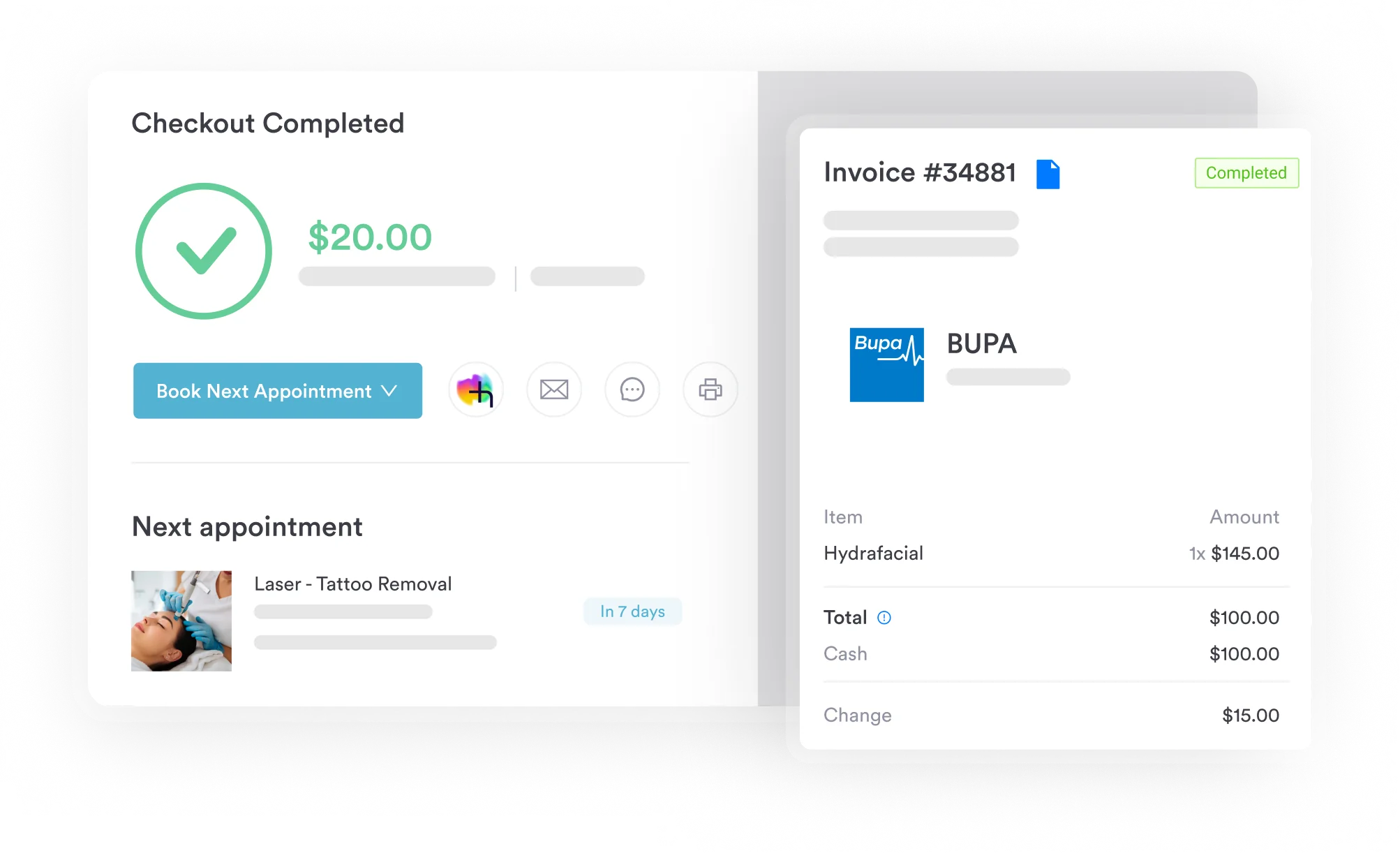

Pabau keeps the prescription, lab order and diagnosis in one patient record, then pre-fills the claim from it. Required fields are checked before each claim goes out.

V2221 rewards billers who code from the lab order, not from the prescription strength. Confirm the lenticular build, put each eye on its own line, and tie the aphakia diagnosis to each lens.
Do that at dispensing and the claim rarely comes back. Skip it, and the appeal can take longer than the lens took to make.
Book a demo to see how Pabau keeps prescriptions, lab orders and lens claims together for your optical practice.

Billing a myodisc lens instead? HCPCS code V2215 covers the high-minus lenticular bifocal that sits right next to V2221.
Is the lenticular lens single vision? HCPCS code V2115 explains the myodisc single-vision lens and how its claim differs.
Coding a routine low-power bifocal? HCPCS code V2200 walks through the standard sphere bifocal in the plano to +/-4.00D range.
Is the bifocal segment extra wide? HCPCS code V2219 covers the bifocal code for a segment wider than 28mm.
Fighting a denial on a lens claim? Denial codes in medical billing decodes the reason codes payers send back and what each one asks you to fix.
Yes, once. Medicare Part B covers one pair of conventional eyeglasses or contact lenses after each cataract surgery with an intraocular lens. Those lenses use standard V-codes, because an implanted lens usually removes the need for a lenticular design.
Each lens needs RT or LT. DME MAC guidance asks for two claim lines with one unit each when both lenses are billed. Lines missing the modifiers, or with both on one line, are rejected as incorrect coding.
No. A myodisc bifocal, used for very high minus prescriptions, takes V2215. A myodisc single-vision lens takes V2115. V2221 is the lenticular bifocal used mostly for high plus prescriptions, such as aphakia.
No. V2221 covers spectacle lenses only. Contact lenses have their own codes in the V2500 range, and Medicare covers them for aphakia under the same prosthetic benefit.
Yes. V2221 pays for the lens only. Frames go on their own line, usually V2020, and coatings or tints have separate V-codes. Check whether the payer bundles any of them into the lens fee.