CPT Code 98981: RTM Treatment Management Billing Guide
CPT code 98981: Definition and official descriptor CPT code 98981 is an add-on c...

Last Updated: Nov 9, 2026
S0508 is the HCPCS Level II code for a trifocal vision prescription lens (safety, athletic, or sunglass), per lens. It covers a three-zone prescription lens made for one of those purposes, billed one unit per lens.
S0508 belongs to the S-code series, temporary national codes for non-Medicare payers. Commercial insurers and select state Medicaid programs accept it, while Medicare does not. Standard trifocal lenses are billed under V2300-V2399 instead. Coverage, prior authorization, and allowed amounts vary by plan contract.
Let Pabau's smart automation suggest the right codes, reduce claim denials, and keep your practice compliant—effortlessly.
Automate repetitive tasks and focus on what matters most—your patients.
Reduce coding errors and ensure compliance with the latest regulations.
Clean claims, fewer denials, and faster reimbursements.
Powerful insights and reporting to help your practice thrive.
HIPAA compliant SOC 2 certified GDPR-compliant Trusted by 4,000+ clinics worldwide

HCPCS Code S0508 covers one trifocal vision prescription lens made for safety, athletic, or sunglass use, billed per lens.
S-codes are not covered by Medicare, so submit S0508 only to commercial payers or Medicaid programs that accept S-codes.
Claims need a valid trifocal prescription, a work order stating the lens purpose, and a supporting ICD-10-CM diagnosis code.
A standard trifocal lens with no safety, athletic, or sunglass purpose is billed under the V2300-V2399 range instead.
Pabau, the practice software we build, ties code selection to the prescription and dispensing record, so S0508 claims go out complete.
HCPCS Code S0508 is the HCPCS Level II code for a trifocal vision prescription lens made for safety, athletic, or sunglass use. It is billed per lens.
As a temporary national S-code, it is meant for non-Medicare payers, so commercial insurers and some state Medicaid programs pay it while Medicare does not. The table below shows the reference data coders need at a glance.
The descriptor’s parenthetical lists three lens purposes, namely safety, athletic, and sunglass use. For safety lenses, payers and optical labs commonly look for compliance with ANSI Z87.1, the industry standard for occupational eye protection.
The CMS HCPCS descriptor itself does not cite that standard, so the documentation bar comes from payer policy. A standard trifocal lens with none of those three purposes falls outside S0508 and is billed under the V2300-V2399 range.
S0508 covers a single trifocal lens made for safety, athletic, or sunglass use and dispensed under a valid vision prescription. The scope is narrower than the word “trifocal” suggests.
Included:
Not included:
Frames carry their own code when the pair is sunglasses. S0518 bills the frame alone, one unit per frame, and its two-word descriptor names no lens at all. The trifocal lenses still bill on separate S0508 lines, one unit per eye.
Two variables decide the code. The number of focal zones picks between S0504, S0506, and S0508. The lens purpose decides between an S-code and a standard V-code, as the matrix below shows. Getting either wrong at code selection creates a mismatch that payers flag on edit.
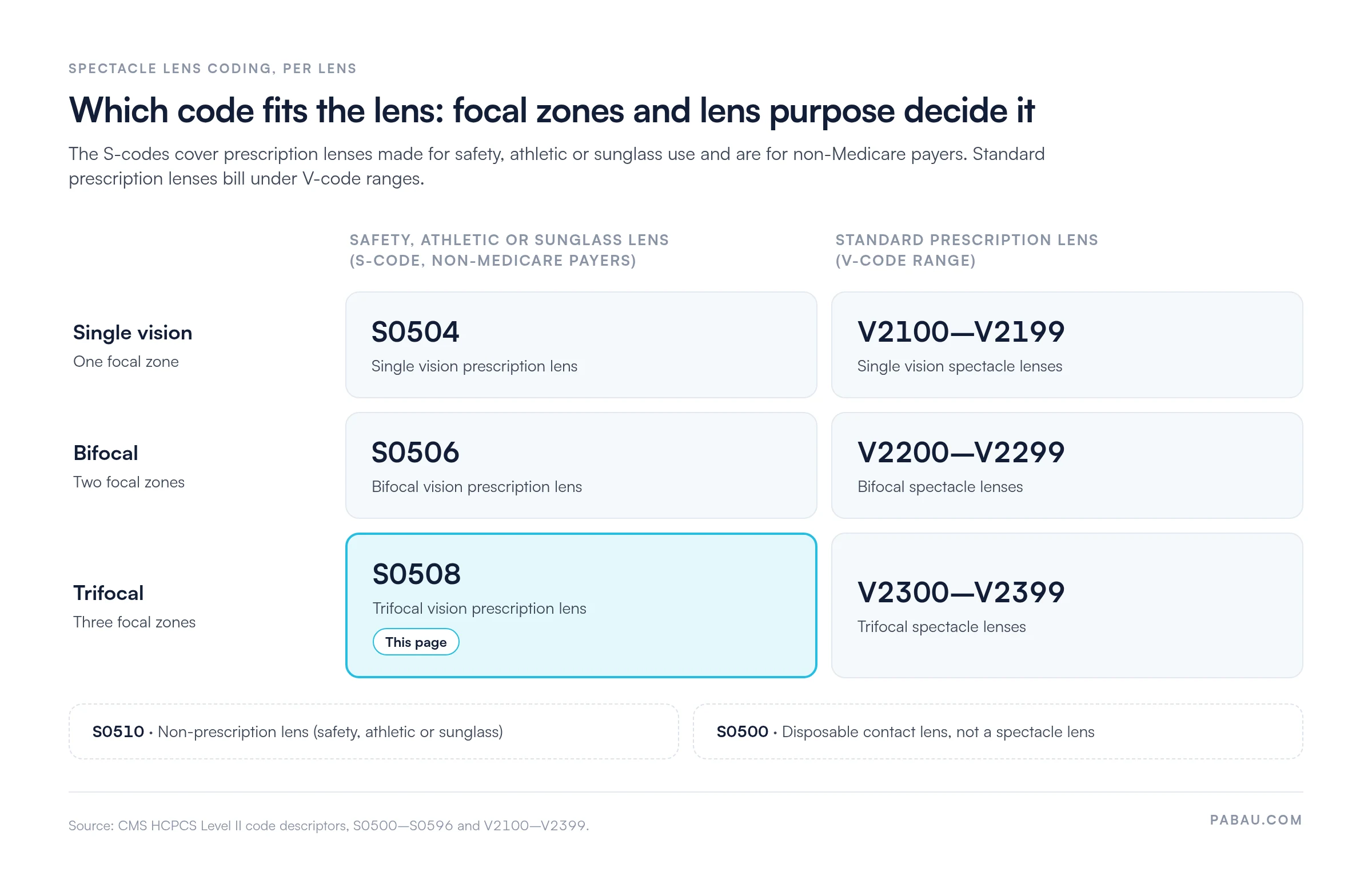
S-codes, including S0508, are explicitly excluded from Medicare reimbursement. CMS designates S-codes for non-Medicare payers only.
A claim sent to traditional Medicare, or to a Medicare Advantage plan that has not adopted S-codes, comes back as a non-covered benefit denial. This is the single most common S0508 denial reason and is entirely avoidable.
For commercial payers, always verify coverage eligibility before dispensing. A patient’s vision benefit summary does not always confirm S-code acceptance at the plan level. Call the payer or use the plan’s provider portal to confirm S0508 coverage and any frequency limitations before the appointment.
No Medicare fee schedule exists for S0508 because Medicare does not cover S-codes. Allowed amounts are set entirely by commercial plan contracts and state Medicaid fee schedules, which means there is no single published rate to reference.
Typical commercial payer allowed amounts for trifocal safety lenses range from roughly $60 to $180 per lens. The figure depends on plan tier, geographic market, and lens specifications. These figures are indicative industry benchmarks; actual contracted rates must be confirmed against each payer’s current fee schedule or remittance history.
Practices billing S0508 regularly should:
Pull your last six months of S0508 EOBs and sort by payer. If any payer is paying below 70% of your billed charge, request a fee schedule review. Also check whether a V-code crosswalk yields a higher allowed amount under that plan’s benefit structure.
Accurate S0508 billing starts with the documentation assembled at the point of dispensing. Each missing item below is a common cause of preventable denials. Most commercial payers also enforce billing compliance requirements for ophthalmic supply codes at the claim level.
Trifocal lenses are prescribed for patients with presbyopia or complex refractive errors that cannot be corrected with a single focal zone. The following ICD-10-CM codes are commonly accepted as supporting diagnoses; payer acceptance should be confirmed against the applicable local coverage determination (LCD) or plan policy.
List the most specific diagnosis first. Presbyopia, coded as H52.4, is often the principal diagnosis, with refractive error codes as secondary. Verify laterality codes match the eye for which the lens is dispensed.
Prior authorization for S0508 is payer-specific. Many commercial vision plans waive PA for standard trifocal lenses within benefit year frequency limits. PA is more likely when the claim involves a safety designation or occupational necessity documentation. A second pair of lenses within the same benefit year often triggers it too.
Three S-codes cover prescription spectacle lenses for safety, athletic, or sunglass use. S0504 is single vision, S0506 is bifocal, and S0508 is trifocal. Standard lenses sit in the V-code ranges instead. Picking a code with the wrong number of focal zones is another frequent denial trigger.
Not every code in the S0500-S0596 vision range bills a product. S0595 reports the dispensing work itself, charged once when new lenses go into a frame the patient already owns. Because no frame is sold, no frame code joins it on the claim.
When a payer does not accept S-codes, check whether a V-code equivalent applies. V2300 through V2399 cover trifocal spectacle lenses and are recognized by Medicare vision benefit riders and some Medicaid plans.
The PGM Billing HCPCS lookup tool lets you search S-code and V-code ranges side by side. Use it to find the right crosswalk for a given payer.
S0508 denials follow predictable patterns. Most stem from a handful of billing errors that surface consistently across optometry and dispensing practices. A strong denial management process addresses these at the coding stage, not after the EOB arrives.
Payers communicate each of these rejection reasons on the EOB through medical billing denial codes. Knowing the CARC code attached to a denial tells you exactly which corrective action to take without calling the payer.
Four modifiers come up on S0508 claims. They cover laterality, replacement lenses, and coverage attestation.
Some commercial payers require the KX modifier as a claim-level attestation that coverage criteria have been met. Omitting KX when a plan requires it triggers a denial coded as “missing required modifier.” Check the payer’s billing manual or provider portal to confirm KX requirements before submission.
Bill S0508 on separate claim lines for right and left lenses using RT and LT modifiers rather than a single line with quantity 2. Many vision payers process bilateral ophthalmic supply codes on separate lines and may reject a quantity-2 submission as a duplicate or unbundling error.
Optometry practices and dispensing opticians billing S0508 face the same core challenge. The supporting documentation is assembled at the point of care. The claim goes out later, often from a different team member.
When prescription details, safety certification, and prior authorization numbers live in separate places, one of them is often missing when the claim goes out.
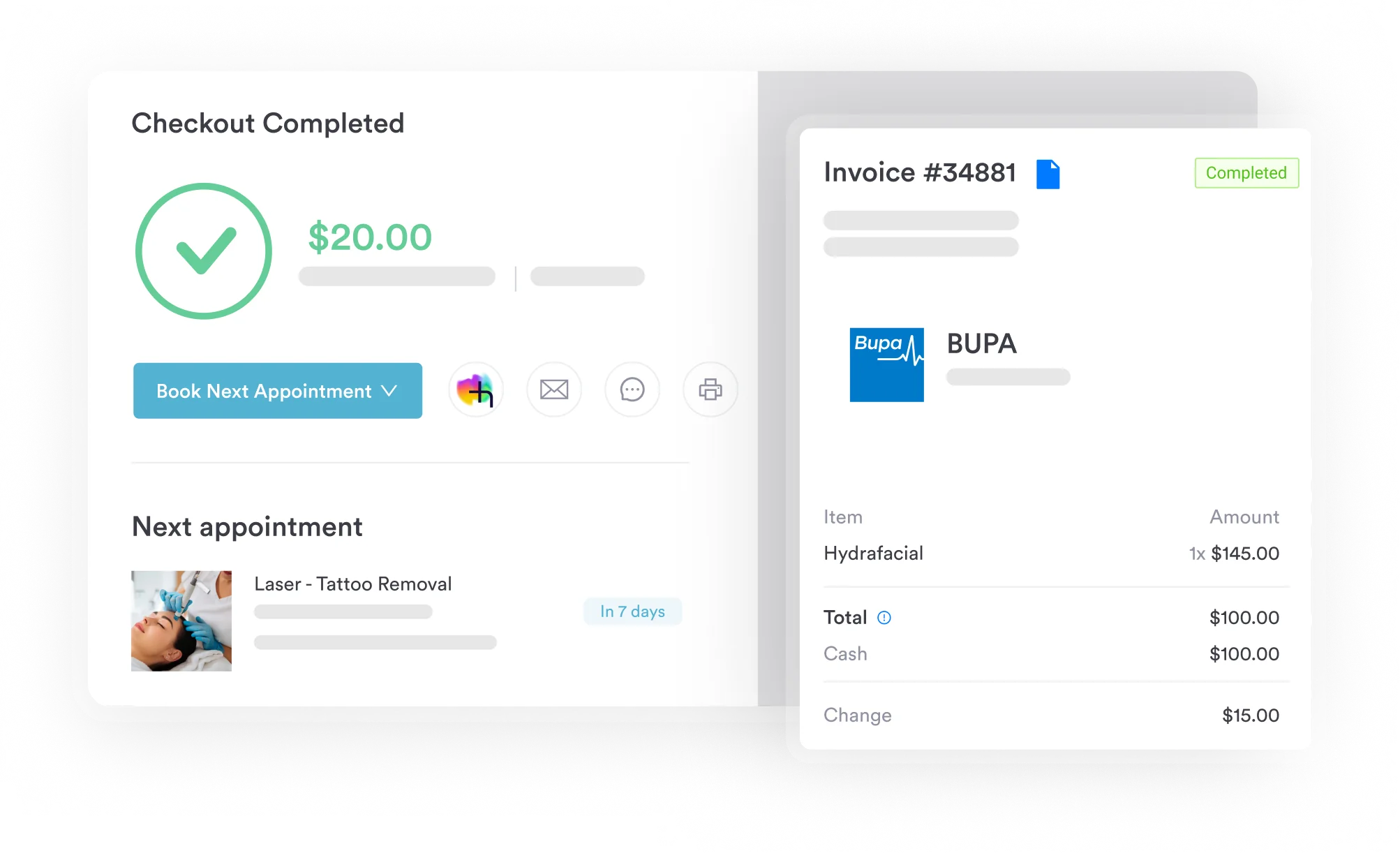
In Pabau’s claims management software, code selection links directly to the patient record. The coder working the claim sees the prescription, the dispensing record, and the diagnosis codes in one view. That removes the transcription step where many S0508 denials start.
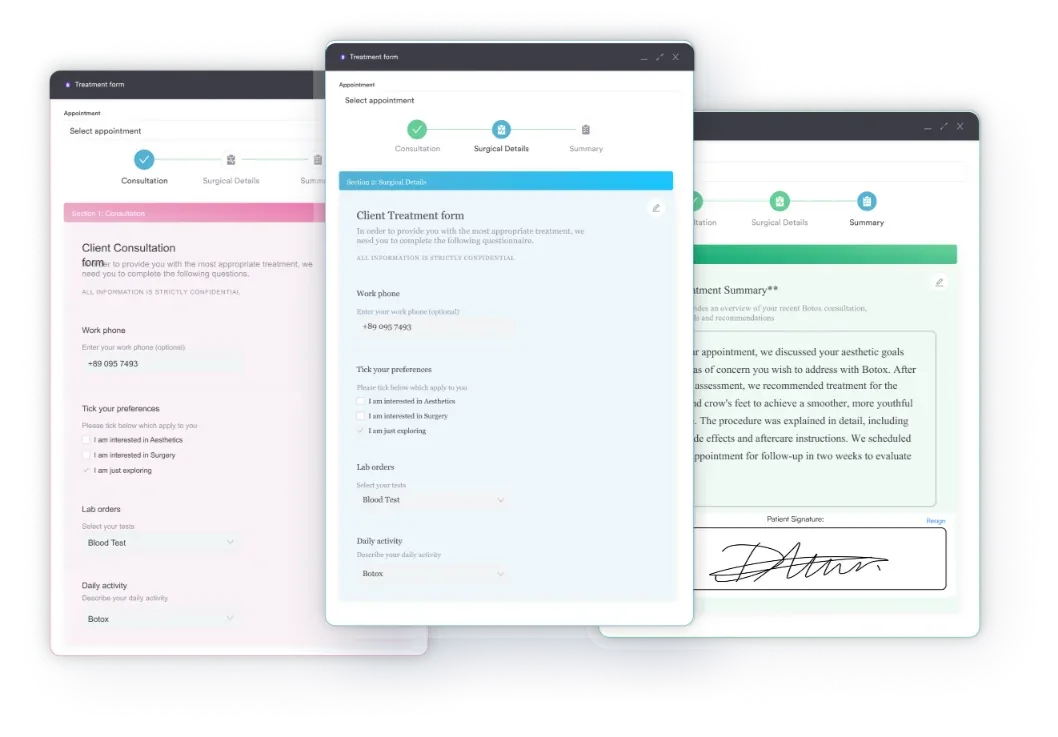
Pabau’s digital intake forms capture occupational need declarations and safety lens consent at the patient encounter. That creates the audit trail payers request during claim review. Structured forms also make the safety certification field mandatory, so it is completed even when staff are under pressure.
Pabau also checks each claim against a clean claim standard and flags missing fields before submission. The common S0508 denial reasons are caught at that edit stage instead of on the EOB. Our guide to revenue cycle management shows how the full billing workflow connects for optical practices.

Pabau links code selection, prescription documentation, and claim submission in a single workflow, so S0508 claims go out complete the first time.

S0508 rewards precision at the dispensing desk. Before the lens is ordered, confirm that the payer accepts S-codes and that the lens is trifocal. Then make sure the work order names its safety, athletic, or sunglass purpose. Practices that check those facts at intake stop chasing S0508 denials after the EOB arrives.
The trade-off is a few minutes of verification per patient against the rework of a rejected claim. If your payer mix leans on Medicare, plan for V-code billing instead. Book a demo to see how Pabau keeps prescription, lens, and claim records together for optical and vision practices.

Looking for a complete guide to medical billing workflows? What is medical billing explains the end-to-end claims process, from code selection through payment posting.
Want to understand how payers communicate denials? Common denial codes in medical billing covers CARC and RARC codes used on EOBs for optical supply claims.
HCPCS Code S0508 is a HCPCS Level II code for a trifocal vision prescription lens made for safety, athletic, or sunglass use. It is billed per lens, mainly to commercial payers and select state Medicaid programs. Medicare does not recognize it.
No. S-codes, including S0508, are explicitly excluded from Medicare reimbursement. CMS designates S-codes for non-Medicare payers only. Submitting S0508 to traditional Medicare results in a non-covered benefit denial. Some Medicare Advantage plans with added vision benefits may recognize S-codes, so verify each plan individually.
S0506 covers a bifocal vision prescription lens, and S0508 covers a trifocal one. Both carry the same safety, athletic, or sunglass qualifier and are billed per lens. Pick the code by the number of focal zones on the prescription and the lab work order.
Presbyopia (H52.4) is the most commonly accepted primary diagnosis for trifocal lens claims. Refractive error codes are typically listed as secondary diagnoses. Examples include H52.11 and H52.12 for myopia, or H52.21 and H52.22 for hyperopia, by eye. Confirm acceptance with each payer’s LCD or plan policy before submitting.
The most common reason is a claim routed to Medicare, which does not cover S-codes. Others include missing safety lens documentation, an invalid or overly broad ICD-10 diagnosis code, and prior authorization not obtained before dispensing. Incorrect modifier usage also triggers denials. A pre-submission documentation checklist prevents each of these.
No Medicare fee schedule exists for S0508 because Medicare does not cover S-codes. Allowed amounts are set by individual commercial plan contracts and state Medicaid fee schedules. Industry benchmarks for trifocal safety lenses typically range from $60 to $180 per lens, but contracted rates vary. Verify the current allowed amount with each payer directly.