HCPCS Code L1904: Ankle orthosis billing and coverage guide
HCPCS Code L1904: Code descriptor and device specifications HCPCS Code L1904 des...

Last Updated: Oct 23, 2026
HCPCS code V2321 is the Level II code for one lenticular trifocal spectacle lens, billed per lens. A lenticular lens puts its power in a central zone, with a thinner carrier around it to cut weight. The trifocal design gives distance, intermediate and near zones.
V2321 sits in the V2300-V2399 trifocal range, apart from the single vision and bifocal lenticular codes. Medicare covers refractive lenses like it only for aphakia, congenital aphakia and pseudophakia. Bill each lens on its own line with an RT or LT modifier.
Let Pabau's smart automation suggest the right codes, reduce claim denials, and keep your practice compliant—effortlessly.
Automate repetitive tasks and focus on what matters most—your patients.
Reduce coding errors and ensure compliance with the latest regulations.
Clean claims, fewer denials, and faster reimbursements.
Powerful insights and reporting to help your practice thrive.
HIPAA compliant SOC 2 certified GDPR-compliant Trusted by 4,000+ clinics worldwide

HCPCS code V2321 bills one lenticular trifocal spectacle lens, so a pair goes on two claim lines.
It sits in the V2300-V2399 trifocal range, while lenticular single vision (V2121) and bifocal (V2221) lenses have their own codes.
Medicare covers refractive lenses only for aphakia, congenital aphakia and pseudophakia, under LCD L33793 and Article A52499.
Each line needs an RT or LT modifier and one unit, because a combined RTLT line is rejected.
Pabau, the practice software we build, keeps the order and delivery proof with the patient record and tracks each claim after submission.
HCPCS code V2321 bills one lenticular trifocal spectacle lens. The official long descriptor reads “Lenticular lens, per lens, trifocal.” The descriptor sets no power threshold, so the lens design decides the code, not the prescription strength.
A lenticular lens puts its optical power in a central zone. A thinner carrier surrounds that zone to cut weight and edge thickness. The trifocal part means the lens has three viewing zones: distance, intermediate and near.
Coverage code D matters here. It tells you Medicare applies special instructions, which live in the refractive lens policy covered below.
Vision lens codes follow a simple pattern, which you can trace across our HCPCS procedure code guides. V21xx codes are single vision, V22xx codes are bifocal and V23xx codes are trifocal. Lenticular lenses appear in each series, so the focal design picks the code. A lenticular bifocal, for example, bills as V2221.
The most common mix-up is treating V2320 as a lens code. It describes an add power over 3.25 diopters, not a lenticular lens. A myodisc trifocal is a different lens again and bills as V2315. Check each payer’s policy before you report V2319 or V2320 on the same claim as V2321.
Medicare excludes routine eyeglasses, but it treats lenses after cataract surgery as prosthetic devices. Chapter 15, Section 120 of the Medicare Benefit Policy Manual covers these lenses whether or not the surgeon implanted an intraocular lens (IOL).
The DME MAC policy sits in LCD L33793 and Article A52499. According to the CMS compliance tips for lenses, Medicare covers refractive lenses for three diagnoses only:
The limits differ by group. A pseudophakic patient gets one pair of eyeglasses or contact lenses after each cataract surgery with an IOL. Medicare does not cover replacements for that group. Aphakic patients can get replacement lenses when they are medically necessary.
Payment follows the DMEPOS fee schedule, which CMS updates each year. Medicare pays 80% of the allowed amount after the Part B deductible, and the patient owes the 20% coinsurance. Check the current year’s file before you quote a patient, because rates change.
Every V2321 line needs a diagnosis that supports the prosthetic lens benefit. Lenses billed with other diagnoses are denied as non-covered under the Medicare policy. Commercial plans and Medicaid set their own rules, so check them separately.
Confirm the diagnosis list in Article A52499 before you submit. Payers revise their code lists, and laterality has to match the modifier on each line.
A clean V2321 claim comes down to four checks. The decision path below shows each one, and the steps after it apply them to every pair you dispense.
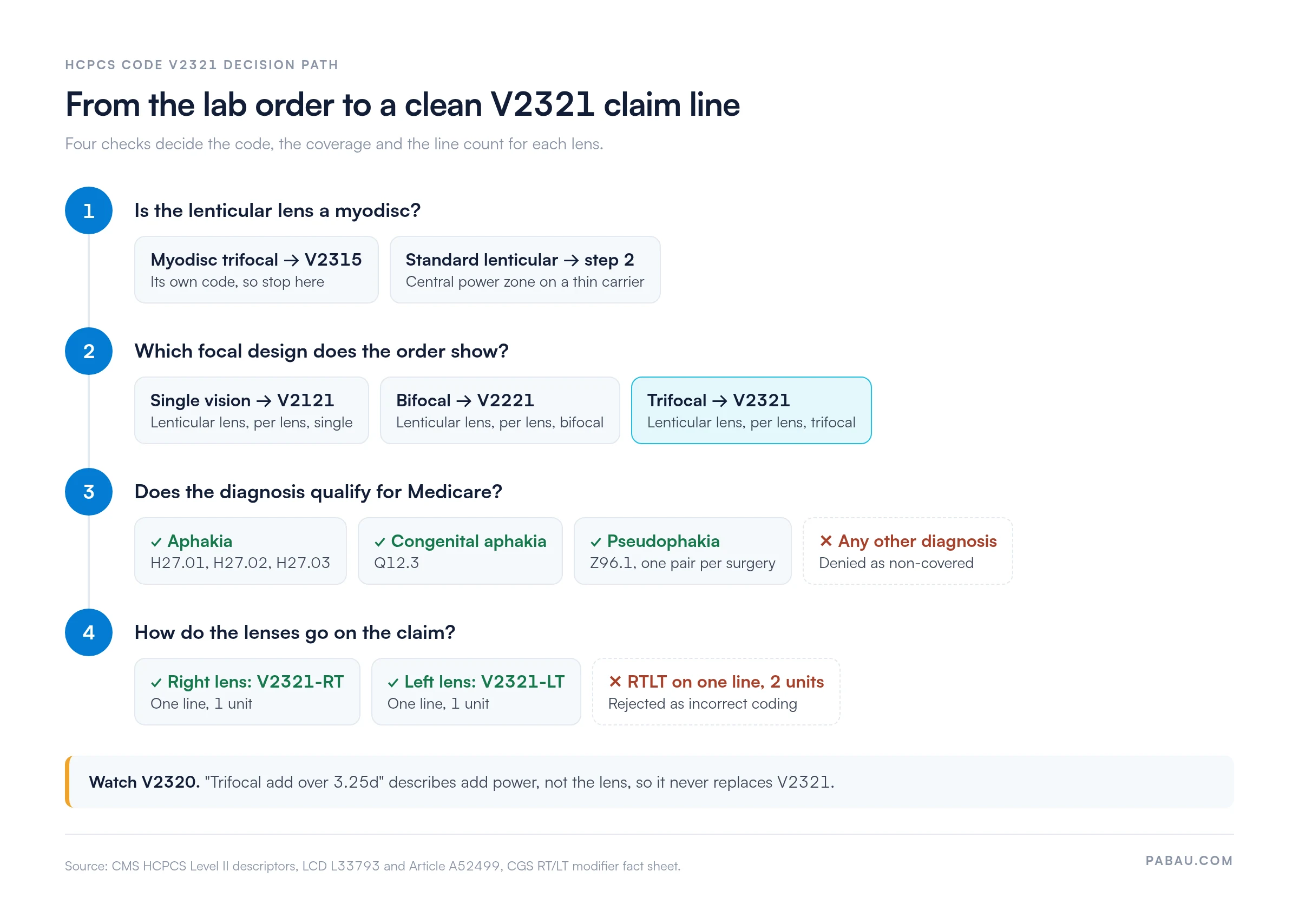
The two-line rule is strict. The CGS RT and LT modifier fact sheet says a combined RTLT modifier on one line with two units is rejected as incorrect coding.
Missing paperwork drives most lens payment errors. CMS reports that insufficient documentation caused 32.7% of improper lens payments in the 2024 reporting period. Strong medical billing compliance starts with a complete file for every claim.
Pabau keeps these documents attached to the patient record, so your team finds them in one place when an auditor asks.
Run through this list before each V2321 claim leaves the office. It takes a couple of minutes and catches the usual rejections.
Most V2321 denials repeat the same few errors. Good denial management starts by spotting the pattern early.
For an appeal, send the operative report, the order and the proof of delivery together. A short letter from the treating practitioner explaining the lens choice strengthens the case.
Lens claims often stall because the paperwork lives in three places. The order sits in one folder, the surgery notes in another and the delivery slip at the front desk. When a DME MAC asks for records, someone has to rebuild the file by hand.
Pabau keeps the order, clinical notes and signed forms on the patient record. Its medical billing software then submits and tracks each claim, with Claim.MD handling submission for US practices.
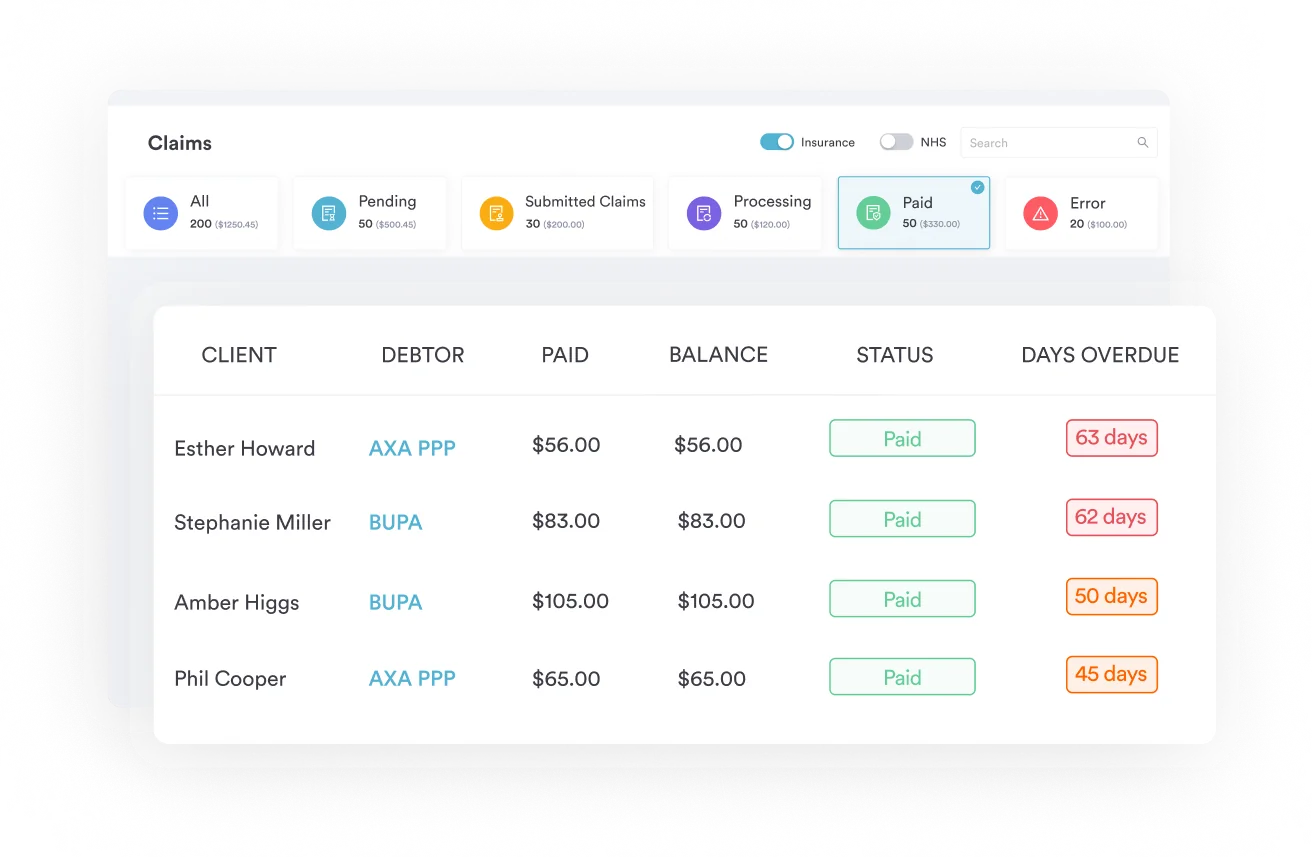
Your team sees each claim’s status in one view. A rejected line gets fixed and resubmitted the same day, instead of turning up weeks later.

Pabau stores lens orders and delivery records with the patient file and tracks each claim from submission to payment. See it in a demo.

V2321 is a narrow code, and the descriptor does the hard work for you. If the lens is lenticular and trifocal, it is V2321. If it is single vision or bifocal, it is not.
Coverage is the bigger risk. Medicare pays only for aphakia, congenital aphakia or pseudophakia, and pseudophakic patients get one pair per surgery. Check those two facts before you dispense, and the remaining steps become routine.
Practices that store the order, surgery notes and delivery proof together answer audits in minutes. Book a demo to see how Pabau keeps lens claims and their records in one place.

Need a primer on how medical billing works? What is medical billing walks through the claims lifecycle from visit to payment.
Billing a lenticular bifocal instead? HCPCS code V2221 covers the bifocal version of this lens.
Dispensing a myodisc trifocal? HCPCS code V2315 explains when that code applies instead.
Want fewer claim denials? Denial management in healthcare covers root-cause analysis and appeal strategies.
Checking benefits before dispensing? Insurance eligibility verification explains how to confirm coverage before the patient visit.
The CMS short descriptor is “Lenticular lens, trifocal.” The long descriptor reads “Lenticular lens, per lens, trifocal.” Use the long form when an appeal or audit asks for the official wording.
Yes, within limits. Pseudophakia is a covered diagnosis, but Medicare pays for one pair of eyeglasses or contact lenses after each cataract surgery with an IOL. Replacement pairs for pseudophakic patients are not covered.
No. V2321 is trifocal only. Bill a single vision lenticular lens as V2121 and a bifocal lenticular lens as V2221.
Use two claim lines. Put the right lens on one line with RT and the left lens on another with LT, one unit each. A single RTLT line with two units is rejected.
Check the CMS DMEPOS fee schedule for the current year. V2321 carries pricing indicator 38, so its allowed amount is subject to floors and ceilings. Commercial plans set their own rates.