CPT code 49321: Laparoscopy with biopsy billing guide
What is CPT code 49321? CPT code 49321 is the surgical laparoscopy code for a bi...

Last Updated: Oct 7, 2026
V2301 is the HCPCS Level II code for sphere, trifocal, plus or minus 4.12 to plus or minus 7.00d, per lens.
Most V2301 denials come from three causes. A wrong diopter range, a missing RT or LT modifier, or a diagnosis that does not establish medical necessity each triggers one. Get those three right and V2301 claims move cleanly through most payers.
Medicare Part B does not cover routine vision correction. The exception is narrow: corrective lenses after cataract surgery with insertion of an intraocular lens, where a specific benefit applies. That distinction trips up optometry billing teams more than any other rule in the V-series.
Let Pabau's smart automation suggest the right codes, reduce claim denials, and keep your practice compliant—effortlessly.
Automate repetitive tasks and focus on what matters most—your patients.
Reduce coding errors and ensure compliance with the latest regulations.
Clean claims, fewer denials, and faster reimbursements.
Powerful insights and reporting to help your practice thrive.
HIPAA compliant SOC 2 certified GDPR-compliant Trusted by 4,000+ clinics worldwide

HCPCS code V2301 covers one sphere-only trifocal spectacle lens with a power of ±4.12D to ±7.00D, billed per lens.
A lower sphere moves the lens to V2300 and a higher one to V2302. Any cylinder moves it to a spherocylinder trifocal code.
Single vision (V2101) and bifocal (V2201) lenses share the same power band, so confirm the lens design before you pick the code.
Medicare Part B covers one pair of post-cataract spectacles per surgery with IOL implantation. Trifocals for routine vision are non-covered.
Bill each eye as a separate line item with an RT or LT modifier. A single line with 2 units is a common denial trigger.
HCPCS code V2301 describes one sphere-only trifocal spectacle lens, billed per lens. The official descriptor reads: Sphere, trifocal, plus or minus 4.12 to plus or minus 7.00d, per lens.
The code sits in the Lenses, Trifocal section (V2300-V2399) of the HCPCS Level II code set. CMS maintains HCPCS Level II for the supplies and services that CPT does not cover.
Three words in the descriptor decide whether a lens belongs here. “Sphere” means the prescription corrects spherical error only, with no cylinder for astigmatism. “Trifocal” means the lens has three focal zones, for distance, intermediate, and near vision. The power range then places the lens between V2300 and V2302.
Vision codes in HCPCS Level II run from V2020 to V2799. The lens series follows the lens design: V2100s are single vision, V2200s are bifocal, and V2300s are trifocal. Hearing services sit in a separate block, V5008 to V5364.
V2301 covers the physical lens supply for a sphere-only trifocal inside its power range. It does not cover the frame, the fitting, or the dispensing fee. Those are billed under their own codes, and bundling them into V2301 triggers a claim edit.
Medicare covers V2301 only after cataract surgery with an intraocular lens. A trifocal prescribed for routine refractive correction is not a Part B benefit, so issue an ABN where it applies.
The three sphere-only trifocal codes split by power alone. V2300 takes the lowest band, V2301 the middle band, and V2302 the highest. Once a cylinder appears on the prescription, the lens leaves this trio for the spherocylinder trifocal codes.
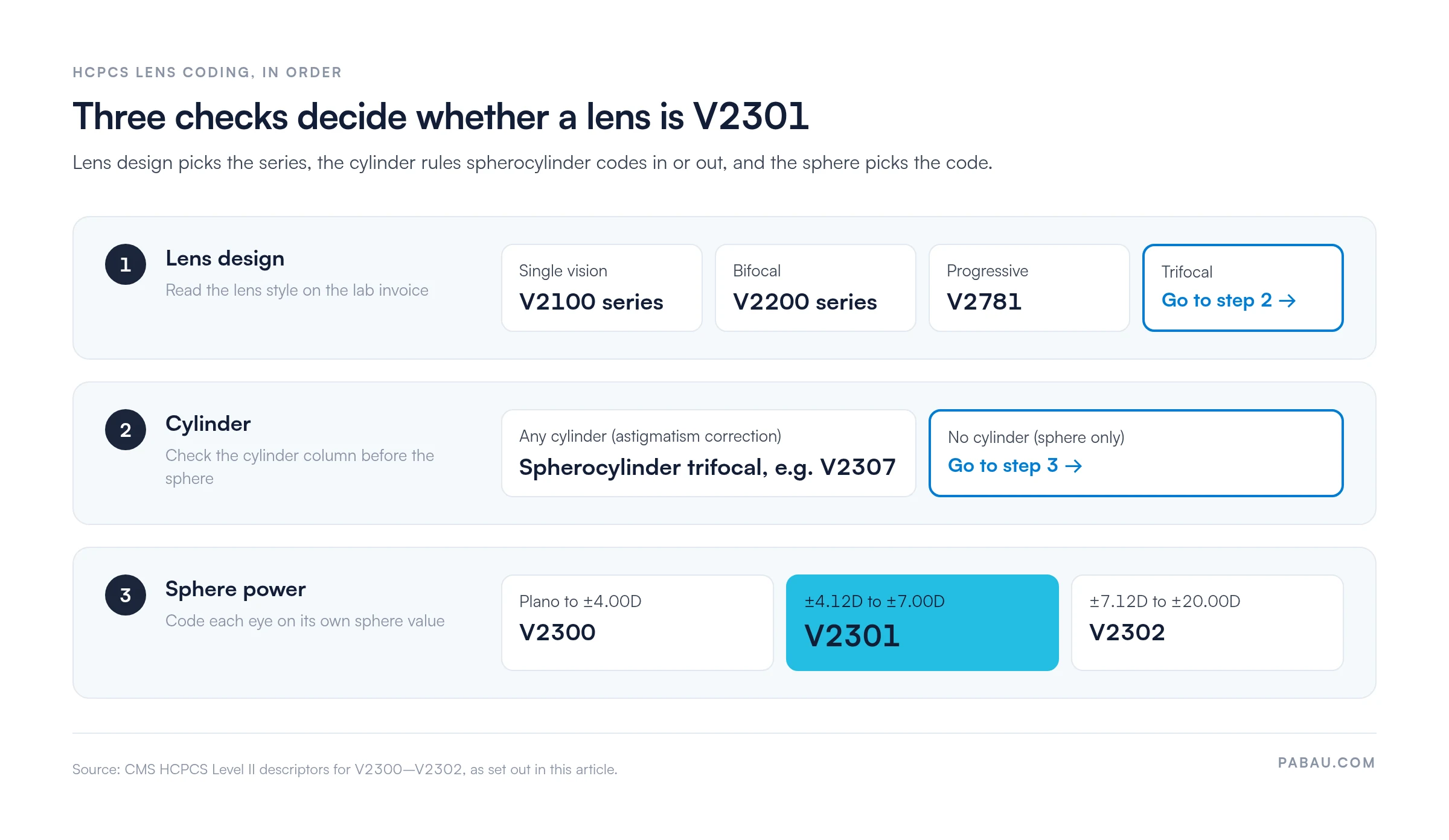
The table shows why the power alone never picks the code. V2101, V2201, and V2301 share the same ±4.12D to ±7.00D sphere band. The lens design picks the series, and only then does the power pick the code within it. The decision path below runs those checks in the order a coder should.
Two boundaries cause most V2301 errors. The first is the line between ±4.00D and ±4.12D. A -4.00D trifocal is V2300, while a -4.50D trifocal is V2301.
The second is the line between ±7.00D and ±7.12D. A +7.50D trifocal is V2302, not V2301. Read both eyes separately, because each lens is coded on its own power.
Check the cylinder column before the sphere. If the lab order shows any cylinder, V2300 to V2302 are off the table, whatever the sphere reads. Then confirm the lens style is trifocal on the lab invoice, because a progressive at the same power is V2781.
Medicare Part B covers one pair of eyeglasses or one set of contact lenses after each cataract surgery with an implanted intraocular lens (IOL). The benefit is set out in the Medicare Benefit Policy Manual, Chapter 15, Section 120. It is the main pathway for V2301 reimbursement.
Outside this post-cataract context, Medicare does not cover spectacle lenses for routine refractive correction. Billing V2301 to Medicare for a patient with no cataract surgery on record is a compliance risk.
Medicare Advantage (Part C) plans may add routine vision as an extra benefit. Copays, frequency limits, and allowances vary by plan, so verify benefits at the plan level before you bill V2301 under one.
Medicare pays V2301 through the DMEPOS fee schedule, not the Physician Fee Schedule. DMEPOS stands for Durable Medical Equipment, Prosthetics, Orthotics and Supplies. Rates vary by state, so there is no single national allowable for the code.
Pull the current-year rate for your state from the CMS DMEPOS fee schedule before you quote coverage amounts to patients. Never hardcode an allowable in a billing template, because CMS updates the file each quarter.
Medicaid coverage for V2301 varies by state. Some programs cover routine vision for adults, while others limit it to children or to medically necessary lenses. Check the state’s optical fee schedule and frequency limits before you assume coverage.
Commercial payer rules differ again. Check these points before you bill:
V2301 claims use four modifiers. RT (right side) and LT (left side) must appear on separate line items when you bill both eyes. A single V2301 line with 2 units will deny, because lens codes are processed per eye.
Requirements can differ between DME MAC jurisdictions. Check your contractor’s billing guidance before you build a modifier template for lens codes.
Every V2301 claim needs a supporting ICD-10-CM diagnosis code. Most covered claims follow cataract surgery, so the status codes that show the IOL is in place carry the benefit. Refractive error codes then describe what the lens corrects.
An astigmatism code does not belong on a V2301 line. If the record supports one, the prescription carries a cylinder and the lens needs a spherocylinder code. Select the most specific lateralized diagnosis available.
Billing V2301 correctly takes five steps, each tied to a documentation element. Skipping any of them raises the denial risk under Medicare’s DMEPOS claim edits.
If the two eyes fall in different power bands, each line takes its own code. A right lens at +3.50D and a left lens at +4.50D bill as V2300-RT and V2301-LT.
If no fixed descriptor fits the dispensed lens, bill V2399 by report instead. That claim needs a written report naming the lens and the clinical reason for it.
A V2301 claim needs records that prove three facts. The patient had cataract surgery with IOL implantation, the lens is a sphere-only trifocal in the V2301 range, and the patient received it.
Keep these records retrievable for the payer’s full retention period. Consistent medical billing compliance practices for optical documentation shorten audits and speed up claim processing.
Most V2301 denials trace back to the wrong code for the lens, missing cataract documentation, or modifier errors. A check of lens style, cylinder, and sphere before submission prevents the most frequent one.
Track denials by code and payer through a denial management workflow. The pattern shows whether a problem is systemic, like a missing modifier for one payer, or a one-off.
Build a pre-claim checklist for every V2301 line. (1) Confirm the lens is a trifocal with no cylinder. (2) Confirm the sphere is ±4.12D to ±7.00D for that eye. (3) Verify IOL surgery documentation is on file. (4) Check for separate RT and LT lines. (5) Confirm no prior covered claim exists for the same eye and surgery.
In many optical practices, the V2301 claim is assembled by hand. Someone reads the lab invoice, picks among three trifocal codes, and adds the laterality modifier. Then they hunt for the operative report when a payer queries it.
Pabau, the practice management and claims management software we build, holds the dispense record, the claim, and the supporting documents in one patient record. Modifier rules sit on the service itself, so each V2301 line carries its RT or LT modifier before anyone submits it.
Billing staff can see which lens lines still lack a modifier or a diagnosis, and remittances post back to the line they paid. When a payer asks for the prescription, the surgery record, or the ABN, it sits in the same record.

Pabau helps optical and ophthalmic practices document dispensing events, carry the right modifiers on every lens line, and track post-cataract spectacle benefits per patient.

V2301 is decided in a fixed order: lens design first, then cylinder, then sphere. A trifocal with no cylinder and a ±4.12D to ±7.00D sphere is V2301. Change any one of those three facts and the code changes with it.
Coverage then rests on the post-cataract benefit, which needs the IOL documentation on file before the claim is built. Bill each eye on its own line, and issue an ABN for the patients Medicare will not cover.
Build those checks into the claim rather than a reviewer’s memory, and the common V2301 denials stop recurring. Book a demo to see how Pabau handles optical billing from the dispense record through to remittance.

Want to understand how clearinghouse claim scrubbing works? Clean claim billing guide covers what makes a claim clean at submission and how to build a scrub process that catches HCPCS errors before transmission.
New to the billing cycle behind optical claims? Medical billing fundamentals guide explains the end-to-end billing cycle including how supply codes like V2301 move from charge entry to payment posting.
HCPCS code V2301 covers one sphere-only trifocal spectacle lens with a power of plus or minus 4.12 to 7.00 diopters. It covers the lens supply only, per lens. Lenses with a cylinder, single vision lenses, bifocals, and progressives use other codes.
Medicare Part B covers V2301 only after cataract surgery with an implanted intraocular lens (IOL), limited to one pair per surgery. Trifocals for routine refractive correction are not a Part B benefit. Medicare Advantage plans may add routine vision, but terms vary by plan.
All three are sphere-only trifocal lenses, split by power. V2300 covers plano to ±4.00D, V2301 covers ±4.12D to ±7.00D, and V2302 covers ±7.12D to ±20.00D. Code each eye on its own sphere value.
No. V2301 is a trifocal code. A single vision sphere lens at the same ±4.12D to ±7.00D power is V2101, and a bifocal at that power is V2201.
Use RT for the right eye and LT for the left eye, each on its own line with 1 unit. Append -GA when a signed ABN is on file, or -GY for a statutorily non-covered item.
You need the cataract operative report confirming IOL implantation and the post-cataract prescription showing a sphere-only power for each eye. You also need the dispensing record, plus an ABN if coverage is uncertain. Many MACs also ask for the lens lab invoice.
The most common are a sphere outside ±4.12D to ±7.00D, a lens that is not a trifocal, or a cylinder on the prescription. Missing IOL documentation, both eyes on one line, and duplicate claims follow.