

CPT Code 98981: RTM Treatment Management Billing Guide
CPT code 98981: Definition and official descriptor CPT code 98981 is an add-on c...

Last Updated: Nov 9, 2026
S0175 is the HCPCS Level II code for flutamide, oral, 125 mg, billed at one unit per 125 mg capsule dispensed.
S-codes are temporary national codes used by Medicaid agencies and commercial payers. Medicare does not pay them under fee-for-service, so Medicare patients receive flutamide through their Part D plan. Most S0175 denials trace to unit counts, missing NDC qualifiers, or a claim sent to the wrong payer benefit.
Let Pabau's smart automation suggest the right codes, reduce claim denials, and keep your practice compliant—effortlessly.
Automate repetitive tasks and focus on what matters most—your patients.
Reduce coding errors and ensure compliance with the latest regulations.
Clean claims, fewer denials, and faster reimbursements.
Powerful insights and reporting to help your practice thrive.
HIPAA compliant SOC 2 certified GDPR-compliant Trusted by 4,000+ clinics worldwide

HCPCS Code S0175 describes flutamide, oral, 125 mg, billed at one unit per capsule dispensed.
A 30-day supply at the standard 250 mg three-times-daily dose is 180 units, not 30 or 90.
Traditional Medicare fee-for-service does not pay S-codes, so Medicare patients get flutamide through their Part D drug plan.
Medicaid drug claims for S0175 typically need an 11-digit NDC with the N4 qualifier and the UN unit-of-measure code.
Claims management software that submits CMS-1500/837P claims and tracks prior authorization keeps S0175 claims and their records on one case.
HCPCS Code S0175 covers flutamide dispensed as an oral 125 mg capsule, billed at one unit per capsule.
The code belongs to the HCPCS Level II S-code series, which are temporary national codes used by Medicaid agencies and private payers, not Medicare. S0175 is active for the 2025 and 2026 HCPCS editions.
The code does not cover compounded flutamide preparations, injectable hormone therapies, or flutamide in a strength other than 125 mg. Bill compounded preparations under your payer’s compound drug code. Bill injectable LHRH agonists such as leuprolide under their own J-codes.
The table below summarizes the core attributes of HCPCS Code S0175 for checking a claim or a payer contract.
Flutamide (brand name Eulexin) is a non-steroidal antiandrogen that competitively blocks androgen receptors. It is FDA-approved for locally advanced and metastatic prostate cancer, typically alongside an LHRH agonist such as leuprolide to achieve complete androgen blockade.
Standard dosing is 250 mg three times daily, which equals two 125 mg capsules per dose. A patient on the standard regimen therefore takes six capsules per day. A 30-day supply at standard dosing is 180 capsules, so the claim shows 180 units of S0175.
Knowing the regimen prevents the most common unit error on these claims. Counting doses instead of capsules bills 90 units for the same 30-day supply, which is half the correct total.
Medical necessity for S0175 is established by linking the claim to an appropriate ICD-10-CM code. The table below lists the codes most often paired with HCPCS Code S0175, led by C61 for prostate cancer.
Some payer contracts accept off-label diagnoses with S0175, such as benign prostatic hyperplasia or hirsutism. Expect stricter prior authorization and fuller medical necessity documentation for those pairings. Flag any pairing without a prostate cancer code for clinical review before submission.
S0175 is billed per 125 mg capsule, so one unit equals one capsule dispensed. The quantity billed reflects the capsules dispensed, not the number of doses or the days’ supply, and the gap between those counts is large.
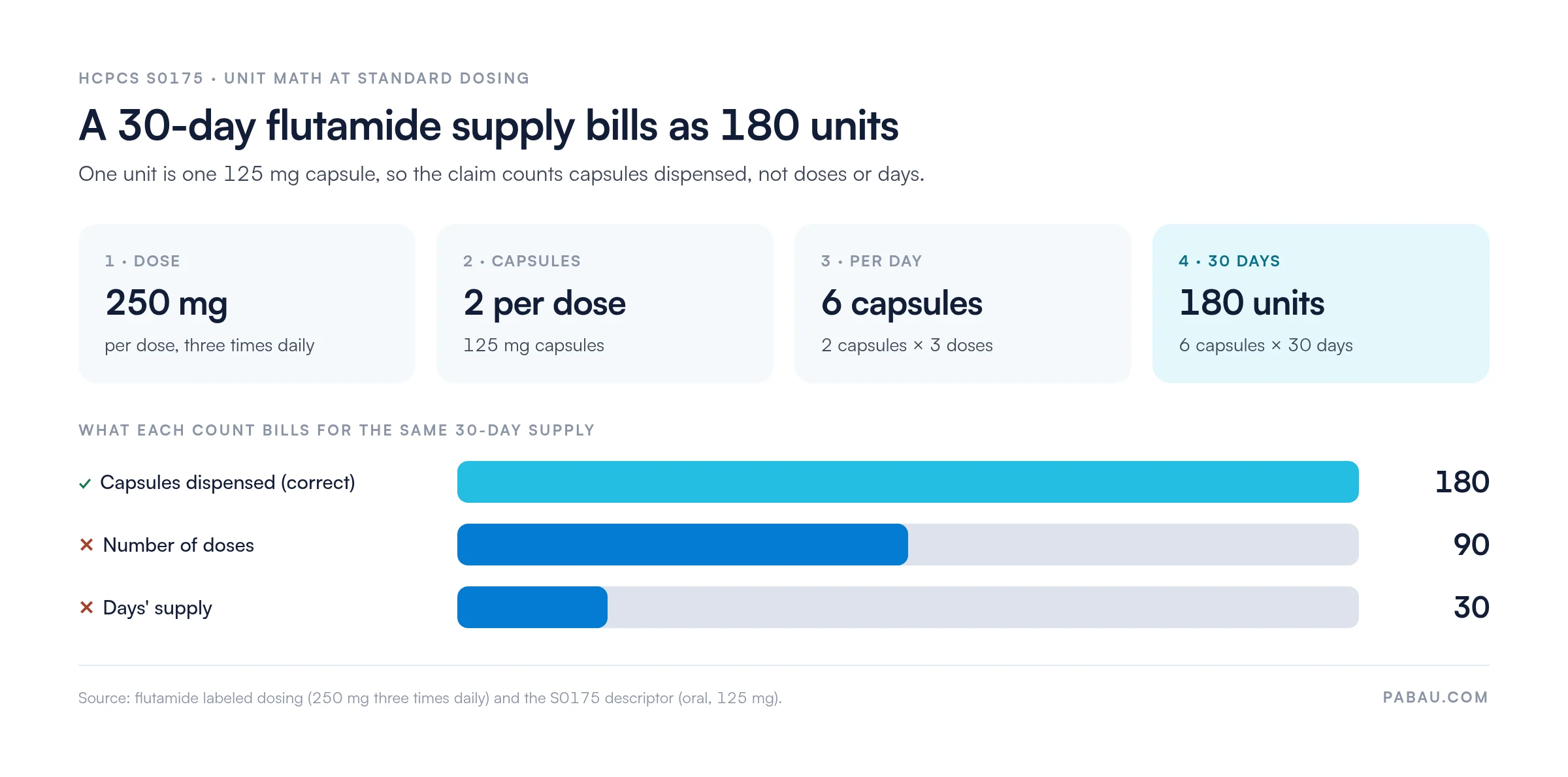
Use this formula: Units billed = total milligrams dispensed divided by 125. The worked examples below show the most common supply lengths and where errors occur.
Always cross-reference the dispensing record against the prescription. A mismatch between the prescription quantity and the billed quantity is one of the top triggers for automated payer edits on drug claims.
Medicaid requires a National Drug Code (NDC) on drug claims, including those submitted with S0175. Many commercial payers have adopted the same requirement. A missing or malformed NDC is among the fastest paths to a denial on these claims.
Report the NDC using the following format on a CMS-1500 or 837P claim:
Use the NDC printed on the package you dispensed, not one taken from a reference database. NDCs differ by manufacturer and package size, so a reference NDC can mismatch the dispensed product and draw a flag in a retrospective audit. Record the dispensed NDC at the point of service so it carries through to the claim.
Coders frequently confuse S0175 with the J-codes for injectable hormone therapy. The distinction matters because the payer pathways, NDC requirements, and claim forms differ substantially.
S-codes and J-codes can appear on the same claim when the practice administers a depot leuprolide injection and also dispenses oral flutamide. Bill S0175 for the flutamide and the matching leuprolide code, such as J9217, for the injection on separate lines. Confirm each descriptor in AAPC’s HCPCS code lookup, then check the payer’s bundling rules before submission.
HCPCS Code S0175 is not payable by traditional Medicare fee-for-service. CMS does not reimburse S-codes under the Physician Fee Schedule or the outpatient prospective payment system. For Medicare patients, oral flutamide goes through Medicare Part D, the pharmacy benefit run by prescription drug plans. It does not travel on a professional or outpatient facility claim carrying S0175.
The most common routing mistake is submitting S0175 on a CMS-1500 for a Medicare patient. That claim is denied whatever the quality of the documentation.
Reimbursement rates for S0175 are set by individual state Medicaid fee schedules and commercial plan contracts, not by a CMS national payment amount. S0175 does not appear on the Medicare Physician Fee Schedule, so take the rate from the specific payer’s fee schedule or provider portal.
Prior authorization for S0175 is not universal, but Medicaid managed care plans and many commercial payers require it for specialty oncology drugs. Good revenue cycle management practice is to check the payer’s drug formulary before dispensing rather than after a denial arrives.
When prior authorization is required, the submission typically needs:
If a PA is denied, the payer’s notice or remittance advice will carry a denial reason code. Request the specific clinical criteria the plan used and submit an appeal with additional supporting documentation. Some state Medicaid programs and plans allow retroactive authorization. The window varies by state, so check the plan contract.
Most S0175 denials fall into six categories. Identifying the remittance remark code on the ERA is the fastest way to match the denial to the correct fix. Structured denial management processes at the practice level stop the same error from recurring across multiple claims.
Check the full list of denial codes when the remark code on the ERA does not map clearly to one of the categories above. The CARC and RARC codes on the 835 remittance file identify the denial reason and point to the fix.
Run a monthly unit-mismatch audit on your S0175 claims by comparing the quantity billed against the dispensing records. Filter for claims where units fall below capsules per day multiplied by days’ supply. A 180-capsule dispense billed as 30 units leaves 150 units unpaid, and the loss repeats for every patient on the same regimen.
Complete documentation is the strongest defense against both initial denials and retrospective audits. For HCPCS Code S0175, solid medical billing compliance means keeping the following on file for every claim submitted.
Post-payment audits of specialty drug claims often ask for several of these records at once. A practice that files them together at dispensing answers an audit far faster than one rebuilding records months later.
The clean claim requirements for Medicaid and commercial drug claims set out what a payer treats as a complete submission. The PGM Billing HCPCS lookup tool can confirm active code status and descriptor before submission.
Without a connected system, staff calculate S0175 units by hand, copy the NDC from the package, and keep authorization numbers in a separate spreadsheet. Each handoff is a chance for a 180-capsule dispense to leave the practice as a 30-unit claim.
Pabau, the practice management platform we build, keeps the patient’s insurance case and its claims in one place. Its claims management software sends US claims as CMS-1500/837P through Claim.MD, with eligibility checks before submission and ERA remittances posted back.
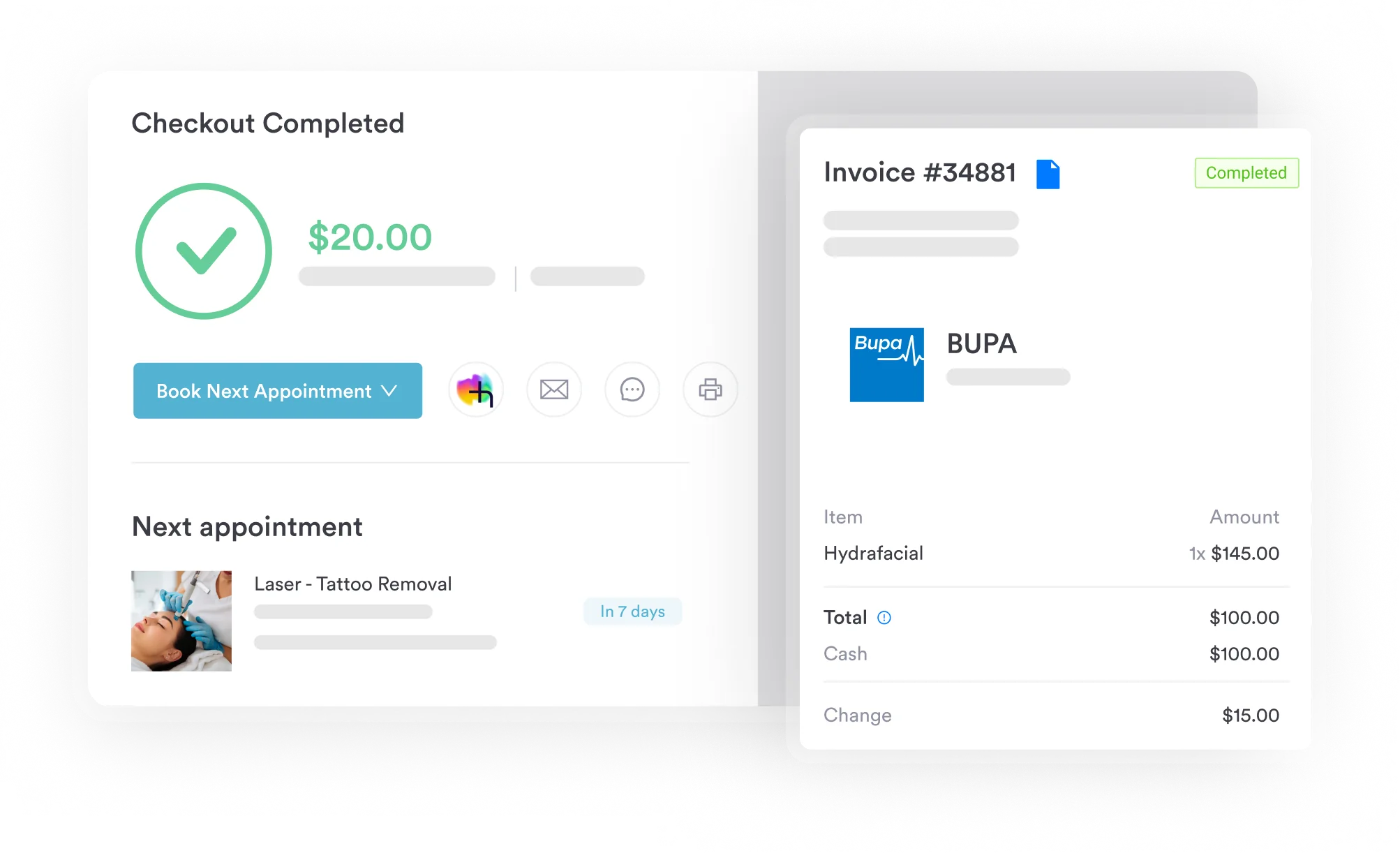
Prior authorization codes, dates and sessions are tracked on the case, with a warning when one is missing. Your team sees the missing authorization before the S0175 claim goes out, instead of reading it on a remittance weeks later.

Pabau’s claims management software sends US claims through Claim.MD and tracks prior authorization codes on the patient’s case. Your billing team spends less time reworking denied drug claims.

Treat S0175 as a payer-routing decision before it becomes a coding decision. Medicare fee-for-service patients belong in Part D, and only Medicaid or commercial plans that accept S-codes should receive the claim.
Once the payer is right, the claim stands or falls on the capsule count and the NDC from the dispensed package. Capture both at dispensing rather than at billing, and the most common S0175 denials stop repeating.
Book a demo to see how Pabau keeps drug claims and prior authorizations on one patient case.

Need a framework for reducing claim rejections across your whole billing team? Denial management in healthcare covers the operational systems that catch coding errors before they reach the payer.
Want to understand what makes a drug claim clean before submission? Clean claim submission guidelines outlines the CMS and payer requirements that determine whether a claim processes without manual review.
Exploring how revenue cycle management fits around specialty drug billing? Revenue cycle management explained maps the full billing lifecycle from prescription through payment posting.
HCPCS Code S0175 is the billing code for flutamide, oral, 125 mg. It covers each 125 mg capsule of oral flutamide dispensed, primarily for prostate cancer under androgen deprivation therapy. It does not cover compounded preparations or injectable hormone therapies.
No. Traditional Medicare fee-for-service does not reimburse S-codes. Oral flutamide for Medicare patients goes through Medicare Part D via the patient’s prescription drug plan, not through a professional claim carrying S0175.
One unit equals one 125 mg capsule dispensed. For a patient on the standard regimen of two capsules three times daily, bill six units per day. A 30-day supply at standard dosing equals 180 units. Never equate units to doses, prescriptions, or days’ supply.
Yes, for Medicaid claims and many commercial payers. Report the 11-digit NDC from the dispensed package using the N4 qualifier, with UN as the unit-of-measure qualifier. A missing NDC is one of the top denial triggers for S0175 claims.
The primary code is C61 (malignant neoplasm of prostate). Add Z79.899 as a secondary code for patients on ongoing drug therapy. For metastatic disease, use the code for the metastatic site, such as C79.51 for bone. Off-label diagnoses require additional documentation and payer pre-approval.
S0175 is an S-code for oral flutamide capsules. J-codes cover injectable drugs administered in a clinical setting, and flutamide has no active J-code because it is only available orally. J-codes like J9217 and J9218 apply to injectable leuprolide, which is often used alongside flutamide.




