CCSD code L6530: Revision femoral bypass graft
CCSD code L6530: Definition and clinical scope CCSD code L6530 carries the offic...

Last Updated: Nov 13, 2026
S0117 is the HCPCS Level II code for tretinoin, topical, 5 grams. It reports a dispensed supply of topical tretinoin, a retinoid prescribed mainly for acne, billed in units of 5 grams.
S0117 is a temporary national S-code with Medicare coverage code I, so Medicare does not pay it. Medicaid programs and commercial plans decide for themselves whether to accept it, and many ask for the NDC and prior authorization.
Let Pabau's smart automation suggest the right codes, reduce claim denials, and keep your practice compliant—effortlessly.
Automate repetitive tasks and focus on what matters most—your patients.
Reduce coding errors and ensure compliance with the latest regulations.
Clean claims, fewer denials, and faster reimbursements.
Powerful insights and reporting to help your practice thrive.
HIPAA compliant SOC 2 certified GDPR-compliant Trusted by 4,000+ clinics worldwide

HCPCS code S0117 reports topical tretinoin in units of 5 grams, so a 20 g tube is billed as 4 units.
The CMS HCPCS file lists S0117 as “Tretinoin, topical, 5 grams”, added on July 1, 2004.
Medicare coverage code I means Medicare does not pay S0117, so the claim goes to Medicaid or a commercial plan.
Pair S0117 with a specific acne diagnosis such as L70.0 and report the NDC, because many plans screen tretinoin for cosmetic use.
Pabau, the practice management platform we build, sends the claim from the same record that holds the prescription and the dispensed tube’s lot.
HCPCS code S0117 reports a dispensed supply of topical tretinoin, billed per 5 grams. The October 2026 HCPCS quarterly file lists it as “Tretinoin, topical, 5 grams”, with an add date of July 1, 2004. Its short descriptor is “Tretinoin topical 5 g”.
S0117 sits in HCPCS Level II, the code set maintained by the Centers for Medicare and Medicaid Services (CMS). Level II reports drugs, supplies, and services that CPT codes do not describe. S0117 belongs to the S-series (S0000-S9999), the temporary national codes that private payers and Medicaid programs use where no permanent national code exists.
S0117 covers topical tretinoin dispensed to a patient as a distinct billable supply, counted in 5-gram units. It is billed most often from dermatology offices and medical aesthetic practices that dispense the product on site, usually for acne.
S0117 does not include the visit itself. The evaluation that leads to the prescription is billed separately with the appropriate office E/M code. Oral tretinoin capsules are also outside S0117, because the descriptor is limited to topical use.
Other topical retinoids, such as adapalene and tazarotene, are different drugs, so S0117 does not describe them. Combination products that pair tretinoin with another active ingredient need a payer check too. Some payers want the whole product reported by NDC, or under an unclassified drug code, rather than as S0117.
Payers read the diagnosis on an S0117 line to decide whether the tretinoin treats a skin condition or serves a cosmetic goal. Acne vulgaris is the main FDA-labeled use of topical tretinoin, and it is the diagnosis most plans will pay against. Report the most specific acne code the record supports.
Photodamage is the diagnosis most likely to put an S0117 claim in dispute. Some tretinoin formulations carry an FDA label for fine wrinkles in photodamaged skin, yet many benefit plans exclude cosmetic use. Check the plan’s exclusions before you dispense for that indication.
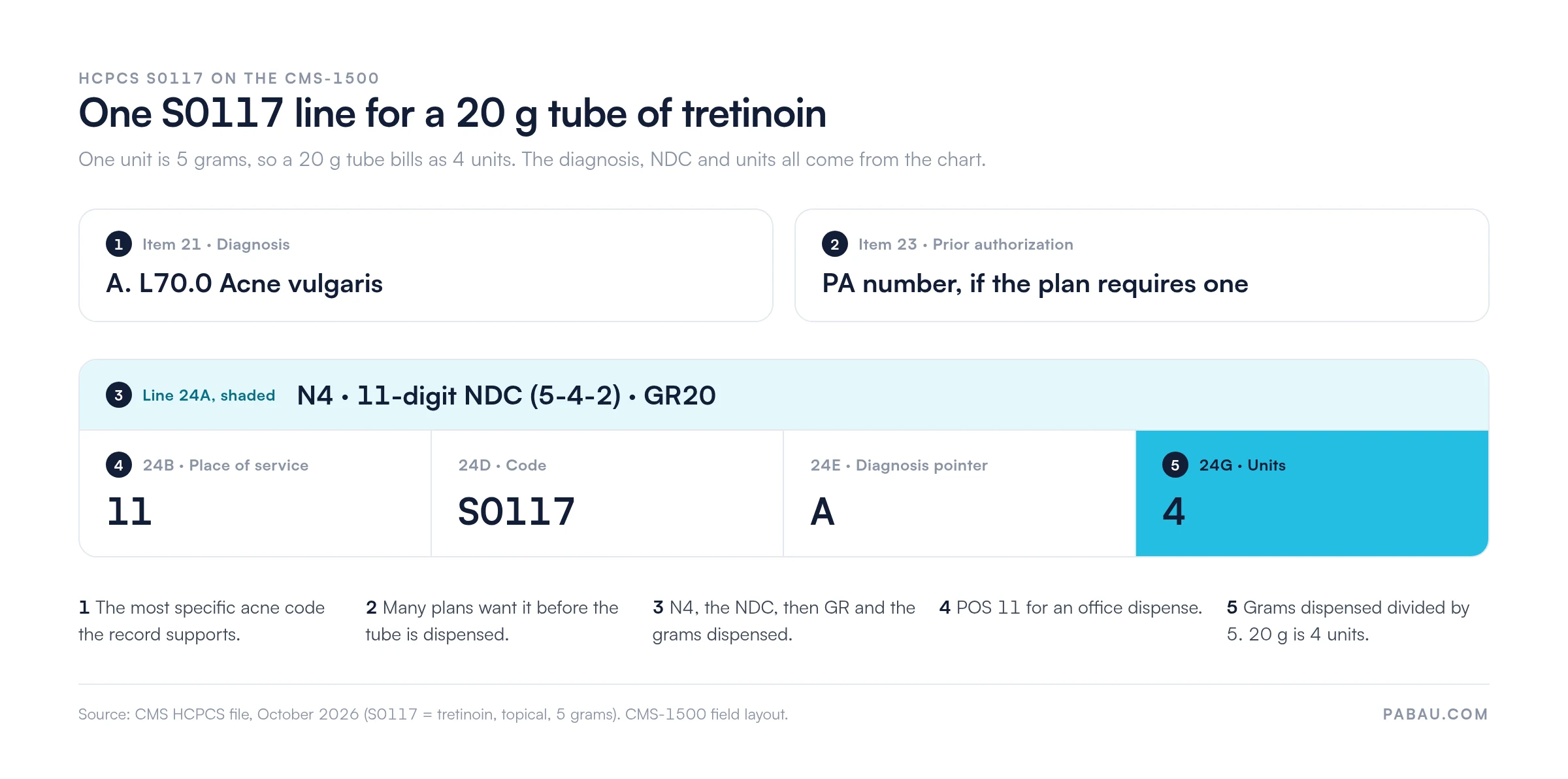
Bill S0117 in units of 5 grams of the product dispensed. Divide the total grams by five to get the unit count, and enter that number in item 24G of the CMS-1500.
Where a tube size does not divide evenly by five, follow the payer’s rounding rule. Some plans round to the nearest whole unit, and others set their own rule for a partial unit. The payer’s provider manual states which approach it uses.
Most Medicaid programs and many commercial payers want the National Drug Code (NDC) alongside a drug HCPCS code. On the CMS-1500, enter it in the shaded area of item 24A. Use the N4 qualifier, the 11-digit NDC in 5-4-2 format, and the GR unit qualifier with the grams dispensed.
Place of service is usually 11 (office), since S0117 is dispensed in the practice where the patient is seen. A prescription filled at a retail pharmacy is billed by the pharmacy through the pharmacy benefit, not by the practice. If the practice also bills S0117 for that tube, the claim duplicates the fill.
Put S0117 in item 24D and the place of service in item 24B. Item 24E points to the acne diagnosis listed in item 21. Here is one complete line for a 20 g tube.
Medicare does not pay HCPCS code S0117. The CMS HCPCS file gives it coverage code I, which means not payable by Medicare. A Medicare Administrative Contractor (MAC) rejects the line on a CMS-1500 before any review of medical necessity, so an appeal will not change the outcome.
Coverage under Medicaid varies by state. Each state Medicaid program sets its own HCPCS coverage policy, and adoption of S-series codes is discretionary. Some states list S0117 as covered, while others route topical tretinoin only through the pharmacy benefit. The same applies to other S-series drugs, such as oral sildenafil under HCPCS code S0090. Oral minoxidil follows the same pattern under the S0139 code, billed per 10 mg.
Verify coverage with the state Medicaid agency or the payer’s portal before you dispense. An insurance eligibility verification check at intake shows coverage and benefit limits before the claim is built.
Because Medicare does not pay HCPCS code S0117, it has no Medicare payment rate on any CMS fee schedule. Reimbursement depends entirely on each payer’s own fee schedule, so rates differ across state Medicaid programs and commercial contracts.
Medicaid usually prices a drug supply from a pharmacy-style fee schedule rather than a physician fee schedule. The allowable is set per unit, which for S0117 means per 5 grams dispensed. Some states pay acquisition cost plus a dispensing fee, and others pay a percentage of average wholesale price (AWP).
Check the CMS Physician Fee Schedule search tool to confirm S0117 carries no Medicare rate. Then take the allowable from the state Medicaid portal or the commercial contract. MCO contracts often reference Medicaid rates or set a fixed amount per unit.
Strength does not change the unit, so a 0.025% and a 0.1% tube of the same size bill the same units. The allowed amount can still differ, because some fee schedules price by the NDC of the product dispensed. Check that the NDC on the claim is the one in the patient’s chart.
Prior authorization (PA) for HCPCS code S0117 depends on the payer, and it is common for topical tretinoin. Many plans use PA to separate acne treatment from cosmetic use. Some apply it only above a set patient age, which the plan’s drug policy states.
Request authorization before the product is dispensed. The steps below follow the standard prior authorization process:
Documentation is what makes an S0117 claim payable. Payers reviewing these claims look for a covered skin diagnosis, a correctly identified product, and proof that the stated quantity was dispensed.
The clinical record should contain:
Pabau’s claims management software builds the claim from the patient record that holds these fields. Billing staff stop chasing clinicians for a missing NDC or tube size.
S0117 is sometimes confused with unclassified drug codes and with the visit codes billed on the same date. The table below lists the codes that most often sit near it on a claim, and what separates each from S0117.
When tretinoin is dispensed at the visit, the E/M code and S0117 go on separate lines of the same claim. Do not fold the supply into the visit fee unless the payer’s policy says to.
A plan that has not adopted S0117 may want the tretinoin billed under J3490 with its NDC instead. Use the AAPC HCPCS Level II code reference to confirm current descriptors before billing.
Run a crosswalk check before billing S0117 to a new payer. If the plan lists topical tretinoin under its pharmacy benefit by NDC only, it may deny S0117 on the medical claim. Get the payer’s preferred route in writing and keep that confirmation in your billing notes.
Most S0117 denials trace back to one of six causes, and each one can be fixed before the claim goes out. The table below maps each common denial to its corrective action.
Reading the payer’s denial codes alongside your EOBs gives you the exact CARC code behind each rejected line. That code narrows the corrective action faster than the denial description alone. Denial management tracking across S0117 claims over a rolling 90 days shows whether a pattern is payer-specific or practice-wide.
A denied S0117 claim is not automatically lost, unless the payer is Medicare. Most Medicaid programs and MCOs have a formal appeal process with set timelines. Missing the filing deadline forfeits the right to appeal, so act quickly.
Ensuring medical billing compliance at each step, from documentation through appeal, lowers the odds that a denied claim stays denied. A clean claim sent correctly the first time is faster than a corrected resubmission or a formal appeal.
Set a calendar alert for the appeal deadline on every denied S0117 claim the day the denial arrives. A recoverable denial is often written off only because its filing window closed.
CMS publishes the HCPCS Level II code set in quarterly files. A free lookup is the NLM Clinical Tables HCPCS API, which mirrors the CMS data and can be searched by code or descriptor. It returns S0117 as “Tretinoin, topical, 5 grams”, with an add date of July 1, 2004.
Check S0117 at the start of each year and after each quarterly update. First, confirm the code is still active, since CMS can add or delete temporary codes in any quarterly file. Second, confirm the payer has not changed its coverage or PA rules.
In many practices, a tretinoin claim is rebuilt by hand. The prescriber writes the strength and tube size in the note. Someone at the front desk then pulls the NDC off the box and works out the units, and any slip turns into a denial.
Pabau keeps those steps in one patient record. Prescriptions are drafted and approved in the same chart, and US e-prescribing runs through DoseSpot. Stock carries its batch number and expiry date, and the lot is recorded against the patient and the appointment.
US claims go out through Claim.MD as CMS-1500 claims, with eligibility checks before the visit and ERA remittances after it. The S0117 line is built from the record that shows what was dispensed. Your team spends less time matching tubes to claims and more time on patients.

Pabau keeps the prescription, the dispensed lot, and the CMS-1500 claim in one record. Your S0117 units and diagnosis match the chart before the claim reaches the payer.

HCPCS code S0117 pays when three facts on the claim agree with the chart. Those are the acne diagnosis, the grams dispensed, and the NDC of the tube the patient took home.
Medicare will never pay S0117, so spend your checking time on Medicaid and commercial rules instead. A plan that screens tretinoin for cosmetic use will judge the claim on your note. A specific L70 code and a recorded treatment history do more for the claim than any appeal.
Book a demo to see how Pabau keeps dispensed tretinoin, its lot, and the claim in one record for dermatology and aesthetic practices.

Need a framework for managing claim denials systematically? Denial management in healthcare covers the processes and metrics that help billing teams recover more denied claims.
Want to understand what makes a claim pay first time? Clean claim fundamentals explains the elements payers check before adjudication.
Looking for the full picture on S-series and HCPCS billing compliance? Medical billing compliance covers the regulatory requirements that apply to HCPCS claim submissions.
Sending a prior authorization request? Medical prior authorization form gives your team a ready-made template for the request.
HCPCS code S0117 is the temporary national Level II code for tretinoin, topical, 5 grams. Practices use it to bill a dispensed supply of topical tretinoin, one unit per 5 grams. Medicaid and commercial payers may accept it, but Medicare does not pay it.
No. S0117 carries Medicare coverage code I, which means it is not payable by Medicare. A Medicare Administrative Contractor rejects the line outright. An appeal cannot change a non-payable coverage status.
Divide the grams dispensed by five. A 20 g tube is 4 units and a 45 g tube is 9 units. Report the NDC with the GR qualifier and the total grams, and follow the payer’s rule for any partial unit.
State Medicaid programs and commercial managed care organizations (MCOs) are the main payers for S0117. Adoption varies by state plan and by MCO contract. Some plans cover topical tretinoin only through the pharmacy benefit, so verify the route before you dispense.
It often does. Many plans require prior authorization for topical tretinoin to separate acne treatment from cosmetic use, sometimes only above a set patient age. Check the payer’s PA list and submit the acne diagnosis, prior therapies, and NDC before dispensing.
The leading reasons are billing a non-covered payer such as Medicare and missing prior authorization. Others are a cosmetic or unsupported diagnosis, units that do not match the grams dispensed, and a missing NDC. A duplicate of a pharmacy fill is another common cause.
S-series codes are temporary national codes. CMS can add, revise, or delete them in any quarterly HCPCS update. Confirm that S0117 is still active at the start of each year and after each quarterly file.