CCSD code L3711: Bypass of the subclavian artery – extrathoracic
CCSD code L3711: Definition and official descriptor CCSD code L3711 is the billi...

Last Updated: Nov 11, 2026
S0187 is the HCPCS Level II code for tamoxifen citrate, oral, 10 mg. Each unit equals one 10 mg tablet, and commercial insurers and many state Medicaid programs accept it.
Medicare Part B does not recognize HCPCS S codes, so a claim under S0187 sent to a traditional Medicare contractor is rejected. Medicare patients get tamoxifen through Part D, billed by the pharmacy under the NDC.
Let Pabau's smart automation suggest the right codes, reduce claim denials, and keep your practice compliant—effortlessly.
Automate repetitive tasks and focus on what matters most—your patients.
Reduce coding errors and ensure compliance with the latest regulations.
Clean claims, fewer denials, and faster reimbursements.
Powerful insights and reporting to help your practice thrive.
HIPAA compliant SOC 2 certified GDPR-compliant Trusted by 4,000+ clinics worldwide

HCPCS Code S0187 describes tamoxifen citrate, oral, 10 mg, and each billing unit equals one 10 mg tablet.
Medicare Part B rejects S codes, so Medicare patients get tamoxifen through Part D, billed by the pharmacy under the NDC.
A missing or invalid NDC and a wrong unit count are the two leading causes of S0187 denials.
No modifier is standard for S0187, so add KX or GY only where a payer’s own policy asks for it.
Pabau, the practice management platform we build, submits claims through a clearinghouse and tracks their status, while your team still enters the NDC and units.
HCPCS Code S0187 is the Level II code for tamoxifen citrate, oral, 10 mg, and each unit represents one 10 mg tablet. Commercial insurers and many state Medicaid programs accept it, while Medicare Part B does not.
The code sits in the S range of the CMS HCPCS Level II code set, the temporary national codes for non-Medicare use. Our HCPCS code library lists the neighboring codes in the same set.
S codes sit in the CMS HCPCS Level II file, but they exist for private payers and Medicaid programs. Medicare does not use them and assigns them no payment rate, which is why S0187 sits outside Medicare Part B.
Tamoxifen citrate is a selective estrogen receptor modulator (SERM) with several FDA-approved uses. The supporting diagnosis code changes with the indication, and a mismatch leads straight to a denial.
Standard dosing is 20 mg per day, which is two units of S0187. That dosing detail drives the unit count on every claim.
Payer acceptance of S0187 follows the S-code rule, and CMS excludes S codes from Medicare Part B processing. Tamoxifen is an oral drug that Part D formularies cover as a prescription benefit. It is not a physician-administered drug that Part B reimburses. If payer types are new to you, our guide to medical billing basics walks through how each one pays.
Always verify coverage before dispensing. A payer that accepts S codes in general may still decline tamoxifen for the chemoprevention indication. The routing below shows where each claim goes and how the units add up.
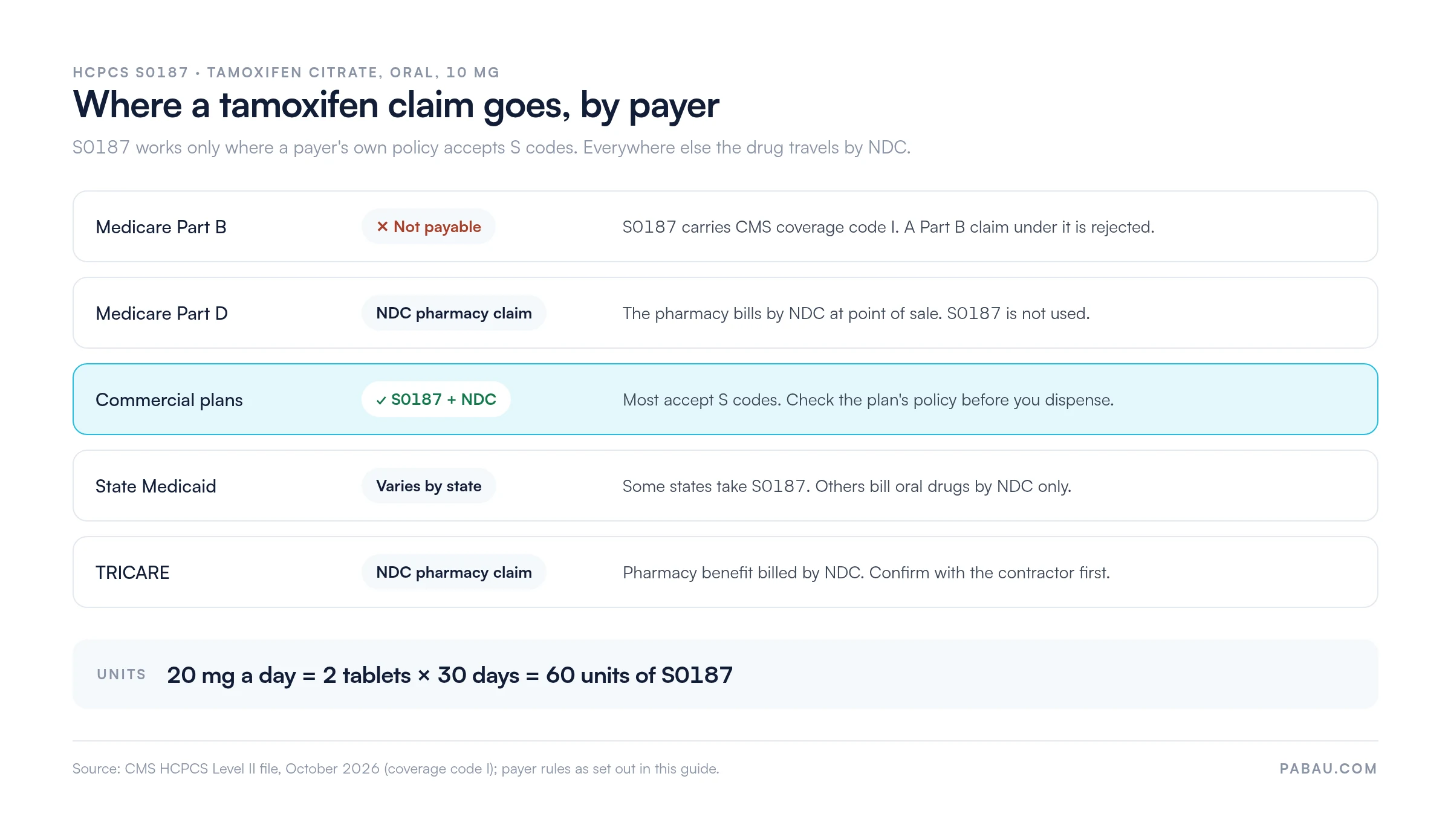
Accurate billing under S0187 depends on three details at once: the unit count, the NDC, and the place of service. An error in any one of them is enough for the payer to reject the claim.
One unit of S0187 equals 10 mg of tamoxifen, which is one 10 mg tablet. Bill the total units dispensed, not the number of days supplied. A 20 mg dose is two units.
Worked example: A patient on standard 20 mg/day dosing (two 10 mg tablets) receives a 30-day supply. Total tablets dispensed: 60. Units to bill: 60.
Most payers that accept S0187 require the National Drug Code (NDC) on the claim. For electronic 837P claims, the NDC goes in Loop 2410 (Drug Identification), with the unit of measure qualifier set to UN (units).
On a paper CMS-1500, report the NDC in the shaded area of item 24A. Enter the N4 qualifier, then the 11-digit NDC without hyphens in 5-4-2 format, then the unit qualifier UN and the quantity. A clean claim carries the NDC in exactly that format.
Use POS 11 (Office) for physician practice dispensing and POS 01 (Pharmacy) for retail or specialty pharmacy billing. Hospital outpatient departments use POS 22 (Outpatient Hospital). The place of service must match the billing provider type, or the payer’s provider-setting edit rejects the claim.
Include at least one ICD-10-CM diagnosis code that establishes medical necessity. If the diagnosis does not clinically justify tamoxifen, the claim is denied on medical necessity grounds, however correctly S0187 is coded.
No modifier is standard for S0187. KX and GY are Medicare-defined modifiers, and they apply to an S0187 claim only where a payer’s own policy says so.
Confirm modifier requirements in each payer’s medical policy or EDI companion guide before submitting. A modifier one commercial plan ignores may be a hard edit for another.
Prior authorization (PA) requirements for tamoxifen under S0187 vary by payer and by indication. The breast cancer treatment indication generally faces fewer PA hurdles than chemoprevention. Some commercial plans and Medicaid managed care organizations (MCOs) still require PA regardless of indication, particularly for specialty pharmacy dispensing.
Check the payer’s formulary tier before initiating PA. Tamoxifen is a generic and often sits on Tier 1 or Tier 2, which typically means no PA for treatment indications. Chemoprevention claims are more likely to hit a step-therapy or PA requirement. Confirm before dispensing to avoid a retro-PA scramble.
When PA is required, payers typically ask for the following documentation.
PA requirements are plan-year-specific. A plan that did not require PA last year may add it at contract renewal, so verify at the start of each benefit year.
The diagnosis code on a tamoxifen claim tells the payer why the drug is medically necessary. A code that does not clinically support tamoxifen is the fastest route to a medical necessity denial. These ICD-10-CM codes are the ones most often paired with S0187.
Use the most specific code available. Z85.3 alone is sometimes insufficient for a chemoprevention claim, and some payers want Z15.01 or a documented Gail score alongside it. When in doubt, add Z17.0 as a secondary code to confirm ER-positive status.
No tamoxifen-specific J code exists. Oral anticancer J codes do exist, such as J8520 and J8521 for capecitabine and J8999 for oral chemotherapy not otherwise specified. Medicare Part B pays only certain oral anticancer drugs, though, and tamoxifen goes through Part D instead. For commercial payers, S0187 is the code to use.
The CMS HCPCS file carries no 20 mg tamoxifen S code, so S0187 covers every strength in 10 mg units. Bill a 20 mg dose as 2 units of S0187.
S0187 denials cluster around six root causes. Good denial management catches most of them before the claim reaches the payer, and the rework is straightforward when one slips through.
When appealing a medical necessity denial, include a letter of medical necessity from the prescribing oncologist with the pathology report and ICD-10 codes. Appeals that arrive without clinical documentation rarely succeed on first review.
Solid documentation underpins S0187 reimbursement and is your best defense in a payer audit. A well-built superbill should capture each of these items before the claim goes out.
Payers auditing tamoxifen claims check three items. They want a diagnosis that supports the drug, a PA reference number where required, and an NDC matching the product billed. A claim missing any of them can trigger recoupment.
Scan every prior authorization approval into the patient record as soon as it arrives. Payers often deny retro-PA requests for missing documentation, and the original approval letter in the chart settles that argument on appeal.
A practice that dispenses tamoxifen usually bills S0187 by hand. Someone keys the NDC, counts the units, and follows the claim through each payer’s portal. A missing qualifier or a wrong unit count often surfaces weeks later as a rejection.
Pabau’s claims management software, which supports insurance billing in the US, submits claims through a clearinghouse and tracks their status. Your team still enters the NDC, the unit qualifier, and the quantity on each claim. Pabau checks the claim for missing details before it goes out.
Every claim then shows its stage, from pending to paid. When a payer rejects a line, the claim is flagged for action with the reason attached. Your biller corrects it and resubmits from one screen.
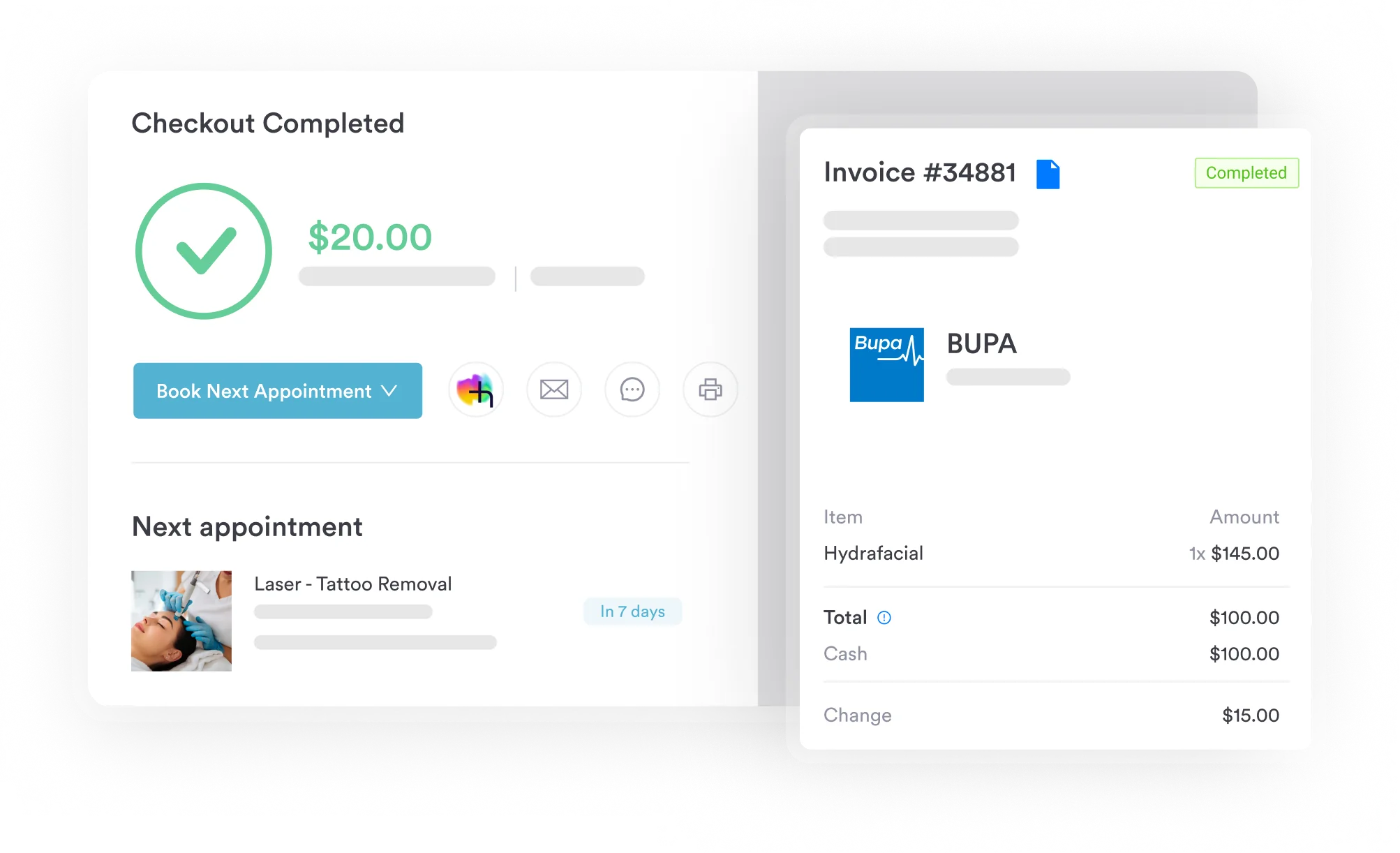

Pabau’s claims management submits claims through a clearinghouse and tracks each one from pending to paid. Your billing team sees each rejection with its reason and resubmits from one screen.

Before you dispense tamoxifen, decide which route the claim will take. Medicare patients go to Part D by NDC. A commercial or Medicaid claim goes out under S0187 only after you confirm the plan accepts it.
Once the route is settled, most of the risk sits in two fields: the unit count in 10 mg units and the 11-digit NDC. Build both into your claim checklist, and leave modifiers off unless the payer’s policy names one.
Book a demo to see how Pabau tracks each tamoxifen claim from submission to payment.

Need a broader view of medical billing fundamentals? Medical billing overview covers the full claim lifecycle from service capture to payment posting.
Struggling with claim rejection workflows? Denial management in healthcare explains how to build a systematic denial follow-up process.
Want to understand what makes a claim pay first time? Clean claim submission details every element that must be correct before the claim leaves the practice.
Decoding a remittance after an S0187 rejection? Denial codes in medical billing maps common CARC and RARC codes to the right correction.
HCPCS Code S0187 is the Level II HCPCS code for tamoxifen citrate, oral, 10 mg. Commercial insurers and many state Medicaid programs use it to pay for dispensed oral tamoxifen. Medicare Part B does not accept S codes, so Medicare patients get tamoxifen through Part D instead.
No. Medicare Part B does not recognize HCPCS S codes, so a claim under S0187 sent to a traditional Medicare contractor is rejected. Tamoxifen is covered under Medicare Part D as a prescription drug benefit. Part D plans process it through pharmacy point-of-sale claims using the National Drug Code (NDC), not the S0187 HCPCS code.
Bill one unit for every 10 mg dispensed. A patient on the standard 20 mg daily dose takes two 10 mg tablets a day, so a 30-day supply is 60 units. Billing 1 unit for the whole supply, or entering milligrams as units, leads to a denial and a corrected claim.
Yes, in most cases. State Medicaid programs and many commercial payers require the 11-digit NDC on drug claims, including S0187. On an 837P claim, report the NDC in Loop 2410 with the unit qualifier UN. On a paper CMS-1500, enter the N4 qualifier and the NDC in the shaded area of item 24A. A missing or badly formatted NDC is one of the two most common S0187 denial causes.