HCPCS Code Q4185: Cellesta flowable amnion billing guide
HCPCS Code Q4185: definition and official descriptor HCPCS Code Q4185 is the Lev...

Last Updated: Nov 20, 2026
J3315 is the HCPCS Level II code for injection, triptorelin pamoate, 3.75 mg. One billing unit equals 3.75 mg, so a 22.5 mg depot is billed as 6 units.
The code covers the drug only, and the injection is billed on its own line with an administration code such as 96372. Unit miscalculation and a missing NDC are the two most common reasons J3315 claims are denied.
Let Pabau's smart automation suggest the right codes, reduce claim denials, and keep your practice compliant—effortlessly.
Automate repetitive tasks and focus on what matters most—your patients.
Reduce coding errors and ensure compliance with the latest regulations.
Clean claims, fewer denials, and faster reimbursements.
Powerful insights and reporting to help your practice thrive.
HIPAA compliant SOC 2 certified GDPR-compliant Trusted by 4,000+ clinics worldwide

HCPCS Code J3315 bills triptorelin pamoate (Trelstar) at 3.75 mg per unit, and it never substitutes for the leuprolide codes J9217, J9218 or J1950.
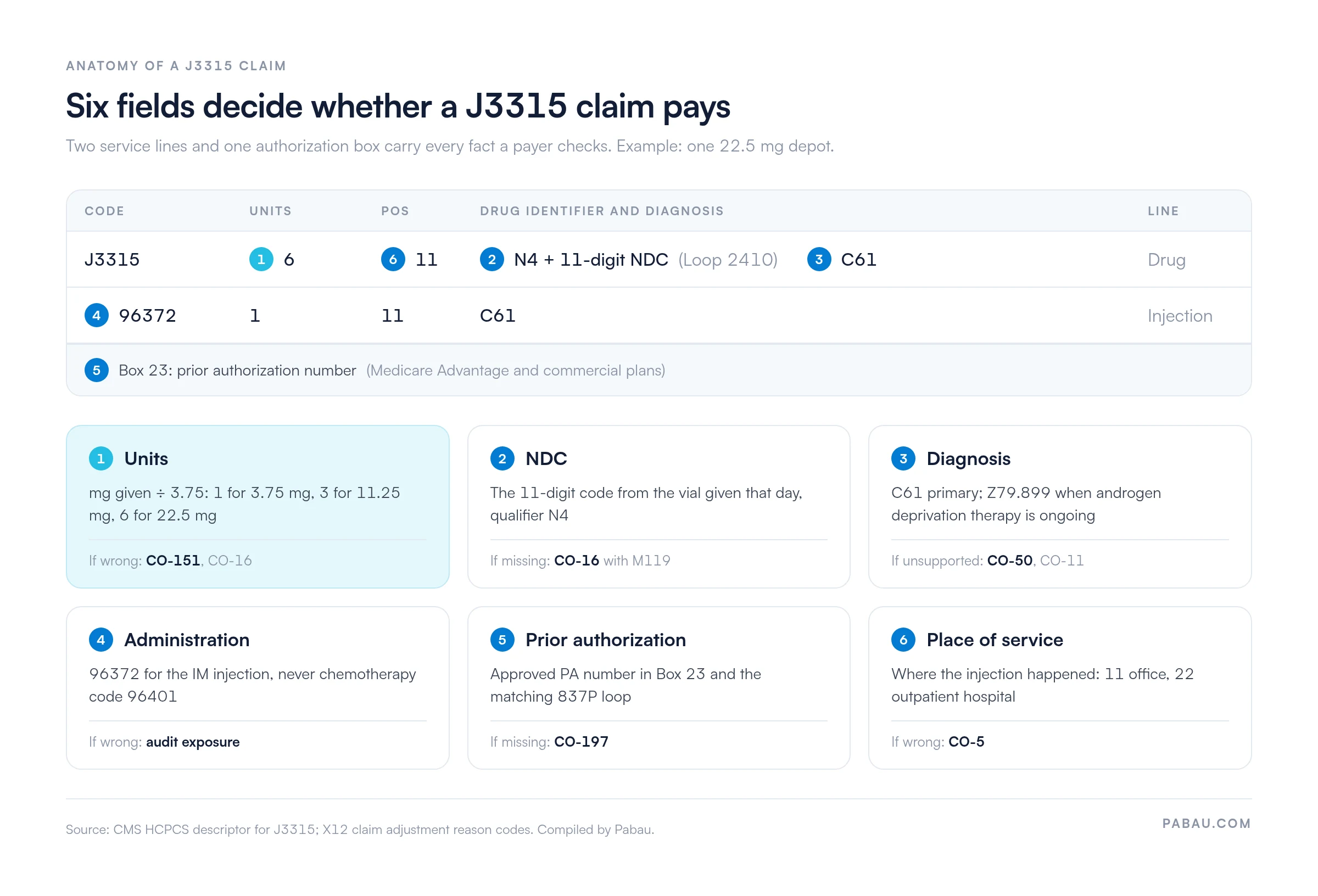
Bill 1 unit for the 3.75 mg depot, 3 units for the 11.25 mg depot, and 6 units for the 22.5 mg depot.
Report the 11-digit NDC in Loop 2410 with qualifier N4, because a missing NDC is one of the most frequent reasons J3315 claims are denied.
The injection is billed on its own line, usually with 96372, and never with chemotherapy administration code 96401.
Pabau sends J3315 claims through the Claim.MD clearinghouse and records each drug lot against the patient and the appointment.
HCPCS Code J3315 is the HCPCS Level II code for injection, triptorelin pamoate, 3.75 mg, so one billing unit equals 3.75 mg of the drug. CMS maintains HCPCS Level II codes and decides every addition, revision and deletion, reviewing drug code requests each quarter. J3315 sits in the J0120-J8999 range for drugs administered other than oral method.
Triptorelin first stimulates and then desensitizes pituitary GnRH receptors, which suppresses testosterone production to castrate levels. That makes it an androgen deprivation therapy (ADT) for advanced prostate cancer, the FDA-approved indication billed under J3315.
A J3315 claim pays only when a supported diagnosis establishes medical necessity. The FDA-approved indication on the Trelstar label is palliative treatment of advanced prostate cancer, which is reported with C61.
Supported ICD-10-CM diagnosis codes include:
Off-label use of triptorelin pamoate in conditions such as central precocious puberty or endometriosis is not automatically covered under J3315.
Review the Local Coverage Determinations (LCDs) from your Medicare Administrative Contractor (MAC) before submitting a claim for any non-oncology indication. Some MACs publish LCDs for GnRH agonists that extend the coverage criteria, and others do not.
The descriptor for J3315 defines one unit as 3.75 mg of triptorelin pamoate. Trelstar is commercially available in three depot strengths, and each requires a different unit count on the claim.
Billing one unit for a 22.5 mg injection is a common error, and it underpays the claim by five units. Billing more units than the administered dose supports is an overpayment that creates compliance exposure. Check the vial strength dispensed before entering the unit count.
NDC reporting: CMS requires the 11-digit National Drug Code on all outpatient HCPCS drug claims (Medicare Claims Processing Manual, Chapter 17). Report the NDC in Loop 2410 of the 837P transaction using qualifier N4. The NDC must match the vial label administered that day, not a standing NDC from a previous encounter. Missing or mismatched NDC data triggers automatic denial at many MACs.
J3315 covers the drug cost only. A separate CPT administration code must appear on the same claim. The correct code depends on the clinical context and setting.
Most urology and oncology offices bill 96372 alongside J3315. Billing 96401 for a hormonal injectable is a common coding error, so a well-built superbill lists 96372 as the default line for triptorelin. When the pairing is unclear, confirm it with your compliance officer, because the wrong administration code creates audit exposure.
Always print or export the final superbill before patient checkout and confirm the administration CPT code matches the drug route. For triptorelin, 96372 is the correct IM injection administration code in virtually every office-based scenario. Flagging this during charge capture prevents the downstream denial and resubmission cycle.
Medicare Part B covers physician-administered injectable drugs like triptorelin pamoate when medical necessity is established and the drug is administered in a covered setting. Reimbursement is calculated under the Average Sales Price (ASP) methodology.
Reimbursement methodology: CMS pays J3315 at ASP+6% in both the physician office and the hospital outpatient department (HOPD). In the HOPD, the outpatient prospective payment system (OPPS) packaging rules also apply.
The dollar rate changes every calendar quarter with manufacturer-reported ASP data, so check the current CMS ASP drug pricing files for the quarter of service.
Place of service impact: Claims billed with POS 11 (office) are reimbursed at the ASP+6% rate. POS 22 (outpatient hospital) claims are subject to OPPS packaging. Depending on the Ambulatory Payment Classification (APC), that can reduce or remove the separate drug payment. A urology practice that gives triptorelin in an attached outpatient hospital suite should confirm the POS before submitting.
Medicare Advantage and commercial payers: Medicare Advantage (MA) plans set their own reimbursement rates, which may differ from traditional Medicare ASP+6%. Commercial payers often reimburse at a contracted percentage of AWP or a plan-specific rate. Prior authorization requirements also vary by plan, as the next sections explain.
Triptorelin pamoate is one of several GnRH agonists used in androgen deprivation therapy for prostate cancer, and each drug has its own HCPCS code.
Choosing the wrong one misstates the drug given, which makes it a compliance error as well as a billing one. The table below lists the codes most often confused with J3315 in urology and oncology.
The NDC crosswalk is the most reliable safeguard here. If the NDC on the vial corresponds to Trelstar, the correct code is J3315. Submitting J9217 or J9218 for a triptorelin injection is a drug-code mismatch that can trigger both a denial and a compliance flag. Verify the administered drug name against the vial label before coding.
Traditional Medicare (Parts A and B) does not require prior authorization for J3315 in most circumstances, provided medical necessity is well documented. Medicare Advantage plans and commercial insurers, however, commonly require prior authorization for GnRH agonists.
Documentation typically required for a PA submission includes:
Submitting a J3315 claim to a Medicare Advantage plan without an approved PA number results in a CO-197 denial. Record the PA number in Box 23 of the CMS-1500 form and in the corresponding 837P loop. PA requirements change with each plan year, so verify them at the start of the year instead of relying on last year’s rules.
J3315 claims are denied for a predictable set of reasons. Most can be prevented at charge capture with a claims management software workflow that checks the claim before it goes out. The table below maps the most frequent denial categories to their standard remark codes and corrective actions.
Each of those denials traces back to one field on the claim. The example below marks all six on a claim for a single 22.5 mg depot.
Our guide to denial codes in medical billing lists every reason and remark code. The appeal workflow is covered under denial management in healthcare. Appeals for J3315 denials rooted in medical necessity typically require the treating physician’s clinical notes, PSA trend data, and the pathology report as supporting documentation.
A complete J3315 claim audit trail requires specific documentation elements in the patient record and the billing file. Missing any one of these at the time of a MAC audit results in recoupment of the payment.
A clean claim for a J-code drug has every element above in place before it transmits. A short pre-submission checklist at charge capture turns each item into a yes or no. A missing lot number or PA number is then fixed before the payer sees it.
Audit a sample of 10 J3315 claims from the previous quarter. For each one, verify the NDC in Loop 2410 matches the drug lot on the administration record. This one cross-check catches NDC mismatches before they turn into a run of auto-denials. Flag any mismatches for corrected-claim resubmission within the payer’s timely-filing window.
A J3315 claim draws on three records: the administration note, the vial label and the payer’s authorization. When a biller rebuilds them by hand on a claim form, the NDC, lot number or unit count is easy to mistype.
Pabau, a practice management platform with built-in insurance billing, keeps those records together. Stock carries a batch number and an expiry date, and the lot is recorded against the patient and the appointment. Prior authorization codes, dates and sessions sit on the patient’s case, with a warning when one is missing.
Claims go out as CMS-1500 and 837P claims through the Claim.MD clearinghouse, which also handles eligibility checks, ERA remittances and secondary claims. A denied J3315 line comes back to the same patient record, so the corrected claim starts from the original documentation.

Pabau submits claims through the Claim.MD clearinghouse, tracks prior authorizations on the patient’s case, and records drug lots against each appointment. See how it handles J3315 billing.

Triptorelin is one of the simpler drugs to bill, which is exactly why its denials are avoidable. The descriptor fixes the unit at 3.75 mg, the vial label supplies the NDC, and C61 carries medical necessity on most claims.
What pays off is moving the check earlier. Confirm the strength, the NDC and the authorization while the vial is still in the room, not when the remittance arrives. Book a demo to see how Pabau keeps drug lots, authorizations and claims on one patient record.

Want to understand how the billing pipeline connects to payment? What is revenue cycle management explains the full cycle from charge capture through remittance posting.
HCPCS Code J3315 covers triptorelin pamoate 3.75 mg per unit, administered by intramuscular injection for palliative treatment of advanced prostate cancer. It covers the drug cost only, so the injection itself is billed separately, typically with 96372.
One unit equals 3.75 mg. Bill 1 unit for the 3.75 mg depot, 3 units for the 11.25 mg depot, and 6 units for the 22.5 mg depot. Divide the milligrams administered by 3.75 to get the correct unit count for any strength.
Yes, Medicare Part B covers J3315 when a physician administers the drug and a supported diagnosis such as C61 establishes medical necessity. Reimbursement is at ASP+6% in the office setting, and CMS publishes the quarterly rate in its ASP drug pricing files.
Traditional Medicare generally does not require prior authorization for J3315, but most Medicare Advantage plans and commercial insurers do. Requirements change by plan year, so verify them with each payer at the start of the benefit year. Record the authorization number in Box 23 of the CMS-1500.
CPT code 96372 (therapeutic, prophylactic, or diagnostic injection, subcutaneous or intramuscular) is the standard companion administration code for J3315 in the office setting. CPT 96401 applies to non-hormonal anti-neoplastic chemotherapy and is generally not appropriate for triptorelin, which is a hormonal agent.
J3315 covers triptorelin pamoate (Trelstar) at 3.75 mg per unit, while J9218 covers short-acting leuprolide acetate at 1 mg per unit. Both drugs are GnRH agonists, but they have different NDCs. Use the code that matches the vial administered, because swapping them is a compliance error.
CMS requires the 11-digit National Drug Code on all outpatient HCPCS drug claims, per Chapter 17 of the Medicare Claims Processing Manual. The NDC links the specific vial dispensed to the billed code. Missing or incorrect NDC data triggers automatic denial at most MACs and must be corrected on a corrected claim resubmission.