

CCSD Code D1010: Radical mastoidectomy including meatoplasty
CCSD Code D1010: Definition and clinical scope CCSD Code D1010 is the UK private...

Last Updated: Nov 25, 2026
S0182 is the HCPCS Level II code for procarbazine hydrochloride, oral, 50 mg. It reports the oral chemotherapy drug procarbazine, sold as Matulane 50 mg capsules, so one capsule equals one billing unit.
S0182 is a temporary national S-code. Medicare does not pay it, and Medicaid programs and commercial plans each set their own policy. A clean claim carries the NDC, the units in 50 mg steps, and an oncology diagnosis such as Hodgkin lymphoma.
Let Pabau's smart automation suggest the right codes, reduce claim denials, and keep your practice compliant—effortlessly.
Automate repetitive tasks and focus on what matters most—your patients.
Reduce coding errors and ensure compliance with the latest regulations.
Clean claims, fewer denials, and faster reimbursements.
Powerful insights and reporting to help your practice thrive.
HIPAA compliant SOC 2 certified GDPR-compliant Trusted by 4,000+ clinics worldwide

HCPCS code S0182 reports procarbazine hydrochloride, oral, 50 mg, so each 50 mg capsule dispensed is one billing unit.
S0182 is a temporary national S-code with Medicare coverage indicator I, which means Medicare does not pay it.
Medicare patients get procarbazine through Part D at the pharmacy, because Part B covers only oral cancer drugs with an injectable equivalent.
Medicaid and commercial claims need the 11-digit NDC, units in 50 mg steps, and a supporting diagnosis such as Hodgkin lymphoma (C81).
S0182 has no link to cervical cancer screening, which is billed with G0101, Q0091, P3000, P3001, G0123, G0124 and CPT 88141 to 88175.
HCPCS code S0182 is the Level II code for procarbazine hydrochloride, oral, 50 mg, an alkylating chemotherapy drug taken as a capsule. CMS’s quarterly HCPCS release carries that exact descriptor, with the short form “Procarbazine, oral.” The AAPC listing for S0182 files it under Non-Medicare Drug Codes, the S0012 to S0197 range of temporary national codes.
The drug behind the code is Matulane. Its FDA label on DailyMed indicates it, with other anticancer drugs, for Stage III or Stage IV Hodgkin lymphoma. Each capsule carries a labeled strength of 50 mg, so one capsule is one unit of S0182.
S-codes are one series within the HCPCS procedure codes. They were created for private insurers, and Medicaid programs use them too, to report drugs and services that have no permanent national code. Medicare does not recognize them for payment, so S0182 lives on Medicaid and commercial claims only.
S0182 reports the drug itself, counted in 50 mg units of oral procarbazine. It carries no professional service, so the visit, the teaching and the lab monitoring each go on their own claim lines.
S0182 covers:
Bill these separately, with their own codes:
S0182 has no connection to Pap smears or to any cervical screening supply. If a charge master or coding cheat sheet maps S0182 to cervical screening, that mapping is wrong and should be corrected. Cervical screening uses these codes instead, from the G0101 screening exam to the laboratory’s cytopathology codes:
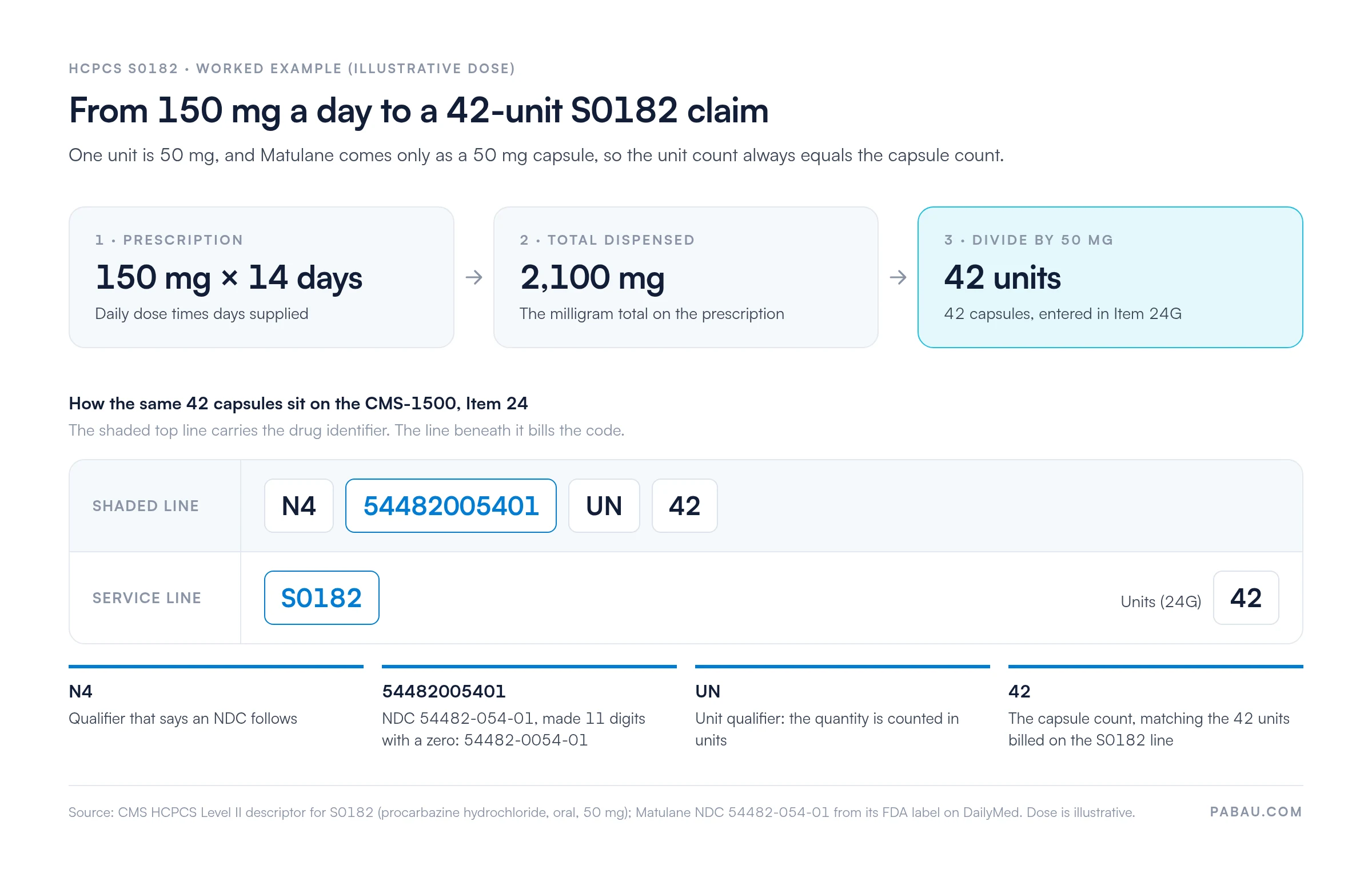
Report one unit of S0182 for every 50 mg of procarbazine dispensed. Divide the total milligrams on the prescription by 50, and enter the result in Item 24G of the CMS-1500.
Matulane comes only as a 50 mg capsule, so the unit count always equals the number of capsules. A fractional unit count means the milligram total was entered wrong.
These rows show the arithmetic only. The label doses procarbazine at 100 mg/m2 a day, and the prescriber individualizes the dose and schedule for each patient.
Most Medicaid programs and many commercial plans want the National Drug Code next to S0182. Matulane’s package NDC is 54482-054-01, a bottle of 100 capsules.
Claims use the 11-digit 5-4-2 format, so add a leading zero to the product segment to get 54482-0054-01. On the CMS-1500, the shaded top line of Item 24 carries the N4 qualifier, the NDC without hyphens, the unit qualifier and the quantity.
For 42 capsules, that line reads N454482005401 UN42, and the S0182 line beneath it bills 42 units. On an 837P, the same values go in loop 2410. Check each payer’s spacing rules for the shaded line. The worked example below traces those 42 capsules from the prescription to both claim lines.
Oral cancer drugs split into two code families. The J8 codes cover oral drugs that Medicare Part B can pay, because an injectable form of the same drug exists. The S01 codes cover oral cancer drugs without that route, which is where procarbazine sits.
One cycle of PCV shows the split on a single claim. Procarbazine bills as S0182, lomustine as S0178 and vincristine as J9370, each with its own units and NDC. PCV is an off-label use of procarbazine, so confirm the payer covers it before the first cycle.
Only Medicaid programs and commercial plans can pay S0182, and each one sets its own policy. Medicare reaches procarbazine through a different door.
Medicare does not pay S0182. CMS gives it coverage indicator I, not payable by Medicare, so Part B sets no fee for it.
The Medicare Benefit Policy Manual limits Part B to oral cancer drugs that share their active ingredient with a covered drug that is not self-administered. Procarbazine has no injectable form, so it never qualifies. Medicare patients fill it through their Part D plan as a pharmacy claim billed by NDC.
State Medicaid programs set their own S0182 policy, fee schedule and prior authorization rules. Many cover oral chemotherapy through the pharmacy benefit, so check whether the state expects a pharmacy claim rather than a medical claim. Where the state accepts S0182 on a medical claim, expect it to require the NDC.
Commercial plans that recognize S-codes may accept S0182 on a medical claim, typically from an oncology practice that dispenses in-house. Many plans route oral chemotherapy through a specialty pharmacy instead, and then the practice never bills the drug.
Confirm the benefit, the prior authorization rule and the contracted rate before the first dispense. The insurance eligibility verification check is the right moment to ask, because it happens before the drug leaves the practice.
S0182 needs a diagnosis that supports chemotherapy with procarbazine. The FDA-labeled use is Stage III or Stage IV Hodgkin lymphoma, which codes to ICD-10-CM category C81.
Code the Hodgkin lymphoma subtype and site from the pathology report rather than reaching for an unspecified code. Payers screen drug claims against the diagnosis, and a specific code gives the reviewer less to question.
A payer reviewing an S0182 claim wants to trace each capsule from the order to the bottle. Keep these records in the chart:
The capsule count in the dispensing record has to match the units on the claim. That one check catches a wrong unit count before a payer does, and it supports medical billing compliance if the claim is audited later.
S0182 denials cluster around the benefit, the NDC and the units. Each one has a fix that belongs before submission.
A clean claim on the first S0182 claim to each payer saves the most rework. After the first claim pays, the same NDC, unit math and diagnosis can repeat for later cycles. For appeals, denial management covers the workflow once a denial lands.
Before the first dispense, ask the plan one question: is oral procarbazine a medical benefit or a pharmacy benefit for this member? The answer decides whether S0182 belongs on a claim at all.
In many oncology practices, the prescription, the dispensing log and the claim live in three different places. A biller copies the NDC and capsule count by hand, which is where wrong units and missing NDCs start.
Pabau, the practice management and EHR platform we build, keeps those steps in one patient record. Prescribers approve prescriptions there, with US e-prescribing through DoseSpot. Stock carries its batch number and expiry date, and the lot is recorded against the patient and the appointment.
Pabau’s claims management software sends CMS-1500 and 837P claims through Claim.MD, with eligibility checks and ERA remittances in the same workflow. Prior authorization codes, dates and sessions sit on the patient’s case, and Pabau warns staff when one is missing.
The result is a claim built from what the practice dispensed. The units match the capsules, the NDC matches the bottle, and the authorization is on file before the claim leaves.

Pabau keeps the prescription, the stock lot and the claim in one record, so S0182 units, NDCs and prior authorizations match what the practice dispensed.

Treat S0182 as a drug code first and a claim second. Bill it only after the payer confirms that oral procarbazine is a medical benefit, and send Medicare patients to their Part D pharmacy.
Once the benefit question is settled, three details decide payment. The units must equal the capsules dispensed, the NDC must match the bottle, and the diagnosis must support the regimen. Book a demo to see how Pabau carries those details from the prescription to the claim.

Sending oral drug claims through a clearinghouse? Medical claims clearinghouse guide explains how clearinghouses validate and route HCPCS claims before they reach the payer.
Working an S0182 denial? Denial codes in medical billing breaks down the CARC and RARC codes behind drug claim denials and how to appeal each one.
Need a superbill for an out-of-network patient? Superbill guide covers how to structure a superbill that lists HCPCS codes alongside diagnosis codes.
Billing an antiemetic with the regimen? HCPCS code S0183 is the billing guide for oral prochlorperazine 5 mg, another S-code drug.
Reporting another oral alkylating agent? HCPCS code S0172 is the billing guide for oral chlorambucil from the same S-code range.
HCPCS code S0182 is the Level II code for procarbazine hydrochloride, oral, 50 mg. It reports the oral chemotherapy drug procarbazine, sold as Matulane capsules, with one 50 mg capsule per unit.
No. CMS assigns S0182 coverage indicator I, not payable by Medicare. Part B covers oral cancer drugs only when an injectable version of the same drug exists, and procarbazine has none. Medicare patients fill it through Part D at the pharmacy.
Bill one unit for every 50 mg dispensed, which is one unit per capsule. A 14-day supply of 150 mg a day is 2,100 mg, or 42 units.
Matulane’s NDC is 54482-054-01, a bottle of 100 capsules. Enter it on the claim in 11-digit form, 54482005401, with the N4 qualifier, the UN unit qualifier and the capsule count.
No. S0182 reports oral procarbazine only. Cervical cancer screening is billed with G0101, Q0091, P3000, P3001, G0123, G0124 and CPT codes 88141 to 88175.
The FDA-labeled use is Stage III or Stage IV Hodgkin lymphoma, coded in ICD-10-CM category C81 with the subtype and site. Off-label uses, such as the PCV regimen for some brain tumors, need payer policy support. Z79.630 can be added for ongoing alkylating agent therapy.
The nearest codes are the other oral cancer S-codes, such as S0178 for lomustine and S0172 for chlorambucil. Oral chemotherapy that Medicare Part B covers uses J8 codes, such as J8560 for etoposide and J8700 for temozolomide.




