HCPCS Code L0472: Hyperextension TLSO billing guide
HCPCS code L0472: Official descriptor and device definition HCPCS code L0472 des...

Last Updated: Nov 5, 2026
L2038 is the HCPCS Level II code for a custom-fabricated, full plastic knee ankle foot orthosis (KAFO) with a multi-axis ankle. The knee may or may not be free motion.
The multi-axis ankle sets it apart from L2036 and L2037, the double- and single-upright full plastic KAFOs. L2034 adds medial lateral rotation control, and L2035 is the range's only prefabricated, pediatric-size KAFO. Medicare covers L2038 under LCD L33686 when an ambulatory beneficiary qualifies for an AFO and needs additional knee stability.
Let Pabau's smart automation suggest the right codes, reduce claim denials, and keep your practice compliant—effortlessly.
Automate repetitive tasks and focus on what matters most—your patients.
Reduce coding errors and ensure compliance with the latest regulations.
Clean claims, fewer denials, and faster reimbursements.
Powerful insights and reporting to help your practice thrive.
HIPAA compliant SOC 2 certified GDPR-compliant Trusted by 4,000+ clinics worldwide

HCPCS Code L2038 is a custom-fabricated, full plastic knee ankle foot orthosis (KAFO) with a multi-axis ankle, with or without a free motion knee.
The multi-axis ankle separates L2038 from L2036 and L2037, and custom fabrication separates it from L2035, the prefabricated pediatric KAFO.
LCD L33686 covers L2038 for an ambulatory beneficiary who qualifies for an AFO, needs extra knee stability and meets one custom-fabrication criterion.
Policy Article A52457 specifies no covered ICD-10 codes for L2038, and no Certificate of Medical Necessity applies.
Add KX only when every coverage criterion is met and the evidence is on file, and put RT or LT on every line.
L2038 is on the CMS Master List but needs no prior authorization, and Medicare pays it from the DMEPOS fee schedule.
HCPCS Code L2038 describes a custom-fabricated, full plastic knee ankle foot orthosis (KAFO) with a multi-axis ankle. The official CMS descriptor reads “Knee ankle foot orthosis, full plastic, with or without free motion knee, multi-axis ankle, custom fabricated.”
A KAFO spans the thigh, knee, lower leg, ankle and foot. That makes L2038 a different device from an ankle-foot orthosis (AFO), which stops below the knee and is coded in the L1900 range. Those AFO codes sit beside L2038 in our full HCPCS code library, so you can compare descriptors side by side.
The descriptor fixes three features: a full plastic build, a multi-axis ankle joint and custom fabrication. The knee joint can be free motion or not, and the descriptor names no upright count. L2038 sits in the HCPCS Level II code set that CMS maintains, inside the L2000-L2038 KAFO range.
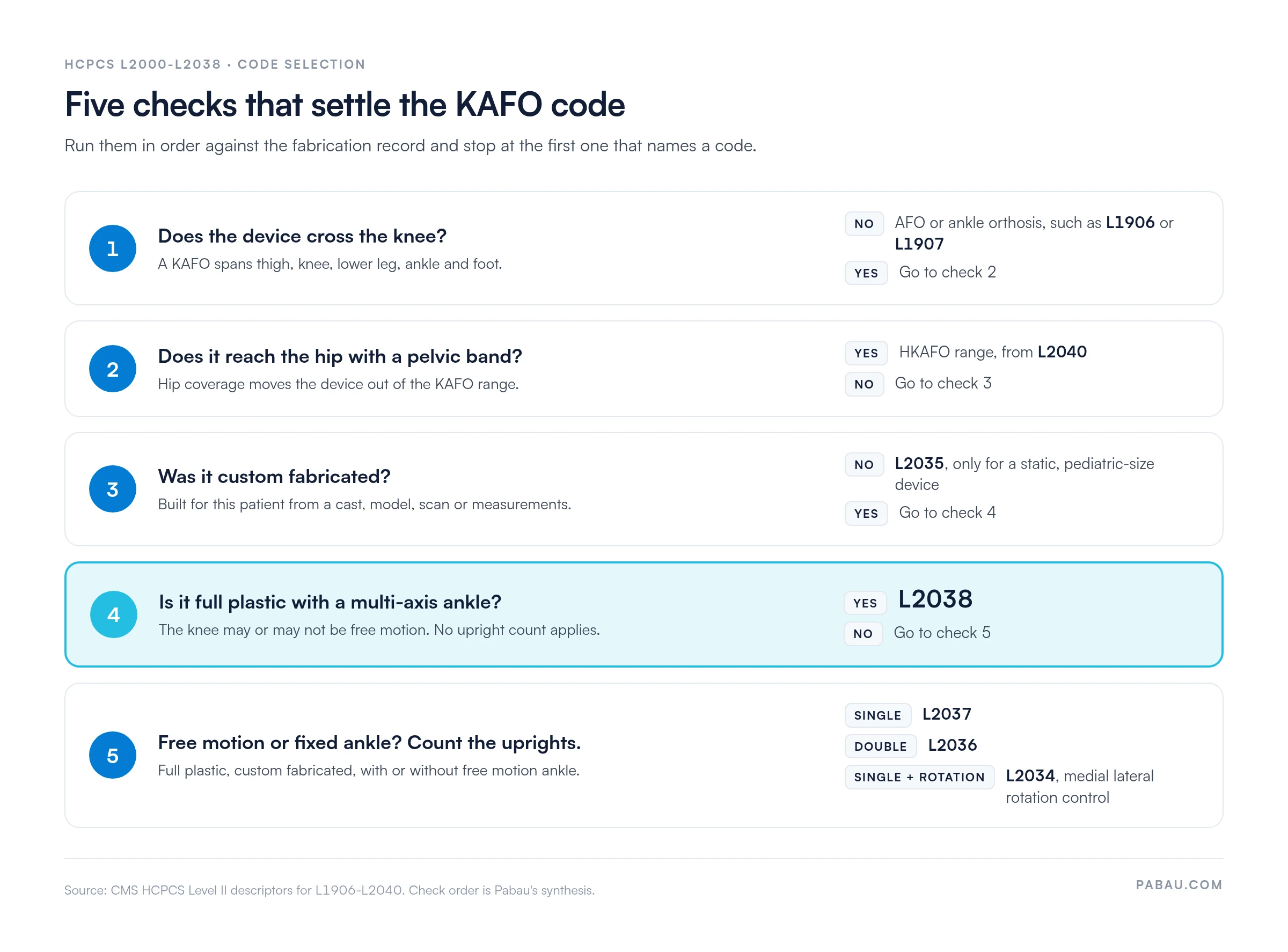
Fabrication method, upright count and ankle type separate the codes in the L2000-L2038 KAFO range. Only L2035 mentions size, as the range’s one prefabricated, pediatric KAFO. Knee function is a fourth axis. L2005 is the stance control KAFO, with a knee that locks under load and releases for swing.
Check descriptors against the orthotist’s fabrication record, not the order alone.
Work through these checks in order.
Medicare covers L2038 under LCD L33686 (Ankle-Foot/Knee-Ankle-Foot Orthosis), which the DME MACs publish. A KAFO is covered for an ambulatory beneficiary who qualifies for an AFO and needs additional knee stability. Coverage is functional, so the medical record has to show both conditions.
The AFO test comes first. The beneficiary must be ambulatory, with weakness or deformity of the foot and ankle, and must meet both of these conditions:
Because L2038 is custom fabricated, the record must also meet at least one of the five criteria the LCD sets for custom AFOs and KAFOs:
The multi-plane criterion often fits L2038 well, since a multi-axis ankle exists to control motion in more than one plane. Name the criterion that applies in the treating practitioner’s notes rather than leaving the reviewer to infer it.
There is no covered-diagnosis list behind these rules. Policy Article A52457 specifies ICD-10 codes only for a few static AFO and interface codes. For L2038 and the rest of the KAFO range, diagnoses are not specified.
A KAFO that fails the basic criteria is denied as not reasonable and necessary. So is a custom-fabricated KAFO that meets the basic test but none of the five custom criteria.
Policy Article A52457 defines a custom fabricated item as “one that is individually made for a specific patient.” A prefabricated orthosis is “manufactured in quantity without a specific beneficiary in mind,” even when the supplier trims, bends or heats it to fit.
L2038 is a custom code, so the device has to be built for this beneficiary from a cast, a model, a scan or measurements. Billing it for a stock device that was adjusted at delivery is incorrect coding. Within the KAFO range, the only prefabricated code is L2035, and its descriptor is a static, pediatric-size device.
Keep the fabrication evidence in the file: the cast or scan record, the measurement sheet and the fitting notes. An auditor asks for these first on a custom KAFO claim.
The supplier needs a complete record before the claim goes out. Following billing compliance requirements at each step keeps that record whole at delivery, not rebuilt during an audit.
The SWO must reach the supplier before the claim is submitted. A claim billed without a completed SWO is denied as not reasonable and necessary.
No Certificate of Medical Necessity (CMN) applies to L2038. The CMS master list also shows that it does not need a face-to-face encounter or a written order prior to delivery.
Policy Article A52457 sets the modifier rules for AFO and KAFO codes. The KX modifier attests that every coverage criterion is met and that evidence of it is retained in the supplier’s file.
A bilateral pair goes on two lines, one with RT and one with LT. Never add KX to move a claim through when the record does not support it. The modifier is an attestation, and it is checked against the file on review.
The KX, GA and GZ rules are Medicare rules. Commercial and Medicaid plans set their own modifier requirements, so check each payer’s policy.
Medicare pays L2038 from the CMS DMEPOS fee schedule, not the Physician Fee Schedule. CMS publishes the schedule as quarterly files that list a fee for each state, with national floor and ceiling limits.
Look up L2038 in the current quarter’s file for the beneficiary’s state, and quote any figure with its state, quarter and source. Orthoses are bought outright, so the purchase fee is the one to read.
Medicare pays 80% of the allowed amount after the Part B deductible. The beneficiary owes the remaining 20% coinsurance, which a supplemental plan may cover.
Custom-fabricated orthoses sit outside the DMEPOS Competitive Bidding Program, which can include only off-the-shelf orthoses. The standard fee schedule applies wherever the supplier is located.
L2038 does not require Medicare prior authorization. It appears on the CMS Master List of DMEPOS items that could face conditions of payment. CMS has not placed it on the Required Prior Authorization List.
CMS announces each addition to the required list in advance, so check the master list entry before each order. Commercial plans and state Medicaid programs set their own authorization rules. Where a plan requires approval, deliver the KAFO only after it is confirmed in writing.
LCD L33686 binds Medicare claims only. Running insurance eligibility verification before fabrication starts is the most useful single step for other payers. A custom KAFO cannot be restocked if a plan refuses it.
Most L2038 denials trace back to the code choice or the file behind it. Structured denial management strategies catch these patterns before submission.
A custom KAFO claim depends on a chain of records. It runs from the order and the practitioner’s notes to the cast or scan, the fitting notes and the proof of delivery. When one link is missing, the problem tends to surface months later in a review.
Pabau, the practice management software we build, keeps that chain in the patient’s record. Its claims management software helps your team prepare claims from the data already on file, submit them and track their status until payment posts.
Your billing team still decides whether a claim meets LCD L33686 and carries KX. Pabau keeps the evidence for that decision in one place, so your team can answer an audit request from a single record.

Pabau keeps orders, fitting notes and delivery records on the patient record, and helps your team prepare, submit and track orthotic claims.

L2038 is a KAFO code, and the multi-axis ankle is what earns it. Confirm that the device crosses the knee, was custom fabricated and has that ankle before anyone codes it. That check prevents the costliest coding error for this device.
The claim then rests on the file. Most L2038 claims go through with a signed SWO and RT or LT on each line. The notes must also meet LCD L33686 and name a custom-fabrication criterion. Book a demo to see how Pabau keeps your orthotic records together, so each claim goes out with its evidence attached.

Need to understand how clearinghouses handle DMEPOS claims? How a medical claims clearinghouse works explains the EDI transmission path from supplier to payer.
Looking for a denial management framework? Denial management in healthcare covers root-cause categorization and appeal workflows.
Want to understand the full revenue cycle behind DMEPOS billing? What is revenue cycle management maps each stage from patient intake to payment posting.
Billing a single-upright KAFO with rotation control? HCPCS Code L2034 covers the custom full plastic KAFO with medial lateral rotation control.
HCPCS Code L2038 covers a custom-fabricated, full plastic knee ankle foot orthosis (KAFO) with a multi-axis ankle, with or without a free motion knee. It is not an ankle-foot orthosis code, because the device spans the knee, ankle and foot.
L2038 requires a multi-axis ankle and names no upright count. L2037 is the single-upright full plastic KAFO, and L2036 is the double-upright version, both with or without a free motion ankle.
No. L2035 is the only prefabricated code in the L2000-L2038 KAFO range, and it describes a static, pediatric-size device without a free motion ankle. A prefabricated KAFO is never billed as L2038.
Policy Article A52457 specifies no covered ICD-10 codes for L2038. Coverage rests on the functional criteria in LCD L33686, so the record must show why the beneficiary needs a custom KAFO.
No. L2038 is on the CMS Master List of items that could be selected for prior authorization. It is not on the Required Prior Authorization List. It also needs no face-to-face encounter or written order prior to delivery.