CCSD code H4430: Examination of rectum under anaesthetic
CCSD code H4430 pays for the examination alone CCSD code H4430 is the UK private...

Last Updated: Oct 20, 2026
L2037 is the HCPCS Level II code for a custom-fabricated, full plastic, single-upright knee ankle foot orthosis (KAFO). It applies with or without a free motion knee and with or without a free motion ankle.
L2037 sits in the KAFO range L2000-L2038, next to L2036, its double-upright counterpart. Medicare covers it under LCD L33686, and every claim carries the KX modifier to attest that the documentation meets the policy.
Let Pabau's smart automation suggest the right codes, reduce claim denials, and keep your practice compliant—effortlessly.
Automate repetitive tasks and focus on what matters most—your patients.
Reduce coding errors and ensure compliance with the latest regulations.
Clean claims, fewer denials, and faster reimbursements.
Powerful insights and reporting to help your practice thrive.
HIPAA compliant SOC 2 certified GDPR-compliant Trusted by 4,000+ clinics worldwide

HCPCS Code L2037 covers a custom-fabricated, full plastic, single-upright KAFO, with or without free motion knee and ankle joints.
L2036 is the double-upright counterpart to L2037, and L2038 is the full plastic KAFO with a multi-axis ankle.
Medicare coverage follows LCD L33686, which requires a neurological or musculoskeletal deficit that prevents safe walking without the orthosis.
The KX modifier goes on every Medicare claim to attest that documentation meeting the LCD is on file.
L2037 needs no Medicare prior authorization today and sits outside competitive bidding, so the standard DMEPOS fee schedule applies.
HCPCS Code L2037 describes a custom-fabricated, full plastic knee-ankle-foot orthosis (KAFO) with a single upright. The official descriptor adds “with or without free motion knee, with or without free motion ankle.”
The knee and ankle joints therefore don’t change the code. Construction, upright count and fabrication method do. If any one of them doesn’t match the device, the code is wrong.
L2037 sits within the HCPCS Level II L-code series, which CMS maintains for DME, orthotics, and prosthetics. The L2000-L2999 range covers lower-limb orthoses, with KAFO codes clustered in the L2000-L2038 band. Our HCPCS code reference covers the neighboring L-codes in that band.
L2036 is the most common misselection when billing L2037. Both are custom-fabricated, full plastic KAFOs with or without free motion knee and ankle joints. L2037 has a single upright and L2036 has two, and that one structural difference changes the code and the reimbursement rate.
Five checks against the orthotist’s fabrication record separate L2037 from its neighbors. The order below rules out the more specific codes first, so the upright count is the last question you answer.
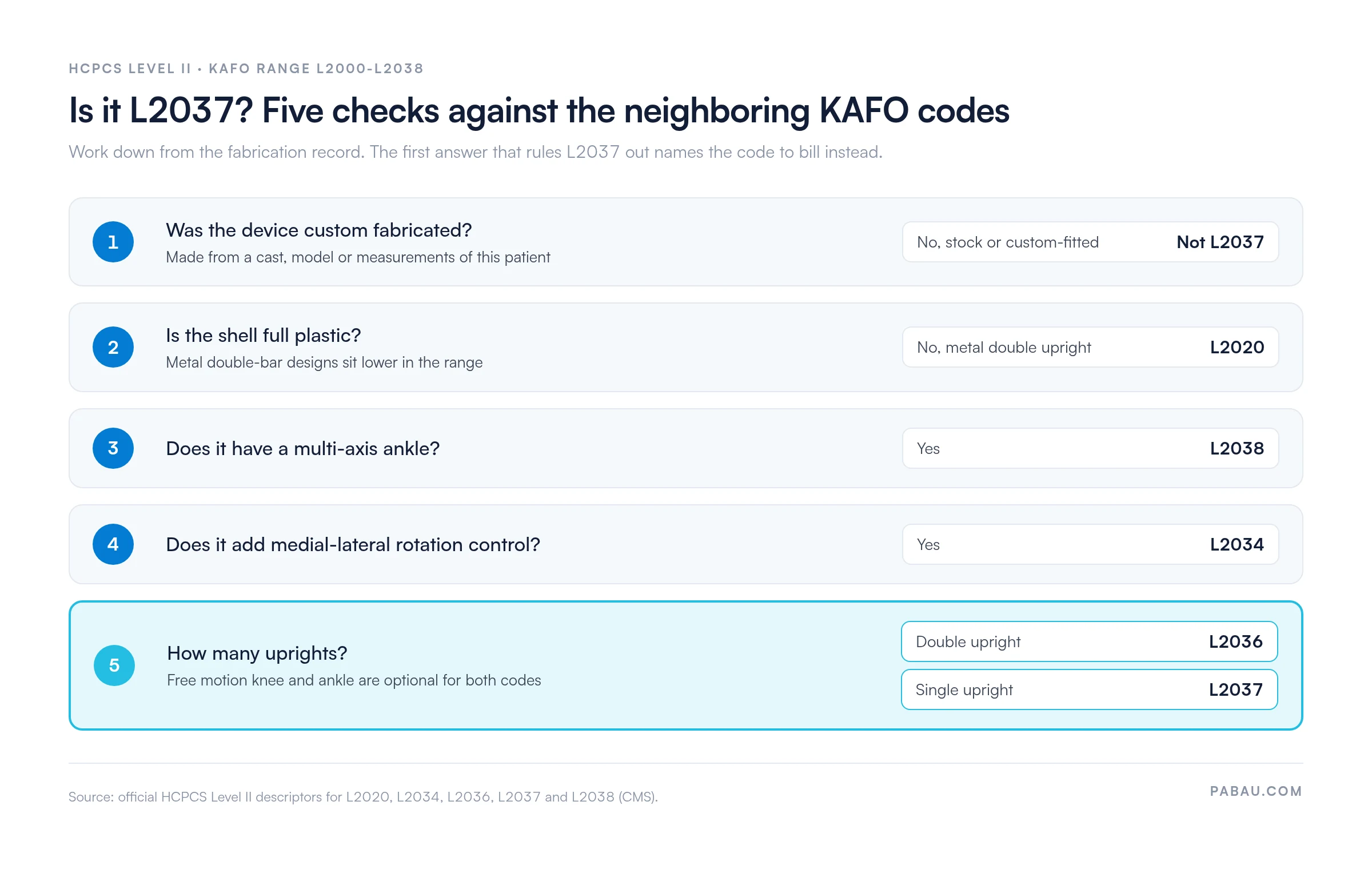
Beyond the L2037/L2036 pair, the KAFO range contains several adjacent codes that coders encounter in the same patient populations. The comparison below covers the codes most likely to appear alongside L2037 in a KAFO billing review.
Review the AAPC HCPCS code lookup to cross-reference adjacent codes and verify the correct descriptor before submitting. When the orthosis has two uprights, L2036 is the correct code regardless of how the ordering clinician described the device. A single-upright device that adds medial-lateral rotation control belongs under L2034 instead.
Medicare coverage for HCPCS Code L2037 is governed by LCD L33686 (Ankle-Foot/Knee-Ankle-Foot Orthoses). The applicable DME MAC issues this Local Coverage Determination, which is Noridian or CGS depending on jurisdiction. The LCD sets the indications, limitations, and documentation standards that a claim must satisfy before Medicare will pay.
To meet LCD L33686 coverage criteria, the patient must have a qualifying diagnosis and a functional deficit that the orthosis directly addresses. The key conditions include:
The LCD also sets absolute exclusions. A KAFO is not covered for cosmetic purposes or for conditions an AFO manages adequately.
Nor is it covered for non-ambulatory patients who will not use the device for functional mobility. Billing L2037 without a documented qualifying diagnosis that maps to the LCD indications is the most straightforward route to a coverage denial.
Noridian administers DME Jurisdictions A and D, and CGS administers Jurisdictions B and C in the remaining states. Confirm which DME MAC covers your supplier’s location. Then cite the active revision of LCD L33686 and its policy article, not a cached copy.
L2037 is a custom-fabricated code. The orthosis must be individually made from raw materials or a base, then measured and fitted directly to the patient. A stock item sold from a catalog does not qualify. Billing L2037 for a device that was pulled from a shelf and adjusted for fit is an audit trigger and a denial waiting to happen.
The PDAC (Pricing, Data Analysis and Coding contractor) is the CMS-designated body that issues product verification for HCPCS orthotic codes. It publishes a list of the products coded to each HCPCS code.
If a product appears on the PDAC list for a prefabricated code, billing it under L2037 misrepresents the device. Coders should verify fabrication status through the PDAC before assigning the code to any commercially manufactured KAFO.
Medicare requires a specific documentation set for HCPCS Code L2037 before a claim is payable. Incomplete records are one of the most common causes of post-payment audit recoupment for orthotic suppliers. Following billing compliance requirements for each required document keeps the record complete at the time of delivery.
The minimum required documentation includes:
Since January 1, 2020, CMS final rule CMS-1713-F has replaced the DWO and WOPD with a single Standard Written Order for DMEPOS items. Medicare needs the SWO on file before the claim is submitted.
Items on the CMS Required Face-to-Face Encounter and Written Order Prior to Delivery List need it before delivery. Holding delivery until the signed SWO arrives keeps the file complete either way.
Medicare DMEPOS billing for L2037 requires specific modifiers on every claim. Omitting a required modifier results in an automatic denial without review of the underlying documentation. Submitting a clean claim means verifying modifier placement before transmission, not during an appeal.
The KX modifier is Medicare-specific. Commercial payers have their own modifier requirements that may differ. Always verify modifier rules against each payer’s policy before submitting, particularly for Medicaid managed care plans that administer DMEPOS benefits differently than traditional Medicare.
Medicare reimburses L2037 under the DMEPOS fee schedule, which CMS updates every January 1 and revises quarterly. Allowed amounts differ by state, so a supplier in Mississippi receives a different allowable than one in New York for the same code. Quote a figure only with its state, year and source, because the amounts change with each update.
Use the CMS DMEPOS fee schedule to find the current allowed amount for L2037. CMS publishes it as quarterly files that list each code’s fee amounts by state, along with the floor and ceiling. L2037 KAFO devices are typically billed as a purchase rather than a rental, so the purchase amount is the one to read.
Medicare pays 80% of the allowed amount after the beneficiary’s Part B deductible. The remaining 20% is the beneficiary’s coinsurance, which a supplemental plan may cover.
Custom-fabricated codes like L2037 are excluded from the DMEPOS Competitive Bidding Program, which currently covers only off-the-shelf back and knee braces. The standard fee schedule applies wherever the supplier is located.
L2037 does not currently require Medicare prior authorization. CMS lists the code on the DMEPOS Master List, a watch list of items that could be selected for prior authorization later.
Only codes on the Required Prior Authorization List need approval before delivery, and CMS announces each addition in advance. Check that list on the CMS website before each order rather than relying on cached guidance.
If CMS moves L2037 onto the required list, or a commercial plan requires approval, the process works as follows:
Where prior authorization applies, delivering the KAFO before an affirmation leaves the supplier liable for the full cost of the device. Commercial payers set their own prior authorization rules, so verify each plan’s DMEPOS policy separately.
The PGM Billing HCPCS lookup tool can help confirm payer-specific modifier and authorization requirements during pre-submission checks.
Most L2037 claim denials are preventable. They fall into a small set of recurring categories, each with a specific corrective action. Using structured denial management strategies before submission eliminates the majority of these before they become appeals.
Billing HCPCS Code L2037 means managing a documentation chain that runs from the physician order through delivery and claim submission. Each step leaves a record that has to be in the file before Medicare pays. When one is missing, the denial tends to arrive months after delivery, when the clinical record is harder to reconstruct.
Pabau, the practice management and claims platform we build, keeps that chain inside one patient record. Its orthotic claims management tools hold clinical notes, delivery records and modifier checklists together. You can pull a complete file for an audit or an appeal without chasing paperwork across systems.
Understanding medical billing workflows end to end, from order to ERA posting, is where most orthotic billing errors are caught before they become denials. Pabau supports that full workflow for practices managing DMEPOS claims alongside clinical visit billing.

Pabau’s claims management tools help DME and orthotic providers track documentation requirements, manage modifier workflows, and keep records audit-ready for HCPCS L-code claims.

HCPCS Code L2037 rewards precision at the coding desk. Check upright count, ankle type and fabrication method against the orthotist’s record before you code, and most adjacent-code denials never happen.
The paperwork deserves the same discipline. Most L2037 claims clear the first time with three things in place. You need a signed standard written order on file, a KX modifier backed by LCD-qualifying notes, and a laterality modifier on every line. Collecting a missing document up front costs far less than an appeal months later.
Book a demo to see how Pabau keeps orthotic documentation, modifiers and delivery records together, so your L2037 claims go out complete.

Billing KAFO codes alongside rehabilitation therapy visits? Medical billing fundamentals explains how DME and procedure billing interact in a single-payer workflow.
Want audit-ready documentation for HCPCS L-code claims? Billing compliance requirements outlines the record-keeping standards that apply to DMEPOS suppliers under Medicare.
HCPCS Code L2037 covers a custom-fabricated, full plastic, single-upright knee-ankle-foot orthosis (KAFO), with or without free motion knee and ankle joints. Prefabricated devices, double-upright KAFOs and KAFOs with a multi-axis ankle each use a different code.
L2038 is a full plastic KAFO with a multi-axis ankle joint, while L2037 specifies a single upright with or without a free motion ankle. When the difference is upright count, the counterpart to L2037 is L2036, the double-upright version.
The KX modifier is required on every Medicare claim for L2037 to attest that documentation meeting LCD criteria is on file. Either LT (left) or RT (right) must also be appended to indicate which limb received the device. The GA modifier is added when an ABN is on file and coverage may be denied.
No, L2037 does not currently require Medicare prior authorization. CMS lists it on the DMEPOS Master List, a watch list of items that could be selected later. Check the Required Prior Authorization List before each order, and confirm commercial plans’ rules separately.
The most common denial reasons are a missing KX modifier and documentation that does not satisfy LCD L33686 criteria. Billing a prefabricated device under a custom-fabrication code and a missing or incomplete standard written order follow close behind. Each denial carries a remittance advice remark code that identifies which element of the claim failed.
LCD L33686 (Ankle-Foot/Knee-Ankle-Foot Orthoses) governs Medicare coverage for L2037. The LCD is issued by the applicable MAC (Noridian or CGS, depending on jurisdiction). It sets the covered diagnoses, functional criteria, and documentation requirements that a payable claim must satisfy.