

CCSD code G5100: Bypass of duodenum billing guide
CCSD code G5100 bills a bypass that leaves the duodenum in place CCSD code G5100...

Last Updated: Oct 16, 2026
L2035 is the HCPCS Level II code for a prefabricated pediatric knee ankle foot orthosis (KAFO). The full descriptor reads: full plastic, static (pediatric size), without free motion ankle, prefabricated, includes fitting and adjustment.
It is the only prefabricated code in the L2000-L2038 KAFO range, and the only one carrying a size qualifier. Every other full-plastic KAFO code in that range is custom fabricated, so how the device was built decides the code.
Let Pabau's smart automation suggest the right codes, reduce claim denials, and keep your practice compliant—effortlessly.
Automate repetitive tasks and focus on what matters most—your patients.
Reduce coding errors and ensure compliance with the latest regulations.
Clean claims, fewer denials, and faster reimbursements.
Powerful insights and reporting to help your practice thrive.
HIPAA compliant SOC 2 certified GDPR-compliant Trusted by 4,000+ clinics worldwide

HCPCS Code L2035 describes a prefabricated, full plastic, static pediatric-size KAFO without free motion at the ankle. The code also bundles fitting and adjustment.
L2035 is the only prefabricated code in the L2000-L2038 KAFO range and the only one carrying a size qualifier. In contrast, suppliers custom-fabricate every other full-plastic KAFO device in the range.
Coverage rests on LCD L33686 and its functional test. The beneficiary must be ambulatory, qualify for an ankle-foot orthosis, and need additional knee stability.
Policy Article A52457 publishes no covered-diagnosis list for L2035. It states that it does not specify diagnoses for codes outside its two named groups, so the clinical record carries the argument.
Practice management software like Pabau keeps the order, the clinical notes, the product description and the proof of delivery on one patient record. That is what an audit request asks for.
HCPCS Code L2035 is the Healthcare Common Procedure Coding System Level II code for a prefabricated pediatric knee-ankle-foot orthosis. The full descriptor reads: full plastic, static (pediatric size), without free motion ankle, prefabricated, includes fitting and adjustment. CMS publishes and maintains it as part of the HCPCS Level II code set, and it belongs to the L-code series covering orthotic devices.
In practice, breaking down the descriptor makes the billing rules clearer. Each term is a coding gate: if the device dispensed does not match all of them, a different code applies.
In fact, the codes sitting around L2035 do not differ from it by patient size. They differ by fabrication method, by upright count, and by what movement the knee and ankle joints allow. L2035 stands alone on the first of those axes, because it is the only prefabricated code in the range.
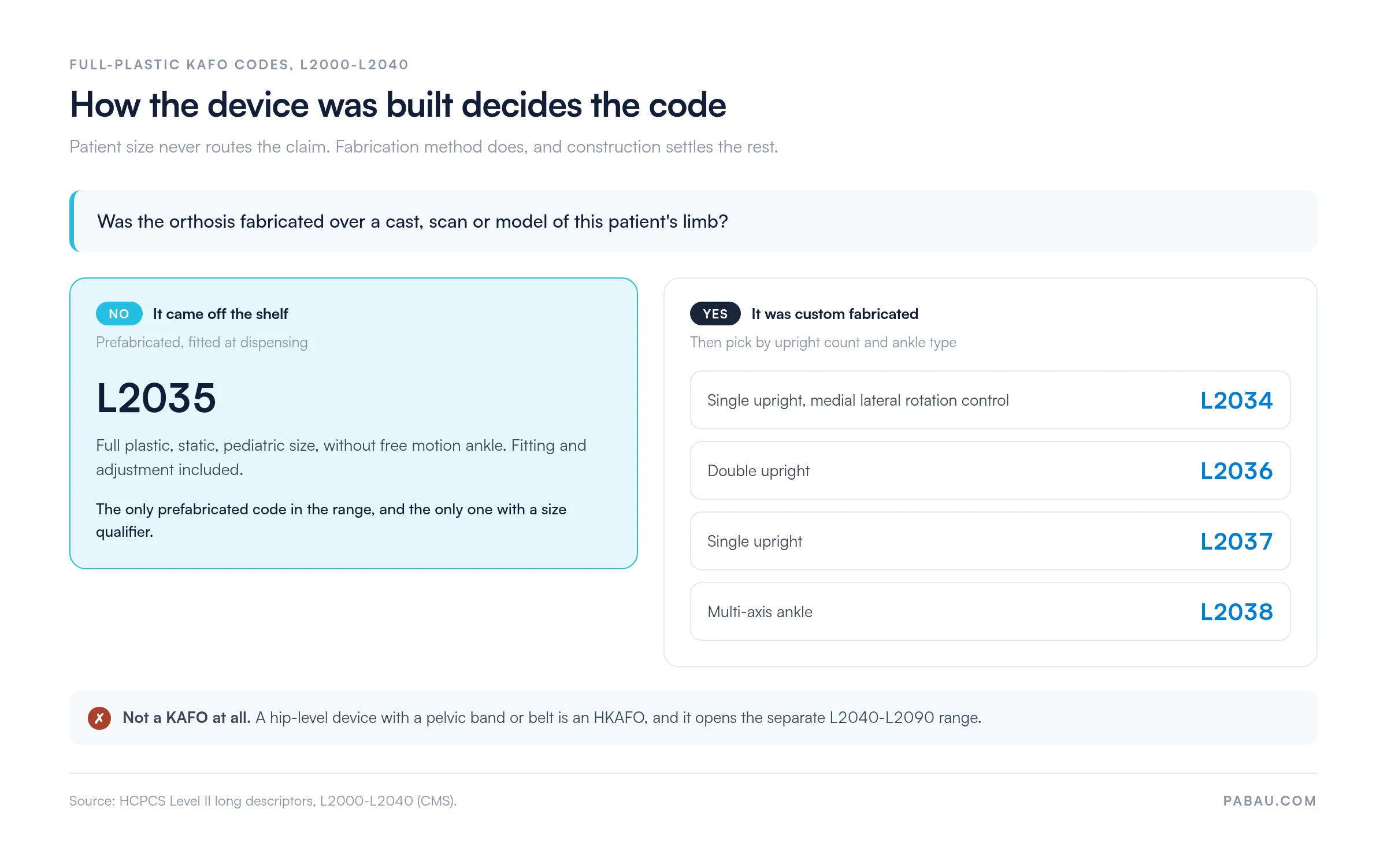
Use the comparison below to confirm the correct code before billing. Read it from the fabrication column first, then the construction columns.
Three rules follow from that table. The first is that patient age never decides the code. What decides it is whether the device came off the shelf or a technician fabricated it over a model of this patient’s limb. A custom-fabricated full-plastic KAFO codes to L2034, L2036, L2037 or L2038 depending on upright count and ankle type.
The second is that no prefabricated adult equivalent of L2035 exists in this range. When a clinician fits an adult with a full-plastic KAFO, the code follows how the manufacturer built the device. The size qualifier only narrows L2035; it never routes a claim to a sibling code.
The third is that L2040 is not a KAFO at all. It opens the separate HKAFO range, L2040 to L2090. Those codes cover hip-knee-ankle-foot orthoses with a pelvic band or belt, and they require hip-level involvement. Billing one for a device that stops at the thigh is an anatomical mismatch rather than a size or fabrication mismatch.
A device that spans the trunk as well moves further still, into the THKAO group. Its mobility-frame code, L1500, was deleted on January 1, 2012, so a current claim needs a different code.
The remaining L2000 to L2030 codes cover conventional custom-fabricated designs built on metal uprights rather than a plastic shell. The diagram below runs the same checks in the order a coder applies them.
Medicare Part B covers HCPCS Code L2035 as a DMEPOS item under the braces benefit. The coverage rules sit in LCD L33686, Ankle-Foot/Knee-Ankle-Foot Orthosis, and the test it applies is functional rather than diagnostic. Medicare covers a KAFO for an ambulatory beneficiary who qualifies for an ankle-foot orthosis and who needs additional knee stability.
The core requirements behind that test are:
Prior authorization applies to a defined list of DMEPOS codes rather than to the L-code series as a whole, and CMS updates that list periodically. Check the current CMS required prior authorization list, and your own MAC’s guidance, before dispensing a high-cost orthosis.
A claim that CMS publishes a covered-diagnosis list for L2035 circulates widely, and it is wrong. Policy Article A52457 does carry ICD-10 coverage groups, but each group applies only to specific named HCPCS codes. Group 1 applies to L4392, L4396 and L4397. Group 2 applies to L4631.
For all other codes, A52457 states plainly that it does not specify diagnoses. L2035 and the rest of the L2000-L2038 range fall into that second bucket.
That changes where you have to make the medical necessity argument. There is no approved list to match a claim against. Instead, the functional findings in the record defend the claim. A reviewer needs to see an ambulatory beneficiary, a covered AFO, and a knee that needs more stability than the AFO gives.
The conditions below are common clinical reasons a clinician fits a child with a KAFO. They are illustrative only, they are not a CMS covered list, and none of them makes a claim payable on its own. Even so, suppliers should confirm the documented diagnosis against the treating practitioner’s notes before the claim goes out.
Pair the ICD-10-CM code the treating practitioner documented with notes describing the functional deficit. A specific diagnosis with no functional narrative fails review for the same reason a vague one does. Simply put, the reviewer cannot see why this patient’s knee needs support.
Do not spend time hunting for an approved diagnosis list for L2035, because A52457 does not publish one. Spend it on the practitioner’s notes instead. They should state that the patient is ambulatory, that the patient qualifies for an ankle-foot orthosis, and what happens at the knee without additional support. Those three findings are what a reviewer looks for.
Overall, DMEPOS suppliers carry a heavier documentation burden than most provider types. CMS expects the supplier to hold a complete file before submitting the claim, not merely before an audit. Orthotic recoupments usually trace back to an incomplete file rather than a wrong code, which is why medical billing compliance is a records discipline first. Every L2035 claim file should contain:
A checklist mapped to the documentation requirements in LCD L33686 and Policy Article A52457 cuts the risk that a post-payment audit ends in recoupment. Build it once, then work through it before every device leaves the shelf.
Medicare reimburses HCPCS Code L2035 under the DMEPOS fee schedule, which CMS publishes annually and revises quarterly. Allowable amounts vary by state and locality, so no single national figure applies. The physician fee schedule does not price this code, and looking it up there is a common source of wrong expectations.
For the current L2035 allowable applicable to your supplier location:
When an L2035 claim pays below the expected allowable, read the adjustment reason codes on the electronic remittance advice before reworking it. They show whether the variance is a fee schedule difference or a claim edit. A locality difference needs no appeal, while a claim edit does.
Medicare pays 80% of the allowable amount once the patient meets the annual deductible. The remaining 20% coinsurance falls to the patient unless supplemental coverage or Medicaid pays on their behalf. The supplier bills its full charge rather than a discounted rate, with the modifiers described below.
The sequence below keeps the file complete in the order a reviewer expects to see it. In practice, most L2035 denials trace back to a step taken out of order rather than to a step skipped entirely.
Preventing an L2035 denial starts with knowing which errors MACs flag most often. In short, the table below maps the leading denial reasons to their corrective actions.
Reading the remittance against the published denial codes narrows the investigation when an L2035 claim comes back. The CARC shows whether the denial is a medical necessity, coding or eligibility issue. Each one calls for a different appeal, so classify it before anyone starts rewriting the file.
L2035 is explicitly a prefabricated code. The manufacturer builds the device to standard sizes, ships it from inventory, and a clinician fits it to the patient at the point of dispensing. For every other full-plastic KAFO code in the range, a technician custom-fabricates the device over a model of the patient’s limb. Put another way, LCD L33686 does not treat the two routes as interchangeable.
Under that LCD, a custom-fabricated KAFO qualifies for coverage only where the record documents at least one of these findings:
Without one of those findings, the prefabricated item is the covered option. In practice, the distinction carries compliance consequences beyond picking the wrong code. Billing a custom-fabricated device under a prefabricated code understates what the supplier actually provided, and the reverse overstates it. Custom codes carry higher allowables, so the second direction creates False Claims Act exposure when the misclassification is systematic.
The phrase “includes fitting and adjustment” in the L2035 descriptor means the supplier adapts the prefabricated device to the patient at dispensing. The supplier adjusts straps, trim lines and position, and none of that is custom fabrication.
CGS Medicare guidance draws the line clearly. Fitting adjusts a stock item to the individual, while fabrication creates the item from raw materials or a patient-specific model. In fact, conflating the two is the misclassification auditors identify most often in KAFO reviews.
Because the descriptor bundles fitting and adjustment into HCPCS Code L2035, no separate fitting code is billable on the same date of service. In other words, billing one alongside L2035 is duplicate billing. Beyond that core rule, the modifier and bundling considerations below apply to L2035 claims.
You generally cannot bill L2035 alongside another orthotic code covering the same anatomical region on the same date of service. Where a patient receives an ankle-foot orthosis on the same limb, the rationale has to show why both devices are necessary.
That scenario is uncommon and draws close scrutiny. Confirm bundling restrictions with your MAC before billing multiple orthotic codes for one patient on one date.
In most orthotic practices the L2035 file lives in three places at once. The order sits in a paper tray or a fax folder. The evaluation notes sit in the clinical record, and the product description and delivery receipt sit with the supplier. When a MAC asks for the file, someone spends a day reassembling it.
Typically, the piece that turns out to be missing is the functional narrative that justified the knee support.
Essentially, Pabau is practice management software that keeps all of it on one patient timeline. The evaluation note, the order, the product description, the fitting record and the proof of delivery attach to the same record. Responding to a documentation request then means exporting a file rather than rebuilding one.
Claims move out through claims management software and the Claim.MD integration, and the ERA comes back against the same record.
For a pediatric caseload that also keeps the replacement cycle visible. Children outgrow a KAFO, and each replacement needs its own order and its own justification. A shared timeline shows when the practice last dispensed the device before anyone quotes a new one.

Pabau helps DMEPOS suppliers and orthotic practices manage documentation requirements, track claim status, and submit clean claims through integrated clearinghouse connections. See how it works for your practice.

HCPCS Code L2035 is a narrow code: prefabricated, full plastic, static ankle, pediatric size, fitting included. In short, the word doing the most work there is prefabricated. As a result, it separates L2035 from every custom-fabricated neighbor in the L2000-L2038 range. Even so, size is a qualifier on this one code, never the axis that routes a claim to a sibling.
The rest is documentation. There is no covered-diagnosis list to match, so the claim stands or falls on the notes. They have to show an ambulatory patient, a covered AFO, and a knee that needs more support than the AFO gives. Build that file before the device leaves the shelf, and the predictable denials stop being predictable.
Pabau tracks the documentation checklist, submits the claim electronically, and posts the remittance back against the same patient record. To see how it handles orthotic and DMEPOS billing workflows, book a demo.

Need to understand how clearinghouse submissions work for DMEPOS claims? Medical claims clearinghouse guide explains how electronic claim routing, payer connections, and ERA processing work end to end.
Concerned about DMEPOS compliance documentation standards? Getting credentialed with insurance companies walks through the enrollment and credentialing requirements suppliers must meet before billing Medicare.
Want to reduce claim rework after denials? Best medical billing software for US practices reviews tools that automate pre-submission claim edits and reduce orthotic billing denials.
HCPCS Code L2035 covers a prefabricated knee-ankle-foot orthosis (KAFO) that is full plastic, static and pediatric-sized. Static means there is no free motion at the ankle joint, and the code includes fitting and adjustment. Medicare Part B covers it as a DMEPOS item when the record documents the criteria in LCD L33686. Those criteria are an ambulatory beneficiary, a covered ankle-foot orthosis, and a need for additional knee stability.
Yes. Medicare Part B covers L2035 when the record meets and documents the functional criteria in LCD L33686. The supplier also needs a Standard Written Order from the treating practitioner and active Medicare DMEPOS enrollment. Coverage turns on the documented functional need rather than on a specific diagnosis code.
L2035 is a prefabricated code. The manufacturer builds the device to standard sizes, and the supplier fits it to the patient at dispensing. No one fabricates it over a cast, scan or model of the limb. Custom-fabricated full plastic KAFOs bill under L2034, L2036, L2037 or L2038, and those codes carry different allowable rates.
Prior authorization applies to a defined list of DMEPOS codes rather than to the whole L-code series, and CMS updates that list periodically. L2035 is also not on the Required Face-to-Face Encounter and Written Order Prior to Delivery list. Check the current CMS lists and your MAC’s guidance before dispensing.



