CCSD code G5100: Bypass of duodenum billing guide
CCSD code G5100 bills a bypass that leaves the duodenum in place CCSD code G5100...

Last Updated: Oct 16, 2026
L2036 is the HCPCS Level II code for a knee ankle foot orthosis, full plastic, double upright, custom fabricated. The descriptor allows a free motion knee and a free motion ankle, in any combination.
Medicare covers the brace for ambulatory patients who need knee stability on top of ankle and foot support. A prefabricated device must also have been ruled out. LCD L33686 sets those functional criteria and names no covered diagnosis codes. Denials usually follow a thin fabrication record or a missing KX modifier.
Let Pabau's smart automation suggest the right codes, reduce claim denials, and keep your practice compliant—effortlessly.
Automate repetitive tasks and focus on what matters most—your patients.
Reduce coding errors and ensure compliance with the latest regulations.
Clean claims, fewer denials, and faster reimbursements.
Powerful insights and reporting to help your practice thrive.
HIPAA compliant SOC 2 certified GDPR-compliant Trusted by 4,000+ clinics worldwide

HCPCS code L2036 covers a custom-fabricated, full-plastic, double-upright KAFO with optional free motion knee and ankle joints.
Coverage turns on function, not on a diagnosis list. LCD L33686 names no covered ICD-10 codes for this brace.
Modifier KX goes on the claim line once the file on hand supports every coverage criterion in the LCD.
Thin paperwork causes most L2036 denials, so the detailed written order has to name every component of the device.
Practice management software like Pabau pre-fills the claim from the patient record and checks required fields before it goes out.
HCPCS code L2036 is the Level II code for a custom-fabricated, full-plastic, double-upright knee-ankle-foot orthosis. The descriptor also allows a free motion knee and a free motion ankle, in any combination.
Each phrase in it carries billing weight. Full plastic rules out metal uprights. Double upright rules out single-upright shells. Custom fabricated rules out any brace that existed before the patient was measured.
The code sits in the L2000-L2038 subgroup of the L-series orthotic codes. CMS maintains it through the HCPCS Level II program and revises descriptors on a quarterly cycle. The table below is the short version of what the code stands for.
A device qualifies only when it matches all four elements of the descriptor. Miss one and the claim belongs to a different L-code. Here is each side of the line.
The order of those checks matters, because the first one that fails already decides the code.
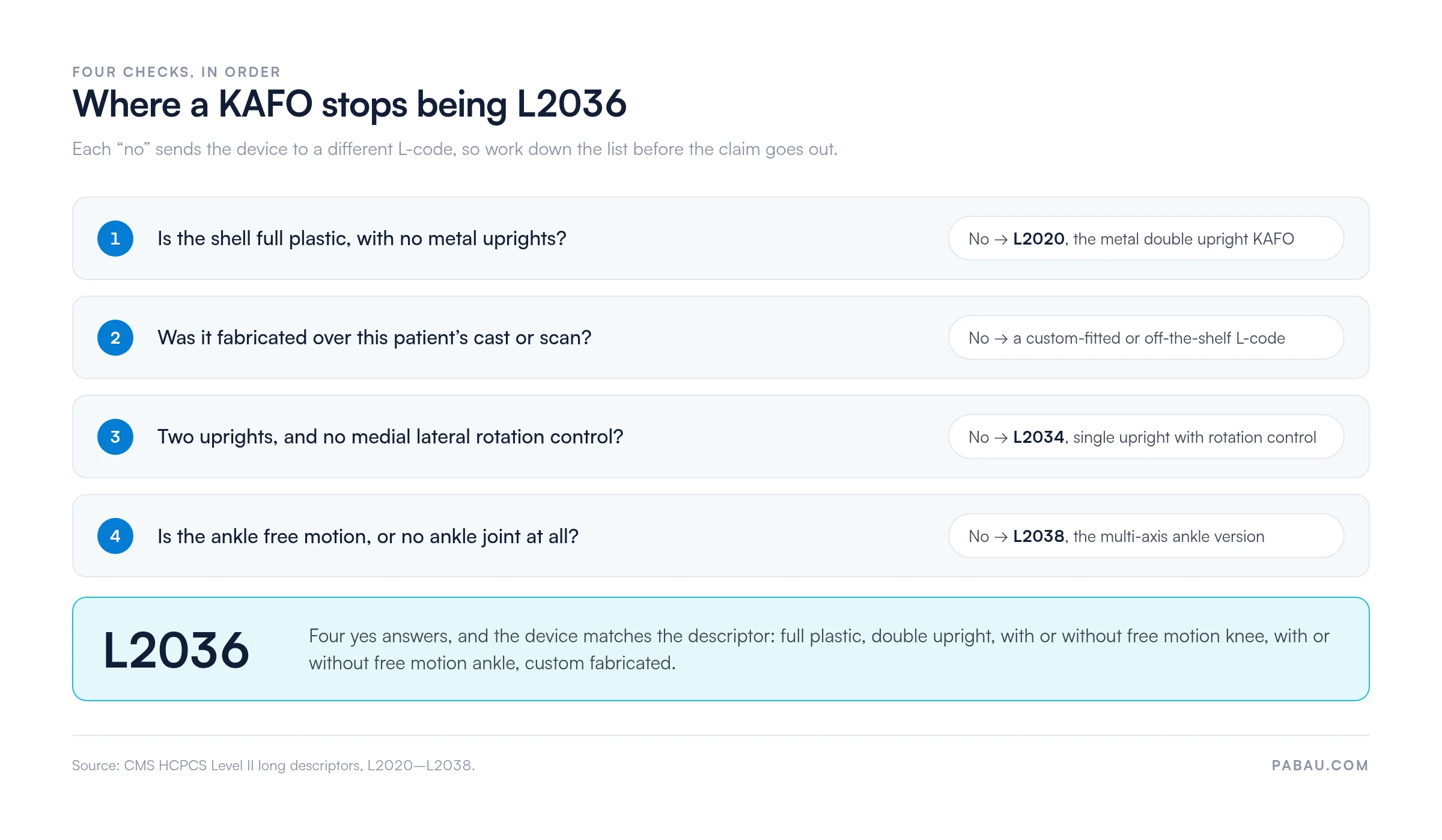
This is the compliance error auditors find most often. A custom-fitted brace starts life as a prefabricated shell and is then trimmed, heated, or bent to suit the patient. A custom-fabricated brace starts as a cast or scan and has no shape until the orthotist builds one.
CMS Policy Article A52457 treats them as separate categories. Billing a custom-fitted KAFO under L2036 is upcoding, and it invites recoupment. A static, prefabricated full-plastic KAFO in a pediatric size bills as L2035, the only prefabricated code in the L2000-L2038 range.
Picking correctly across the KAFO codes comes down to four variables: material, upright count, ankle joint, and fabrication method. The table isolates them.
L2034 and L2036 are the pair billers swap most often. Upright count is the obvious difference, and it is not the only one. L2034’s descriptor also carries medial lateral rotation control, which L2036’s descriptor leaves out. A full-plastic single-upright brace with rotation control is therefore L2034, and the fabrication notes need to say so in those words.
One range gets cited here by mistake. L2126 through L2136 are femoral fracture cast orthoses, and several of them are prefabricated. They are not the metal-upright KAFO codes, so send a double-upright metal brace to L2020 instead.
Fabrication follows the same sequence every time, and a reviewer can ask to see any stage of it years later. Walk through it as the record has to read.
Each step needs its own dated entry. A single summary note written at delivery reads like a reconstruction, and reviewers treat it that way. What they look for is evidence that the cast or scan came before the brace existed.
Medicare pays for this brace when the patient walks and needs knee stability on top of ankle and foot support. A prefabricated device also has to be ruled out. Coverage sits under the Part B DME benefit and is governed by LCD L33686, maintained by the DME MACs.
A KAFO clears the basic test when an ankle-foot orthosis would already be covered and the patient needs extra knee stability to walk. Custom fabrication then has to be justified on its own. The LCD accepts any one of the following:
Two administrative conditions sit alongside the clinical ones. The treating physician has to order the brace after a face-to-face encounter, and the supplier has to be enrolled with Medicare for DMEPOS.
The detailed written order must also list every device specification before fabrication starts. Orders dated after the cast is taken are a standard audit finding, and they usually end in recoupment.
Which diagnosis codes does LCD L33686 require? None. The LCD’s ICD-10 section reads N/A. Policy Article A52457 is more explicit still. It specifies diagnosis codes for L4392, L4396, L4397, and L4631 only, and for no other code in the policy. L2036 is not among them.
So what goes on the claim? The diagnosis the treating physician documented, coded to the highest level of detail the record supports. Foot drop, hemiplegia, and post-polio weakness all appear on L2036 claims, and none of them is a pass. The functional criteria above are what carries the claim.
Covered-diagnosis tables for L2036 circulate widely online. None of them come from the LCD, and none of them will help at review. Pick the code because the record says so, never because a list said it pays.
Thin paperwork is the leading cause of L2036 denials. Assemble the file before the claim goes out, not after the rejection lands.
Keeping these together in one file shortens prior authorization turnaround and makes an appeal straightforward. It also helps to check the submission against the elements of a clean claim before it leaves the building.
The claim goes out on a CMS-1500 form, or on its electronic equivalent, the 837P file. It has to carry the ordering physician’s NPI, the supplier’s NPI and PTAN, and the patient’s Medicare ID. Routing matters too. L-code claims go to the DME MAC for the state where the patient is enrolled, not the state the supplier sits in.
From there, modifiers decide whether the claim pays, pends, or bounces.
KX does the heavy lifting. Leaving it off a claim the file would have supported is one of the most expensive habits in orthotic billing. It tells the DME MAC that the supplier has already confirmed every coverage criterion. Never append it when the record falls short, though. A KX on an unsupported claim creates false claims exposure.
Prior authorization is worth checking separately. The DMEPOS Prior Authorization Program list changes from year to year, so confirm whether L2036 sits on it in your jurisdiction before fabrication begins.
L2036 is paid as a purchased item under the Medicare DMEPOS fee schedule, billed with modifier NU. Payment is the lesser of the actual charge or the fee schedule amount. Rates then vary by geography, because competitive bidding rules adjust them in some areas and leave the national amount alone in others.
Amounts also change each year, so quote from the current file rather than last year’s. Medicaid is set by each state agency instead of CMS, and commercial rates follow whatever the supplier contract says. Check the payer’s own schedule before you promise a patient a number.
Denials on this code repeat. Almost all come down to paperwork rather than a coverage dispute. That is good news, because paperwork gets fixed upstream. The denial reason codes that land on L2036 claims group into nine causes.
Sort your denials by reason code once a month and the pattern tells you where to fix the workflow. A run of incomplete-order denials points at intake. A run of jurisdiction denials points at claim routing. Both are operational problems, and both stop once somebody can see them.
Run five checks before an L2036 claim goes out. Does the detailed written order list every device specification? Is KX on the line, with a file behind it? Is the cast or scan dated before fabrication? Do the notes explain why a prefabricated brace would not work? Is the claim routed to the DME MAC for the patient’s enrollment state?
In most orthotics practices the evidence for one claim lives in four places. The order sits in the referral inbox and the cast photos on a tablet. Fabrication notes live in a workshop log, and the delivery slip in a scanned PDF. Assembling that file takes a person an hour, and it happens after a denial rather than before submission.
Practice management software like Pabau closes that loop. Pabau’s claims software for orthotists pre-fills the claim from the patient record, so codes already attached to the service land on the charge line.
Built-in HCPCS and ICD-10 lookup libraries sit behind a search icon on the form. Required-field validation holds the claim until membership numbers, authorization codes, and the rest are complete.
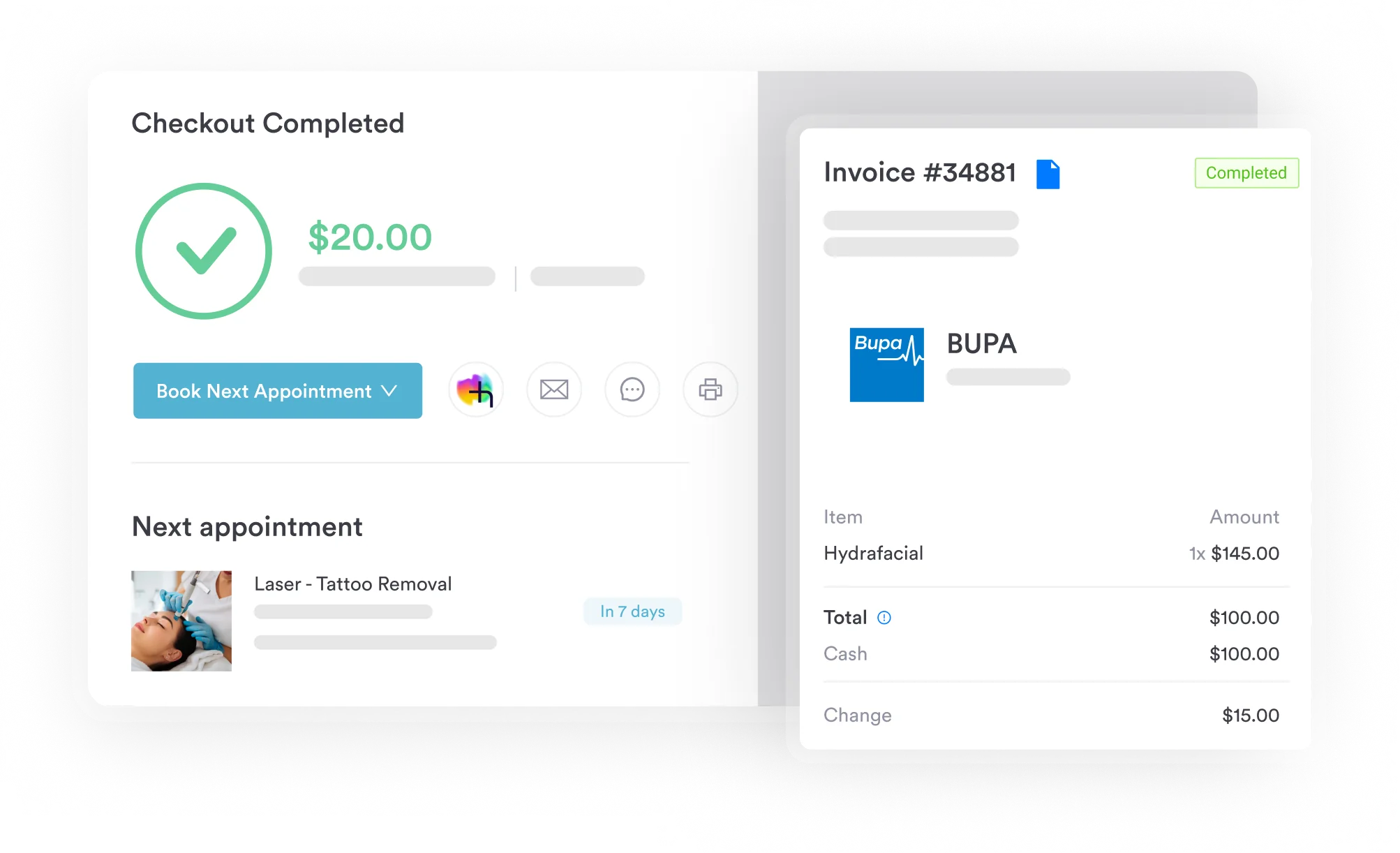
Fabrication records, cast documentation, and signed delivery confirmations attach to the same claim file. The result is a submission your billing team can defend without hunting through three systems. An appeal then takes minutes to assemble instead of an afternoon.

Pabau’s claims management software pre-fills the claim from the patient record and holds it until required fields are complete. Fabrication and delivery documentation stay on the same file. Book a demo to see the orthotics workflow end to end.

Assigning L2036 takes one careful read of the descriptor. Defending it takes a file a reviewer can follow from the physician’s order to the delivery signature. The second job is where the money is won or lost.
Build the pre-submission check once and run it on every claim. The claims left over will be the handful that genuinely turn on coverage. Missing dates and unsigned forms stop costing you money.
Book a demo to see how Pabau keeps orthotic documentation, code lookups, and claim validation on one screen.

Need to know how a DMEPOS claim reaches the payer? Medical claims clearinghouse guide traces the route from supplier to payer and shows where claims fall over.
Seeing the same L-code rejections every month? Denial management in healthcare covers how to group denial patterns and fix the workflow behind them.
Want coverage confirmed before fabrication starts? Insurance eligibility verification sets out the pre-service checks that prevent surprises after delivery.
Submitting L-codes electronically? The 837 file explained breaks down the electronic claim format that carries your CMS-1500 data to the payer.
Tightening up your audit position? Medical billing compliance explains the record-keeping standards that decide how a post-payment review goes.
A supplier enrolled with Medicare for DMEPOS bills the code, using its own NPI and PTAN. The treating physician writes the order but does not bill the device. A practice that fabricates and supplies braces in house needs both the enrollment and the accreditation before it submits.
It is billed as a purchase, with modifier NU on the line. A custom-fabricated brace is made for one patient’s limb, so the rental modifiers used on reusable equipment do not apply. Payment is the lesser of the actual charge or the DMEPOS fee schedule amount.
No. One code covers every joint combination the descriptor allows. A brace with a free motion knee and no ankle joint, and a brace with both joints, are both L2036. The fabrication notes still have to record which joints were fitted, because a reviewer will check the device against the order.
File a redetermination request with the DME MAC within 120 days of the remittance advice. Attach the order, the face-to-face notes, the cast or scan record, and the signed delivery confirmation. Most reversals come from documents that existed all along and were never sent with the claim.