CPT Code 37248: Venous angioplasty billing and documentation guide
CPT code 37248: Official descriptor and procedure overview CPT code 37248 is the...

Last Updated: Nov 2, 2026
L2005 is the HCPCS Level II code for a custom-fabricated stance control knee-ankle-foot orthosis (KAFO). Its knee joint locks automatically while the leg bears weight, then releases during swing so the patient can bend the knee. The code allows single or double uprights, any material, and any type of ankle joint.
The stance-control knee is the feature that separates L2005 from the other codes in the L2000-L2038 range. Medicare covers it under the braces benefit when LCD L33686 criteria are documented.
Let Pabau's smart automation suggest the right codes, reduce claim denials, and keep your practice compliant—effortlessly.
Automate repetitive tasks and focus on what matters most—your patients.
Reduce coding errors and ensure compliance with the latest regulations.
Clean claims, fewer denials, and faster reimbursements.
Powerful insights and reporting to help your practice thrive.
HIPAA compliant SOC 2 certified GDPR-compliant Trusted by 4,000+ clinics worldwide

HCPCS Code L2005 is a custom-fabricated KAFO whose stance-control knee locks automatically under load and releases for the swing phase.
Upright count and ankle style do not define L2005, because its descriptor allows single or double uprights and any type of ankle joint.
Medicare covers L2005 under the braces benefit when LCD L33686 criteria are met, starting with an AFO-qualifying patient who needs added knee stability.
Each claim line needs KX when every coverage criterion is met, or GA or GZ when it is not, plus RT or LT.
Pabau’s claims management submits the claim data already on the patient record and tracks each claim’s status after submission.
HCPCS Code L2005 is the Medicare billing code for a custom-fabricated knee-ankle-foot orthosis (KAFO) with a stance-control knee joint. The knee locks automatically while the leg bears weight. It then releases during the swing phase, so the patient can bend the knee to step through. The code sits in the L2000-L2038 KAFO range of the CMS HCPCS Level II system.
The stance-control knee is what defines L2005. The descriptor allows single or double uprights, any material, and any type of activation for the lock. An ankle joint of any type is included in the code. A KAFO whose knee is always free, always locked, or locked by hand does not meet the descriptor. A KAFO with microprocessor control of stance and swing is coded L2006 instead.
The codes in the L2000-L2038 range differ by knee joint, upright count and material, ankle type, and fabrication method. For L2005, the knee joint decides the code. The table below uses the official CMS descriptors, and each code has its own entry in our searchable HCPCS code library.
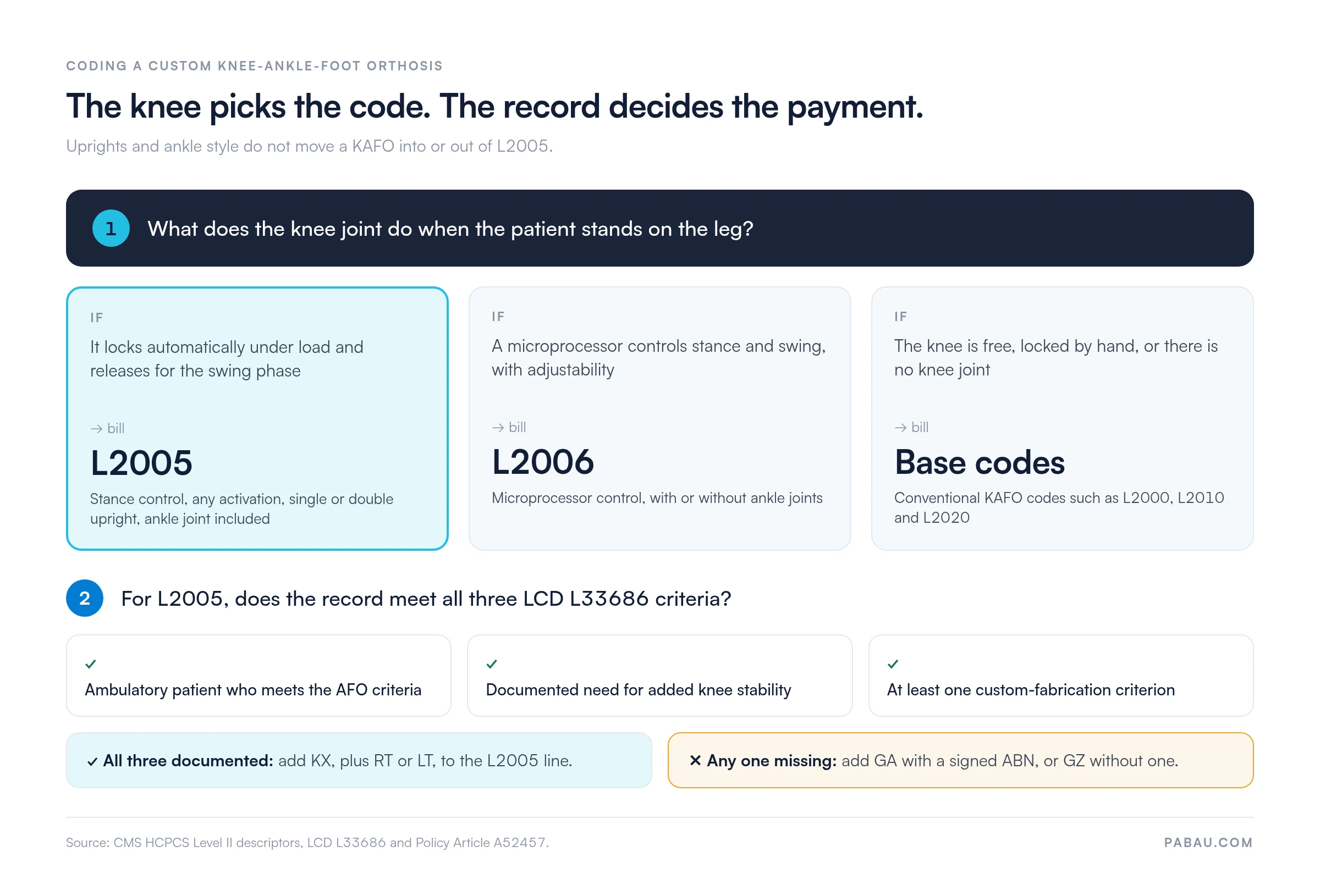
The practical test is what the knee does when the patient stands. If it locks automatically under load and unlocks for swing, L2005 fits whatever the uprights or ankle look like. If a microprocessor adjusts stance and swing resistance, the device belongs under L2006. A free knee or a hand-operated lock points back to the conventional base codes, and a single-upright KAFO with no knee joint is L2010.
The diagram below runs both decisions in order: the knee picks the code, then the record picks the modifier.
Policy Article A52457 also states that there are no add-on codes for L2005. The stance-control knee is part of the L2005 code itself, so the claim never pairs a base code with a knee-lock addition.
Medicare covers L2005 under the prosthetics and orthotics (braces) benefit when the criteria in LCD L33686 are met and documented. The companion Policy Article A52457 sets the coding and modifier rules. Orthotists, physical therapy practices and other settings that refer patients for KAFOs work from these two documents.
The LCD covers a KAFO for an ambulatory patient who qualifies for an ankle-foot orthosis (AFO) and needs added knee stability. The AFO criteria require weakness or deformity of the foot and ankle, a medical need for stabilization, and the potential to benefit functionally.
Because L2005 is custom fabricated, the record must also show at least one of the LCD’s custom-fabrication criteria:
Policy Article A52457 does not specify covered diagnoses for KAFO codes. Coverage turns on the functional criteria above, so a diagnosis code alone never proves medical necessity. The ICD-10-CM code on the claim still has to match a condition the medical record documents.
An L2005 claim is denied when the record does not support the coverage criteria. The common cases are:
Medicare KAFO documentation has to exist before the claim goes out. Missing a single required element is enough for a full denial on audit. The medical billing compliance standard for DMEPOS items expects records to be created at the time of care, not reconstructed after an audit request.
CMS names the DMEPOS items that need prior authorization on its Required Prior Authorization List, which changes over time. Check the current list and your DME MAC’s guidance before dispensing L2005. Noridian and CGS, the two DME MACs, publish this guidance on their websites. A claim submitted without a required prior authorization is denied on that basis alone, regardless of documentation quality.
Before delivering an L2005 KAFO, check the file against LCD L33686. Confirm ambulatory status, the AFO criteria, the knee-stability need, a custom-fabrication criterion and the written order. Record the stance-control knee joint and its activation in the fitting notes, since auditors check that first.
Modifiers on L2005 claims communicate coverage status, laterality, and advance beneficiary notice status to Medicare and other payers. Using the wrong modifier, or omitting a required one, triggers automatic claim edits.
KX (or GA or GZ) and a laterality modifier are both required on the same L2005 line. Policy Article A52457 requires RT or LT on every orthosis base code, addition and replacement part. For a bilateral fitting, bill each side on its own line with its own modifier.
HCPCS Code L2005 reimbursement is set by the CMS DMEPOS fee schedule, which CMS updates each January and during the year. Allowables for orthoses vary by state, so suppliers should pull the current file rather than rely on prior-year figures. The DMEPOS Competitive Bidding Program has targeted off-the-shelf orthoses, not custom-fabricated KAFOs, so L2005 is paid from the fee schedule.
L2005 is a purchased item, so the fee schedule lists a single purchase allowable rather than a rental rate. Medicare pays 80% of the allowable after the Part B deductible. The patient or a secondary payer owes the remaining 20% coinsurance.
To check the current allowable, download the DMEPOS fee schedule file from cms.gov, filter for L2005, and read the row for the patient’s state. The AAPC HCPCS code search helps with descriptor lookups, but confirm every rate against the CMS file. Do not reuse historical figures from older articles or billing software defaults.
Each denial pattern below traces back to a coding choice or a document that was missing at delivery. That makes denial management for KAFO codes mostly a job done before the claim goes out.
HCPCS Code L2005 claims are submitted on the CMS-1500 claim form or the electronic 837P transaction by an accredited DMEPOS supplier. Four parts of the workflow decide whether the claim lands cleanly:
For every Medicare L2005 claim, keep the signed order, the practitioner’s notes, the fitting notes and the proof of delivery in one electronic file. The fitting notes should describe the stance-control knee. Additional documentation request (ADR) responses go out faster when the file is already organized.
Orthotic suppliers often track KAFO claims across spreadsheets, payer portals and fax queues. A rejected line can then sit unnoticed until the payment fails to arrive.
Pabau, the practice management platform we build, submits the claim data already on the patient record. Its claims management tools then track each claim’s status. Your team sees which L2005 claims are paid, pending or rejected without leaving Pabau.
Coding, coverage checks and modifier choices stay with your billing team. Pabau keeps the medical billing workflow from submission to remittance posting in one place, so follow-up on a rejection can start the day it arrives.
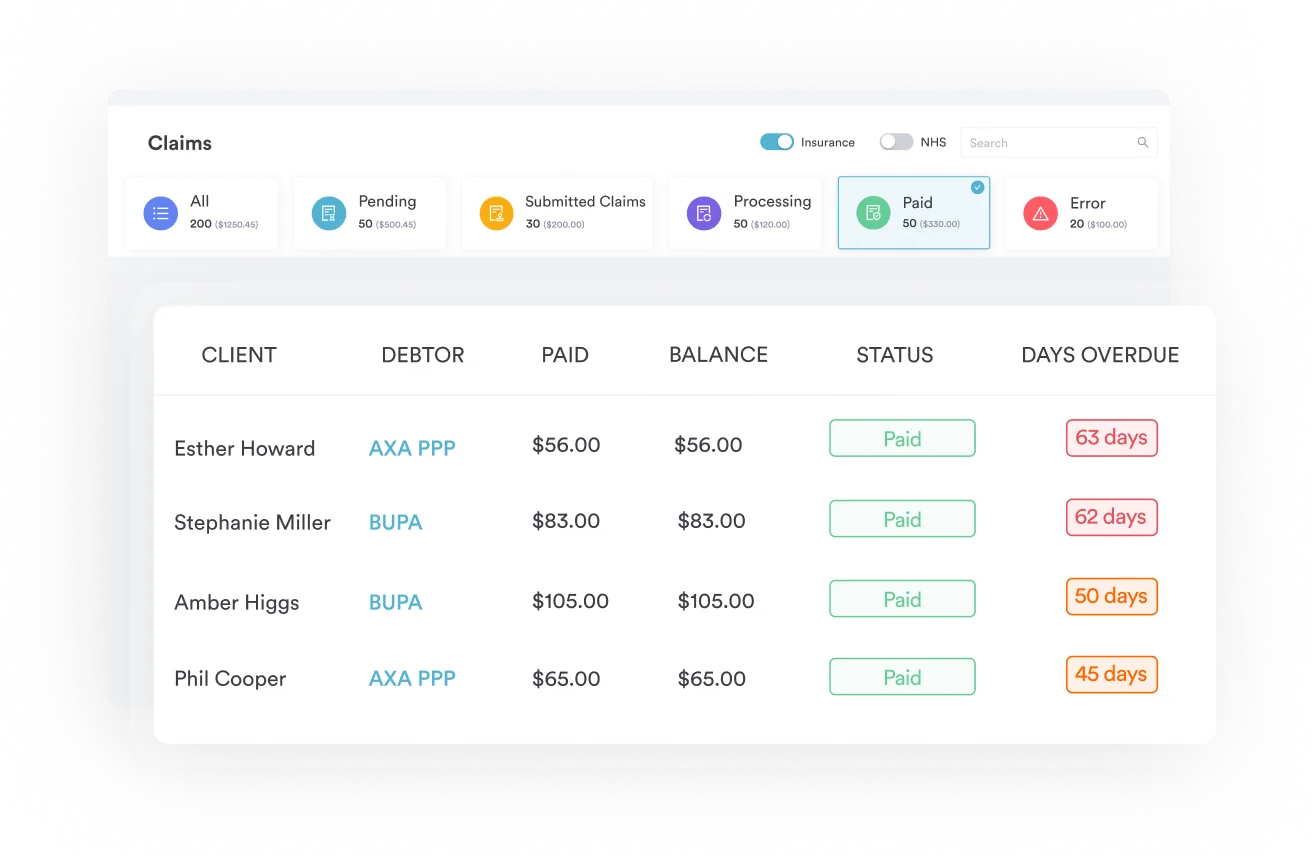

Pabau’s claims management submits the claim data on each patient record and tracks every claim’s status. Your team sees which L2005 claims are paid, pending or rejected without switching systems.

Code L2005 from the knee, not the ankle or the uprights. If the fitting notes show a stance-control joint that locks under load and releases for swing, the code fits. If they do not, the claim belongs elsewhere in the range, or under L2006.
Coverage is the second test. Medicare pays when the record shows an ambulatory patient who qualifies for an AFO, needs added knee stability, and meets a custom-fabrication criterion. A file that proves both before delivery is far harder to deny than one assembled after an audit letter.
Book a demo to see how Pabau submits and tracks orthotic claims like L2005 from the patient record.

Need guidance on managing claim denials across your practice? Denial management in healthcare covers the process of identifying, appealing, and preventing common claim denials for DMEPOS and clinical practices.
Want to understand what clean claims look like before submission? Medical billing compliance explains the documentation standards and audit-readiness requirements that protect practices from DMEPOS claim reversals.
Looking for a billing workflow platform for your orthotic practice? Claims management software from Pabau submits claims from the patient record and tracks their status in one place.
Billing a KAFO with no knee joint? HCPCS Code L2010 covers the single-upright KAFO that sits beside L2005 in the base-code range.
HCPCS Code L2005 is the billing code for a custom-fabricated knee-ankle-foot orthosis (KAFO) with a stance-control knee. The knee locks automatically under load and releases during the swing phase. The code allows single or double uprights, any material and any ankle joint. Medicare covers it under the braces benefit when LCD L33686 criteria are met.
L2005 has a stance-control knee joint that locks automatically under load and releases for swing. L2010 is a single-upright KAFO without a knee joint, with a free ankle and a solid stirrup. Both are custom fabricated. The fitting notes must describe the knee mechanism so a reviewer can match the device to the code.
Yes, Medicare Part B covers L2005 under the braces benefit when the LCD L33686 criteria are documented. The patient must be ambulatory, qualify for an AFO, need added knee stability, and meet a custom-fabrication criterion. Medicare pays 80% of the allowable after the Part B deductible.
L2005 needs prior authorization only when it appears on the current CMS Required Prior Authorization List, which changes over time. Check the list and your DME MAC’s guidance from Noridian or CGS before dispensing the device. Claims submitted without a required prior authorization are denied regardless of documentation quality.