

HCPCS code E0198: Water pressure pad billing guide
HCPCS code E0198 is a water pad for a standard mattress HCPCS code E0198 is the ...

Last Updated: Oct 13, 2026
L2034 is the HCPCS Level II code for a custom-fabricated, full-plastic knee-ankle-foot orthosis with a single upright. The brace controls medial-lateral rotation at the knee, and it may include a free-motion knee joint, a free-motion ankle joint, or both.
This is not an off-the-shelf device. Only L2035 is prefabricated in the L2000-L2038 range. Every L2034 claim therefore asserts that the brace was made over a model of the patient's limb. LCD L33686 sets no diagnosis list for the code, which puts the whole weight of coverage on the narrative in the medical record.
Let Pabau's smart automation suggest the right codes, reduce claim denials, and keep your practice compliant—effortlessly.
Automate repetitive tasks and focus on what matters most—your patients.
Reduce coding errors and ensure compliance with the latest regulations.
Clean claims, fewer denials, and faster reimbursements.
Powerful insights and reporting to help your practice thrive.
HIPAA compliant SOC 2 certified GDPR-compliant Trusted by 4,000+ clinics worldwide

HCPCS code L2034 is a custom-fabricated, full-plastic knee-ankle-foot orthosis with a single upright and medial-lateral rotation control.
Only L2035 is prefabricated in the L2000-L2038 range. Every other code in that family, L2034 included, is custom fabricated.
LCD L33686 sets no diagnosis list for L2034. Coverage rests on narrative criteria, so the clinical notes carry the claim.
Every claim line needs KX, GA or GZ, plus RT or LT. Lines carrying none of the first three reject as missing information.
Practice management software like Pabau pre-fills the CMS-1500 from the patient record and submits it through Claim.MD in the US.
HCPCS code L2034 describes a custom-fabricated knee-ankle-foot orthosis (KAFO) built entirely from plastic. It runs from the thigh to the foot and carries a single upright. The knee and ankle joints are both optional, and the shell controls medial-lateral rotation at the knee.
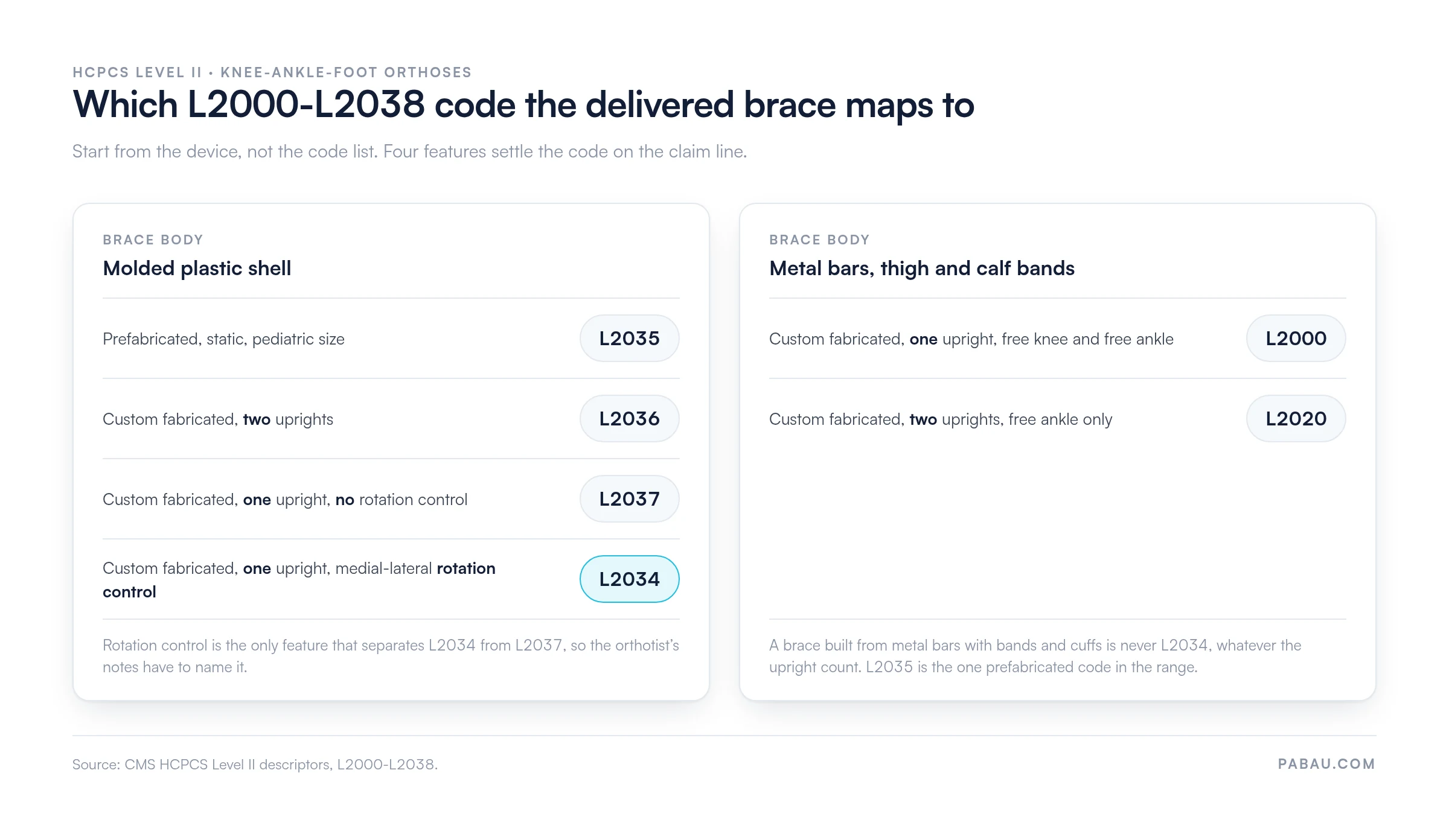
Three details separate this code from its neighbors. The body of the brace is a molded plastic shell, not metal bars with bands and cuffs. One upright runs down the limb instead of two. Rotation control is built in, and that feature is what sets L2034 apart from L2037.
CMS writes the descriptor in seven clauses. Each one appears below in order, exactly as written, with what it means on the fitting bench.
The descriptor never names a solid stirrup, thigh and calf bands, or an off-the-shelf option. Those features belong to L2020, a metal double-upright brace. If the delivered device has bands and cuffs on metal bars, L2034 is the wrong code.
The L2000-L2038 range covers knee-ankle-foot orthoses, and almost all of it is custom fabricated. L2035 is the single exception. It describes a static pediatric KAFO supplied prefabricated, with fitting and adjustment included. Every other code in the range, L2034 among them, requires fabrication over a patient model.
That distinction drives both payment and paperwork. A supplier who bills L2034 is telling Medicare the brace was made over a model. The record then has to back that claim up, which is where LCD L33686 comes in.
L2034 and L2037 are the pair most often confused. Both are single-upright plastic KAFOs made over a model. Only L2034 includes medial-lateral rotation control, so the orthotist’s notes have to say the brace provides it. Working from the delivered device rather than the code list makes that call faster.
LCD L33686 governs ankle-foot and knee-ankle-foot orthoses across all four DME MACs. It sets no diagnosis list for L2034. Coverage turns on two written tests instead, and a claim has to satisfy both.
The LCD covers a KAFO for ambulatory beneficiaries who already qualify for an ankle-foot orthosis and need additional knee stability. AFO coverage in turn requires weakness or deformity of the foot and ankle. The beneficiary must also need stabilization for medical reasons and stand to benefit functionally.
Where the notes justify ankle and foot support but not knee stability, the claim belongs on an AFO code instead. A custom-fabricated spiral AFO is HCPCS code L1950.
A custom-fabricated KAFO is covered only when the basic criteria are met and one of five further conditions applies.
Condition three is the natural fit for L2034. Medial-lateral rotation control is multi-plane control by definition, so the code and the criterion line up neatly. Say so in the notes rather than leaving a reviewer to infer it.
Miss the basic test and the orthosis is denied as not reasonable and necessary. Meet the basic test but not the custom-fabrication test, and the custom device alone is denied.
Records have to exist before delivery, not after a denial arrives. LCD L33686 and its Policy Article A52457 set the list below. Building these steps into your medical billing compliance routine is cheaper than rebuilding a file under audit.
Keep the file for the full audit window. Ankle-foot and knee-ankle-foot orthoses sit on the approved Recovery Audit topic list under topic 0013, so record requests are routine rather than rare.
Modifier selection decides whether the line processes at all. A52457 rejects any line that carries none of KX, GA or GZ, treating it as missing information.
KX, GA and GZ are mutually exclusive. KX attests that the criteria are met. GA and GZ both signal the opposite, and they differ only on whether the beneficiary signed an ABN.
Bilateral braces go on two separate lines. Bill one unit with RT and one unit with LT, rather than two units on a single line.
Before an L2034 claim goes out, check three things. The orthotist’s notes name medial-lateral rotation control. The practitioner’s record explains why a prefabricated brace would not serve. The claim line carries KX plus RT or LT.
L2034 is paid from the Medicare DMEPOS fee schedule, not the physician fee schedule. Allowables are set each January and vary by state and pricing region. Only an enrolled DMEPOS supplier with the right specialty type can bill the code.
Look up the current allowable in the CMS DMEPOS fee schedule before you bill. Prior-year figures are not safe to reuse. Once the Part B deductible is met, Medicare pays 80% of the allowable. The beneficiary or a secondary payer covers the remaining 20%.
Participating suppliers accept assignment and cannot balance-bill above the allowable. Non-participating suppliers have more freedom on price, but the ABN rules still apply to any non-covered item.
L2034 carries no prior authorization requirement and no mandatory written order prior to delivery. Two codes beside it in the same family do.
L2036, the double-upright version of the same plastic KAFO, sits on the CMS Required Face-to-Face Encounter and Written Order Prior to Delivery List. L2035, the prefabricated pediatric code, sits on the DMEPOS Probationary Prior Authorization List. L2034 appears on neither.
Switching between those codes therefore changes the paperwork, not just the payment. Check the current lists before you assume a brace order can go straight to fabrication. CMS revises both, so a code that was clear last year may not be clear now.
Medicare Advantage plans and commercial payers run their own prior authorization rules. Treat each payer separately and check at the point of referral. A denial that lands after delivery leaves the supplier holding the cost.
Most L2034 denials trace back to five causes, and every one of them is preventable before submission. Mapping each rejection to a cause is easier once you can read the denial codes that come back on the remittance.
Medicare runs a five-level appeals process for denied DMEPOS claims. Redetermination comes first, filed with the MAC within 120 days of the denial notice.
A Qualified Independent Contractor handles reconsideration next, within 180 days of that decision. An Administrative Law Judge hearing follows, and it requires an amount in controversy of at least $200 for 2026.
The strongest appeal evidence is a letter from the treating practitioner. It should tie the beneficiary’s walking limitation to the LCD criteria and to the need for rotation control. Gait analysis, muscle testing or mobility scores help, provided they were recorded at the time of the order.
Most suppliers assemble an L2034 claim from three places. The practitioner’s note sits in one system, the orthotist’s evaluation in another, and the CMS-1500 in a third. Rekeying between them is where detail goes missing.
Practice management software like Pabau keeps the record and the claim together. The CMS-1500 is pre-filled from the patient record, so the HCPCS code attached to the service lands on the charge line. ICD-10 slots draw from the recorded problem list. Lookup libraries for ICD-10 and HCPCS sit behind a search icon in the form.
Pabau also checks that claim-required fields are complete before the send button unlocks. In the US, claims route through Claim.MD, which handles eligibility checks, claim status tracking and ERA posting. Pabau does not pick modifiers for you, so KX and RT or LT stay a human decision.
For an L2034 order, the practical benefit is a single file. The order, the notes, the fabrication justification and the claim all live against one patient record. An audit request then takes minutes rather than an afternoon.

Pabau holds orthotic orders, clinical notes and DMEPOS claims on one patient record, and submits them through Claim.MD in the US.

HCPCS code L2034 is a custom-fabricated, full-plastic KAFO with a single upright and medial-lateral rotation control. Treating it as an off-the-shelf brace is the most common reason these claims fail on review.
After that, the work is documentary. Show why a prefabricated orthosis would not serve, name the rotation control, and attach KX with RT or LT.
Pabau’s audit-ready claims management keeps the order, the clinical notes and the CMS-1500 on one record. DMEPOS teams can then answer an audit without hunting through three systems. Book a demo to see how it fits your L2034 workflow.

Need a structured approach to DME billing compliance? Medical billing compliance outlines the documentation and audit-readiness practices that protect DMEPOS suppliers during MAC reviews.
Unsure how denial codes map to appeal strategies? Denial codes in medical billing provides a reference guide to common CARC and RARC codes and how to respond to each.
Looking to streamline your full billing cycle? Medical billing software covers the key features to evaluate when choosing a platform that handles DMEPOS claims alongside clinical workflows.
L2034 covers a custom-fabricated, full-plastic knee-ankle-foot orthosis with a single upright and medial-lateral rotation control. The knee and ankle joints are optional. It is not an off-the-shelf brace.
Both are custom-fabricated full-plastic KAFOs. L2034 has a single upright and medial-lateral rotation control. L2036 has a double upright. L2036 also sits on the CMS required face-to-face and written order prior to delivery list, while L2034 does not.
Custom fabricated. In the L2000-L2038 range, only L2035 is prefabricated. Every other code, L2034 included, requires fabrication over a model of the patient’s limb.
Use KX when every LCD L33686 criterion is met and documented. Use GA or GZ when a denial is expected, depending on whether an ABN was signed. Add RT or LT to every line.
No. The LCD sets narrative criteria for ambulatory AFO and KAFO coverage instead. Its policy article, A52457, lists diagnosis codes only for L4392, L4396, L4397 and L4631.
No. L2034 is not on the CMS required prior authorization list or the probationary list. Its neighbor L2035 is on the probationary list, so check the current version before ordering.



