



CCSD code G5100: Bypass of duodenum billing guide
CCSD code G5100 bills a bypass that leaves the duodenum in place CCSD code G5100...

Last Updated: Oct 16, 2026
CPT code 28750 is the procedure code for arthrodesis of the great toe at the metatarsophalangeal (MTP) joint. It covers surgical fusion of the first MTP joint to correct hallux rigidus and severe hallux valgus. Podiatric and orthopedic practices billing this code face a specific set of documentation and modifier decisions that directly affect reimbursement.
The code is maintained by the American Medical Association (AMA), which publishes the descriptor that defines what 28750 may be reported for. This guide covers that descriptor, the clinical indications, the ICD-10 crosswalk, and the modifiers. It also covers 2026 Medicare fee schedule and RVU figures, plus the documentation payers expect.

CPT code 28750 describes surgical fusion of the great toe MTP joint, distinct from interphalangeal joint fusion (CPT 28760).
Primary ICD-10 indications are hallux rigidus (M20.20-M20.22) and hallux valgus (M20.10-M20.12), coded to the operated side.
Modifier 50 covers bilateral procedures, but some payers want separate LT and RT lines instead, so check the policy first.
The 2026 work RVU is 8.75, and the 90-day global period bundles routine follow-up visits into the surgical payment.
Pabau’s claims management software supports coding accuracy and clean claim submission for foot and ankle surgery practices.
CPT code 28750 is the billing code for arthrodesis of the great toe at the metatarsophalangeal joint, as defined in the AMA’s Current Procedural Terminology. The official descriptor reads: Arthrodesis, great toe; metatarsophalangeal joint. This is a Category I CPT code that falls within the musculoskeletal surgery section covering foot and ankle procedures.
The procedure involves surgically fusing the first metatarsal head to the proximal phalanx of the great toe, eliminating motion at that joint. Surgeons typically use internal fixation hardware (plates, screws, or crossed screws) to hold the bones in the corrected position while fusion occurs. CPT 28750 captures only the MTP joint fusion; interphalangeal joint fusion is reported separately under CPT 28760.
First MTP joint arthrodesis is indicated when conservative treatment fails to relieve pain or correct deformity. Payers expect documentation showing that non-surgical options were tried and failed. Orthotics, corticosteroid injections, physical therapy, and shoe modification all count toward that history.
The two primary diagnoses driving billing for CPT 28750 are hallux rigidus and severe hallux valgus. Hallux rigidus involves progressive cartilage loss and osteophyte formation at the MTP joint that restricts dorsiflexion; end-stage cases cause significant functional impairment. Severe hallux valgus with a high intermetatarsal angle that is not amenable to osteotomy correction is another common indication, particularly in revision cases.
When the intermetatarsal angle still allows correction without fusion, an osteotomy code applies instead. CPT 28298 reports hallux valgus correction with a proximal phalanx osteotomy, often called an Akin osteotomy.
Performed on its own, without a bunionectomy on the same claim, the Akin is reported with CPT 28310 instead. The code carries a separate procedure designation, so it bundles into a more comprehensive foot procedure at the same site.
These ICD-10-CM codes are commonly documented alongside CPT 28750 to establish medical necessity. Payers match the diagnosis to the procedure, and a non-specific code is a common reason for denial. Use laterality-specific codes wherever the operative record supports them. The supporting diagnosis comes from the ICD-10-CM code set, not from an unspecified default.
Modifier selection for CPT 28750 depends on the operative site (right, left, or bilateral) and any circumstances affecting complexity. Incorrect modifier use is one of the top causes of claim rejection for foot surgery codes. Confirm modifier policies with each payer’s local coverage determination (LCD) before submitting, as rules on bilateral reporting in particular vary.
Toe modifiers (TA and T1 through T9) identify individual toes, and some payers want them in addition to or instead of LT and RT. TA is the left great toe and T5 is the right great toe, which is the pair that applies to 28750. Check the payer’s surgical coding policy for foot procedures before you submit. Some commercial payers accept modifier 50, while others require two line items with LT and RT.
Medicare reimbursement for CPT 28750 varies by geographic location, and the figures below represent national averages based on the 2026 Medicare Physician Fee Schedule. Use the CMS Physician Fee Schedule Look-Up Tool to obtain your practice’s locality-adjusted rates. The geographic practice cost index (GPCI) affects all three RVU components. Rates are also different in facility settings (hospital outpatient department or ASC) versus non-facility (office) settings.
Important: The figures above are estimates drawn from published fee schedule data. Verify them against the official CMS MPFS for your locality and the applicable year. Private payer rates vary substantially and may sit above or below Medicare. On a surgical claim of this size, one missing modifier costs more than a full day of office visits.
Relative value units (RVUs) quantify the physician work, practice expense, and malpractice components that together determine Medicare payment. CMS finalized a 2026 work RVU of 8.75 for CPT 28750, up from 8.57 in 2025. The code carries a 90-day global surgery period.
The work RVU covers surgeon time and cognitive effort, and it does not change with the setting. The practice expense RVU is the component that moves, because office overhead is carried by the practice and hospital overhead is not.
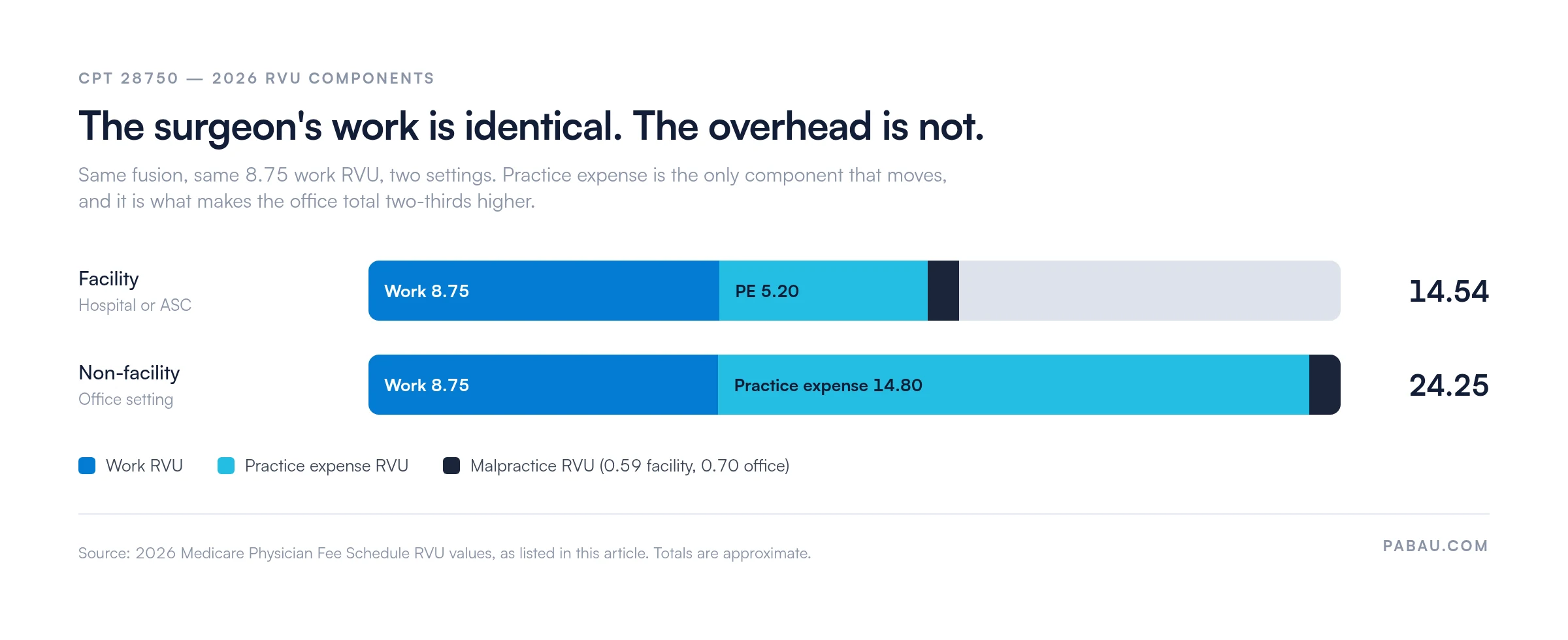
The table below splits the total into its three components for each setting.
Practice expense and malpractice figures are approximate and should be confirmed against the CMS Physician Fee Schedule for your locality. The 90-day global period bundles routine follow-up visits into the 28750 payment. Billing an evaluation and management code inside that window requires modifier 24, which tells the payer the visit was unrelated to the surgery.
Thorough documentation is the front line against claim denial and audit exposure. Payers look for evidence of medical necessity and operative specificity. The operative report has to describe what was done at that joint, in that patient, rather than repeat a stock fusion narrative. The record for 28750 should contain each element below.
Some payers require prior authorization for elective foot arthrodesis. Confirm authorization requirements before scheduling the procedure, as retro-authorization is not always granted. General documentation guidance applies; always consult the individual payer’s LCD for CPT 28750 to confirm their specific requirements.
Foot surgery coding has predictable error patterns, most of them created by bundling rules and bilateral billing. The issues below are the most common sources of claim denial on CPT 28750 submissions.
Tracking denial codes after 28750 submissions shows which error patterns recur in your practice. CO-4 means the procedure code is inconsistent with the modifier, and CO-97 means payment is included in another service.
CO-197 is the code tied to missing or absent prior authorization. CO-57 is a separate problem, since it means the payer considers the submitted information insufficient to support that level of service. A clean claim passes every payer edit on first submission, and complete documentation is what gets it there.
CPT 28750 and CPT 28760 are two distinct arthrodesis codes for the great toe, differing by which joint is fused. Auditors look for operative report language that names the joint level, so the wrong choice surfaces on review rather than at submission.
Paired codes do not always divide on anatomy. HCPCS code J2710 and J2711 separate by drug product rather than dose, since J2711 covers neostigmine methylsulfate combined with glycopyrrolate.
CPT 28750 sits within a family of foot and ankle codes used to capture related procedures. When multiple procedures are performed at the same operative session, each must be reported separately with appropriate modifiers.
The table below shows the codes most frequently referenced alongside 28750, including related foot arthrodesis codes and hallux correction procedures. Reporting more than one of them together calls for a payer-specific review of NCCI edits.
The official descriptor for CPT 28270 ends with the parenthetical separate procedure. That wording decides whether the capsulotomy is reported on its own or absorbed by a more comprehensive procedure at the same joint.
Podiatric and orthopedic practices billing high-value surgical codes like CPT 28750 depend on claims management software. It validates code combinations, modifier logic, and diagnosis linkage before a claim leaves the practice. Reviewing each surgical encounter by hand is slow and error-prone, especially when several codes are reported in one session.
Pabau, practice management software built for medical and aesthetic practices, integrates with Claim.MD. That clearinghouse connects to over 4,000 US payers. A 28750 claim routes electronically, eligibility checks confirm patient coverage before surgery, and remittances post against the claim after payment.
Your billing team sees which foot arthrodesis claims were paid, adjusted, or denied, and can open the denial code without switching systems. Denial patterns by payer then surface early enough to change the next authorization request.
Set up a claim dashboard filter for CPT 28750 and its related codes (28760, 28296, 28285) to monitor denial patterns by payer. If one commercial payer keeps denying 28750 for missing prior authorization, that pattern shows up within the first few billing cycles. You can then build an authorization step into the workflow before the next surgical case.

Pabau’s claims management tools help podiatric and orthopedic practices submit accurate claims for surgical codes like CPT 28750. Track denials by code and reconcile remittances automatically.

Three things decide whether a 28750 claim is paid. The operative report must name the joint level. The modifier must carry the correct laterality, and the ICD-10 code must support medical necessity. Get one wrong and the claim comes back on a procedure worth several hundred dollars a side.
The 2026 work RVU rose to 8.75, so the claim is worth marginally more than last year. That makes no difference if it denies. The authorization check and the modifier belong in the pre-surgical workflow, not in the billing queue.
Pabau’s claims management tools help podiatric and orthopedic practices submit 28750 claims accurately, track remittances by code, and clear denials before they age. Book a demo to see how the surgical billing workflow runs end to end.

Want to understand how clearinghouse claims routing works? Medical claims clearinghouse guide explains how electronic claims move from practice to payer and where errors get caught.
Need to track denial patterns across surgical codes? Denial management in healthcare covers how to categorise, appeal, and reduce claim denials systematically.
Looking for guidance on ERA remittance reconciliation? Medical superbill guide walks through how superbills connect to clearinghouse submissions and ERA matching.
CPT code 28750 covers surgical arthrodesis of the great toe at the metatarsophalangeal (MTP) joint. The procedure fuses the first metatarsal head to the proximal phalanx of the hallux. The code includes the surgical approach, bone preparation, internal fixation, and closure at that joint level. It does not include fusion of the interphalangeal joint (CPT 28760), which must be billed separately if performed.
The most commonly used modifiers are RT (right), LT (left), and 50 (bilateral). Modifier 22 applies when the procedure is substantially more complex than typical. Modifier 59 is used when 28750 is reported alongside another procedure subject to bundling edits. Toe modifiers TA (left great toe) and T5 (right great toe) are accepted by some payers in place of LT and RT. Confirm the payer’s policy before submitting.
The most common ICD-10-CM codes paired with CPT 28750 are M20.10-M20.12 (hallux valgus, unspecified/right/left foot) and M20.20-M20.22 (hallux rigidus, unspecified/right/left foot). Laterality-specific codes (right or left) are preferred over unspecified codes when the operative record documents the side. Additional codes such as M06.071 (rheumatoid arthritis) or M19.071 (osteoarthritis) apply when those are the primary indications.
Yes, bilateral billing is allowed when both great toe MTP joints are fused in the same operative session. The standard approach is modifier 50 on a single line item, which Medicare pays at 150% of the single-procedure rate. Some commercial payers require separate line items with LT on one line and RT on another. Check the payer’s surgical billing policy before submitting a bilateral claim.
CPT 28750 is for arthrodesis of the great toe at the metatarsophalangeal joint, between the metatarsal and the proximal phalanx. CPT 28760 is for arthrodesis at the interphalangeal joint, between the proximal and distal phalanges. The distinction is the joint level fused. Both codes can be reported together in the same surgical session using modifier 59, provided the operative report documents both joint levels separately.
Hallux valgus is treated by several CPT codes depending on the surgical approach. CPT 28296 covers correction of hallux valgus with sesamoidectomy, when performed, with distal metatarsal osteotomy. CPT 28750 is used instead when the surgeon performs MTP joint fusion rather than an osteotomy. That applies to severe deformity or an arthritic joint. The ICD-10-CM diagnosis code for hallux valgus is M20.10 (unspecified), M20.11 (right), or M20.12 (left).



