HCPCS Code G0163: Skilled nursing observation and assessment
What is HCPCS Code G0163? HCPCS Code G0163 is a deleted Level II code for skille...

Last Updated: Oct 15, 2026
CPT code 36558 is the procedure code for inserting a tunneled centrally inserted central venous catheter (CVC), for patients age 5 years or older. No subcutaneous port or pump is placed. It is assigned when a physician or qualified provider places the catheter via a central vein. The subclavian, internal jugular, and femoral veins are the usual access points.
Accurate use of CPT code 36558 depends on three facts from the operative report. Those are the patient’s age, the tunneling technique, and whether a port or pump was implanted.
Tunneled CVCs are placed in oncology, critical care, long-term IV therapy, and hemodialysis settings where durable central access is required for weeks or months. Coding errors on vascular access procedures are a common audit trigger. Before the claim goes out, confirm the age threshold, the modifier rules, and how any imaging guidance was documented.

CPT code 36558 covers tunneled CVC insertion without port or pump, for patients age 5 years or older only
CPT 36557 is the parallel code for patients under 5, and an age mismatch is a common audit finding
The port codes reverse the usual order: 36560 covers patients under 5 and 36561 covers age 5 or older
Imaging guidance (CPT 76937, 77001) is separately reportable with 36558 only when medical necessity is documented in the operative note
Pabau’s claims management software helps reduce denials on CVC insertion claims through built-in claim scrubbing and clearinghouse submission
CPT code 36558 is a surgical procedure code for a tunneled centrally inserted central venous catheter placed without a subcutaneous port or pump. It applies to patients age 5 years or older. The full AMA CPT descriptor reads: Insertion of tunneled centrally inserted central venous catheter, without subcutaneous port or pump; age 5 years or older.
A tunneled catheter is physically routed under the skin from the insertion site to a separate exit point on the chest wall. This distinguishes it from a non-tunneled CVC, where the catheter exits at the venipuncture site. The tunneling process reduces infection risk for patients who require central access over extended periods.
Three facts from the operative report determine whether 36558 applies:
Never code 36558 based on clinical setting or catheter brand alone. The operative note must confirm tunneling technique and the absence of a port device. Misclassification between tunneled and non-tunneled is one of the most common vascular access audit findings. A catheter threaded from an arm vein is a PICC instead, reported as 36569 when imaging guidance is absent.
The age split between 36557 and 36558 is a hard AMA rule. Both codes describe the same tunneled CVC insertion procedure without a port. The only differentiator is patient age at the time of service.
If the patient’s age is borderline (exactly 5 on the date of service), use 36558. When an operative note does not specify patient age, query the physician before coding. Submitting 36557 for a patient who is 5 or older, or vice versa, will trigger a payer age-validation edit and likely result in a denial.
CPT code 36558 sits within a family of central venous access device codes. Selecting the correct one turns on tunneled versus non-tunneled status, patient age, and whether a port or pump is included. The grid below maps all six codes against those three facts.
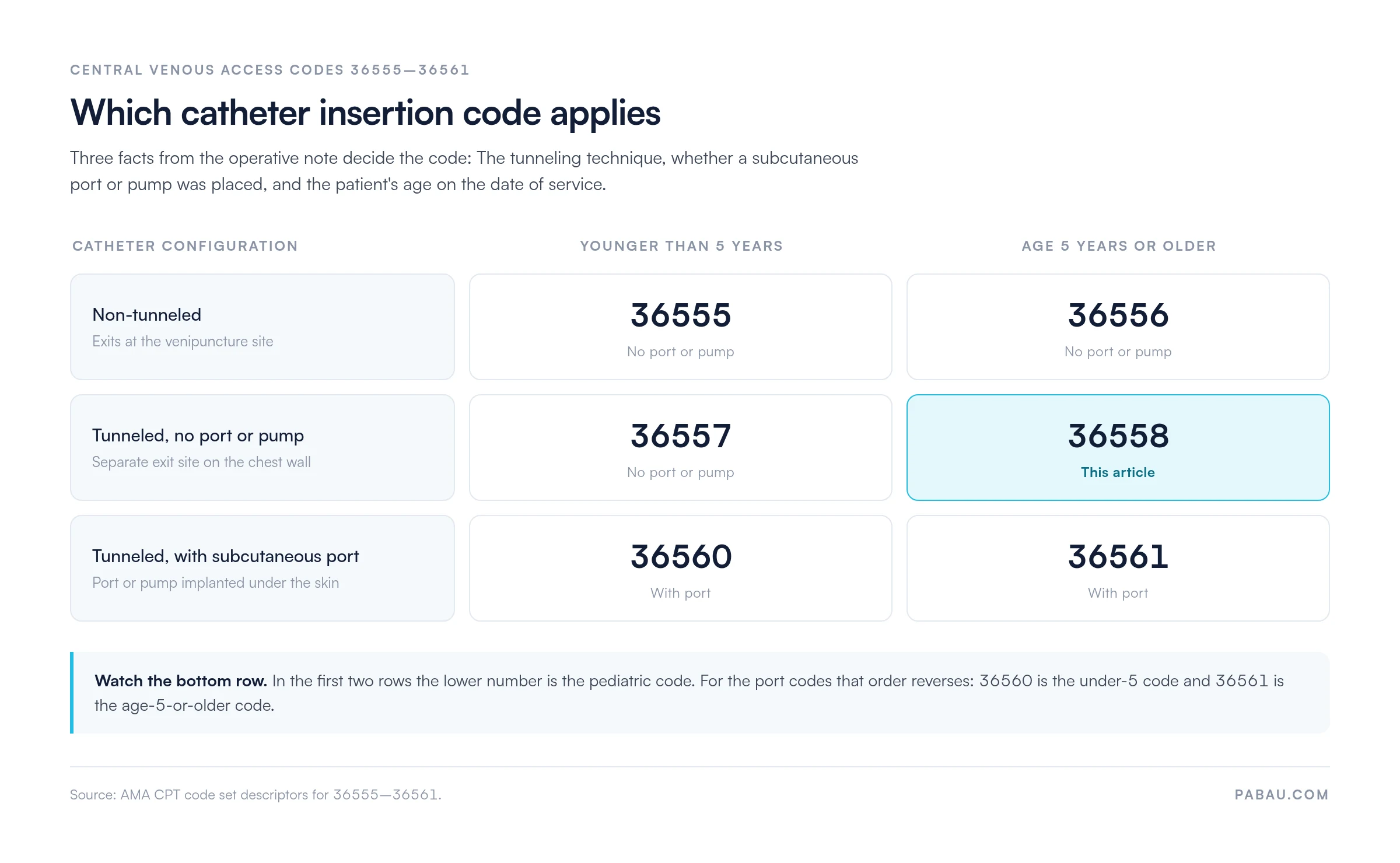
The port pair breaks the numbering pattern the rest of the family follows. From 36555 through 36558, the lower number is the pediatric code. For 36560 and 36561 that order reverses, so 36560 covers patients under 5 and 36561 covers age 5 or older.
Hickman and Broviac catheters are brand-name tunneled CVCs that map to this code family. The procedure name in the operative report does not always match the CPT descriptor. Code from the clinical characteristics, meaning tunneled or not, port present or not, and patient age, rather than the device brand.
Modifier selection for CPT code 36558 affects both claim acceptance and the amount paid. Applying a modifier incorrectly, or omitting one that is required, is a frequent denial trigger on vascular access claims. Confirm the payer’s own modifier policy before submission.
Modifier 52 carries audit risk on CVC insertion codes. CMS and AMA policy require specific documentation of why the service was reduced before modifier 52 is applied. Verify current payer guidance rather than defaulting to community coding practice.
Check your Medicare Administrative Contractor (MAC) local coverage determinations before applying modifier 52 to CPT 36558. MAC policies on reduced-service modifiers for vascular access codes vary by jurisdiction, and submitting without checking can result in an automatic denial or post-payment audit.
Ultrasound guidance (CPT 76937) and fluoroscopic guidance (CPT 77001) are add-on codes that may be reported alongside CPT code 36558. Separate reporting requires the medical record to document their use and the medical necessity for it. These codes are not automatically bundled into 36558 under the National Correct Coding Initiative (NCCI), but separate reportability still depends on complete documentation.
Billing 76937 or 77001 without a permanently stored image is the most common reason these add-ons are denied or recouped. The operative note must describe the guidance as real-time, not a post-procedure scout film, and the image belongs in the permanent record. Verify current NCCI edit tables annually, as bundling rules change with each fiscal year update.
Medicare reimbursement for CPT code 36558 is built from relative value units (RVUs) in the CMS Medicare Physician Fee Schedule. Each locality’s payment is then adjusted by its Geographic Practice Cost Index (GPCI). The RVUs below are the national values. Actual payment varies with the MAC locality and the GPCI multipliers for work, practice expense, and malpractice.
The facility rate applies when the procedure is performed in a hospital, ambulatory surgical center (ASC), or other facility setting. The non-facility (office) rate is far higher because it absorbs the practice expense the provider carries directly. Look up your locality’s GPCI values and the current conversion factor in the CMS fee schedule tool for an accurate payment estimate.
Submitting claims through a clearinghouse improves payment accuracy and shortens turnaround. Tracking each 36558 claim from code selection through to the remittance advice shows where payment is being lost.
A diagnosis code must support the medical necessity of the tunneled CVC insertion. The ICD-10-CM code must reflect the documented clinical indication, not the catheter placement itself. The most frequently paired diagnoses include malignancy, renal failure, and conditions requiring long-term parenteral nutrition or medication administration.
Renal failure pairs with 36558 when hemodialysis access is needed and no fistula is available. Creating that fistula is a separate operation, an open autogenous arteriovenous anastomosis reported as 36821. Where the veins cannot support an autogenous fistula, the surgeon places a nonautogenous graft instead, reported as 36830.
Payers may request clinical notes to confirm the indication. The diagnosis code must carry the specificity the documentation supports. A patient with a known primary malignancy is coded to that specific neoplasm rather than C80.1. Confirm the choice against the full ICD-10-CM index before the claim is built.
The National Correct Coding Initiative (NCCI) publishes edit tables that identify code pairs which cannot be billed together without a modifier indicating a distinct service. For CPT code 36558, the most common bundling issues involve central venous access repair and repositioning codes that CMS considers inherent to the insertion procedure.
Codes typically bundled into 36558 include central line evaluation services and most venous catheter maintenance procedures performed on the same encounter. Unbundling these without supporting documentation and a valid modifier is an audit risk. Check which CCI edit pairs apply before the claim leaves the practice.
Declotting that same tunneled line at a later encounter is a separate service. It is reported as CPT 36593 when a thrombolytic agent is used to restore patency.
Two practical rules for CCI compliance with 36558:
Verify the current NCCI table version before applying any unbundling modifier. CCI edit pairs for vascular access codes are updated quarterly. Knowing what makes a clean claim for a CVC insertion encounter cuts the rework from returned and denied claims.
A complete operative note is the foundation of a defensible claim for CPT code 36558. Missing any of the elements below creates exposure to a medical necessity denial or a post-payment recoupment. The superbill and the operative note must agree with each other.
An 837 professional claim file carrying CPT 36558 without matching chart documentation is a common pre-payment review target. The same records are what protect the practice when a retrospective audit arrives.
Build a CVC insertion documentation checklist into your procedure note template. A short structured section covering age, tunneling technique, access site, tip confirmation, and imaging guidance answers every payer question up front. That cuts the back-and-forth with reviewers after the claim is submitted.
Claims for CPT code 36558 fail for a short list of predictable reasons. Wrong age-based code selection, missing imaging guidance documentation, and CCI edit violations account for most of them. Software that scrubs the claim before submission catches all three while they are still cheap to fix.
Practice management software like Pabau ties the operative note to the claim that leaves the practice. Pabau’s claim scrubbing software connects to Claim.MD, our clearinghouse partner, which routes claims to more than 4,000 US payers and supports CMS-1500 and 837P submissions.
Eligibility checks run before the procedure date, and denial tracking uses CARC reason codes. Together with electronic remittance advice processing, they show billing teams where CVC insertion claims are failing. Practices running high volumes of oncology or infusion cases get the most from automated checks that flag CPT pairing problems before the payer sees them.

Reviewing remittance data by CPT code is the fastest way to find a documentation problem that repeats. If 36558 claims keep returning with the same CARC code, look at the operative note template and the intake workflow before blaming the coder. Fixing it there beats appealing the claims one at a time.

Pabau connects your clinical documentation to Claim.MD clearinghouse submission, with eligibility checks, 837P claims, and ERA denial tracking across 4,000+ US payers. See how it works for your practice.

Most 36558 denials trace back to the operative note rather than to the coding decision. A note that states the patient’s age, the tunneling technique, and the absence of a port settles the code. Adding the stored guidance image settles 76937 and 77001 too.
The practical move sits upstream of billing. Build those elements into the procedure note template so the surgeon supplies them once, rather than answering a reviewer’s question weeks later. The codes around 36558 punish the same lapse, and the port pair punishes it twice because its age order runs backwards.
Pabau’s billing workflow carries the documentation from the procedure note through to clearinghouse submission and remittance reconciliation. That removes the manual steps where 36558 errors start. Book a demo to see how it handles claims for procedure-heavy practices.

List Item #1
List Item #2
CPT code 36558 covers insertion of a tunneled centrally inserted central venous catheter, for patients age 5 years or older. No subcutaneous port or pump is placed. It is reported in oncology, critical care, hemodialysis, and long-term IV therapy settings where durable central vascular access is required.
CPT 36557 applies to patients under 5 years old. CPT 36558 applies to patients age 5 or older. Both describe tunneled CVC insertion without a subcutaneous port or pump. The only differentiator is patient age at the time of service, which must be confirmed from the medical record before code selection.
Applicable modifiers include 52 for reduced services, 59 for a distinct procedural service, and LT or RT for laterality where the payer requires it. Modifier 76 marks a repeat procedure by the same physician, and 77 marks a repeat by a different one. Verify modifier 52 eligibility with your MAC before applying it to a 36558 claim.
Yes, when the documentation supports it. CPT 76937 covers ultrasound guidance and 77001 covers fluoroscopic guidance, and both are separately reportable with 36558. The operative note must document real-time use of the modality, and a permanently stored image must exist in the patient record. Billing either add-on without that image is a common audit trigger.
Common pairings include C80.1 for chemotherapy access, N18.6 for hemodialysis access, and E43 for long-term parenteral nutrition. K50.90 and A41.9 cover long-term IV therapy in Crohn’s disease and IV antibiotics in sepsis. The diagnosis code must reflect the documented indication for central access rather than the catheter placement itself.
The operative note must confirm the patient’s age, the catheter type, and the access site and vein used. It must also record the catheter tip position, the clinical indication linking to the billed ICD-10-CM code, and any imaging guidance used. Missing any of these elements creates exposure to a medical necessity denial.