HCPCS code G0257: Unscheduled or emergency dialysis billing guide
HCPCS code G0257: Official descriptor and code overview HCPCS code G0257 is defi...

Last Updated: Oct 27, 2026
V2219 is the HCPCS Level II code for a bifocal lens with a segment width over 28 mm. It is billed per lens, so a complete pair takes two units.
Most V2219 denials come from the same omission. The chart names the lens as bifocal but never records the measured segment width. The DME MAC is then left with no evidence that the lens clears 28 mm. Recording that measurement at dispensing keeps the claim payable.
Let Pabau's smart automation suggest the right codes, reduce claim denials, and keep your practice compliant—effortlessly.
Automate repetitive tasks and focus on what matters most—your patients.
Reduce coding errors and ensure compliance with the latest regulations.
Clean claims, fewer denials, and faster reimbursements.
Powerful insights and reporting to help your practice thrive.
HIPAA compliant SOC 2 certified GDPR-compliant Trusted by 4,000+ clinics worldwide

V2219 applies specifically to bifocal lenses where the segment width exceeds 28mm, not simply any large bifocal lens
Medicare Part B covers V2219 as a prosthetic lens benefit following cataract surgery with IOL implantation
The code is billed per lens, meaning two units are required for a complete pair of glasses
Missing segment width documentation is the leading cause of V2219 claim denials
Pabau’s claims management module supports HCPCS code entry, modifier attachment, and ICD-10 pairing for optical billing workflows
HCPCS code V2219 covers a bifocal lens whose segment width measures more than 28mm. Medicare Part B pays for it as a prosthetic benefit after cataract surgery with an intraocular lens. The code is billed per lens, so a full pair is two units, each carrying the modifier for the eye it was made for.
The code turns on one measurement. Where the chart records a segment width above 28mm, the claim has a basis. Where it does not, the DME MAC has no way to tell a V2219 lens from an ordinary bifocal.
The table below sets out the code attributes worth checking before a claim goes out. Verify active status against the current CMS HCPCS annual update, as codes can be revised or deleted each fiscal year.
Medicare Part B covers V2219 as a prosthetic device, not a routine vision benefit. Coverage is triggered once a beneficiary has had cataract surgery with intraocular lens (IOL) implantation. That surgery makes the bifocal lens a prosthetic replacement for the eye’s natural lens. Confirm the condition before dispensing, because it has to appear in the patient’s surgical record.
Coverage applies only when all three of these conditions are met:
The 28mm threshold is what separates V2219 from the base bifocal power codes in the V2200 range. Partial coverage or non-coverage applies when any of these conditions is absent. The chart below runs the same conditions in the order a biller checks them.
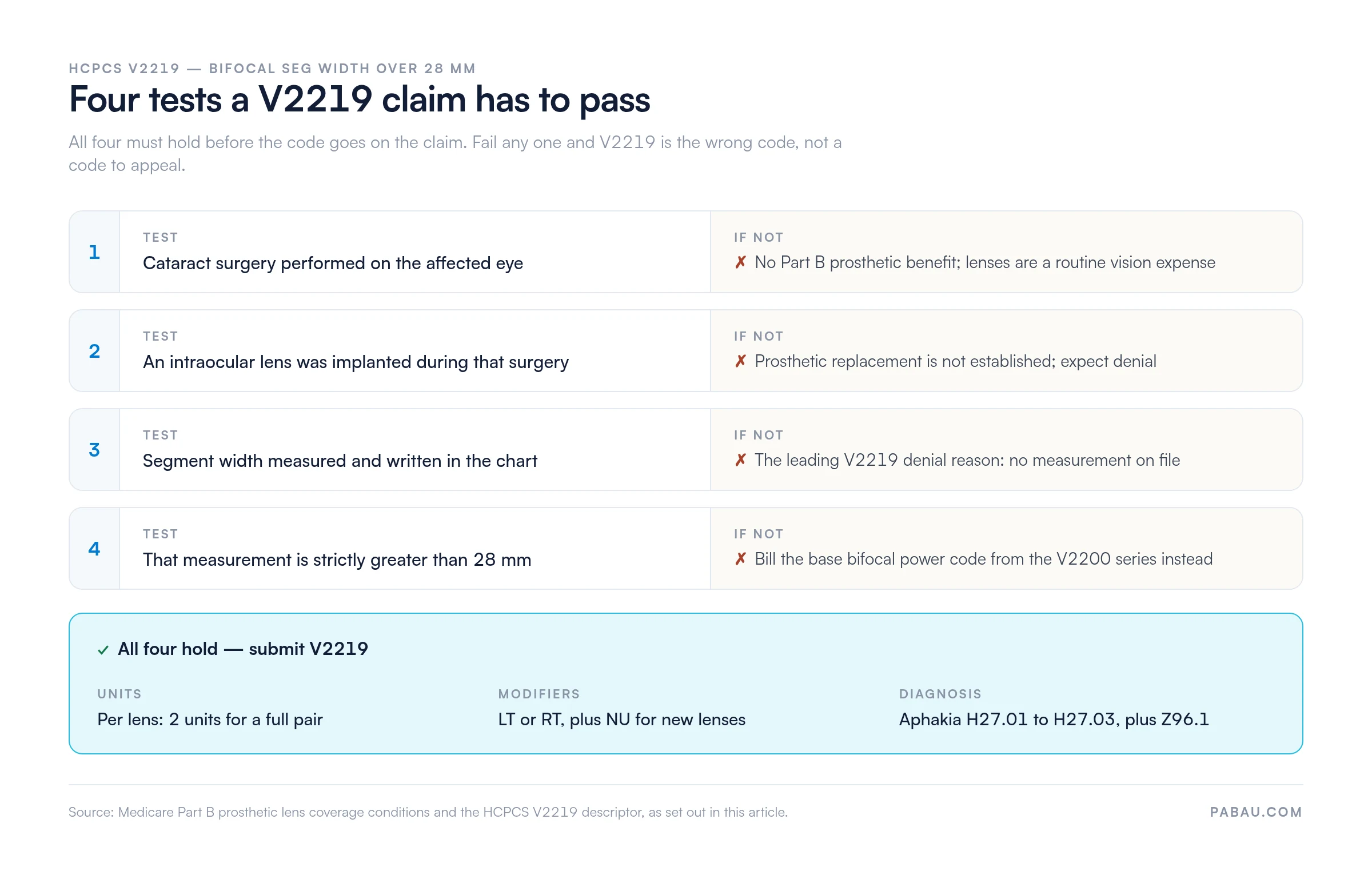
Medicaid coverage for V2219 varies significantly by state. Some state programs cover prosthetic lenses following cataract surgery under the same logic as Medicare; others limit vision benefits to children or emergency services. Always verify with the specific state Medicaid program before billing. Colorado’s Child Health Plan Plus (CHP+) is one example of a state-level vision billing manual that explicitly references HCPCS V-codes for optical dispensing.
Medicare allowable rates for V2219 are set by the Durable Medical Equipment Medicare Administrative Contractors (DME MACs) rather than the Physician Fee Schedule. Geographic adjustment factors mean the national average rate differs from what individual MAC localities pay. Use the CMS Physician Fee Schedule lookup tool to verify current rates by locality before quoting patients or setting practice fees. Build that locality lookup into your pre-service workflow, so the figure you quote matches what the MAC will allow.
Thorough documentation is the single most reliable way to prevent V2219 claim denials. Every element in the checklist below must be present in the patient’s file before the claim goes out. A single missing item, particularly the segment width measurement, is enough for a DME MAC to reject the claim. Compliance work on an optical claim starts at the point of dispensing, not at claims submission.
Add a dedicated field for bifocal segment width to your intake and dispensing forms. When the measurement is captured at dispensing and recorded in the same note as the prescription, it reaches the claim record without a second entry. That one field removes the most common reason V2219 claims come back.
Modifiers communicate essential context to the payer about which eye is being billed, the supply status of the item, and the beneficiary’s eligibility category. Appending the wrong modifier, or omitting a required one, is a fast path to denial.
The table below covers the modifiers most commonly paired with V2219, based on standard HCPCS optical billing conventions. Verify current applicability with your DME MAC, as modifier requirements can change between coverage determinations.
Every V2219 claim requires a supporting ICD-10 diagnosis code that establishes medical necessity. The most defensible codes are those that directly document the post-cataract aphakia status or the acquired absence of the natural lens. Using a code that is too generic or that does not establish a prosthetic need is a common denial trigger.
Pabau’s index of ICD-10-CM codes carries the full descriptor for each aphakia code. That is worth checking when the operative note leaves laterality unclear. The AAPC HCPCS code lookup tool also includes crosswalk guidance for pairing HCPCS V-codes with ICD-10 diagnoses.
V2219 sits within the V2200-V2299 bifocal lens family. Choosing the wrong code from this range is one of the most avoidable billing errors in optical dispensing. V2219 is selected on the segment width measurement alone, while the codes around it are selected on lens power. Use the NLM HCPCS code lookup to verify current descriptions for adjacent codes before submitting claims.
The neighboring power codes turn on prescription values instead. A plano to plus or minus 4.00D sphere with cylinder above 6.00D is billed as V2206, with no segment width condition. The same sphere band with a cylinder of 4.25 to 6.00D is billed as V2205, again with no segment width condition.
Sphere power alone can also decide the code. A bifocal with no cylinder is billed as V2201 when the sphere runs from plus or minus 4.12 to plus or minus 7.00 diopters.
V2219 applies to any standard bifocal lens where the segment width is greater than 28mm. V2299 is reserved for specialty bifocal lenses that fall outside the standard code set and require a written description (the “by report” designation).
Using V2299 for a lens that simply has a large segment is a miscoding that can trigger an audit. If the dispensed lens is a standard bifocal and the segment measurement exceeds 28mm, V2219 is the correct code.
Lens construction decides the code elsewhere in this range too. A lenticular myodisc bifocal is billed as V2215, which applies only when the lab order specifies a myodisc design. An aniseikonic bifocal, designed to equalize image size between the eyes, is billed as V2218.
The six steps below follow the order that prevents most V2219 denials. Each step closes off one of the reasons that turn up on a remittance advice. Working through them before the claim leaves the practice removes most of the rework.
Claim denials for V2219 follow a short list of repeating patterns. Most are preventable at the point of documentation, not at resubmission. Once you know the root cause of each denial type, the intake and dispensing workflow can be designed around it. The errors below then stop reaching the payer at all.
Effective denial management for optical codes starts with a dispensing checklist, not a clearinghouse.
Optical practices submitting HCPCS claims work under the same pressure as any other specialty. The measurement has to be captured at dispensing, the modifiers applied at coding, and the ICD-10 codes paired before submission. Practice management software like Pabau keeps all three steps attached to one patient record.
Pabau’s claims management software lets billing teams configure HCPCS V-code templates with pre-attached modifiers and linked diagnosis codes. That removes several manual steps between dispensing and submission.

The workflow also supports per-unit billing controls, so a bilateral lens order stays as two lines instead of collapsing into one. Eligibility checks, remittance processing and denial tracking sit in the same platform, so a V2219 claim never leaves the patient record to be worked.
Run a quarterly audit of your V2219 claims against the denial reason codes in your DME MAC remittance files. Track the three categories that come up most often, then update the dispensing checklist to close each one. A denial category that survives two quarters usually points at a missing field on the form.

Pabau’s claims management module handles HCPCS code entry, modifier attachment and ICD-10 pairing. Your team spends less time correcting claims and more time with patients.

V2219 is a narrow code. It covers bifocal lenses with a segment width strictly over 28mm, billed per lens as a Medicare prosthetic benefit after cataract surgery. Most denials trace back to one omission at the dispensing desk, where the measured width never reaches the note.
So the work sits on the dispensing form rather than in the billing queue. Make segment width a required field there, and every V2219 claim carries its own proof of medical necessity before anyone codes it.
Pabau builds HCPCS code templates with pre-configured modifiers and diagnosis pairings, so V2219 submissions leave the practice correctly structured. To see how Pabau handles optical billing from dispensing through remittance, book a demo with the team.

Need a complete overview of medical billing workflows? What is medical billing covers the end-to-end process from patient encounter through payment posting.
Struggling with recurring claim rejections? Denial codes in medical billing breaks down common CARC codes and how to resolve them.
Want to reduce claim errors across your practice? Medical billing compliance outlines the documentation and process controls that keep HCPCS claims audit-ready.
HCPCS code V2219 is a Level II billing code for a bifocal lens with a segment width greater than 28mm. It is used on Medicare Part B, Medicaid and private insurance claims for optical and ophthalmology services. It falls within the V2020-V2799 vision services range and is classified as a permanent, active code for 2026.
Use V2219 only when the bifocal lens segment width is strictly greater than 28mm. At exactly 28mm the code does not apply, so bill the base bifocal power code that matches the prescription. V2299 is for specialty bifocal lenses by report and is not interchangeable with V2219.
Yes, Medicare Part B covers V2219 as a prosthetic lens benefit when the patient has had cataract surgery with IOL implantation. This coverage is a post-surgical prosthetic benefit, not a routine vision benefit, so the patient’s surgical record must be on file. Standard Part B cost-sharing applies.
LT (left eye) or RT (right eye) modifiers indicate which lens is being billed. NU (new equipment) applies when the lenses are purchased new, which covers the majority of claims. KH is added for the initial claim under Medicare’s capped purchase benefit. Always verify current modifier requirements with your DME MAC.
V2219 covers standard bifocal lenses with a segment width over 28mm. V2299 is a “specialty bifocal by report” code for non-standard bifocal designs. Those lenses fall outside the standard code set and need a written description submitted with the claim. Using V2299 for a lens that simply has a large segment is a miscoding that can trigger a payer audit.
Required documentation includes a valid prescription specifying bifocal lenses and a recorded segment width measurement exceeding 28mm. You also need a medical necessity statement, the cataract surgery operative note confirming IOL implantation, and the ordering and dispensing provider details. The segment width measurement is the most commonly missing element and the leading cause of denials.