Inpatient billing cheat sheet
An inpatient billing cheat sheet is a quick reference for the codes and claim ru...

Last Updated: Oct 19, 2026
Q4171 is the HCPCS Level II code for Interfyl, 1 mg, a non-sheet skin substitute applied to chronic wounds. From January 1, 2026, CMS pays for Interfyl as an incident-to supply. The national rate is $127.14 per square centimeter of documented wound surface area.
That rate replaced the per-milligram, ASP-based pricing used through 2025. Report the code with HCPCS application codes G0681-G0684, not CPT 15271-15278, which now cover sheet-form products only. Coverage still varies by jurisdiction after the December 2025 LCD withdrawals.
Let Pabau's smart automation suggest the right codes, reduce claim denials, and keep your practice compliant—effortlessly.
Automate repetitive tasks and focus on what matters most—your patients.
Reduce coding errors and ensure compliance with the latest regulations.
Clean claims, fewer denials, and faster reimbursements.
Powerful insights and reporting to help your practice thrive.
HIPAA compliant SOC 2 certified GDPR-compliant Trusted by 4,000+ clinics worldwide

Q4171 is the HCPCS Level II code for Interfyl, 1 mg, a non-sheet cellular and tissue-based product applied to chronic wounds
From January 1, 2026, CMS pays for Interfyl as an incident-to supply at a single national rate of $127.14 per square centimeter of wound
Payment now follows the documented wound surface area, so the per-milligram, ASP-based pricing that applied through 2025 no longer sets the allowed amount
Pair Q4171 with HCPCS application codes G0681-G0684, not CPT 15271-15278, which remain correct only for sheet-form skin substitutes
Practice management software like Pabau captures the wound measurements, treatment history, and ICD-10 diagnoses that a payable CTP claim needs
HCPCS code Q4171 is the billing code for Interfyl, 1 mg, a human placental connective tissue matrix. It is applied to chronic wounds that have not responded to conventional care. The code belongs to HCPCS Level II, which CMS maintains for products, supplies, and services that CPT does not capture.
Interfyl is a flowable, non-sheet cellular and tissue-based product (CTP). Sheet-form skin substitutes are cut to shape and laid onto the wound bed. A non-sheet product is packed or injected into the wound instead, which is why it carries its own application codes.
That classification now decides almost every billing question on the claim. It sets which application code you report, which payment rule applies, and which measurement in the clinical note supports the allowed amount.
CMS rebuilt skin substitute payment in the CY 2026 Physician Fee Schedule final rule (CMS-1832-F). Products such as Interfyl are now paid as incident-to supplies when they form part of a covered application procedure.
The change was driven by spending. Part B outlays on skin substitutes grew from $252 million in 2019 to more than $10 billion in 2024. Average sales price pricing was the mechanism behind that growth.
Any Q4171 reference written before 2026 will describe the retired model. The table below sets the two side by side so you can check your own claim templates against the current rules.
One point survives the change intact. The HCPCS descriptor for Q4171 is still Interfyl, 1 mg in the 2026 code set, so milligrams remain the unit of the product itself. They simply no longer calculate the payment.
Medicare Part B covers Interfyl when the claim carries a covered ICD-10 diagnosis, the correct application code, and supporting documentation. That documentation has to meet your Medicare Administrative Contractor’s coverage criteria. Payment reform did not create a national coverage policy, so the jurisdiction you bill in still decides the answer.
Coverage got harder to research at the end of 2025. On December 24, 2025, the A/B MACs withdrew the Local Coverage Determinations for skin substitute grafts in diabetic foot ulcers and venous leg ulcers. Those policies had been due to take effect on January 1, 2026.
The withdrawal left an uneven map. Novitas, CGS, and First Coast kept their earlier skin substitute policies in force, and the retirement dates on those documents were removed. Other contractors now review these claims without an active LCD to point to.
Commercial and Medicaid managed care plans set their own rules regardless. At least one plan, Superior Health Plan, lists Interfyl as a non-covered benefit. Verifying the patient’s benefits before the application date keeps Q4171 off a plan that will never pay it.
The table reflects the position after the December 2025 withdrawals. Contractor policy on CTPs moves quickly, so treat it as a starting point and confirm against your MAC’s current coverage documents before you bill.
An absent LCD is not an approval. Where no policy exists, the reviewer falls back on general medical necessity rules, and the clinical note carries the whole argument for the claim.
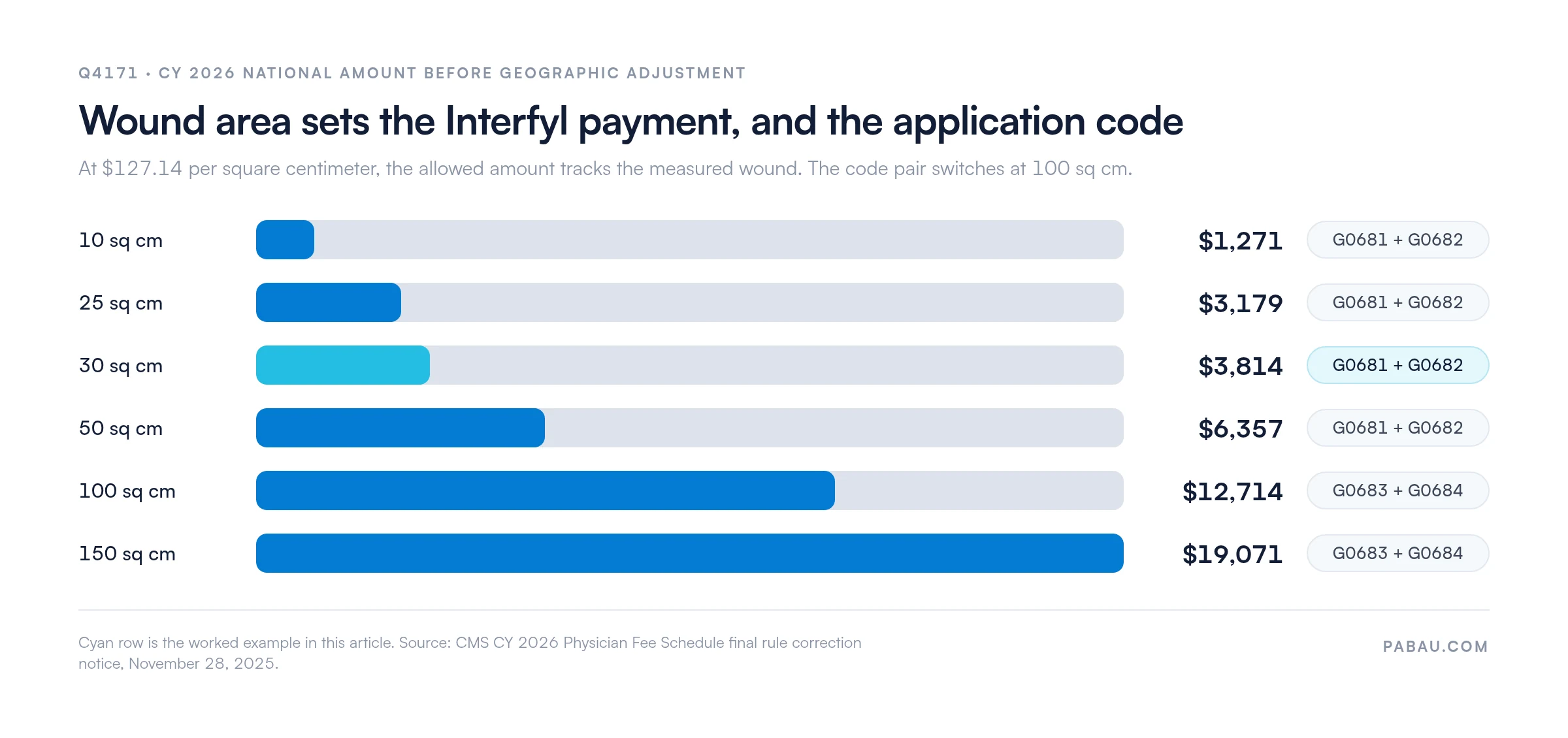
For dates of service on or after January 1, 2026, Medicare pays for Interfyl at a single national rate. That rate is $127.14 per square centimeter of documented wound surface area. CMS set that figure in a correction notice to the CY 2026 final rule, published on November 28, 2025.
The correction matters if you built a fee schedule in November 2025. The original final rule carried $127.28 per square centimeter, and CMS revised it down to align the physician office rate with the hospital outpatient rate.
Underneath the headline number is a relative value calculation. CMS assigned 3.81 total RVUs to the applicable non-sheet product codes. Your allowed amount is those RVUs multiplied by the documented wound area in square centimeters, adjusted by your locality’s GPCIs and the conversion factor.
A worked example makes the scale clear. A 30 sq cm venous leg ulcer treated with Interfyl attracts roughly $3,814 nationally before geographic adjustment, because 30 multiplied by $127.14 is $3,814.20. The chart below runs the same arithmetic across the wound sizes a wound care practice sees most.
Discarded product no longer adds to the payment. Under the old model, wasted milligrams could be reported with the JW modifier. That route closed when the product stopped being priced as a biological. Work the square-centimeter math out before you order stock, not after.
Record wound length and width in centimeters at every Interfyl application, and write the calculated surface area into the note as a number. That figure, not the milligrams applied, sets the CY 2026 allowed amount. A note that logs only the product quantity will not support the payment on audit. Add a surface area field to your wound care template rather than leaving staff to calculate it later.
Billing Interfyl takes more than putting Q4171 on a claim form. The product code travels with a HCPCS application code, a covered diagnosis, and a measured wound. A clean Q4171 claim follows this sequence:
Practices that build these steps into the visit rather than the billing queue see far fewer Q4171 edits. A practice running claims management software can catch a missing wound measurement before the claim reaches the clearinghouse.
CMS created four HCPCS Level II codes for applying non-sheet skin substitutes: G0681 through G0684. The codes were established effective April 1, 2026, and MACs instruct providers to report them for dates of service on or after January 1, 2026.
Which code you pick turns on one threshold. Wounds smaller than 100 sq cm use the 25 sq cm pair. Wounds of 100 sq cm or more use the 100 sq cm pair.
The descriptors also cover pediatric measurement. For infants and children, G0683 and G0684 are reported in increments of 1% of body area rather than fixed square centimeters.
CPT codes 15271 through 15278 were not deleted, and plenty of wound care claims still use them correctly. They describe the application of a sheet-form skin substitute, which is trimmed to the wound and fixed in place. Biovance, another Celularity product, is billed with HCPCS code Q4154 and a companion CPT code from that series.
Interfyl is not supplied in sheet form, so those codes stopped being the right pairing for Q4171 once the G series arrived. Reporting a non-sheet product with a sheet-form CPT code is the error most likely to trigger an edit in 2026.
Debridement codes 97597 and 97598 sit in a separate category again. They describe wound preparation rather than product application, and contractors often bundle debridement performed on the same wound on the same day. Check your MAC’s edits before you report both.
Every Q4171 claim needs an ICD-10-CM diagnosis that reflects the documented wound. A code taken from a covered list must still describe the wound in front of you. Picking an accurate code that the contractor excludes will produce a denial.
The categories below are the wound types contractors have historically recognized for CTPs. Where your MAC no longer holds an active policy, the diagnosis still has to justify the treatment in the record. The ICD-10-CM codes reference carries the full descriptor behind each code in the table.
Documentation failure is the leading cause of Q4171 denial, and the CY 2026 rules raised the stakes on one field in particular. Because payment follows wound surface area, a note without a measurement no longer supports the amount billed. Build the requirements into the wound care template so staff capture them during the visit.
Required documentation for Q4171 billing includes:
Product quantity is still worth recording even though it no longer prices the claim. Lot numbers and expiration dates support traceability. An auditor reading a note that omits them cannot tie the application to a specific unit of product.
Practices that link the wound care template to the charge capture screen miss fewer required fields. Joining the documentation to the billing output from the first visit cuts rework in pre-submission audits.
Build a wound care visit checklist that mirrors what a reviewer will look for. At each Interfyl application, prompt staff to record wound length and width plus the calculated surface area in square centimeters. Add prior treatment duration in weeks, the product lot number, and the treating physician. Those five fields answer most of the questions that arrive with a post-payment audit letter.
Medicare fee-for-service generally does not require prior authorization for CTP applications, and the CY 2026 payment changes did not introduce one. Other payers are a different matter. Confirming the rules through your claim denial management process before the application date beats appealing afterwards.
Q4171 sits in a Q-code series that runs to hundreds of skin substitute products. When a different product is clinically indicated, coders report the code for the product actually applied. Billing a neighboring product’s code is a coding error, even where the clinical result would be similar.
The form of each product decides its application code, which is where most 2026 mistakes start. The AAPC HCPCS code lookup is a quick way to confirm a descriptor before you commit to a pairing.
All five products now draw the same $127.14 per square centimeter, so the product you choose no longer changes the payment. What it changes is the code family on the claim, and a mismatch between product form and application code is what produces the edit. Practices running several CTPs should check the form of each product against its application code before submission.
A Q4171 reference tells you which codes to use. It cannot tell you whether the wound was measured at this visit, and that is where most denied claims come apart.
A practice that codes from a guide but writes notes in a separate system hits this often. The codes come out correct, and the record behind them will not support the claim.
Practice management software like Pabau closes that distance by holding the clinical record and the billing output in one place. Structured patient records capture wound measurements at each visit, product lot numbers, prior treatment history, and the ICD-10 diagnosis tied to the treatment.
Under the CY 2026 rules, that surface area field is worth money. Prompting for it during the visit protects the claim before anyone opens the billing queue. Staff record it once, and the claim carries it.
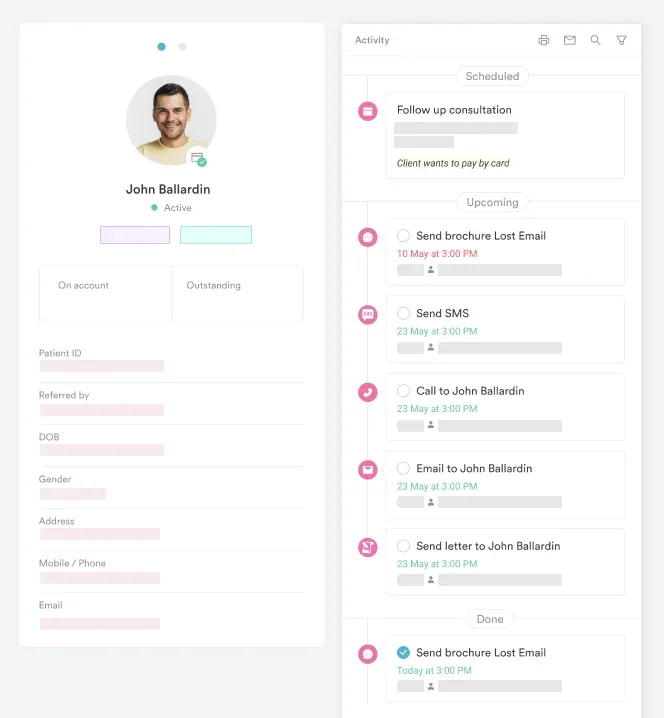
Linking notes to billing also cuts the time spent preparing records for a MAC audit. Clean claim rates rise when the documentation feeding the billing system is structured from the first visit.

Pabau’s claims management and clinical documentation tools help wound care practices capture every required field before a CTP claim goes out. See how structured workflows protect your reimbursement under the 2026 skin substitute rules.

Q4171 is easy to look up and harder to bill cleanly, and 2026 moved most of the difficulty. The product code still reads Interfyl, 1 mg. Payment now rests on a measured wound and a single national rate of $127.14 per square centimeter.
Three habits carry the claim. Confirm your contractor’s coverage position before the application date, and record the wound surface area in the note at every visit. Then pair the product code with G0681-G0684 rather than the sheet-form CPT codes.
Any Q4171 workflow written before 2026 needs checking against all three. Templates built around milligram quantities and CPT 15271-15278 will keep producing denials until someone updates them.
To see how Pabau keeps the wound measurement and the Q4171 line on the same record, book a demo with our team.

Applying a different skin substitute? HCPCS code Q4170: Cygnus skin substitute billing guide covers the coding and coverage rules for another Q-series product.
Billing a sheet-form graft instead? CPT code 15271: Skin substitute graft billing guide explains the application codes that still fit sheet products.
Need the bioengineered product rules? HCPCS code Q4156: Billing guide for bioengineered skin substitutes walks through units, coverage, and documentation.
Debriding the wound at the same visit? CPT code 97597: Active wound care management billing guide sets out when debridement is reported separately.
Working with Apligraf? HCPCS code Q4101: Apligraf billing guide for wound care details the coverage criteria for that product.
HCPCS code Q4171 is the billing code for Interfyl, 1 mg. Interfyl is a non-sheet cellular and tissue-based product applied to chronic wounds under Medicare Part B. Its HCPCS descriptor still reads in milligrams. From January 1, 2026, Medicare pays for it as an incident-to supply priced on documented wound surface area.
Medicare pays a single national rate of $127.14 per square centimeter of documented wound surface area for CY 2026. CMS assigned 3.81 total RVUs to the applicable non-sheet product codes. Your allowed amount is those RVUs multiplied by the wound area, then adjusted by local GPCIs and the conversion factor. A 30 sq cm wound therefore attracts roughly $3,814 nationally before geographic adjustment.
No. The HCPCS descriptor for Q4171 is still Interfyl, 1 mg, so milligrams remain the unit of the product itself. Payment no longer follows that unit. From January 1, 2026, CMS pays for skin substitutes as incident-to supplies. Payment follows the documented wound surface area in square centimeters, not the volume or weight of product used.
Pair Q4171 with HCPCS codes G0681 to G0684, which describe the application of a non-sheet form skin substitute. G0681 and G0682 cover wounds under 100 sq cm, in 25 sq cm increments. G0683 and G0684 cover wounds of 100 sq cm or more, in 100 sq cm increments. Report the application code on the same claim and same date of service as the product code.
No, CPT 15271 through 15278 remain valid. They now apply to sheet-form skin substitutes only, which are trimmed and laid onto the wound bed. Interfyl is supplied in non-sheet form, so those codes are no longer the correct pairing for Q4171. Using them with a non-sheet product is one of the most common 2026 claim edits.
Traditional Medicare fee-for-service generally does not require prior authorization for Q4171, and the CY 2026 payment changes did not add one. Medicare Advantage plans, Medicaid managed care organizations, and commercial payers often do require it. Verify the requirement with the specific plan before applying Interfyl, because rules differ widely across payers.
It depends on your jurisdiction. On December 24, 2025, the A/B MACs withdrew the skin substitute LCDs for diabetic foot ulcers and venous leg ulcers. Those policies had been due to start on January 1, 2026. Novitas, CGS, and First Coast kept their earlier policies in force, while several other contractors now review these claims without an active LCD.