CPT Code 62284: Injection procedure for myelography
CPT Code 62284: official descriptor and procedure overview The American Medical ...

Last Updated: Oct 19, 2026
L1210 is the HCPCS Level II code for an addition to a low-profile thoracic-lumbar-sacral orthosis (TLSO): a lateral thoracic extension. It covers the extension only, and the brace it attaches to is billed under base code L1200.
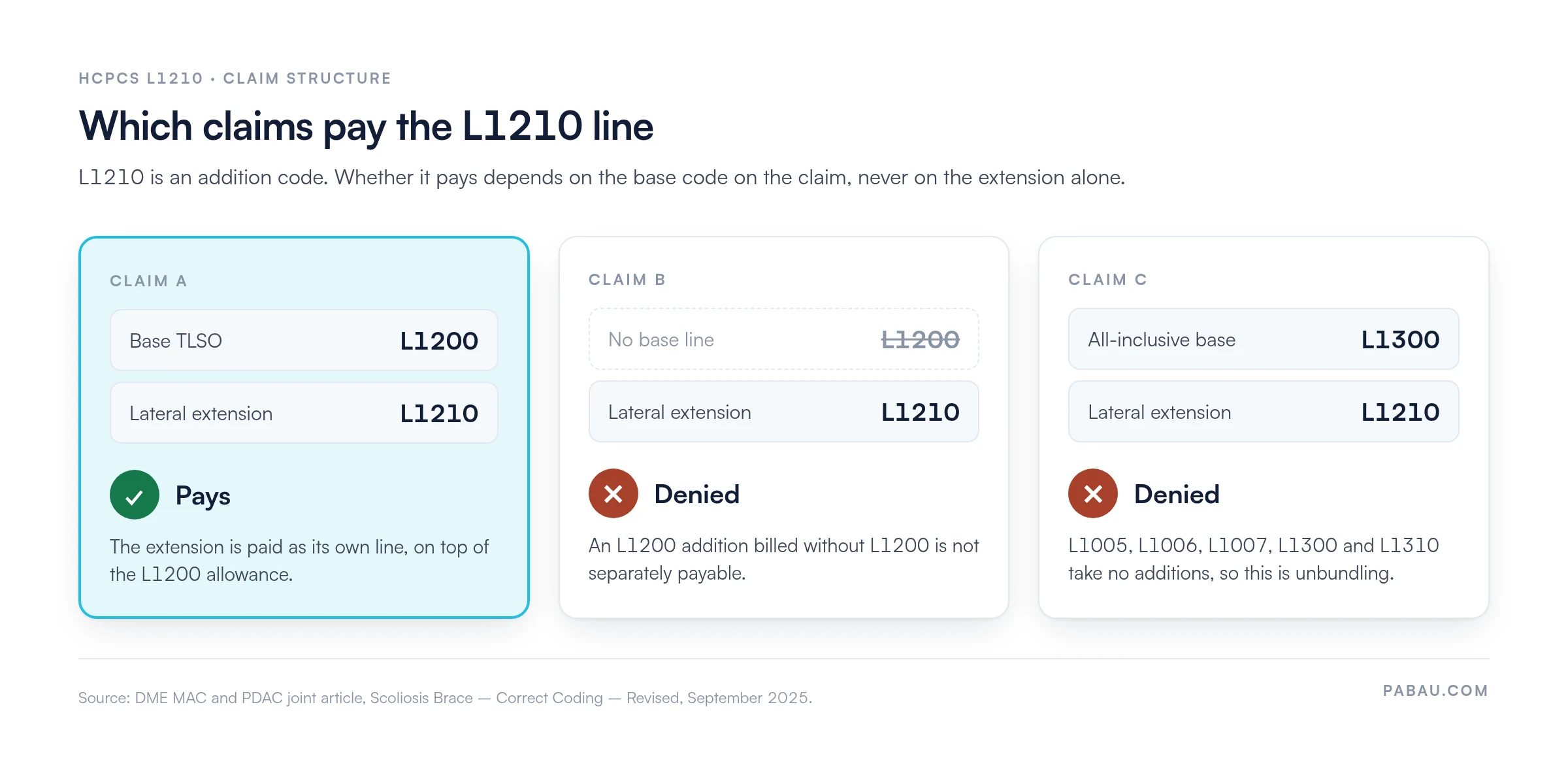
L1210 is an addition code, so it pays only when L1200 sits on the same claim. Billed alone, or added to an all-inclusive scoliosis code such as L1300 or L1310, the line is denied. Ankle foot orthoses are coded separately, in the L1900-L1990 range.
Let Pabau's smart automation suggest the right codes, reduce claim denials, and keep your practice compliant—effortlessly.
Automate repetitive tasks and focus on what matters most—your patients.
Reduce coding errors and ensure compliance with the latest regulations.
Clean claims, fewer denials, and faster reimbursements.
Powerful insights and reporting to help your practice thrive.
HIPAA compliant SOC 2 certified GDPR-compliant Trusted by 4,000+ clinics worldwide

HCPCS code L1210 describes a lateral thoracic extension added to a low-profile TLSO, and the brace itself is billed separately.
L1210 is an addition code, so it pays only when base code L1200 sits on the same claim.
The scoliosis codes L1005, L1006, L1007, L1300 and L1310 are all-inclusive, so billing L1210 with any of them is unbundling.
L1210 is a spinal orthosis addition, so scoliosis diagnoses support it and foot drop or ankle codes do not.
Clean L1210 claims rest on an order and clinical notes that name the lateral extension separately from the base TLSO.
HCPCS code L1210 is the Level II HCPCS code for “Addition to TLSO, (low profile), lateral thoracic extension.” It describes one component added to a low-profile thoracic-lumbar-sacral orthosis (TLSO). The brace itself is billed under base code HCPCS code L1200.
Medicare processes these claims through the Durable Medical Equipment Medicare Administrative Contractors (DME MACs). They and the Pricing, Data Analysis and Coding (PDAC) contractor list L1210 as one of nine additions to L1200.
Their joint scoliosis brace correct coding article was last revised in September 2025. Each addition is paid as its own line, on top of the base orthosis allowance.
Some code lists and billing libraries still label L1210 as an ankle foot orthosis (AFO). That label is wrong, and a claim built on it fails twice. The descriptor does not match the device, and an ankle diagnosis cannot support a spinal addition.
AFOs are coded in the L1900-L1990 range. If your system shows L1210 as an ankle brace, correct the descriptor in the code library before the next scoliosis brace goes out.
A low-profile TLSO is the underarm style of scoliosis brace. It wraps the trunk from the pelvis to below the armpits, with no neck ring or superstructure. It controls the curve through pads and trimlines built into the shell.
A lateral thoracic extension carries one side of that shell higher up the chest wall. The extra height gives the orthotist a contact point at a higher thoracic level than the standard trimline reaches. It is usually prescribed when the curve’s apex sits too high for the base shell to control.
The extension is not included in the L1200 allowance, which is why it has its own code. That also means the clinical notes have to justify it on its own terms. A diagnosis that supports the base brace does not explain why the shell needs the extra height.
L1210 cannot be billed as a standalone code. The DME MACs state that L1200 additions billed without L1200 are denied as not separately payable. The extension has no meaning as a device without the orthosis it is built into.
The base code has to be L1200 specifically. L1000, the Milwaukee-style cervical-thoracic-lumbar-sacral orthosis (CTLSO), has its own additions in the L1010-L1120 range. An L1210 line next to L1000 is still a line without its base.
Five scoliosis codes take no additions at all: L1005, L1006, L1007, L1300 and L1310. The DME MACs treat any addition billed with them as unbundling. The same applies to L0999 or L1499 used for a feature that a specific L-code already describes. The three claims below show how the base code decides the outcome.
One code in the L1200-L1290 range is the base orthosis and the other nine are additions to it. Knowing which is which keeps the claim structured correctly and stops a component from being billed twice.
The code most often confused with L1210 is HCPCS code L1220. Both are thoracic extensions, so the only difference is direction. L1210 raises the side of the shell, while L1220 raises the front.
A brace can carry both extensions, and each is billed once on the same claim as L1200. The fabrication record should show where each extension sits, so a reviewer can match the codes to the device.
Scoliosis braces are covered under the Medicare braces benefit. The Spinal Orthoses: TLSO and LSO policy article sets the test. The orthosis must be rigid or semi-rigid and support a weak or deformed body member. A spinal curve braced to slow its progression fits that definition.
Coverage for the base brace does not carry the extension with it. The ordering clinician’s records must explain why this patient’s curve needs the extra lateral contact.
Payment runs through the durable medical equipment, prosthetics, orthotics and supplies (DMEPOS) fee schedule, not the Physician Fee Schedule. Allowables vary by state and are updated quarterly. Pull the figure for your state from the CMS DMEPOS fee schedule before you quote or post a payment.
Run insurance eligibility verification before fabrication starts, not after delivery. A lapsed policy or a Medicare Advantage plan with its own orthotics rules is cheaper to find before the brace is built.
Ask the prescriber to itemize the components on the order: the L1200 TLSO, then each addition by name. An order that says only scoliosis brace leaves the L1210 line without support on review. Fixing the order template once costs less than reworking every claim it touches.
L1210 takes a small set of standard HCPCS modifiers. Check each one against your DME MAC’s current guidance and the payer’s own policy before you submit.
Keep the same modifier logic on the base line and the addition line. A KX on L1210 with no KX on L1200 tells a reviewer that the two lines were coded separately, often by different people.
The RT and LT laterality pair belongs to limb orthoses such as AFOs. If an L1210 line arrives with RT or LT already attached, check the line’s history, because it was probably carried over from an ankle-code setup.
L1210 is supported by the same spinal diagnosis that supports the L1200 base line. Because the extension works at the thoracic level, thoracic and thoracolumbar region codes are the usual match. Confirm the full code in the ICD-10-CM code reference before it goes on the claim.
Foot drop, hemiplegia and ankle instability codes do not support L1210. They belong to ankle foot orthosis claims, and pairing one with a TLSO addition is an automatic mismatch on review.
Reviewers also look past the code itself. They expect the curve type, the apex level and the Cobb angle in the notes, along with a reason for the lateral extension. Record those details, so the addition line stands on its own.
Each document has to cover the base TLSO and the lateral extension separately. A complete file for the base brace with no mention of the extension still leaves the L1210 line exposed.
Keep the full file for the payer’s audit lookback period. Good billing compliance habits matter most on addition codes, because a reviewer checks every line separately.
L1210 denials cluster around a handful of coding and documentation errors. Each one is cheaper to catch at intake than on appeal.
Structured denial management turns each of these into an upstream control. Every denial code your DME MAC returns points at one missing document or one coding error. A clean claim on the first pass is faster than any appeal.
Orthotics teams often split this work across several systems. The clinical note sits in the EMR, the signed order sits in a scanned folder, and the claim is keyed into a separate billing tool. Each rekey is a chance for the addition line to lose its base.
Pabau, the practice management platform we build, keeps the patient record and the claim in the same system. The HCPCS codes on the service land on the CMS-1500 charge lines, and diagnoses come from the patient’s recorded problem list.
Pabau’s claims management checks required fields before submission, then sends the claim through the Claim.MD clearinghouse in the US.
Claim status and remittances sit on the same screen as the record. So the biller chasing an L1210 denial can see the order, the notes and the base line together.

Pabau builds the CMS-1500 from the patient record, checks required fields before submission and tracks each claim through Claim.MD. Orthotics teams spend less time rekeying DME claims.

HCPCS code L1210 is a small line with one hard rule: it pays only beside L1200. Most L1210 losses come from treating it as something else. That means billing it as an ankle brace, adding it to an all-inclusive scoliosis code, or leaving the extension out of the order.
Fix the descriptor in your code library, itemize the order, and make L1200 a hard requirement on every L1210 claim. The cost is a little more work at intake, before the brace is built. That trade is worth it on a code that a reviewer reads line by line.
Book a demo to see how Pabau keeps each TLSO addition tied to its base code, from order to payment.

Want to understand how the broader billing cycle connects to L1210 claims? Revenue cycle management fundamentals explains how DMEPOS billing fits into the full patient-to-payment workflow.
Adding a lumbar derotation pad to the same TLSO? HCPCS code L1240 covers the lumbar derotation pad, another L1200 addition billed as its own line beside the base.
Billing a derotation pad on the same brace? HCPCS code L1260 covers the anterior thoracic derotation pad, another L1200 addition with the same base-code rule.
HCPCS code L1210 is the Level II code for an addition to a low-profile TLSO: a lateral thoracic extension. It covers the extension only, and the brace itself is billed under base code L1200.
No. L1210 is a spinal orthosis addition in the L1200-L1290 TLSO range. Ankle foot orthoses are coded in the L1900-L1990 range, so a billing library that labels L1210 as an AFO needs correcting.
No. The DME MACs deny L1200 additions as not separately payable when L1200 is missing from the claim. Bill L1200 as the base line and L1210 as a separate line on the same claim.
No. L1300 and L1310 are all-inclusive scoliosis codes, as are L1005, L1006 and L1007. Billing any addition with them is treated as unbundling.
Both are thoracic extensions added to an L1200 TLSO. L1210 raises the side of the shell, while L1220 raises the front. A brace can carry both, each billed once on the same claim.
Scoliosis codes support L1210, usually in the thoracic or thoracolumbar region. Examples include M41.124 and M41.125 for adolescent idiopathic scoliosis, M41.44 for neuromuscular scoliosis and Q76.3 for congenital scoliosis.