HCPCS Code Q4185: Cellesta flowable amnion billing guide
HCPCS Code Q4185: definition and official descriptor HCPCS Code Q4185 is the Lev...

Last Updated: Nov 20, 2026
L1250 is the HCPCS Level II code for an addition to a low-profile TLSO: an anterior ASIS pad. It covers the pad only, and the brace it attaches to is billed under base code L1200.
Billed without L1200 on the same claim, the L1250 line is denied as not separately payable. Neighboring codes L1240, L1260 and L1270 are different pads, so a brace carrying more than one takes a line for each.
Let Pabau's smart automation suggest the right codes, reduce claim denials, and keep your practice compliant—effortlessly.
Automate repetitive tasks and focus on what matters most—your patients.
Reduce coding errors and ensure compliance with the latest regulations.
Clean claims, fewer denials, and faster reimbursements.
Powerful insights and reporting to help your practice thrive.
HIPAA compliant SOC 2 certified GDPR-compliant Trusted by 4,000+ clinics worldwide

HCPCS code L1250 bills one component: an anterior ASIS pad added to a low-profile TLSO, not a brace of its own.
L1250 pays only when base code L1200 is on the same claim. Billed alone, the line is denied as not separately payable.
L1250 is not a lumbar sacral orthosis (LSO) code. LSOs sit in the L0621 to L0651 range under a different coverage policy.
Neighboring codes L1240, L1260 and L1270 are different pads, so each pad on the brace takes its own line.
The order and the orthotist’s fitting notes must name the ASIS pad and say why this patient needs it.
HCPCS code L1250 is the Level II code for “Addition to TLSO, (low profile), anterior ASIS pad.” It bills a pad fitted over the anterior superior iliac spine (ASIS), inside a low-profile thoracic-lumbar-sacral orthosis (TLSO).
The brace itself goes on its own line under base code L1200. Without that base line, L1250 does not pay. That one rule explains most of what goes wrong with this code.
The Centers for Medicare & Medicaid Services (CMS) maintains the HCPCS Level II code set. L1250 sits in the low-profile TLSO additions, L1200 to L1290, within the orthotic procedures section.
CMS revises the HCPCS Level II file every year. Confirm the L1250 descriptor in the current file before you build the claim.
Each phrase in the official descriptor answers a different billing question. Read together, they tell you what the line is, what it needs beside it, and where the pad sits.
The descriptor does not mention a lumbar sacral orthosis, rigid panels or uprights. Some online code summaries describe L1250 that way, and that description belongs to a different code family.
A low-profile TLSO is an underarm brace. It wraps the trunk from the pelvis to below the arms, and its lower edge rests around the pelvis. The anterior superior iliac spine is the bony point you can feel at the front of each hip.
The L1250 pad lines the inside of the brace where it meets that bony point. The orthotist adds it when the fitting calls for padded contact at the front of the pelvis. The fitting record should say where the pad sits and why it was added.
L1250 pays for the pad only. The TLSO body is the L1200 line, and every other pad or extension on the brace carries its own addition code.
The joint DME MAC and PDAC article on scoliosis brace correct coding, revised September 25, 2025, sets the rule. Addition codes are denied as not separately payable when billed without the related base code, L1200.
The same article lists five all-inclusive codes: L1005, L1006, L1007, L1300 and L1310. Adding L1250 to any of them is treated as unbundling. So the code on the line above L1250 decides one of three outcomes.
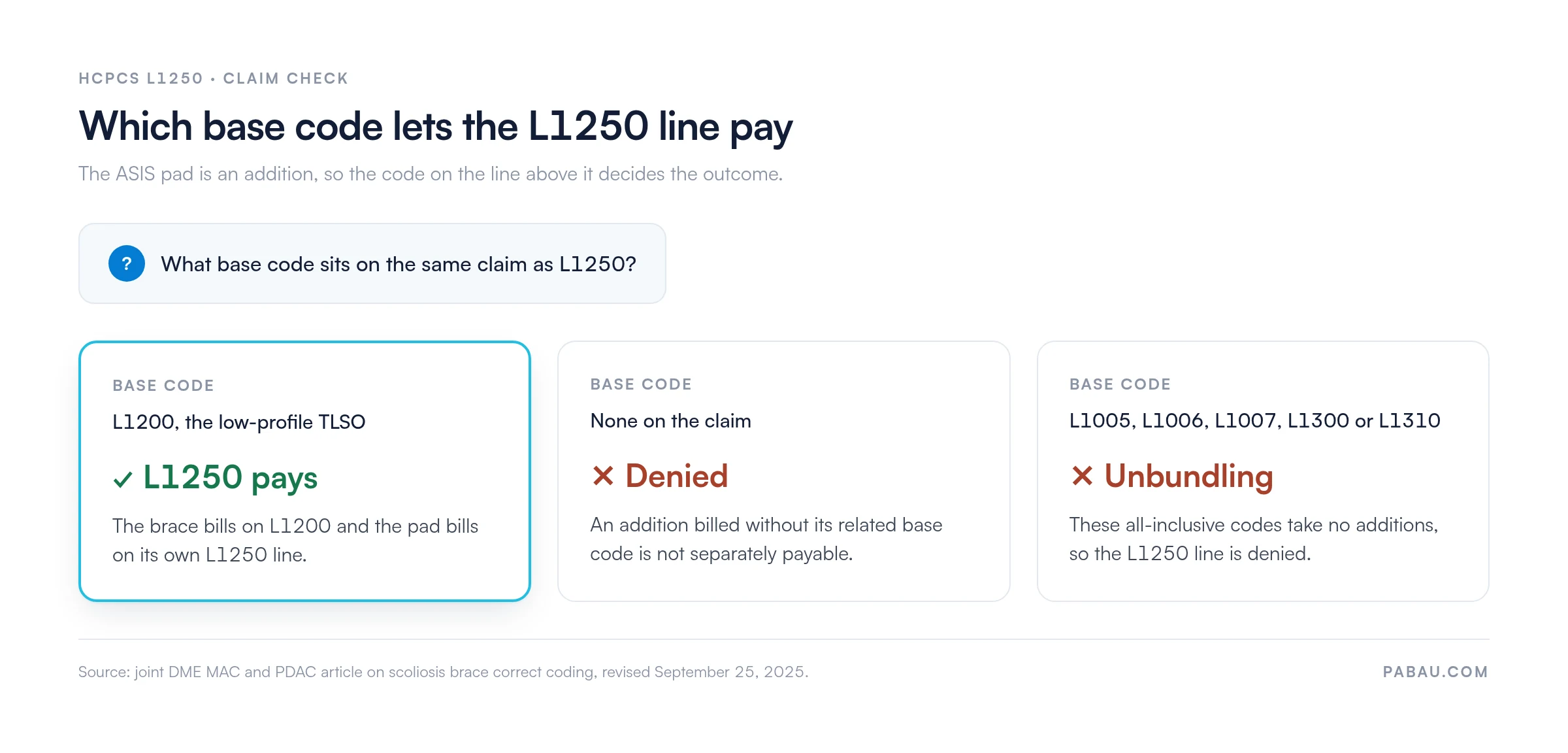
Here is how a clean claim moves from order to payment:
Here is an illustrative claim. A 13-year-old patient is fitted with a low-profile TLSO for adolescent idiopathic scoliosis. The orthotist adds an anterior ASIS pad, a lumbar derotation pad and an abdominal pad.
Every line links to the diagnosis that supports the brace. For this patient that comes from category M41, such as M41.125, adolescent idiopathic scoliosis, thoracolumbar region. Pick the code that matches the documented curve.
If the fitting record mentioned only “pads added,” the coder could not tell which codes apply. Naming each pad and its position is what lets lines 2 to 4 stand up, with L1240 and L1270 each matched to its own pad.
The low-profile TLSO additions each describe a different pad, extension or gusset. Choose the code from the pad’s position in the fitting record, not from a short description.
Two codes outside this family also cause confusion. L0450 is a prefabricated flexible TLSO under the spinal orthoses policy, so it is a different brace and not a base for L1250. Lumbar sacral orthoses sit in L0621 to L0651.
Ask for the orthotist’s fitting record before you code. It names each pad and where it sits. The anterior ASIS pad then lands on the L1250 line, and every other pad gets its own code.
Medicare Part B covers L1250 as a DMEPOS item when the records support the pad. Coverage of the base TLSO does not carry the pad with it, so the file has to show why this patient needs it.
The spinal orthoses LCD, L33790, Spinal Orthoses: TLSO and LSO, addresses codes L0450 to L0651. L1250 sits outside that range. Its coding rules come from the scoliosis brace article above.
CMS updates the DMEPOS fee schedule each January, with quarterly revisions. Pull the current allowed amount for your state before you quote a patient.
Modifiers tell the payer whether the item is new and whether the patient was warned about possible non-coverage. Apply them to the L1200 and L1250 lines separately.
KX is the one to watch. The spinal orthoses policy asks for KX on some TLSO and LSO codes, but L1250 is outside it. Confirm with your DME MAC before you carry KX across from LSO habits.
Build the file at intake, not after a denial arrives. Good medical billing compliance means each item below is on file before the claim goes out.
Notes that justify the brace but never mention the pad leave the L1250 line exposed. One sentence on why the ASIS pad was added protects it.
Run this list against every claim that carries L1250. Each point maps to a denial reason you can still prevent.
L1250 denials usually trace back to its add-on structure or to a wrong description of the code. The table pairs each mistake with the fix.
The remittance names the problem through its denial codes. Grouping L1250 denials by reason shows which step to fix first, and steady denial management keeps them from recurring.
Check the current CMS Required Prior Authorization List for DMEPOS before the brace is made. CMS revises that list, so confirm it each time rather than relying on last year’s answer.
Many commercial and Medicaid managed care plans require prior authorization for spinal orthoses, addition codes included. Confirm the rule with each payer at referral.
Send a letter of medical necessity that covers the ASIS pad as well as the TLSO. Add the orthotist’s assessment and the proposed codes, L1200 and L1250.
Orthotics teams often split this work across systems. The fitting note sits in one place, the signed order in a scanned folder, and the claim in a billing tool. Each rekeying step is another chance for L1250 to lose its L1200 base.
Pabau, the practice management and billing platform we build, keeps the patient record and the claim together. The signed order and the fitting notes sit beside the claim, so a biller sees the L1200 base and the L1250 pad side by side.
In the US, Pabau’s claims management software tracks claim status and ERA remittance through Claim.MD. A denied L1250 line is then worked with the order on screen.

Pabau keeps the order, the fitting notes and every claim line in one record. Orthotics teams see the L1200 base and the L1250 pad together before the claim goes out.

Code L1250 from the fitting record and the CMS descriptor, not from a code summary. The pad’s position at the front of the pelvis is what makes it L1250 rather than L1240, L1260 or L1270.
The work that protects the claim happens before billing. Put L1200 on the line above, name the ASIS pad in the order, and say why the patient needs it. With those three in the file, the L1250 line holds up on review.
Orthotics teams that bill DMEPOS alongside clinical care gain the most from one system holding both. Book a demo to see how Pabau carries an L1250 claim from order to payment.

Billing the brace the pad attaches to? HCPCS code L1200 covers the low-profile TLSO base that every L1250 line depends on.
Fitting an abdominal pad on the same brace? HCPCS code L1270 explains how that neighboring pad is billed on its own line.
Want fewer claims bounced on technical edits? Clean claim submission guidelines covers the front-end checks that keep DMEPOS claims moving.
Billing a pad when coverage is uncertain? Medicare waiver template gives you an ABN form to sign before you append the GA modifier.
Coding a derotation pad at the lumbar spine? HCPCS code L1240 covers the lumbar derotation pad that often sits on the same brace.
ASIS stands for anterior superior iliac spine. It is the bony point at the front of each hip, where the L1250 pad sits inside a low-profile TLSO.
A low-profile scoliosis TLSO bills under base code L1200, with each addition on its own line. Other TLSOs for spinal conditions bill in the L0450 to L0492 range.
No. The DME MAC scoliosis coding article ties the low-profile additions to base code L1200. A spinal TLSO such as L0450 or L0456 is a different brace.
Yes, if the office is enrolled as a Medicare DMEPOS supplier and meets the accreditation rules. Otherwise the supplier that furnishes the brace bills it.
Yes. L1250 is an active HCPCS Level II code. Check the current CMS HCPCS file each year, because descriptors and status can change.