CPT Code 31653: EBUS With 3+ Mediastinal Stations
CPT code 31653: Official descriptor and clinical scope CPT code 31653 is the pro...

Last Updated: Oct 20, 2026
L1240 is the HCPCS Level II code for addition to tlso, (low profile), lumbar derotation pad.
HCPCS code L1240 carries the following official CMS descriptor: Addition, TLSO, low profile, lumbar derotation pad. It is a Level II HCPCS code maintained by the Centers for Medicare and Medicaid Services (CMS) under the L-range orthotic procedures and devices category.
L-codes cover orthopedic braces, orthotics, and prosthetic devices billed under Medicare Part B as DMEPOS (durable medical equipment, prosthetics, orthotics, and supplies).
The word "addition" carries the billing rule. L1240 does not describe a complete TLSO. It describes one component, a lumbar derotation pad, fitted to an existing TLSO system.
The pad applies corrective rotational force to the lumbar spine. Scoliosis management is the usual setting, where a standard TLSO brace does not fully correct the rotational component of a curve.
Because L1240 is an addition, it belongs on a claim with the base code for its family, L1200. That pairing is where most L1240 denials start.
Let Pabau's smart automation suggest the right codes, reduce claim denials, and keep your practice compliant—effortlessly.
Automate repetitive tasks and focus on what matters most—your patients.
Reduce coding errors and ensure compliance with the latest regulations.
Clean claims, fewer denials, and faster reimbursements.
Powerful insights and reporting to help your practice thrive.
HIPAA compliant SOC 2 certified GDPR-compliant Trusted by 4,000+ clinics worldwide

HCPCS code L1240 covers one addition to a thoracic-lumbar-sacral orthosis (TLSO), a low-profile lumbar derotation pad. Medicare pays it under Part B DMEPOS.
L1240 is an addition code, not a base TLSO code. It rides on the base code for its own family, L1200, and denies as unbundled if it is submitted alone.
Medicare coverage needs documented medical necessity, a physician prescription, and evidence that the pad is part of a custom or custom-fitted TLSO. Missing documentation is the leading cause of L1240 claim denials.
Practice management software like Pabau tracks each L1240 claim, flags missing documentation before submission, and manages denials across payers.
Medicare reimburses L1240 under the CMS DMEPOS fee schedule, which is updated annually and adjusted by geographic payment locality. Always verify the current rate in the CMS DMEPOS fee schedule lookup tool. Exact payments vary by contractor jurisdiction and change each year.
The CMS HCPCS system maintains exact amounts in the annual DMEPOS fee schedule files. CMS publishes them each fall for the following calendar year, so check the new file before you bill in January.
Every L1240 claim needs a supporting ICD-10 diagnosis code that establishes medical necessity for a lumbar derotation pad. The common pairings involve scoliosis and other structural spinal conditions where rotational correction is clinically indicated. A diagnosis that does not support the need for a derotation component is a leading cause of denial.
Select the most specific ICD-10 code available. A claim submitted with M41.50 when the patient’s records document a lumbar curve may trigger an audit. Auditors read diagnosis specificity as a proxy for documentation quality.
Medicare covers HCPCS code L1240 under Part B DMEPOS, but only on proof of medical necessity. The supplier has to show that the lumbar derotation pad is needed for the beneficiary’s condition. Coverage does not extend automatically because a TLSO was prescribed. The derotation pad addition needs its own clinical justification.
CGS Medicare’s scoliosis brace correct coding guidance sets out the criteria below. An L1240 addition generally has to meet all of them to qualify for reimbursement. Confirm the detail with your MAC’s Local Coverage Determination (LCD), because criteria vary by jurisdiction.
Check whether your MAC has issued an LCD covering spinal orthoses. An LCD can impose documentation and coverage requirements beyond the national DMEPOS policy. Verifying coverage before the device is fabricated avoids a dispute over a non-covered item.
Check the PDAC (Pricing, Data Analysis and Coding) contractor website at dmepdac.com for coding verification letters covering TLSO addition codes. A letter tells you whether the specific pad you fit maps to L1240 before you bill it.
Missing or incomplete documentation is the most common reason L1240 claims are denied or recouped on audit. Every element below belongs in the patient’s file before the claim goes out.
The CGS Medicare scoliosis brace guidance calls out that suppliers must keep detailed records of each orthotic component provided. For an addition code like L1240, that means the file names the pad itself, not just the brace.
Modifiers clarify the circumstances of a claim and affect both processing and payment. The wrong modifier, or a missing required one, leads to rejection or incorrect payment. The table below covers the modifiers most commonly applicable to L1240 claims. Confirm the requirements with your own MAC, because rules vary by jurisdiction and payer.
The KX modifier carries particular risk if misused. Appending KX when documentation falls short of LCD criteria exposes the supplier to recoupment and to fraud, waste, and abuse scrutiny. Apply it only when every coverage requirement is met and documented.
L1240 sits inside the L1200 series of TLSO codes. Its thoracic counterpart, the anterior thoracic derotation pad, bills as HCPCS code L1260. When the base is a CTLSO or scoliosis orthosis rather than a low-profile TLSO, a sternal pad bills as HCPCS code L1050. Selecting the wrong base code, or billing an addition against an incompatible base, causes automatic denials. The table below maps the base code L1240 attaches to and the sister additions in the same family.
The HCPCS code reference covers the wider L-range if the brace you are billing sits outside this series.
The L0450 and L0460 rows matter for a practical reason. Both are prefabricated braces in their own family, so pairing an L1200-series addition with either one invites a bundling edit.
Check the current active status of any L-code you bill through the AAPC Codify HCPCS lookup. Newer codes sometimes displace a legacy addition for a particular brace configuration.
The CGS Medicare scoliosis brace coding guidance points to the same handful of error patterns across TLSO addition claims. Each one traces back to a single element of the claim or the file. The table below sets out those elements, and the denial route that opens when one is absent.
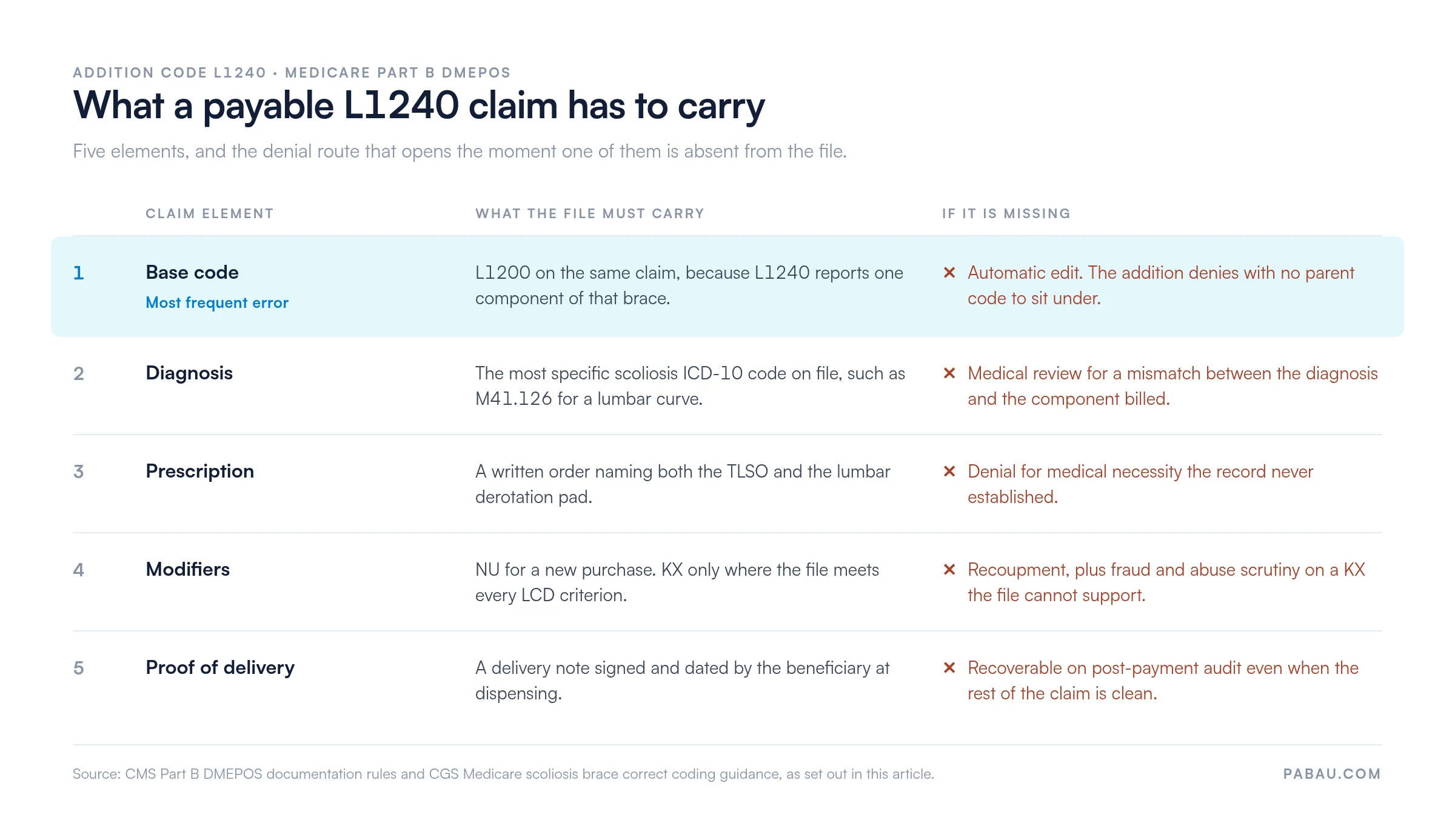
L1240 is an addition, so it needs a parent. Submit it on the same claim as the base TLSO code, or on a claim linked to it. A standalone L1240 line triggers an automatic edit, because the payer’s system looks for the parent code and finds none.
This is the most frequent error on L1240 claims, and a pre-edit review at claim level catches it. Claims software for practices can flag an orphaned addition code before submission, so nobody reads every claim line by hand.
Billing L1240 with a diagnosis that does not support rotational correction invites medical review. A lumbar strain code such as M54.5, in place of a scoliosis code, is a mismatch between the component and the condition.
Reviewers ask whether the diagnosis justifies the specific addition billed, not just whether a TLSO was needed. Code from the documented curve and its location, and the mismatch never arises.
Appending KX without documentation that satisfies every LCD criterion is a compliance exposure. Some billers add KX by default to get past claim edits. Medicare auditors look for exactly that pattern, where the file behind a KX does not support the attestation.
Build the documentation checklist into the dispensing workflow instead, so KX only goes on a complete file. A monthly KX audit of your own claims catches the ones that slipped.
Some base code descriptors already include features inside their own scope. Billing a component separately when the base descriptor covers it is unbundling, and unbundling is a compliance violation. Before you bill L1240, read the base code’s descriptor and confirm it makes no mention of a derotation pad.
The PDAC contractor issues product-specific coding letters that state which features map to which codes for commercially available brace systems. Request a PDAC verification for any new product before you bill it.
Medicare requires a signed proof of delivery for DMEPOS items. A missing, unsigned, or undated delivery document makes the claim recoverable on post-payment audit. The rest of the file being correct does not help. Take the signature from the beneficiary or an authorized representative at the time of dispensing.
Run a pre-billing audit on your TLSO addition claims every month. Check four things on each claim. Is the base code on the same claim? Is the documentation file complete? Is the KX modifier justified? Is the delivery note signed and dated? Catching these pre-submission is faster than appealing a denial.
In most practices that fit and bill spinal orthoses, the L1240 file is assembled from several places. The order sits in the chart, the fitting notes sit with the orthotist, and the delivery signature sits on paper at the front desk. Whoever submits the claim has to gather all three.
Practice management software like Pabau keeps them in one patient record instead. The prescription, the imaging report, the fitting notes, and the signed delivery confirmation all attach to the same file. When the claim goes out, the documentation Medicare would ask for is already sitting behind it.
That changes what your billing team spends its day on. Instead of chasing a signature two weeks after dispensing, they see the missing item while the patient is still in the building.

Pabau’s claims management software tracks every HCPCS line your practice submits and flags missing documentation before the claim goes out. Denials land in one queue, so your billing team stops rebuilding files after the fact.

L1240 is a simple code with a strict claim shape. It pays when the base code sits beside it and the diagnosis matches the component. The file also has to hold the order, the fitting notes, and a signed delivery.
The judgment worth carrying away is that L1240 rarely fails on the coding. It fails on the paperwork behind the coding, which makes it a workflow problem. Fix the point of dispensing and the claim looks after itself.
If your practice bills orthotic additions across several payers, book a demo and see how Pabau holds the whole L1240 file in one record.

Need a broader overview of DMEPOS billing processes? Medical billing fundamentals covers the end-to-end workflow from claim creation to payment posting.
Want to reduce your denial rate across all code types? Denial management in healthcare walks through the most effective strategies for tracking, appealing, and preventing claim denials.
Looking for guidance on clearinghouse claim submission? Clean claim submission principles covers the formatting and documentation standards that prevent front-end rejections.
HCPCS code L1240 is used to bill for a lumbar derotation pad added to a thoracic-lumbar-sacral orthosis (TLSO). It is a DMEPOS addition code under Medicare Part B. Scoliosis management is the usual setting, where the pad supplements the base spinal brace.
Yes, L1240 is covered by Medicare Part B as a DMEPOS item when medical necessity is documented. Coverage requires a physician prescription, supporting medical records, and the base code L1200 on the same claim. It must also comply with the applicable MAC Local Coverage Determination for spinal orthoses.
Medicare reimbursement for L1240 is set annually in the CMS DMEPOS fee schedule and varies by geographic payment locality. Verify current 2026 rates directly through the CMS DMEPOS fee schedule lookup tool, as national averages do not reflect locality-adjusted payments.
The common ICD-10 pairings for L1240 are scoliosis codes. They include M41.00 for infantile idiopathic scoliosis, M41.116 and M41.126 for juvenile and adolescent lumbar curves, and M41.35 for thoracogenic scoliosis. Use the most specific site code the documented curve supports.
L1240 needs a physician prescription naming the TLSO and the lumbar derotation pad. It also needs supporting medical records with imaging, fitting notes from the certified orthotist, and a signed proof of delivery. Some MACs also require a Certificate of Medical Necessity. All of it belongs on file before the claim is submitted.
Yes. CGS Medicare’s scoliosis brace correct coding guidance references L1240 as an applicable addition code for TLSO systems used in scoliosis management. The addition still has to meet standard DMEPOS coverage and documentation requirements. It also has to be billed alongside its base code.
L1200, the base code in this family, describes the complete spinal brace. L1240 describes only the lumbar derotation pad added to that brace. L1240 cannot be billed alone and must always appear alongside its base code on the same claim.