CPT Code 31653: EBUS With 3+ Mediastinal Stations
CPT code 31653: Official descriptor and clinical scope CPT code 31653 is the pro...

Last Updated: Oct 20, 2026
L1260 is the HCPCS Level II code for an addition to a thoracic-lumbar-sacral orthosis (TLSO), low profile, anterior thoracic derotation pad. It covers the pad itself, and the brace it attaches to is billed under its own code.
Pairing is the rule that decides payment. L1260 is an addition code, so it only pays when base code L1200 sits on the same claim. Submitted alone, it is rejected on a claim edit. The documentation behind a custom-fitted component is tighter than many suppliers expect, which is where the second wave of denials comes from.
Let Pabau's smart automation suggest the right codes, reduce claim denials, and keep your practice compliant—effortlessly.
Automate repetitive tasks and focus on what matters most—your patients.
Reduce coding errors and ensure compliance with the latest regulations.
Clean claims, fewer denials, and faster reimbursements.
Powerful insights and reporting to help your practice thrive.
HIPAA compliant SOC 2 certified GDPR-compliant Trusted by 4,000+ clinics worldwide

HCPCS code L1260 describes an anterior thoracic derotation pad added to a low-profile TLSO, not a standalone brace.
L1260 is an addition code, so it only pays when base code L1200 sits on the same claim.
L1200 is the only base code in this range, and L1210 through L1290 are sibling additions rather than alternate bases.
Claims without a physician order, a certificate of medical necessity and notes on spinal pathology are routinely denied.
L1260 is a purchase-only DMEPOS item, so rental modifiers such as RR never belong on the line.
HCPCS code L1260 is a Level II HCPCS code for “Addition to thoracic-lumbar-sacral orthosis (TLSO), low profile, anterior thoracic derotation pad.” It sits in the L-series orthotic codes maintained by CMS’s HCPCS Level II code list. Reimbursement runs through the durable medical equipment (DME) fee schedule.
The short descriptor used on claims is “Addition to TLSO anterior thoracic.” Both the long and short descriptions appear in the CMS Alpha-Numeric HCPCS file, released each October for the following fiscal year. The 2026 version confirms active status with no break in the effective date.
An anterior thoracic derotation pad is a rigid or semi-rigid component that attaches to the front of a low-profile TLSO. It applies a corrective three-point pressure force on the thoracic spine.
The pad is indicated when a spinal deformity needs rotational correction, on top of the lateral or sagittal control the base orthosis already gives. Adolescent idiopathic scoliosis and adult degenerative scoliosis are the usual diagnoses.
The pad presses against the anterior thoracic cage at a specific vertebral level. That creates a derotational moment, complementing the posterior and lateral pads of the TLSO shell.
Because the pad is custom-positioned and often custom-fabricated, payers do not treat it as part of the base TLSO code. It is billed separately under its own code, which is why L1260 exists.
That separation puts a burden on the notes. The clinical rationale has to name the pad itself, because the diagnosis that justified the base orthosis does not carry the addition line with it.
L1260 cannot be billed as a standalone code. CMS classifies it as an addition, so it has to appear on the same claim as the base TLSO code, L1200. Submitting L1260 on its own triggers an automatic claim edit rejection. The pad carries no device meaning without the orthosis it attaches to.
L1200 is the only base code in the L1200-L1290 range. Its descriptor reads “Thoracic-lumbar-sacral orthosis (TLSO), inclusive of furnishing initial orthosis only,” and it covers the orthosis itself. Every code from L1210 through L1290 is an addition to that base, L1260 included.
Treating L1210, L1230 or L1250 as an alternate base is the error that most often puts an L1260 line at risk. Those three codes describe a lateral thoracic extension, a Milwaukee type superstructure and an anterior ASIS pad. Pairing L1260 with one of them still leaves the claim without a base orthosis.
A base-code mismatch is cheapest to catch at data entry, before the claim ever leaves the practice. Manual entry with no second pair of eyes is where the mismatch usually survives all the way to the MAC.
L1260 is priced under the CMS DME fee schedule, not the Medicare Physician Fee Schedule. That distinction matters, because DME rates are published separately and updated each year in the DMEPOS fee schedule files.
We have not independently verified a 2026 national limitation amount (NLA) for L1260 against the official CMS download. Retrieve the current figure from the CMS DMEPOS fee schedule before you bill.
What is confirmed for 2026 is the pricing indicator. L1260 carries a fee schedule indicator, so Medicare reimburses a fixed allowed amount rather than a percentage of charges.
The allowed amount applies at the national limitation amount floor. Medicare administrative contractors (MACs) set regional rates that may fall at or below the NLA. Check your MAC’s locality file for the rate in your jurisdiction.
One claim therefore carries two allowed amounts. Track the base line and the addition line separately in your ledger. Medicare pays them as distinct line items and may adjust one without touching the other.
Medicare covers L1260 when medical necessity is established for both the base TLSO and the derotation pad. Coverage of the base TLSO does not carry the pad with it.
The physician order and the clinical documentation must state why the derotation component is required for this patient’s condition.
Check eligibility before the device is dispensed, not after. A patient whose Medicare coverage has lapsed may not be paid at the standard fee schedule rate.
The same applies to a Medicare Advantage plan running its own DME rules. Confirm coverage and prior authorization requirements before fabrication starts.
CGS Medicare, one of the DME MAC contractors, publishes a PDAC coding verification lookup tool. Use it to confirm which L-code the product you supplied is verified under, then keep that result with the claim documentation.
Request a detailed written order from the prescribing physician before fabricating the TLSO with the anterior derotation pad. The order must name the specific components being provided. A general order for a TLSO that never mentions the anterior thoracic derotation pad is not sufficient documentation. It puts the L1260 line at risk on audit.
HCPCS code L1260 takes a small set of standard HCPCS modifiers that change how payers process the line. Using the wrong one, or omitting a required one, is a common trigger for orthotic claim denials.
Confirm applicability against the current MAC policy article for L-series codes before you submit.
Rental modifiers are the ones to leave off. Custom-fabricated L-series spinal orthoses are purchase-only DMEPOS items, so RR and the other rental indicators never apply to L1260. NU is the correct equipment indicator on an initial dispense.
The KX modifier carries the most risk. Appending it without complete documentation on file constitutes a false claim and creates audit exposure. Append KX only when three documents are already in the file. Those are the physician order, the certificate of medical necessity, and clinical notes confirming the spinal pathology.
A derotation pad is covered only when the diagnosis on the claim explains why rotational correction is needed. The ICD-10 code supporting L1260 is the same one supporting the L1200 base line. Scoliosis diagnoses dominate that list, because vertebral rotation is part of the curve the brace is correcting.
The categories below are shown truncated. Pull the full region digit for each one from the ICD-10-CM code reference before it goes on the claim. Reviewers check that the coded region matches the braced region.
The diagnosis on its own does not justify the pad. Reviewers look for the curve pattern, the Cobb angle, and a note that rotation is being corrected rather than lateral curvature alone. Record those details in the clinical notes filed with the claim, so the addition line stands up on its own terms.
MAC local coverage determinations for spinal orthoses list the diagnoses that clear without extra review. Check your regional LCD before dispensing, because billing a diagnosis outside that list triggers a records request at many contractors.
Documentation separates the L1260 claims that pay from the ones recouped later on audit. L1260 covers a custom-fitted orthotic component added to a base device. So each element of the package has to address the base orthosis and the derotation pad separately.
Assembling that package before submission is where most orthotic practices gain the most ground. A clean L1260 claim carries KX, NU and the complete file behind it. It clears on first pass far more often than one sent out with a vague physician order.
Build a documentation checklist specific to TLSO addition codes, then embed it in the intake workflow rather than the billing queue. Catching a missing order at intake costs minutes. Catching it after a denial costs a re-billing cycle.
HCPCS code L1260 sits within the L1200-L1290 range of low-profile TLSO codes. On a CTLSO or scoliosis brace, the equivalent anterior pad is HCPCS code L1050, billed alongside base code L1000. One code in that range is the base orthosis and the other nine are additions to it. Knowing which is which keeps the claim structured correctly and stops a component being billed twice.
Suppliers providing several additions may bill each applicable code on the same claim as L1200. Every component still needs its own documentation and its own medical necessity. Billing several addition codes off a single order is a common audit finding.
Two neighboring descriptors can look alike on paper. The AAPC HCPCS code lookup is worth checking whenever a component could plausibly fall under either one.
Billing L1260 accurately depends on a sequence your billing system has to support. The addition code goes on the same claim as base code L1200, in line sequence after it.
Each line carries its own modifiers, and the claim waits until the documentation package is confirmed in the file. Practices that treat DME orthotic codes like physician service codes submit too early, and the denials follow.
Run through the finished claim once before it goes out. It should look like this.
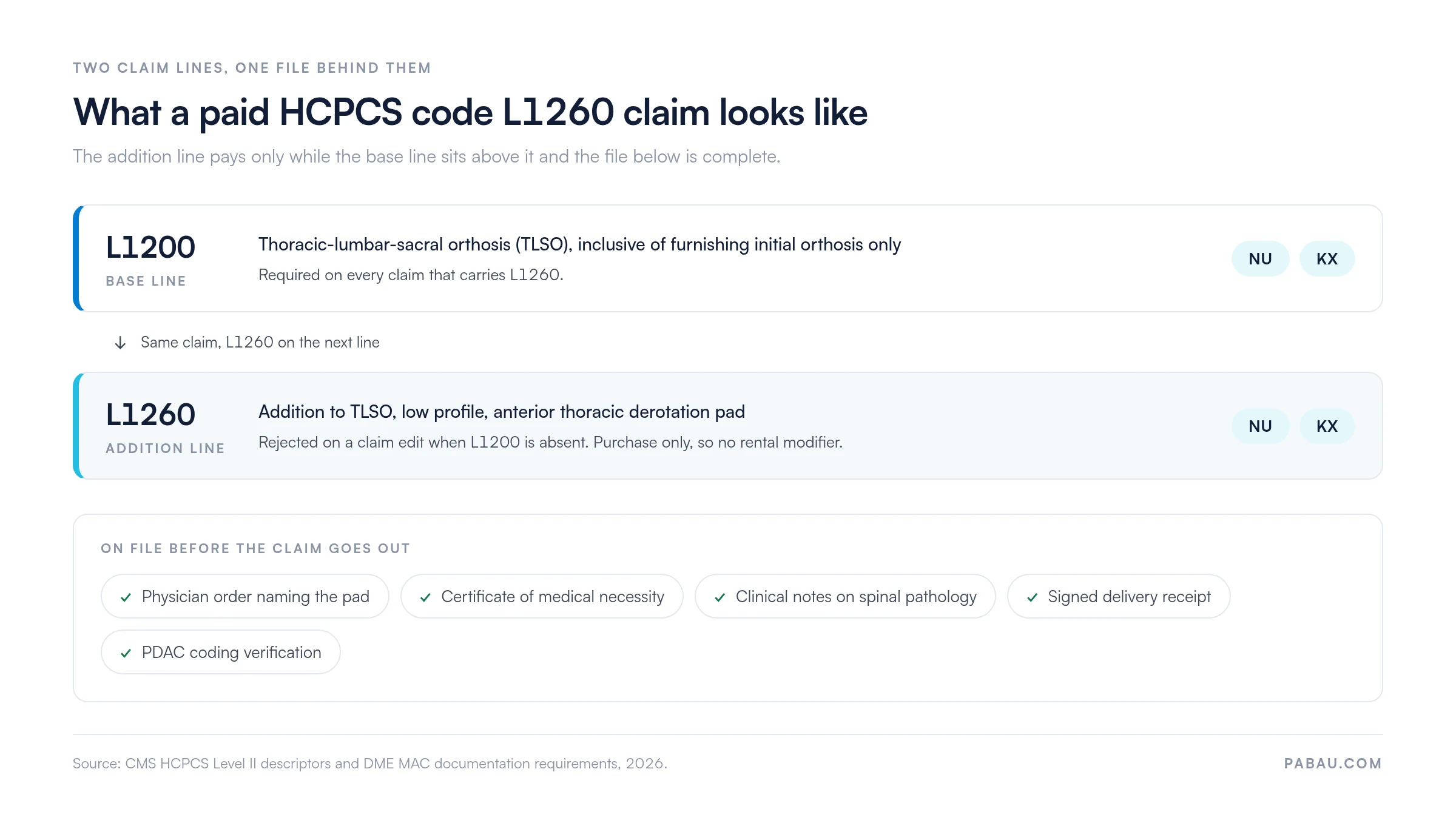
L1260 claims fail at a predictable set of points in the billing cycle. Knowing where the denials concentrate lets a practice build specific workflow controls, instead of reviewing every rejection from scratch.
Structured denial management turns those retrospective reviews into upstream controls. Each denial code your MAC returns points at one missing document or one coding error. Record what went wrong, correct the step that caused it, and the same denial stops appearing on the next batch.
Build a pre-submission checklist specific to L1260 claims. Check five items: L1200 on the claim, KX documentation verified, physician order naming the derotation pad, CMN complete, delivery receipt signed. Running through five items takes under two minutes per claim and catches the denial triggers before they reach the MAC.
Most orthotics practices run this workflow across three systems. The clinical note lives in the EMR and the signed order sits in a scanned folder. The claim is then keyed by hand into a separate billing tool. Every rekeying step is another chance for the base line and the addition line to drift apart.
Practice management software like Pabau keeps the patient record and the claim in the same system. The HCPCS code attached to the service lands on the CMS-1500 charge line automatically.
The ICD-10 slots are seeded from the patient’s recorded problem list. Built-in ICD-10-CM and HCPCS lookup libraries let a biller confirm a descriptor without leaving the claim.
From there, streamlined claims management checks that the claim’s required fields are complete before the send button unlocks, then submits through Claim.MD in the US.
Eligibility checks, ERA remittance posting and claim status tracking all sit on the same screen as the record. So the biller chasing an L1260 denial is looking at the order and the note at the same time.

Pabau pre-fills the CMS-1500 from the patient record, checks the claim’s required fields before submission, and tracks status through Claim.MD. Orthotics teams spend less time rekeying DME claims.

HCPCS code L1260 is simple in concept and unforgiving in practice. Three habits clear most rejections. Name the anterior thoracic derotation pad in the physician order. Put L1200 on the claim as the base line. File the complete documentation package before the claim goes out.
Get those three right and the L1260 line stops being the one your MAC asks about. The trade-off is front-loaded work. The order, the CMN and the PDAC verification all have to exist before fabrication starts. That is a harder sell on the workshop floor than in the billing office.
Orthotics teams billing DME alongside clinical care gain the most from one system holding both. Book a demo to see how Pabau carries an L1260 claim from fitting to payment without a single rekey.

Need a structured overview of how medical billing works? What is medical billing covers the end-to-end billing cycle, from claim creation through to payment posting.
Seeing the same denials come back on DME claims? Denial management in healthcare explains how to build upstream controls that catch billing errors before submission.
Want to know what makes a claim pay on the first pass? Clean claim submission outlines the elements every error-free claim has to include.
Checking DME coverage before you dispense? Insurance eligibility verification walks through confirming benefits before a device is fabricated.
Tracking two allowed amounts on one claim? Revenue cycle management shows where orthotic payments stall between dispensing and posting.
No. Custom-fabricated L-series spinal orthoses are purchase-only DMEPOS items, so RR and the other rental indicators never belong on an L1260 line. Bill NU on an initial dispense instead.
One unit per pad supplied. A single low-profile TLSO normally takes one anterior thoracic derotation pad. Bill more than one unit only when the physician order and the fabrication record both support it.
An enrolled DMEPOS supplier. Medicare pays these claims only to suppliers holding active accreditation and a surety bond. The claim goes to the DME MAC for your jurisdiction, not the Part B carrier.
A Medicare redetermination must be filed within 120 days of the initial determination notice. Send the physician order, the CMN and the delivery receipt with the request, because most L1260 appeals turn on documentation rather than coding.
No. L1200 and its additions describe a custom-fabricated low-profile TLSO. A prefabricated or off-the-shelf spinal orthosis falls in a different L-code range, so check the PDAC verification for the exact product you supplied.