CPT Code 62284: Injection procedure for myelography
CPT Code 62284: official descriptor and procedure overview The American Medical ...

Last Updated: Oct 19, 2026
L1220 is the HCPCS Level II code for addition to tlso, (low profile), anterior thoracic extension.
Two neighboring codes look like plausible bases and are not. L1300 and L1310 are all-inclusive scoliosis codes, so no addition code may be billed with either one. Pair L1220 with either and the line denies, however well the clinical record reads.
Let Pabau's smart automation suggest the right codes, reduce claim denials, and keep your practice compliant—effortlessly.
Automate repetitive tasks and focus on what matters most—your patients.
Reduce coding errors and ensure compliance with the latest regulations.
Clean claims, fewer denials, and faster reimbursements.
Powerful insights and reporting to help your practice thrive.
HIPAA compliant SOC 2 certified GDPR-compliant Trusted by 4,000+ clinics worldwide

HCPCS Code L1220 is a prefabricated add-on code for an anterior thoracic extension fitted to a low-profile TLSO, including fitting and adjustment.
L1220 must always be billed alongside a base TLSO code such as L1200. Submitted on its own, it is an improper billing practice that triggers automatic denial.
L1300 and L1310 are all-inclusive scoliosis codes, so L1220 can never be billed with either of them.
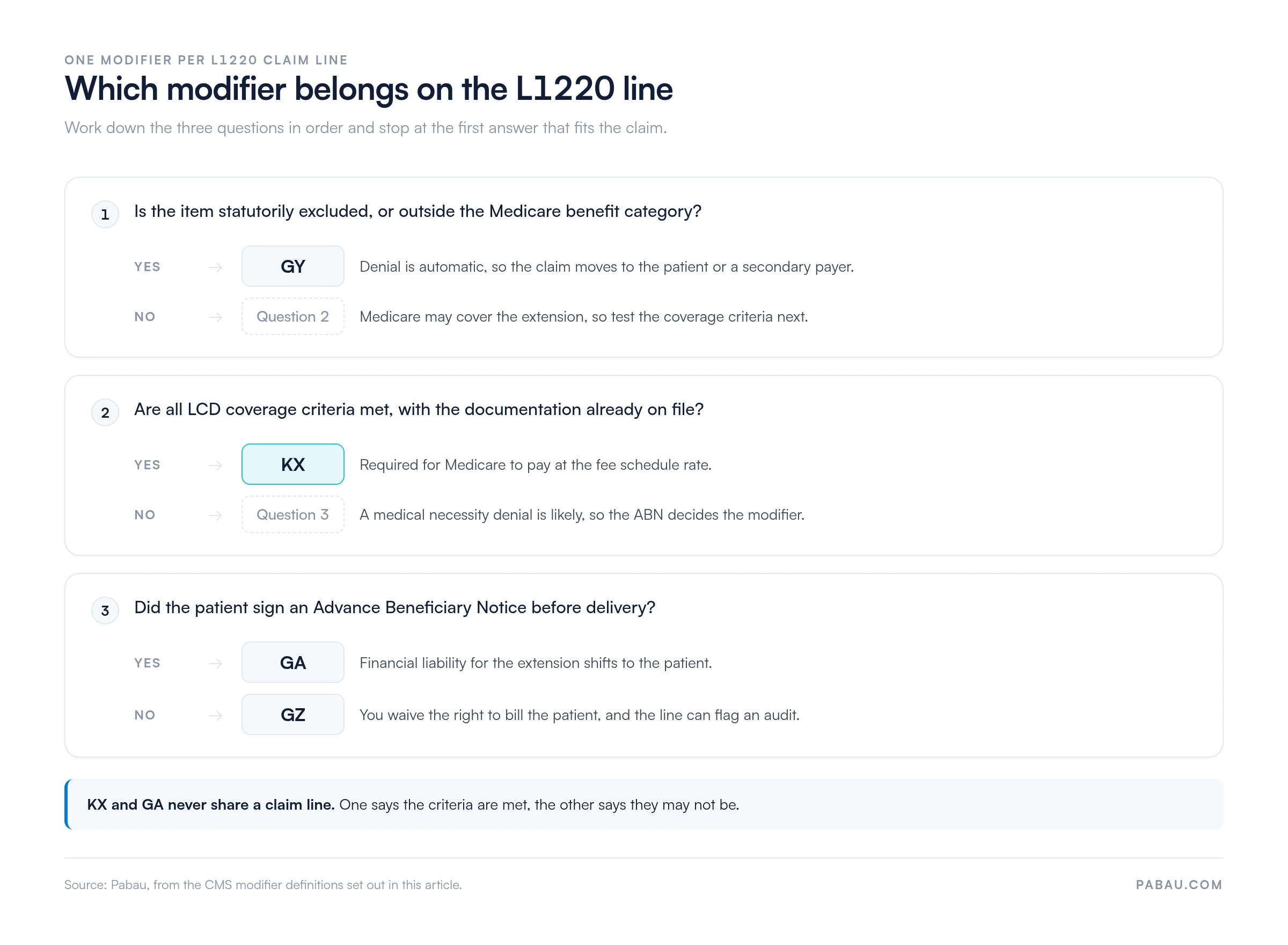
The KX modifier is required when Medicare coverage criteria are met. Use GA when an Advance Beneficiary Notice is on file, and GY for items expected to be non-covered.
Practice management software like Pabau handles HCPCS Level II code entry, modifier management, and claim submission for orthotics and DME providers.
HCPCS Code L1220 has one official full description, consistent across all CMS publications. It reads: Addition to thoracic-lumbar-sacral orthosis (TLSO), (low profile), anterior thoracic extension, prefabricated, includes fitting and adjustment.
Breaking that description down tells you what the code covers and what it excludes. “Addition to” is the critical phrase, because L1220 is not a standalone device code. It reports a component added to an already-prescribed, separately-coded base TLSO. “Low profile” specifies the TLSO subtype.
“Anterior thoracic extension” identifies the physical component. That is a rigid or semi-rigid extension piece mounted to the front of the brace’s thoracic portion. It limits thoracic flexion and adds anterior support.
“Prefabricated, includes fitting and adjustment” tells payers the device was manufactured off-the-shelf and sized to the patient by the orthotist, not custom-fabricated from a mold.
This is a HCPCS Level II code, maintained by the Centers for Medicare and Medicaid Services (CMS). It sits in the L-code series, which covers orthotic procedures and devices. L-codes run from L0100 through L9900, and the L1100-L1499 range covers spinal orthoses, including TLSO systems.
An anterior thoracic extension is prescribed when a standard low-profile TLSO alone does not control thoracic flexion well enough. The extension piece creates a three-point pressure system at the anterior thorax, which limits forward bending of the spine.
Common clinical indications where orthotists prescribe this addition include:
The prescribing physician’s order must explicitly state the need for the anterior thoracic extension component. A general order for a TLSO does not justify the add-on on its own.
L1220 cannot stand alone on a claim. It has to be billed on the same claim as the base TLSO code for the device prescribed, and most claims pair it with L1200. Getting that pairing right prevents the most common L1220 denial.
Two codes in the same family are often mistaken for bases. L1300 covers another scoliosis procedure with a body jacket molded to a patient model, and L1310 covers a post-operative body jacket. Both are all-inclusive under CMS rules, so no addition code may be billed with either of them.
The matrix below sets out which codes L1220 may share a claim with, and which ones reject it.
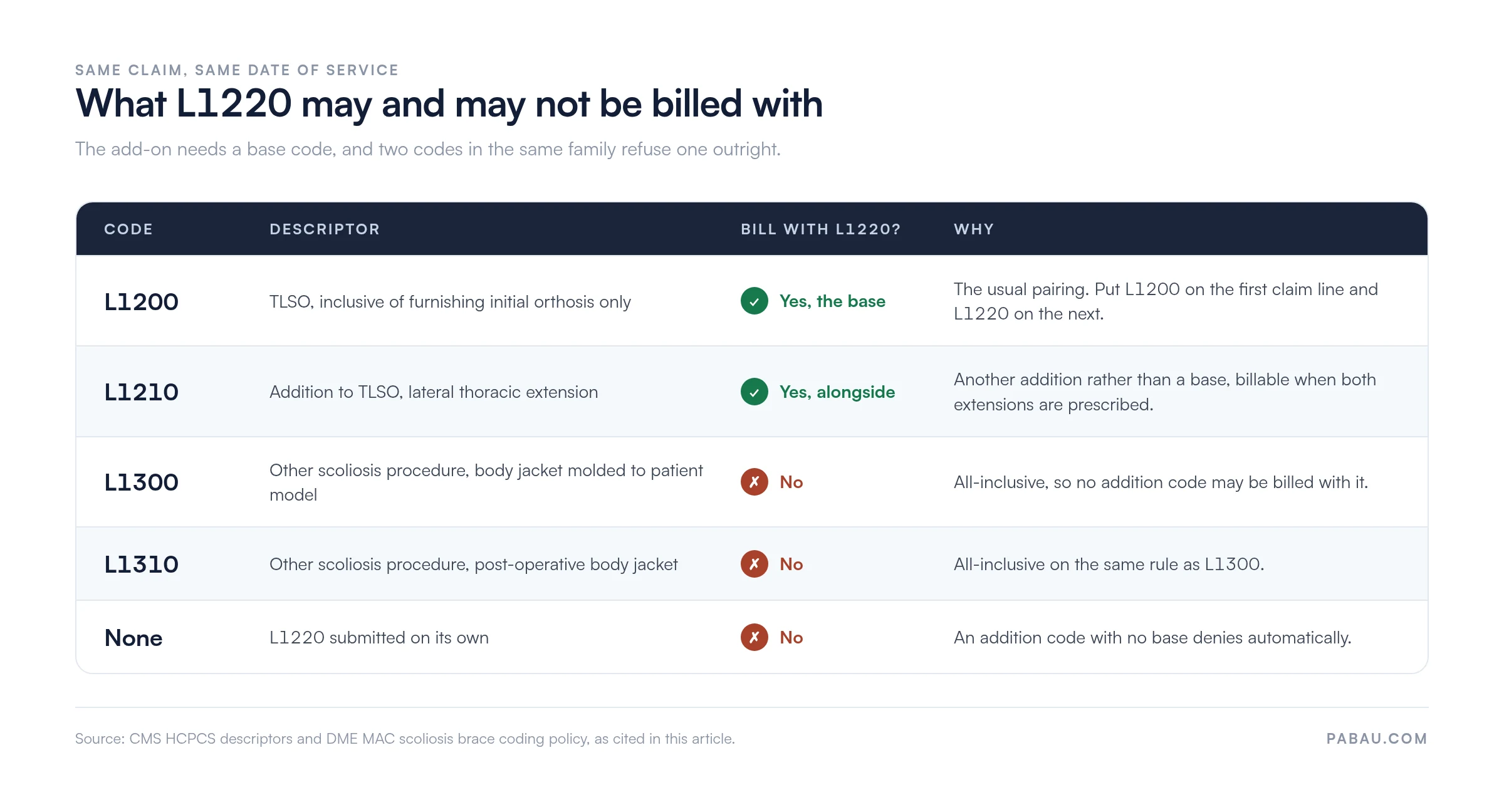
When billing, place the base TLSO code on the first line and L1220 on the line below it. Both codes share the same date of service, which is the date the device was delivered to and accepted by the patient.
Medicare reimburses HCPCS Code L1220 through the DMEPOS fee schedule, which stands for Durable Medical Equipment, Prosthetics, Orthotics, and Supplies. The DME MAC for the patient’s region administers it. Rates vary by MAC jurisdiction and by geographic locality adjustment.
CMS updates the DMEPOS fee schedule annually. Verify the current amounts for L1220 directly through the CMS fee schedule search tool. Published rates differ between the contiguous states, Alaska, Hawaii, and US territories. Always use the fee schedule for the state where the patient received the device, not the provider’s state.
Private payers typically follow Medicare’s fee schedule as a benchmark but may apply their own contracted rates. Always verify contracted amounts with each commercial payer before billing.
Check your DME MAC’s website for the DMEPOS fee schedule file covering your jurisdiction before submitting L1220 claims. Only two contractors administer DME claims: Noridian runs jurisdictions JA and JD, and CGS runs JB and JC. Each publishes its own jurisdiction-specific fee files. Using the wrong jurisdiction’s rates as a billing reference is a common RCM error for multi-state DME providers.
Modifier selection for L1220 is where claims most often go wrong. The wrong modifier tells the payer that the claim either lacks medical necessity documentation or covers a non-covered service. Use the following as a starting framework, then verify against your DME MAC’s HCPCS L-code billing articles and any applicable Local Coverage Determination.
Never append both KX and GA to the same claim line for L1220. KX says the criteria are met, and GA says an ABN is on file because they may not be. The two are mutually exclusive on one service line.
The cascade below settles the choice in three questions, in the order a biller should ask them.
Payers require a covered diagnosis code to establish medical necessity for L1220. The ICD-10-CM codes below are commonly accepted as supporting diagnoses. Your DME MAC’s applicable Local Coverage Determination governs the definitive list for your patient’s claim. Verify accepted codes against that LCD before submitting.
Watch the M47 subcategories closely, because the descriptors are easy to swap. M47.814 to M47.816 describe spondylosis without myelopathy or radiculopathy. Where the record documents thoracic radiculopathy, the correct code is M47.24 instead.
The ICD-10-CM code on the claim must match the physician’s documented diagnosis precisely. Using a generic pain code such as M54.6 without supporting clinical findings is a common audit trigger for TLSO claims.
Medicare coverage for HCPCS Code L1220 follows the medical necessity framework in the DME MAC’s applicable LCD for spinal orthoses. Coverage is not automatic. The biller and provider must confirm that the patient’s situation satisfies each criterion before submitting the KX modifier.
The practical version of this is a coverage checklist worked through before every L1220 claim goes out, rather than after a denial arrives.
DME MAC medical review audits for TLSO L-codes are frequent, and one missing document is enough to trigger a full repayment demand. The checklist below reflects what Medicare’s DME MACs consistently require for HCPCS Code L1220 claims.
Storing these documents as structured digital records rather than paper files makes an audit response much faster. Practice management software like Pabau keeps the order, the product description, the delivery proof, and the clinical notes on one client record.
Most L1220 claim denials fall into three categories: a missing base code, the wrong modifier, or thin documentation. Each error pattern has a specific fix at the point of claim entry.
L1220 cannot be billed alone. It must appear on the same claim as a base TLSO code, typically L1200. Submitting L1220 without a base code results in automatic denial. The fix is to pair the add-on code with its base at the point of entry, rather than catching it in billing review.
Without KX, Medicare treats L1220 as failing to meet coverage criteria and denies payment. If the documentation supports coverage, KX is not optional. Billers often omit it because the base code does not require it, but the add-on line is evaluated independently for modifier compliance.
L1220 describes a prefabricated anterior thoracic extension. If the device was custom-molded to the patient’s torso, a different code applies. Conflating prefabricated and custom-fabricated devices is a compliance risk, and in an audit it invites a recoupment demand.
For DMEPOS items, the date of service is the date the device was delivered to and accepted by the patient. Billing the order date or the dispensing date instead will mismatch the proof of delivery document, which triggers a denial or an audit flag.
Reading the remittance advice against a denial code reference tells you which of these four errors caused the rejection. Tracking that rate by code, month over month, is how a DME provider spots a systematic problem before an auditor does.
In most orthotics practices, the L-code claim and the clinical record live in separate systems. The orthotist documents the fitting in one place, and the biller rebuilds the claim from it in another. The modifier decision then happens away from the notes that justify it.
Pabau’s first-pass claims management tools handle HCPCS Level II code entry, including L-series orthotic codes. They also attach modifiers at the claim line level and store the DME MAC’s required documents against the claim. The claim is built from the record instead of from a summary of it.
Some patients need several L-codes, such as a base TLSO plus L1220 and possibly L1210. Code sets and their required modifiers can be saved as a workflow template. That cuts per-claim entry time and the modifier omissions that come with retyping.
The client record holds the physician order, the DPD, the proof of delivery, and the clinical notes together. An audit response then becomes a file retrieval rather than a paper search.

Pabau’s claims management tools support HCPCS Level II code entry, modifier management, and claim submission for DME and orthotics providers. See how it works for your practice.

L1220 leaves very little room for approximation. It is an add-on, it is prefabricated only, and it is judged on its own claim line. The base code above it earns it no credit. Treat it as a separate claim decision and the denials mostly stop.
The trade-off worth remembering is timing. Every control that keeps an L1220 line clean has to be in place before the device is delivered. That covers the wording of the physician order and the signed ABN. None of it can be added once the claim has already been rejected.
So the work sits with the intake and delivery process, not with the billing team. Book a demo to see how Pabau keeps the order, the modifiers, and the delivery proof on one L-code claim.

Billing a different TLSO addition? HCPCS Code L1080 works through the outrigger addition to a CTLSO or scoliosis orthosis.
Dealing with denied HCPCS claims? Denial management in healthcare walks through denial tracking and appeal workflows for DME and orthotic providers.
Want a clean-claim submission checklist? Clean claim submission guide covers the billing elements that prevent front-end rejections on DMEPOS claims.
Need to understand how medical billing works end to end? What is medical billing covers the full revenue cycle from coding to reimbursement for healthcare providers.
HCPCS Code L1220 is an addition to a thoracic-lumbar-sacral orthosis (TLSO), low profile, anterior thoracic extension, prefabricated, includes fitting and adjustment. It reports the anterior extension component added to an already-prescribed base TLSO device, not the base TLSO itself.
L1220 is strictly an add-on code. It must be billed on the same claim as a base TLSO code such as L1200. Submitting L1220 without a base code results in automatic denial; billing it as standalone is an improper billing practice.
The KX modifier is required when all Medicare LCD coverage criteria are met and documentation supports medical necessity. Use GA when an Advance Beneficiary Notice is on file, and GY for non-covered items. Use GZ when a denial is expected but no ABN was obtained. RT/LT laterality modifiers are generally not applicable to midline spinal orthoses but verify with your DME MAC.
Commonly accepted diagnoses include scoliosis codes (M41 series), thoracic vertebral fracture codes (S22 series), osteoporotic fracture codes (M80 series), and spondylosis codes (M47 series). The definitive covered-diagnosis list is set by your DME MAC’s applicable Local Coverage Determination; always verify before submitting.
L1200 is the base TLSO code covering the core device. L1220 is an add-on code reporting the anterior thoracic extension that is physically added to the L1200 base device. They are billed together on the same claim when both are provided; L1200 covers the orthosis itself, L1220 covers the additional extension piece.
Required documents include a written physician order specifying the anterior thoracic extension, and a detailed product description confirming the prefabricated device match. You also need proof of delivery signed by the patient, contemporaneous clinical notes supporting medical necessity, and an Advance Beneficiary Notice if coverage is uncertain. Missing any one of these elements is the most common cause of L1220 post-payment audit recoupment.