HCPCS Code L0472: Hyperextension TLSO billing guide
HCPCS code L0472: Official descriptor and device definition HCPCS code L0472 des...

Last Updated: Nov 5, 2026
L0830 is the HCPCS Level II code for a halo procedure, cervical halo incorporated into a Milwaukee type orthosis. One line pays for the head ring, the skull pins, the connecting rods and bars, and the rigid TLSO they attach to.
The trunk piece is where coders slip. L0810 covers a halo on a jacket vest and L0820 one on a plaster body jacket, so read the delivery ticket first. Suppliers bill L0830 to the DME MAC as a lump-sum purchase, unless a hospital or SNF stay already covers the device.
Let Pabau's smart automation suggest the right codes, reduce claim denials, and keep your practice compliant—effortlessly.
Automate repetitive tasks and focus on what matters most—your patients.
Reduce coding errors and ensure compliance with the latest regulations.
Clean claims, fewer denials, and faster reimbursements.
Powerful insights and reporting to help your practice thrive.
HIPAA compliant SOC 2 certified GDPR-compliant Trusted by 4,000+ clinics worldwide

HCPCS code L0830 is an active Level II code for a cervical halo incorporated into a Milwaukee type orthosis, in effect since January 1, 1986.
One L0830 line pays for the head ring, the skull pins, the connecting rods and bars, and the rigid TLSO they attach to.
The trunk component decides the code, with L0810 for a jacket vest, L0820 for a plaster body jacket and L0830 for a Milwaukee type orthosis.
A halo supplied before or during a hospital or Part A SNF stay is paid through the facility, so the DME MAC is not billed.
Pabau’s claims management software pre-fills the claim from the invoice and client card, with the order and proof of delivery kept in the record.
HCPCS code L0830 is the Level II code for a halo procedure, cervical halo incorporated into a Milwaukee type orthosis. It describes one device built from four parts, and a DMEPOS supplier bills all four on a single line.
The code took effect on January 1, 1986, and it’s still active. It sits in the cervical halo group, L0810 to L0861, among the orthotic procedure codes of HCPCS Level II.
The DME MAC joint article on halo coding names the parts. They are the metal ring around the head, the skull pins, the connecting rods and bars, and a rigid thoracic-lumbar-sacral orthosis (TLSO). None of them goes on a separate claim line.
Medicare pays L0830 as a lump-sum purchase under the CMS DMEPOS fee schedule. The allowed amount changes each January and varies by state, so pull it from the current file before you quote a patient.
A Milwaukee type orthosis is the rigid TLSO that the halo rods attach to. The DME MAC article describes it running posteriorly to the sacrococcygeal junction and anteriorly to the symphysis pubis.
That reach is what separates L0830 from its two siblings. L0810 attaches the halo to a jacket vest, and L0820 attaches it to a plaster body jacket. The head hardware is the same in all three codes, so the trunk component is the detail a coder has to read.
Here’s how that plays out. An order arrives for a “halo vest” after a C2 fracture. The fitter’s notes describe a rigid TLSO that runs down to the pelvis, front and back. That device is L0830, whatever the order calls it. If the notes describe a jacket vest instead, the code is L0810.
Three codes describe the halo procedure itself, and each one names a different trunk component. Two more describe additions to a halo, and those go on their own claim lines.
L0859 is an addition, not a spinal brace code. It covers a ring, pins and connecting components made of MRI-compatible material. Bill it beside L0830 when the halo uses that hardware, so the patient can be scanned without removing the device.
L0861 covers a replacement liner or interface. The DME MAC article ties it to a jacket vest or body jacket, so confirm which trunk component the liner fits before you use it. A worn liner is never a reason to bill L0830 a second time.
Getting the code right is half the claim, and the diagnosis is the other half. A halo holds the cervical spine still while a fracture, a dislocation or a fusion heals. So the diagnosis on an L0830 claim usually comes from category S12, fracture of the cervical vertebra, or S13, dislocation at neck level.
The 7th character follows the patient’s stage of care. A halo applied during active treatment of a closed fracture takes A. Routine follow-up visits use D, for routine healing. Code to the highest specificity the record supports.
The halo coding article lists no covered diagnoses. Medical necessity therefore rests on the clinical note. It should explain why the patient needs rigid cervical immobilization through a full TLSO rather than a vest.
Medicare Part B covers L0830 as a neck brace when the treating practitioner orders it and the record shows it’s reasonable and necessary. The supplier bills the DME MAC for the patient’s jurisdiction. Before that claim exists, though, someone has to check the calendar.
Most halos go on in hospital after neck trauma or spine surgery, so the delivery date decides who gets paid. The DME MAC article sets out three cases.
Compare the delivery date with the admission and discharge dates before you create the claim. A halo handed over on day three of a ten-day stay belongs to the hospital’s payment.
Every DMEPOS claim needs a standard written order (SWO) on file before the supplier bills. It names the beneficiary, the order date, the item, the quantity and the treating practitioner, and it carries that practitioner’s signature.
CGS notes that L0830 is on the 2022 Master List of DMEPOS items. That list flags items that may face a face-to-face encounter, a written order before delivery or prior authorization.
The Master List marks eligibility only. A rule applies only once CMS moves the code onto one of two required lists. Those are the Required Face-to-Face Encounter and Written Order Prior to Delivery List and the Required Prior Authorization List. Check both lists for the delivery date.
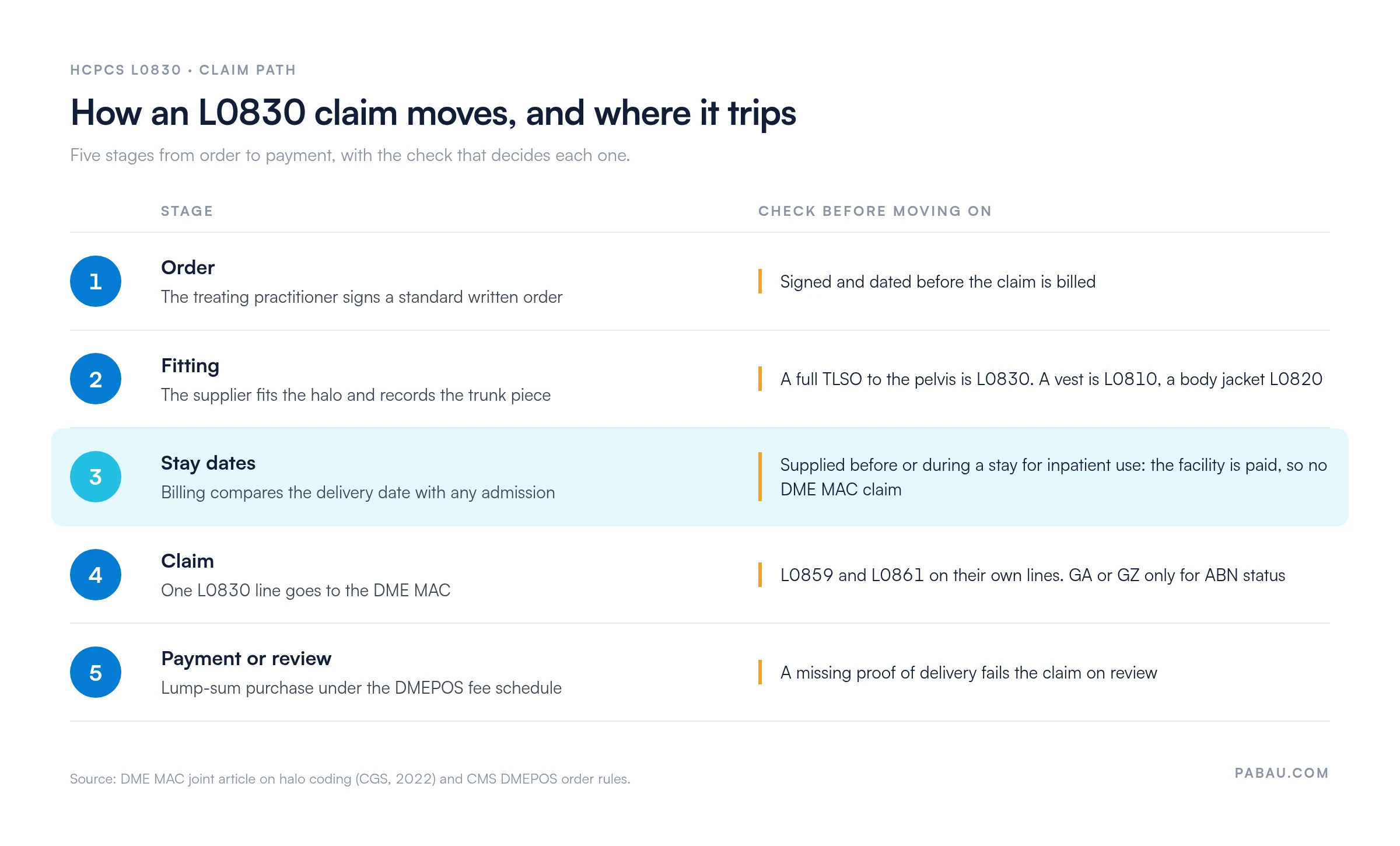
Put those rules in order and an L0830 claim makes five stops. Each stop has one check, and skipping it is what turns into a denial later.
Stage three is the one teams skip, because the hospital stay rarely shows up on the supplier’s own paperwork. The chart lines up each stage with the check that clears it.
Thin records sink more halo claims than coding errors do. Good medical billing compliance means the file is complete before the claim goes out, so tick off each item first.
Keep the set together. A post-payment reviewer asks for the whole file at once, and a missing proof of delivery fails the claim by itself.
The DME MAC halo coding article names no required modifier for L0830. The modifiers that do turn up on these claims describe ABN status, not the device.
CPT 20661 covers the application of a cranial halo, including its later removal. CPT 20664 covers a cranial halo with six or more pins for thin skulls, and CPT 20665 covers removing a halo another clinician applied.
Halo denials trace back to a short list of errors. CO-4, CO-16 and CO-50 below are claim adjustment reason codes (CARCs).
The N- and M-codes printed beside them are remittance advice remark codes (RARCs), which add the detail. A steady approach to denial management in healthcare starts with spotting which of these repeats.
Run these checks before submission and more L0830 claims count as a clean claim on the first pass. For the full revenue cycle, see what medical billing involves from order to payment.
A halo claim passes through several hands. The surgeon writes the order, the fitter records the device, and the billing team matches dates against the hospital stay. When those records live in separate systems, a missing signature turns up on audit instead of before submission.
Pabau, the practice management platform we build, keeps the order, the fitting notes and the signed delivery receipt in the patient’s record. Its claims software for practices pre-fills the claim from the invoice and the client card, where the insurer and policy details sit.
Before a claim can be sent, Pabau checks that every required field is complete. US claims go out through Claim.MD, with eligibility checks and remittance posting in the same place. Fewer claims bounce back for missing information, and your team spends less time on resubmissions.

Pabau pre-fills the claim from the invoice and client card, then checks required fields before sending. Your L0830 claims go out with the order and proof of delivery kept in the record.

L0830 is a narrow code, and that’s exactly why it’s easy to bill wrong. It belongs only to a halo attached to a full Milwaukee type TLSO, billed once for the whole device.
So make two checks a habit. Read the trunk component before you choose the code, and hold the delivery date against any hospital or SNF stay. Get those right and the rest is paperwork, which a complete file carries through review.
Book a demo to see how Pabau keeps halo orders, delivery records and claims together in one patient record.

Need to understand how denial patterns are tracked and resolved? Denial management in healthcare covers the systematic approach to identifying, tracking, and appealing claim denials across payer types.
Looking for a broader grounding in DME and medical billing workflows? What is medical billing explains the end-to-end revenue cycle process from patient encounter to payment posting.
Want to understand what makes a claim pay on first submission? Clean claim standards outlines the data elements and documentation requirements that prevent payer rejections before they happen.
Coding a halo on a plaster body jacket instead? HCPCS code L0820 covers the sibling code, with the same ring, pins and rods on a different trunk piece.
Supplying MRI-compatible rings and pins? HCPCS code L0859 explains the addition code that goes on its own line beside the halo.
L0830 covers a cervical halo built into a Milwaukee type orthosis. One line pays for the head ring, skull pins, connecting rods and bars, and the rigid TLSO they attach to.
Usually not. A halo on a rigid jacket vest is L0810. L0830 applies only when the halo attaches to a Milwaukee type TLSO that reaches the pelvis. Check the delivery ticket, not the order’s wording.
The Milwaukee brace is a full-torso orthosis designed in Milwaukee in 1945 for patients with scoliosis. In L0830, the same style of rigid trunk support anchors the halo rods, which spreads the load down to the pelvis.
A supplier enrolled with Medicare as a DMEPOS supplier bills the claim to the DME MAC. Most suppliers must also be accredited by a CMS-approved organization and meet the federal supplier standards.
The surgeon bills CPT 20661, application of halo including removal, cranial, on their own claim. L0830 covers the device the supplier provides, so the two codes never share a claim.