CPT Code 62284: Injection procedure for myelography
CPT Code 62284: official descriptor and procedure overview The American Medical ...

Last Updated: Oct 19, 2026
L1060 is the HCPCS Level II code for addition to ctlso or scoliosis orthosis, thoracic pad.
The code sits within the Orthotic Procedures category of the L-series (L0000-L4999), which covers spinal, lower extremity, and upper extremity orthotic devices and their additions. L1060 specifically addresses a thoracic pad component added to an existing CTLSO or scoliosis brace.
Let Pabau's smart automation suggest the right codes, reduce claim denials, and keep your practice compliant—effortlessly.
Automate repetitive tasks and focus on what matters most—your patients.
Reduce coding errors and ensure compliance with the latest regulations.
Clean claims, fewer denials, and faster reimbursements.
Powerful insights and reporting to help your practice thrive.
HIPAA compliant SOC 2 certified GDPR-compliant Trusted by 4,000+ clinics worldwide

HCPCS code L1060 covers a thoracic pad added to a cervicothoracolumbosacral orthosis (CTLSO) or scoliosis orthosis.
L1060 is an addition code, so it must be billed alongside a base CTLSO or scoliosis orthosis code.
Medicare adjudicates the claim against the spinal orthosis Local Coverage Determination in your MAC jurisdiction.
A clean claim needs a standard written order, a face-to-face encounter note, and signed proof of delivery.
Practice management software like Pabau ties each addition code to its documentation before the claim goes out.
A CTLSO (cervicothoracolumbosacral orthosis) is a rigid or semi-rigid brace that extends from the cervical spine down through the lumbar region. Scoliosis orthoses, such as the Milwaukee brace or Boston brace variants, manage idiopathic or neuromuscular scoliosis. They are typically prescribed for adolescents whose curves fall in the 25-45 degree Cobb angle range.
A thoracic pad is a contoured pressure pad attached to the brace frame at the thoracic level. Its purpose is to apply corrective lateral force directly over the apex of the scoliotic curve. L1060 captures the cost of fabricating and fitting that pad as an addition to a base orthosis billed under a separate L-code.
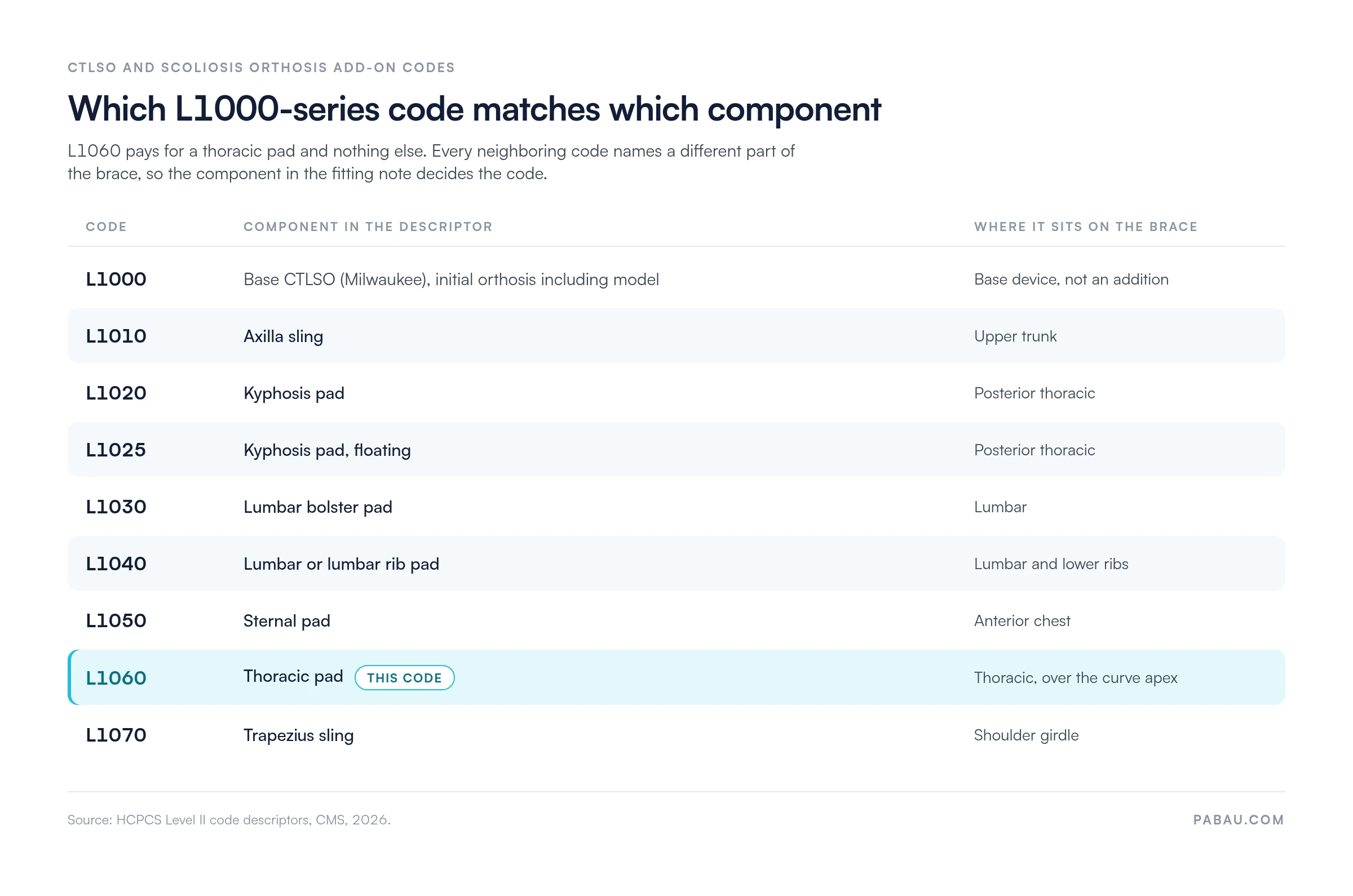
A pad fitted over a kyphotic curve is a different component, billed as L1020 rather than L1060.
The L1000 series names each brace component separately, so the component recorded in the fitting note is what picks the code. The map below shows where each one sits.
Common clinical situations where L1060 applies:
L1060 is not used for thoracic pads added to lumbosacral orthoses (LSOs) or thoracic orthoses (TOs) without cervical components. The base device must be a CTLSO or scoliosis orthosis. Pairing L1060 with any other base puts the line outside its descriptor, which is enough on its own for a denial.
Medicare reimburses HCPCS code L1060 under the DMEPOS fee schedule, which sets locality-based allowable amounts and updates them annually. The 2026 rates vary by Medicare Administrative Contractor (MAC) jurisdiction, and by whether the supplier holds a contract under the local DMEPOS competitive bidding program.
Because rates are locality-specific and change each calendar year, the table below sets out the structure of reimbursement rather than a figure. Verify current amounts in the CMS DMEPOS fee schedule files before you submit.
Medicare pays 80% of the allowed amount once the annual deductible is met. The beneficiary or a secondary insurer covers the remaining 20% coinsurance. Different assignment rules apply to non-participating suppliers.
Coverage for L1060 is not automatic. Claims are adjudicated against the Local Coverage Determination (LCD) for spinal orthoses issued by the relevant MAC. The code itself is defined in the CMS HCPCS Level II file. Coverage under the DMEPOS benefit requires all of the following:
Coverage criteria vary by MAC jurisdiction, because the LCD articles for spinal orthoses are written per jurisdiction. Confirm the applicable LCD for your region before submitting.
Missing or incomplete documentation is the primary reason L1060 claims fail on audit. A clean claim needs a documentation package covering both the base orthosis and the addition.
That package holds together when the supporting documents attach to the claim record before submission, instead of sitting in a separate file store. A scattered documentation trail is the largest audit risk for DMEPOS suppliers billing L-series addition codes.
Run a pre-billing documentation audit before you submit any L1060 claim. Confirm the standard written order, the face-to-face note, proof of delivery, and the base code are all attached. One missing document is enough to trigger a denial, and the appeal costs far more staff time than the check did.
The diagnosis code has to support the medical necessity of the scoliosis orthosis and its thoracic pad. The M41 scoliosis range covers the most common pairings, though the correct code depends on the etiology and the location of the curve.
These pairings follow standard coding conventions. Payer-specific pairing requirements vary, so check the LCD article for your jurisdiction.
Code to the highest level of specificity the record supports. M41.24 (thoracic region) beats M41.20 (site unspecified) whenever the documentation identifies the curve as thoracic. Watch the site digit in the juvenile range too, because M41.12 is a header rather than a billable code.
Knowing which base codes L1060 can accompany is what keeps the claim clean. The table below lists the base CTLSO and scoliosis orthosis codes billed alongside HCPCS code L1060, plus the sibling addition codes from the same section. A sternal pad bills as L1050, never as L1060.
Note that the Milwaukee-type superstructure is L1230, not an L1000-series addition, so it belongs to a different base series. Our HCPCS codes hub covers the other families a DMEPOS supplier bills, and the AAPC HCPCS lookup gives searchable access to current descriptors.
The most frequent L1060 error is structural. A biller submits the addition code with no base orthosis code on the same claim, so the payer cannot tell which device received the pad. On a Milwaukee-type brace, that base code is L1000, which covers furnishing the initial orthosis.
The following errors account for the majority of L1060 denials:
Those denial patterns are predictable, which makes them correctable before submission. Put L-code addition claims in their own audit queue, and treat the base-code check as part of denial management rather than a post-denial cleanup task.
It also helps to know which check a claim failed. Code validity is screened ahead of medical necessity, so a line built on HCPCS code S0161 is rejected before any clinical review.
Cross-reference L1060 against your base orthosis codes before you submit each claim batch. If an L1060 line appears with no L1000-series base code, pull the claim and attach the base first. That five-second check eliminates the most common denial trigger for scoliosis addition codes.
Orthotic providers billing L-codes carry a workflow problem that generic billing software handles badly. A CTLSO claim pairs several codes on one line set and attaches specific documentation to each code. It also has to record whether every addition was captured at the point of dispensing.
Most practices solve that with a paper file and a spreadsheet, then reassemble the package weeks later when a MAC asks for it. Pabau, our practice management platform, keeps the fitting notes and consent forms attached to the patient record instead. The evidence is already in place when the biller opens the claim.
Our DMEPOS claims software captures addition codes like L1060 next to their base codes at the time of service. The superbill flags a missing pairing before submission, so billing staff correct the claim while it is still cheap to fix.
Eligibility runs from the same record, which means the DMEPOS benefit is confirmed before the device is dispensed rather than after the denial arrives. That matters on Medicare claims, where beneficiary eligibility and benefit period rules can change between visits.

Pabau’s claims management tools attach documentation, capture addition codes like L1060 with their base codes, and flag incomplete claims before submission. Fewer denials, less rework for your billing team.

L1060 is a simple code with an unforgiving structure. Almost every denial traces back to the same two decisions, and both are made before the claim is built. Did the fitting note name a thoracic pad, and is the base orthosis code on the same claim?
Answer those at the point of dispensing and L1060 stops being a problem code. Answer them at the point of submission and you are guessing from a record written weeks earlier. The trade-off worth remembering is that a two-minute check at fitting replaces a months-long appeal.
Book a demo to see how Pabau pairs addition codes with their base codes and their documentation before an orthotic claim ever reaches the payer.

Need the revenue cycle context for DMEPOS claims? What is revenue cycle management covers the billing cycle from eligibility check to payment posting.
Want to reduce HCPCS claim denials before they happen? Denial management in healthcare explains how to build a systematic appeals and prevention process.
Looking for guidance on keeping medical billing audit-ready? Medical billing compliance outlines the documentation and policy requirements that protect practices during MAC audits.
HCPCS code L1060 is a Level II addition code for a thoracic pad added to a cervicothoracolumbosacral orthosis (CTLSO) or scoliosis orthosis. CMS maintains it under the Orthotic Procedures category of the L-series, and DMEPOS suppliers use it when billing for scoliosis brace additions.
L1060 is strictly an addition code. It cannot be billed as a standalone claim. It has to appear on the same claim as the base CTLSO or scoliosis orthosis code, typically from the L1000 range. Submitting L1060 without a qualifying base code results in automatic denial.
Medicare covers L1060 under the DMEPOS benefit when the claim meets the coverage criteria in the applicable MAC’s Local Coverage Determination for spinal orthoses. Medical necessity must be documented, a face-to-face encounter must have occurred within six months of the order, and a standard written order must precede dispensing.
Medicare’s allowed amount for L1060 varies by locality and is updated annually in the DMEPOS fee schedule. Rates differ by MAC jurisdiction and by competitive bidding area. Verify current amounts in the CMS DMEPOS fee schedule files rather than relying on a static figure.
The M41 scoliosis range is most commonly paired with L1060. M41.24 (other idiopathic scoliosis, thoracic region) is the closest fit for a thoracic pad addition, and Q67.5 (congenital deformity of spine) applies in pediatric cases. Always select the most specific code the clinical documentation supports.
A complete L1060 claim needs a standard written order dated before dispensing. Add the face-to-face note from within six months of that order, the orthotic evaluation and fitting notes, and signed proof of delivery. The ICD-10-CM codes on the claim must match the clinical record. CMS discontinued Certificates of Medical Necessity for nearly all DME categories on January 1, 2023, so no CMN is required.
Yes. L1040 covers a lumbar or lumbar rib pad and L1060 covers a thoracic pad. The two codes describe different sites on the brace, so they do not overlap. Bill both only when the orthosis actually carries both pads and the fitting notes document each one separately.