CCSD code H4430: Examination of rectum under anaesthetic
CCSD code H4430 pays for the examination alone CCSD code H4430 is the UK private...

Last Updated: Oct 20, 2026
L1120 is the HCPCS Level II code for addition to ctlso, scoliosis orthosis, cover for upright, each.
It closes the L1000 to L1120 scoliosis orthotic range, which pairs a Milwaukee-style CTLSO with more than a dozen separate additions. L1120 is the only addition in that series that applies no corrective force.
That last point is what makes the code awkward to defend. Its allowed amount is small, its unit count varies with the brace, and its justification is protective rather than corrective.
Let Pabau's smart automation suggest the right codes, reduce claim denials, and keep your practice compliant—effortlessly.
Automate repetitive tasks and focus on what matters most—your patients.
Reduce coding errors and ensure compliance with the latest regulations.
Clean claims, fewer denials, and faster reimbursements.
Powerful insights and reporting to help your practice thrive.
HIPAA compliant SOC 2 certified GDPR-compliant Trusted by 4,000+ clinics worldwide

HCPCS Code L1120 is the addition code for a cover fitted over an upright on a CTLSO or scoliosis orthosis.
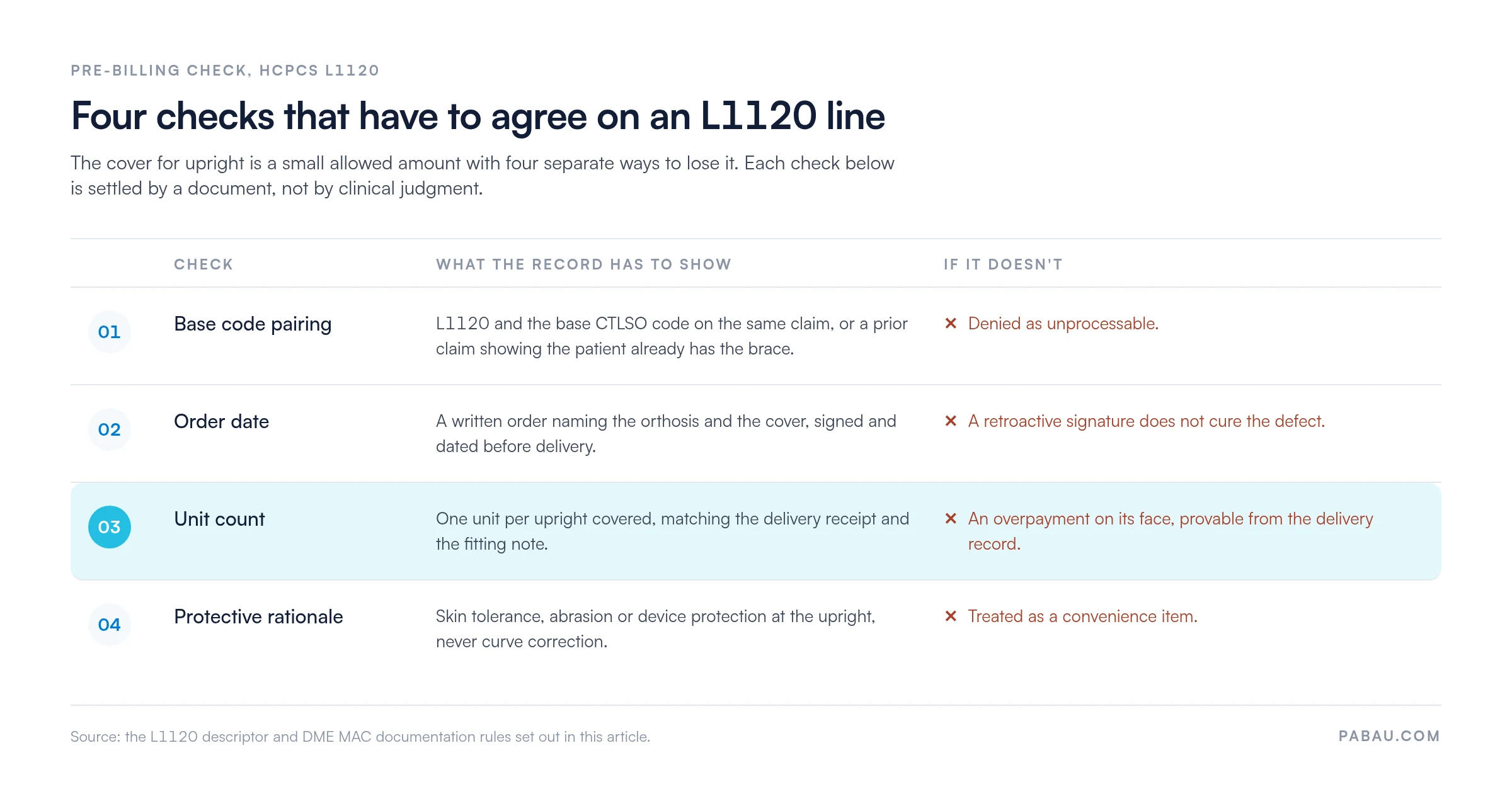
The billing unit is each, so the quantity on the claim equals the number of uprights you covered.
L1120 never bills alone. The base orthosis code belongs on the same claim, or on a prior claim for the same patient.
The cover applies no corrective force, so the notes have to justify it on protective grounds such as skin tolerance.
Pabau, our practice management software, validates DMEPOS claim lines before they go out and tracks each one in a single status view.
HCPCS Code L1120 is a Level II code maintained by the Centers for Medicare and Medicaid Services (CMS). Its official long description is: Addition to Cervical-thoracic-lumbar-sacral orthosis (CTLSO), scoliosis orthosis, cover for upright, each.
The code sits in the Orthotic Procedures and Devices category, within the scoliosis orthotic devices range L1000 to L1120. It is a DMEPOS code, so it applies to durable medical equipment, prosthetics, orthotics, and supplies billed to Medicare Part B or an equivalent payer.
Two properties of the code drive almost all of its billing risk. It is an addition code, so it has to accompany the base orthosis rather than stand in for it.
It is also priced per unit, so the quantity you submit is a factual claim about the device you fabricated. Practice management software like Pabau flags a line that breaks either rule before the claim reaches the clearinghouse.
A CTLSO is a rigid spinal orthosis that spans from the cervical region down to the sacrum. In a Milwaukee-style design, the brace is built around a molded pelvic section and a superior ring at the neck.
Metal uprights connect the two. The uprights carry corrective force between the pelvic section and the ring, which is why they sit close against the trunk.
A cover for upright is a sleeve of plastic, leather, or padded material fitted over one of those bars. It is a protective and cosmetic component rather than a corrective one. The cover keeps bare metal off the skin, reduces abrasion where the bar crosses bony landmarks, and stops the bar chafing or wearing through clothing. It also shields the upright itself from perspiration and surface wear.
Comfort carries clinical weight in scoliosis bracing. Bracing works through wear time, and an adolescent wearing a Milwaukee brace for most of the day will stop wearing it if the hardware rubs. A cover is one of the cheaper ways to protect tissue tolerance and keep the brace on the patient.
The last item on that list decides how the line has to be justified. A kyphosis pad, a lumbar bolster, an outrigger, and a ring flange all change how the brace loads the spine. A cover does not. The medical necessity argument for L1120 therefore has to rest on skin integrity and device protection, documented in the orthotist’s own words.
Medicare Part B covers CTLSO additions under the durable medical equipment benefit. The claim has to meet the requirements in the applicable DME MAC Local Coverage Determination (LCD). Coverage is never automatic. The treating physician and the orthotist have to establish and document medical necessity before the device is delivered.
For L1120, coverage rests on two conditions rather than one. The base scoliosis orthosis has to be covered for the patient in the first place. The cover then has to be warranted on its own, on protective grounds the record can show.
Requirements that typically apply:
Coverage language varies by jurisdiction, so confirm the current LCD for your DME MAC before the device goes out. Where the record shows only that the cover was requested for appearance or general comfort, expect the line to be treated as a convenience item. Practices that standardize prescription and delivery capture with digital forms spend far less time reconstructing that rationale during an audit.
According to CMS, HCPCS Level II orthotic addition codes are priced under the Medicare DMEPOS Fee Schedule, which CMS revises annually. The allowed amount for L1120 varies by pricing region and locality. Verify the current figure against the DMEPOS fee schedule published for your jurisdiction before you submit.
Because L1120 is priced as an addition, the allowed amount reflects only the cover. The base CTLSO code carries its own allowed amount and belongs on the same claim. Splitting the two across separate claims risks a bundling denial under the DME MAC edits that pair CTLSO base codes with their additions.
The per-unit pricing is also where overpayments come from. Billing four units when the fitting notes describe two covered uprights doubles the paid amount on that line. Auditors do not need clinical judgment to find that error, only the delivery record.
L1120 needs a supporting ICD-10-CM diagnosis that establishes medical necessity for the orthosis the cover belongs to. The diagnosis justifies the brace, and the orthotist’s protective rationale justifies the addition. Payers expect the diagnosis to reflect the complexity that warrants a full CTLSO rather than a simpler lumbar orthosis.
Specificity matters. Coding M41.20 when the record documents a thoracic curve at M41.24 invites a medical necessity review. No ICD-10 code describes skin abrasion from a brace upright, so a protective rationale resting on tissue breakdown belongs in the clinical note.
Check the ICD-10-CM code index when the curve site or an underlying condition needs a more specific code than the table above.
DME MACs apply the same documentation standard to a small addition as they do to the base brace. Missing one element can cost the whole line, and a post-payment audit can reach across every claim in the episode.
One outdated habit still shows up on these claims. CMS discontinued Certificates of Medical Necessity and DME Information Forms for dates of service on or after January 1, 2023. Claims that still carry that information are returned to the supplier. Signed proof of delivery plus the medical record now does the work a CMN used to.
Modifiers tell the payer how to read the line. A missing or wrong modifier can cause an outright denial or a silent payment reduction. The table below covers the modifiers that show up most often on L1120 claims.
KX is the consequential one. Without it, many DME MACs pend or deny the line until they have reviewed the record. Add it only after the order, the notes, and the delivery record are confirmed complete.
One modifier pair never belongs here. L1120 takes no RT or LT modifier, because a spinal orthosis is a midline device. Multiple covers are expressed in the units field rather than by adding laterality.
Strong denial management practices put that check in a pre-billing checklist rather than in a biller’s memory.
Reconcile the unit count before you bill. Count the covers on the delivery receipt, match that number to the quantity field, and confirm the orthotist’s note explains why each upright needed covering. A quantity that no document supports is the easiest overpayment for an auditor to prove.
Every code from L1010 through L1120 is an addition that attaches to L1000, the custom-fabricated CTLSO. Picking the wrong one is a leading source of scoliosis orthotic billing errors. Several of these components share materials, or sit inches apart on the same brace. The AAPC HCPCS Level II reference is a useful companion for confirming a current descriptor.
Key crosswalk distinction: L1100 and L1110 are the codes most often confused with L1120. All three can involve plastic or leather, but a ring flange is the component at the top of the brace that the uprights attach to. L1120 covers the upright itself. Read the fabrication note rather than the material list, and the choice resolves quickly.
Several additions can appear on one claim when the brace includes more than one component. Payers do not cap the number of addition codes, but each one needs its own documented justification.
Suppliers billing four or five additions should expect a records request covering all of them at once. The suppliers that clear those requests quickly build the documentation into the fitting workflow itself.
L1120 draws attention out of proportion to its allowed amount, because unit-based accessory codes are simple for a contractor to test. These are the errors most likely to trigger a denial or a recoupment demand:
Those six errors reduce to four checks that have to agree before the line goes out. Running them at submission is cheaper than an appeal, and far cheaper than a probe audit that expands to every DMEPOS claim in the sample.
L1120 has been stable for a long time. The “cover for upright” descriptor appears in HCPCS Level II releases going back more than two decades, and the current release carries the same wording. CMS reviews L-codes through the annual HCPCS update process, published each fall for the following January 1 effective date.
Verify the code’s status in each new HCPCS release rather than assuming continuity. The PGM Billing HCPCS lookup tool mirrors CMS data and gives a quick way to confirm a descriptor and its effective date. Build a code validation step into the annual coding review, so a retired descriptor is caught before it reaches a claim.
Check the CMS HCPCS release file every October. CMS publishes additions, deletions, and descriptor revisions before the January 1 effective date. Catching a change early keeps claims from going out against an invalid code for a full quarter.
DMEPOS billing carries more moving parts than a physician fee schedule claim:
A manual process leaves too much room for a small line to go out wrong.
Pabau takes over the steps that follow the coding decision. Our medical claims management tools submit claims electronically through the Claim.MD integration, and they run eligibility checks before the device is ordered.
Validation checks run in the background each time a claim goes out. A line missing something the payer needs gets flagged before it leaves the practice. Every claim then sits in one view at a named stage, from pending through submitted, processing, paid, or error.
For an orthotics supplier, that view answers a question a spreadsheet cannot. A biller filtering by insurer or invoice can see which L-code lines stalled and where. That shows up the same day they error, rather than three weeks later on a remittance. Clinical notes, orders, and signed delivery receipts stay attached to the patient record, so a records request becomes a search rather than a scramble.

Pabau submits claims electronically, validates each line before it goes out, and tracks every one in a single status view. Your billers see a stalled L-code line the same day.

The risk on L1120 sits in the pairing and the count, not in the clinical decision. The cover for upright is a modest protective component, and the code that describes it is easy to bill and easy to overbill. The four checks above cost a few minutes at submission and settle whether the line clears on the first pass.
The distinction worth holding onto is that this addition applies no corrective force. Documenting it as though it did puts the whole claim in an auditor’s hands. Bill the covers you fabricated, count them the way the delivery receipt does, and say plainly why the patient’s skin needed them.
Pabau puts the validation check in front of the biller and keeps every submitted claim in one status view. Book a demo to see how it handles DMEPOS claim lines.

Looking to understand the full revenue cycle behind orthotic billing? What is revenue cycle management explains how each billing stage connects, from clinical documentation through payment posting.
Billing Medicare Part B for durable medical equipment? Medicare billing walks through enrollment, claim submission, and the rules that decide whether a line gets paid.
Preparing for a DMEPOS documentation audit? Medical billing compliance sets out the record-keeping standards and audit responses that apply to orthotic suppliers.
HCPCS Code L1120 is the Level II code for a cover fitted over an upright on a cervical-thoracic-lumbar-sacral orthosis (CTLSO) or scoliosis orthosis. The official long descriptor reads Addition to Cervical-thoracic-lumbar-sacral orthosis (CTLSO), scoliosis orthosis, cover for upright, each. It is an addition code, so it bills alongside the base orthosis rather than on its own.
The uprights are the bars that run between the pelvic section and the superior ring of a Milwaukee-style CTLSO. A cover is a sleeve of plastic, leather, or padded material fitted over one of those bars. It keeps the metal off the skin and clothing and protects the bar from moisture and wear. It applies no corrective force to the spine.
The billing unit is each, and one unit covers one upright. A brace with three covered uprights supports three units. The quantity you submit has to match the number of covers recorded in the fitting and delivery notes. Unit-count mismatches are among the most common reasons an L1120 line draws a recoupment demand.
Medicare Part B can cover L1120 under the DME benefit when the base orthosis itself is covered and an accredited DMEPOS supplier bills it. Because the cover is protective rather than corrective, the record needs a functional reason such as skin breakdown or poor tissue tolerance. Coverage turns on the Local Coverage Determination for your DME MAC jurisdiction, so confirm the current criteria before delivery.
Several DME MAC policies expect the KX modifier, which attests that the coverage criteria in the applicable LCD are met. Apply it only once the order, the fitting notes, and proof of delivery are all in the record. Use GA instead when coverage is uncertain and you hold a signed Advance Beneficiary Notice. L1120 carries no RT or LT modifier, because a spinal orthosis is a midline device.
L1100 and L1110 both describe a ring flange in plastic or leather, the component the uprights attach to at the top of the brace. L1100 is the prefabricated version and L1110 is molded to a model of the patient. L1120 covers the upright itself, not the flange. The overlapping materials are why these three codes get swapped on claims.
Yes. Put L1120 and the base orthosis code on the same claim as separate line items. Where the patient already has the brace, reference the prior claim that shows the base device was supplied. An addition code with no base device on file is usually denied as unprocessable.
You need a written physician order dated before delivery that names the orthosis and the cover. Add orthotist notes describing which uprights were covered and why, a fitting record, and signed proof of delivery. Keep evidence of current CMS DMEPOS accreditation on file. Certificates of Medical Necessity no longer apply, because CMS discontinued CMNs for dates of service from January 1, 2023 onward.