CPT Code 62284: Injection procedure for myelography
CPT Code 62284: official descriptor and procedure overview The American Medical ...

Last Updated: Oct 19, 2026
Found our content helpful?HCPCS Code L0651: Official descriptor and billing attributes HCPCS Code L0651 is the code for a prefabricated, off-the-shelf lumbar-sacral orthosis (LSO) with rigid shells or panels and sagittal-coronal control. It sits in the L-code orthotics range of the HCPCS Level II code set, which the Centers for Medicare and Medicaid Services (CMS) […]
Let Pabau's smart automation suggest the right codes, reduce claim denials, and keep your practice compliant—effortlessly.
Automate repetitive tasks and focus on what matters most—your patients.
Reduce coding errors and ensure compliance with the latest regulations.
Clean claims, fewer denials, and faster reimbursements.
Powerful insights and reporting to help your practice thrive.
HIPAA compliant SOC 2 certified GDPR-compliant Trusted by 4,000+ clinics worldwide

HCPCS Code L0651 describes a prefabricated, off-the-shelf LSO with overlapping rigid shells that control motion in the sagittal and coronal planes.
Medicare requires PDAC product verification, a detailed written order (DWO), face-to-face examination notes, and proof of delivery before it pays an L0651 claim.
L0649 and L0650 are also rigid, off-the-shelf LSOs with sagittal-coronal control, so the shell design and anterior reach decide the code, not the material.
The same shell design becomes L0639 when it is custom fitted to the patient and L0640 when it is custom fabricated.
Pabau, the practice management platform we build, keeps DMEPOS claim files, modifier tracking, and electronic claim submission through Claim.MD in one place.
HCPCS Code L0651 is the code for a prefabricated, off-the-shelf lumbar-sacral orthosis (LSO) with rigid shells or panels and sagittal-coronal control.
It sits in the L-code orthotics range of the HCPCS Level II code set, which the Centers for Medicare and Medicaid Services (CMS) maintains. The official descriptor reads as follows, set out clause by clause:
Three parts of that descriptor do most of the work for coders. Rigid shell(s)/panel(s) built from overlapping rigid material rule out flexible and elastic supports. The front section must reach from the symphysis pubis to the xyphoid, which separates L0651 from frame-style braces. Off-the-shelf means the supplier dispenses it without trimming, bending, or molding it to the patient.
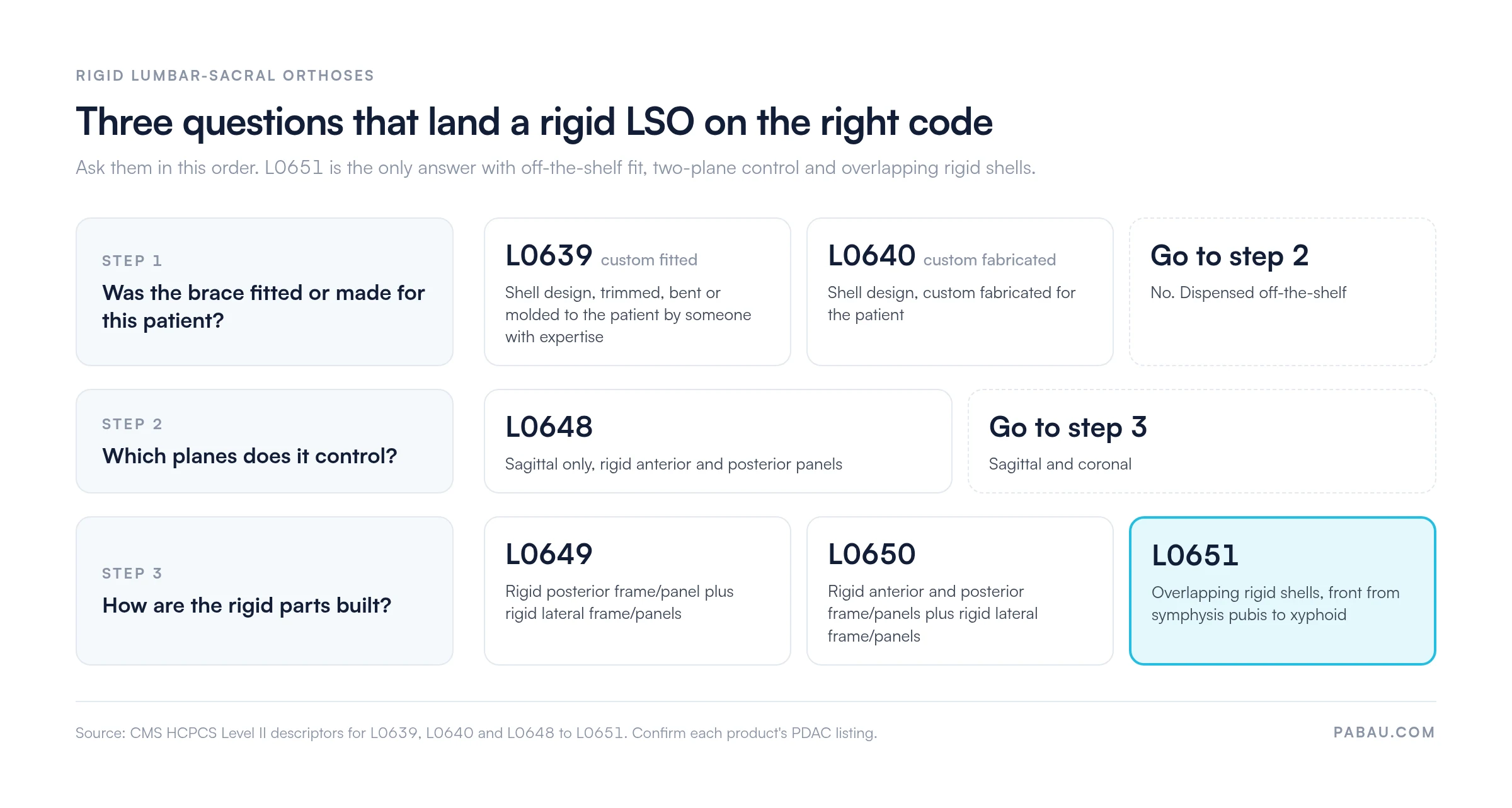
All three codes describe prefabricated, off-the-shelf LSOs with rigid components and sagittal-coronal control. Material and fabrication method don’t separate them. The difference sits in how the rigid parts are built and how far they reach. A wrong pick means a denial and a corrected refile.
The L0649 vs L0651 decision: both are rigid, off-the-shelf braces with sagittal-coronal control. L0649 builds its strength from a rigid posterior frame plus rigid lateral panels. L0651 adds rigid front coverage, with overlapping shells running from the symphysis pubis to the xyphoid. A photo of the dispensed brace and a prescriber note describing its panels keep the two apart on review.
The L0650 vs L0651 decision: both have rigid front and back components, and both are dispensed off-the-shelf. L0650 describes a frame-and-panel brace that gets its lateral strength from rigid lateral frames or panels.
L0651 describes a shell design, where overlapping rigid material and stabilizing closures carry the load. Match the product to its PDAC listing rather than to how it looks.
Fabrication only changes the code once the L0651 shell design is fitted or made for one patient. A prefabricated version trimmed, bent, or molded to the patient by someone with expertise is L0639. A version custom fabricated for the patient is L0640.
The decision path below puts those rules in the order a coder should ask them, starting with fit.
Coders working with L0651 should know the wider L-code range for lumbar and lumbar-sacral orthoses. The codes below sit in the same family, and the CMS descriptors separate them by control planes, construction, and fit.
Medical necessity for HCPCS Code L0651 must be supported by a covered ICD-10-CM diagnosis. The applicable Local Coverage Determination (LCD) from the beneficiary’s Medicare Administrative Contractor (MAC) governs which codes are covered. Confirm the exact list against the current LCD article for your MAC before filing.
The following ICD-10-CM codes are among those that commonly establish medical necessity, based on the clinical indications described in CMS LCD policies for spinal orthoses. Always confirm against the applicable MAC LCD article.
Note that not all spinal diagnoses automatically qualify. The LCD for spinal orthoses typically excludes coverage when conservative treatment has not been tried. It also excludes a non-specific pain code without documented functional impairment. Confirm coverage against the CMS ICD-10 codes page and the applicable MAC LCD before submitting.
Medicare Part B covers HCPCS Code L0651 under the DME benefit when all of the following conditions are met. Meeting one or two of them isn’t enough. The claim needs the complete set.
Medicare Advantage plans generally follow traditional Medicare coverage rules for L0651 but may impose additional prior authorization requirements or use different LCD interpretations. Verify with each plan before dispensing.
PDAC verification is product-specific, not code-wide. A supplier cannot assume that every rigid LSO brace qualifies under L0651 simply because it appears to match the descriptor. Each individual product must be verified by the PDAC contractor as meeting the coding criteria for this code.
To verify a product, search the CGS Medicare coding verification guidance or the PDAC product database at pdac.cms.hhs.gov. Search by the manufacturer’s product name or model number.
The product listing will show the HCPCS code the PDAC has confirmed the product supports. Billing a product under L0651 when the PDAC has it listed under L0649 is an upcoding error and triggers recoupment.
Run a PDAC verification check before dispensing any new brace product, not after the claim is denied. Download the PDAC product verification number and retain it in the claim file alongside the proof of delivery. Auditors specifically look for this documentation during post-payment reviews.
Every L0651 Medicare claim requires a specific documentation package. Missing any single element is sufficient grounds for denial. Build the file in this sequence before submitting.
Submitting an L0651 claim to Medicare follows the standard DMEPOS billing process. The claim goes on a CMS-1500 form (paper) or an 837P electronic transaction. Key submission elements are below.
Claims sent through a medical claims clearinghouse pass front-end edits that catch missing modifiers and diagnosis linkage errors before the MAC sees them. For DME suppliers billing L0651 in volume, that means fewer claims coming back for rework.
Most L0651 denials fall into six categories. Each has a specific corrective action. The missing document behind each denial decides whether you appeal, refile, or write off the claim.
Structured denial management workflows shorten the time between a denial notice and corrective action. Practices that sort denials by root cause spot repeat documentation errors sooner. That stops one error spreading across the whole code family.
Build a pre-submission checklist for L0651. It should cover the PDAC verification number, a DWO signed before dispensing, and a beneficiary-signed POD. Add the KX modifier and a covered ICD-10 code in the physician’s notes. Running this check before each submission catches the errors behind the denials above while they can still be fixed.
Many DME suppliers assemble an L0651 claim file by hand. The DWO lives in one system, the PDAC listing in a browser tab, and the signed proof of delivery in a scanned folder. A missing piece often surfaces only when the denial arrives.
Pabau keeps those documents on the patient record and tracks modifier use, KX included, before a claim goes out. Its claims management software then submits claims electronically through our Claim.MD clearinghouse integration.
The result is a claim file you can check against the documentation list above in minutes, so fewer L0651 claims come back for refiling.

Pabau’s claims management tools help DME suppliers and orthotics practitioners track documentation, apply modifiers correctly, and submit clean claims the first time. See how Pabau handles HCPCS billing from order to payment.

L0651 is a narrow code. It fits one construction: an off-the-shelf brace with overlapping rigid shells. They run from the sacrococcygeal junction to T-9 at the back and from the pubis to the xyphoid at the front. Check the product’s PDAC listing before you pick the code, not after a denial.
Then build the claim file before the brace leaves your hands. It needs the DWO, proof of delivery, PDAC number, and a covered diagnosis in the prescriber’s notes. Doing this once per product, rather than once per denial, is what keeps LSO claims paid the first time.
Book a demo to see how Pabau keeps DMEPOS documentation and modifiers together in one claim file.

Need a structured approach to medical billing compliance? Medical billing compliance guidance covers the documentation standards and audit triggers that apply across DMEPOS claims.
Want to understand how clearinghouse submission works? Clean claim requirements walks through the front-end edits a clearinghouse applies before a claim reaches a MAC.
Looking for context on the broader revenue cycle? Revenue cycle management fundamentals explains how DMEPOS billing fits into the end-to-end claim lifecycle.
Billing a sagittal-only brace instead? HCPCS Code L0648 covers the off-the-shelf LSO with rigid anterior and posterior panels and sagittal control only.
Fitting a frame-style brace to the patient? HCPCS Code L0637 explains the custom-fitted sagittal-coronal LSO built from rigid frames and panels.
HCPCS Code L0651 is a Level II orthotics code for a prefabricated, off-the-shelf lumbar-sacral orthosis with overlapping rigid shells that control sagittal and coronal motion. The same design custom fitted to the patient is L0639, and a custom fabricated version is L0640.
Both are rigid, prefabricated, off-the-shelf LSOs with sagittal-coronal control. L0649 relies on a rigid posterior frame with rigid lateral panels. L0651 uses overlapping rigid shells, with a front section running from the symphysis pubis to the xyphoid. Match the dispensed product to its PDAC listing to choose between them.
Yes. Medicare Part B covers L0651 under the DME benefit when four conditions are met. The beneficiary has a covered diagnosis under the MAC LCD, the device is PDAC-verified, a detailed written order exists, and the supplier holds DMEPOS accreditation. The KX modifier must be appended to attest that the documentation is on file.
Yes, CMS requires PDAC product verification for prefabricated spinal orthoses billed to Medicare. Verification is product-specific: the specific brace model dispensed must appear in the PDAC database as verified for L0651. Billing a non-verified product under this code is a coding error that triggers recoupment.
Traditional Medicare does not require prior authorization for L0651, but Medicare Advantage plans and many commercial payers do. Check the specific plan’s authorization requirements before dispensing. Failing to obtain required prior authorization is a top denial reason for Medicare Advantage claims.
Required documentation includes a detailed written order signed before dispensing and face-to-face examination notes from the prescriber. You also need the PDAC product verification number, fitting notes, and a signed proof of delivery. All records must be retained in the supplier’s file and available for audit on request.