

CCSD code G5100: Bypass of duodenum billing guide
CCSD code G5100 bills a bypass that leaves the duodenum in place CCSD code G5100...

Last Updated: Oct 16, 2026
L0649 is the HCPCS Level II code for an off-the-shelf lumbar-sacral orthosis with sagittal-coronal control and a rigid posterior frame. The frame runs from the sacrococcygeal junction to the T-9 vertebra, backed by rigid lateral panels. The brace needs only minimal self-adjustment, with no expert trimming, bending or molding to fit.
Medicare covers L0649 under the DMEPOS benefit, so claims go to a Durable Medical Equipment Medicare Administrative Contractor (DME MAC). Coverage follows LCD L33790, and the supplier must be enrolled with Medicare as a DMEPOS supplier.
Let Pabau's smart automation suggest the right codes, reduce claim denials, and keep your practice compliant—effortlessly.
Automate repetitive tasks and focus on what matters most—your patients.
Reduce coding errors and ensure compliance with the latest regulations.
Clean claims, fewer denials, and faster reimbursements.
Powerful insights and reporting to help your practice thrive.
HIPAA compliant SOC 2 certified GDPR-compliant Trusted by 4,000+ clinics worldwide

L0649 is an off-the-shelf LSO with a rigid posterior frame only, while L0650 adds a rigid anterior panel.
Medicare coverage requires LCD L33790 criteria to be met and documented before delivery.
Modifier KX is mandatory on every L0649 claim to attest that coverage criteria are on file.
RAC topic 0128 targets spinal orthosis replacement within the Reasonable Useful Lifetime.
HCPCS Code L0649 is a prefabricated, off-the-shelf lumbar-sacral orthosis (LSO) with sagittal-coronal control and a rigid posterior frame. Sagittal-coronal control means the brace limits bending forward, backward and to the side. Under CMS’s HCPCS Level II code system, off-the-shelf (OTS) means the patient needs only minimal self-adjustment, with no expert fitting.
The official descriptor is long, so it helps to read it as a set of construction requirements. A brace billed as L0649 needs each of these:
The PDAC (Pricing, Data Analysis and Coding contractor) provides coding verification letters for manufacturers whose products meet the L0649 descriptor. Suppliers should confirm a device carries PDAC verification before billing. A non-verified brace billed under L0649 is an audit risk during a Recovery Audit Contractor (RAC) review.
LCD L33790 governs Medicare coverage for spinal orthoses including L0649. Coverage requires that all of the following criteria are met before the device is delivered to the patient. A claim billed first and documented later tends to fail on review, because the notes were not on file at delivery.
The Centers for Medicare and Medicaid Services (CMS) administers LCD L33790 through two DME MACs. Noridian (Jurisdictions A and D) and CGS (Jurisdictions B and C) are the only two. Each DME MAC may publish supplemental guidance that expands on the core LCD. Always check the jurisdiction’s policy article alongside the LCD itself.
Every L0649 claim requires at least one ICD-10-CM diagnosis code that establishes medical necessity under LCD L33790. A covered diagnosis is not sufficient on its own. The clinical record must also document the symptom severity, functional limitation, and physician rationale for the orthosis. An AAPC HCPCS code lookup can help verify code-to-LCD pairing before submission.
The three low back pain codes share one subcategory, so the note has to say which type of pain applies. Vertebrogenic pain takes M54.51, and other specified low back pain takes M54.59.
Post-surgical indications (such as lumbar fusion stabilization) may also support coverage. Always verify the codes listed in the current LCD L33790 and its Policy Article. The DME MACs update the covered diagnosis list periodically.
Documentation for HCPCS Code L0649 must be complete before the device is delivered. A file assembled after delivery is a compliance risk and a common cause of denials. The following documents must be on file.
A pre-delivery checklist that covers these five documents cuts the chance of a missing-document denial. Medicare also sets a record retention period for DMEPOS suppliers, so keep the full file after the claim is paid.
L0649 and L0650 are both prefabricated, off-the-shelf lumbar-sacral orthoses with sagittal-coronal control. Neither official descriptor calls for professional fitting, so fitting is not what separates them. Panel configuration is. L0649 has a rigid posterior frame or panel only. L0650 pairs that rigid posterior frame with a rigid anterior panel. Add the fitting question and the four neighboring codes fall into a simple grid.
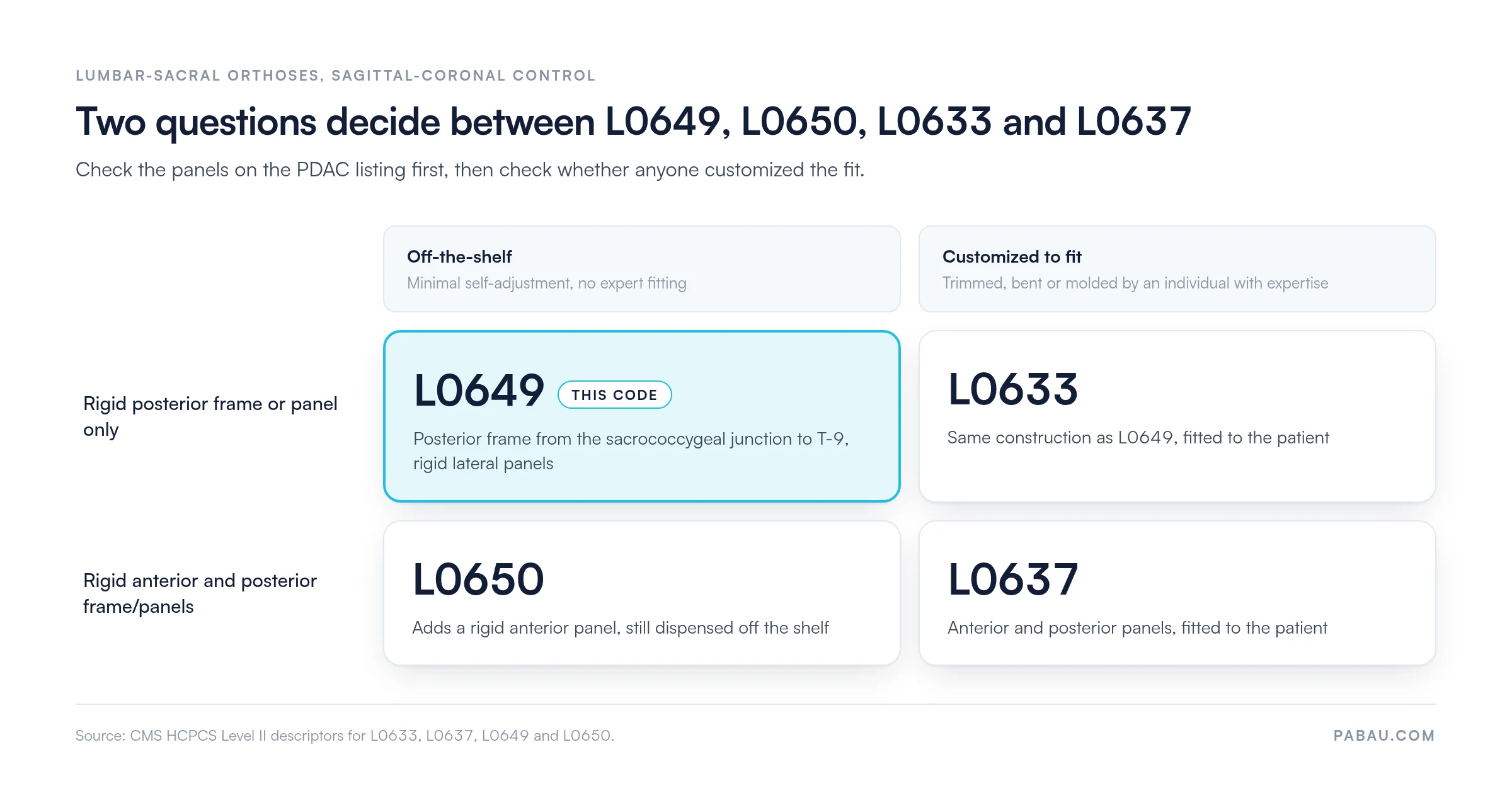
Code from the device, not from how it was handed over. The manufacturer’s PDAC listing confirms whether the brace has an anterior panel. Fitting still matters one step over, though. A posterior-only brace that was trimmed, bent, molded or otherwise customized to fit by an individual with expertise is L0633, not L0649. The DME MACs publish a joint correct coding article that defines off-the-shelf versus custom-fitted orthoses.
L0637 is not a thoracic code. It is a lumbar-sacral orthosis (LSO) with sagittal-coronal control, the same anatomical family as L0649. Both posterior panels extend from the sacrococcygeal junction to the T-9 vertebra. That reach does not make either device a thoracic-lumbar-sacral orthosis (TLSO), which is a separate code family (L0450-L0492).
Two features separate the codes. L0637 has rigid anterior and posterior frame/panels, while L0649 has a rigid posterior frame only. L0637 is also a prefabricated item customized to fit the patient by an individual with expertise, while L0649 is off-the-shelf. The DWO and the delivery record should confirm both the panel configuration and who fitted the brace.
Check the manufacturer’s PDAC listing before billing. It confirms the panel configuration that the code depends on. If your fitter trimmed, bent or molded the brace to the patient, record who did it and how, because that moves the claim off L0649.
HCPCS Code L0649 claims require correct modifier assignment to pass adjudication. Omitting modifier KX is the single most preventable denial on this code and it is also one of the most common. A pre-submission check for the modifier catches the omission before the payer does.
Medicare reimbursements for HCPCS Code L0649 are set by the CMS DMEPOS Fee Schedule, which is updated annually each January. Because amounts change year over year, this guide does not quote a specific dollar figure. Look up the current allowable with the CMS DMEPOS fee schedule tool. Filter by HCPCS code L0649, the patient’s ZIP code, and the date of service. Rates vary between competitive-bidding areas and non-competitive-bidding areas.
State Medicaid programs set their own fee schedules independently of Medicare. Virginia’s Department of Medical Assistance Services (DMAS), for example, publishes L0649 rates in Appendix B of its Orthotics fee schedule. Washington State’s Health Care Authority governs L0649 billing for state Medicaid under its P&O Devices Billing Guide.
Suppliers billing across multiple states should keep state-specific rate tables. Check each payer’s covered indications separately from Medicare’s LCD. Reconciling payments against each fee schedule every quarter catches rate changes before they turn into underpayments.
CMS has expanded its prior authorization (PA) program for certain DMEPOS items in recent years. L0649 may be included in PA requirements depending on your DME MAC jurisdiction and the current CMS PA final rule. Verify the current PA status with your DME MAC before dispensing the device. A claim sent without a required PA approval is denied automatically. Not knowing PA was required is not grounds for appeal.
When prior authorization is required, the request must include the treating physician’s DWO and face-to-face notes. Add the qualifying diagnosis code and any prior treatment history. PA approvals are typically issued for a defined episode of care. Replacements within the Reasonable Useful Lifetime (RUL) may require a new PA request even if the original device was approved.
CMS assigns a Reasonable Useful Lifetime (RUL) to durable medical equipment, including spinal orthoses. Billing a replacement L0649 within the RUL without documenting why early replacement is necessary draws Recovery Audit Contractor attention. RAC approved topic 0128 covers spinal orthosis replacement claims.
Record each patient’s RUL expiry date at delivery. A replacement claim can then be held until its documentation is on file.
Most L0649 denials are preventable at the point of dispensing rather than the point of billing. A reference to medical billing denial codes explains the CARC and RARC codes on a rejected claim. Match each one to the prevention step below.
A structured submission workflow reduces first-pass denial rates for HCPCS Code L0649. The steps below map to the documentation and modifier requirements covered earlier in this guide. Working through them in order heads off the denial reasons listed in the table above.
Run an internal pre-bill audit on every L0649 claim before submission. Check: (1) KX modifier present, (2) DWO complete with all required elements, (3) ICD-10 code covered under LCD L33790, (4) delivery confirmation signed. The check takes a couple of minutes and saves a denial and appeal later.
Confirming that L0649 is the correct code requires ruling out neighboring codes in the spinal orthosis family. The table below lists the codes most often confused with HCPCS Code L0649, with the key distinguishing factor for each. Checking the NLM HCPCS Level II API or a code lookup tool can help verify the current descriptor before submission.
Billing HCPCS Code L0649 means lining up the order, the clinical notes, prior authorization and replacement timing for every claim. Most suppliers track those records across a shared drive, an email thread and the billing system.
Practice management software like Pabau keeps them on one patient record instead. Pabau’s tools for cleaner claims management sit on that same record. A biller can see whether the file is complete before the claim goes out.
The delivery date lives on the same record too, which makes an early replacement claim easy to spot before submission. The outcome is fewer claims sent short a document, and fewer recoupments found on audit months later.

Pabau’s claims management tools help orthotic suppliers keep orders, clinical notes and delivery records with each claim, so fewer claims go out missing a document.

HCPCS Code L0649 is decided by construction before it is decided by paperwork. A rigid posterior frame only, dispensed off the shelf, is L0649. An added anterior panel points to L0650, and customizing the fit points to L0633 or L0637.
Once the code is right, the claim stands or falls on a file assembled before delivery, not after a denial. Suppliers who confirm the PDAC listing, the order and the replacement date up front spend far less time on appeals.
See how Pabau keeps L0649 documentation and claims in one place. Book a demo to walk through it with a specialist.

Need to understand how claims reach the payer? Medical claims clearinghouse overview explains how electronic claims move through the DME MAC system.
Worried about denial patterns across your DMEPOS claims? Denial management in healthcare covers how to categorize, appeal, and systematically prevent recurring denials.
Tracking revenue across multiple payers? Electronic remittance advice guide walks through how to read and reconcile 835 ERA files from DME MACs.
Billing a brace with a rigid anterior panel? HCPCS Code L0650 guide covers the off-the-shelf LSO with anterior and posterior panels.
Did a fitter customize the brace? HCPCS Code L0637 guide explains the custom-fitted LSO with anterior and posterior panels.
HCPCS Code L0649 covers a prefabricated, off-the-shelf lumbar-sacral orthosis with a rigid posterior frame and sagittal-coronal control. It requires no professional fitting by an orthotist or other qualified professional. Medicare covers it under LCD L33790 when the patient’s diagnosis and clinical record meet the coverage criteria.
Modifier KX is required on every L0649 claim where LCD L33790 coverage criteria are met; it attests that the required documentation is on file. Modifier GA is added when an Advance Beneficiary Notice (ABN) has been issued and the patient is financially liable for the item.
CMS has expanded its DME prior authorization program to include certain spinal orthoses. L0649 may require PA depending on the DME MAC jurisdiction and the current CMS PA final rule. Verify the current PA requirement with your applicable DME MAC before dispensing any L0649 device to a Medicare patient.
The most common denials are missing modifier KX, an incomplete or unsigned DWO, and a diagnosis code not covered under LCD L33790. Missing prior authorization and an unjustified replacement within the Reasonable Useful Lifetime follow close behind.



