CPT Code 62284: Injection procedure for myelography
CPT Code 62284: official descriptor and procedure overview The American Medical ...

Last Updated: Oct 19, 2026
L0639 is the HCPCS Level II code for lumbar-sacral orthosis, sagittal-coronal control, rigid shell(s)/panel(s), posterior extends from sacrococcygeal junction to t-9 vertebra, anterior extends from symphysis pubis to xyphoid, produces intracavitary pressure to reduce load on the intervertebral discs, overall strength is provided by overlapping rigid material and stabilizing closures, includes straps, closures, may include soft interface, pendulous abdomen design, prefabricated item that has been trimmed, bent, molded, assembled, or otherwise customized to fit a specific patient by an individual with expertise.
It arrives prefabricated, then gets trimmed, bent, molded or assembled for one patient by someone with expertise. That fitting work is what separates L0639 from L0651, the off-the-shelf version of the same brace. Since August 12, 2024, Medicare has also required prior authorization before it pays an L0639 claim.
Let Pabau's smart automation suggest the right codes, reduce claim denials, and keep your practice compliant—effortlessly.
Automate repetitive tasks and focus on what matters most—your patients.
Reduce coding errors and ensure compliance with the latest regulations.
Clean claims, fewer denials, and faster reimbursements.
Powerful insights and reporting to help your practice thrive.
HIPAA compliant SOC 2 certified GDPR-compliant Trusted by 4,000+ clinics worldwide

HCPCS code L0639 covers a prefabricated lumbar-sacral orthosis with rigid shells or panels, customized to fit one patient.
A brace handed over in a stock size with no fitting work belongs under L0651, the off-the-shelf code.
Medicare has required prior authorization for L0639 nationwide since August 12, 2024, as a condition of payment.
Certificates of Medical Necessity were discontinued for dates of service on or after January 1, 2023.
Only products published on the PDAC Product Classification List may be billed with L0639.
L0639 pays for a prefabricated lumbar-sacral orthosis (LSO) that was customized for a specific patient. CMS is specific about this in the official long descriptor.
The item must be “trimmed, bent, molded, assembled, or otherwise customized to fit a specific patient by an individual with expertise.” So the fitting work is part of the code, not an optional extra.
A brace pulled off the shelf in a stock size and handed over as-is does not meet that wording. That device is L0651, which sits in the same rigid shell family but carries an off-the-shelf descriptor. Mixing the two up is the single most common coding error on this code.
The short descriptor that appears on the claim reads “LSO s/c shell/panel prefab.” L0639 is a HCPCS Level II code maintained by CMS, and it pays through the Medicare DMEPOS fee schedule rather than the Physician Fee Schedule.
The long descriptor sets the anatomy, the mechanics and the build. Every part of it has to match the brace you handed the patient, because that is the comparison an auditor makes.
There is a second filter that catches suppliers out. Only products published on the PDAC Product Classification List may be billed with L0639.
That rule has applied to prefabricated spinal orthoses since July 1, 2010, and it is checked during review. Confirm the model is listed before you order stock, not after a denial lands.
You need an affirmed prior authorization decision before you deliver the brace and bill for it. CMS added L0631, L0637 and L0639 to its Required Prior Authorization List in May 2024. The requirement took effect nationwide on August 12, 2024, as a condition of payment, and the DME MACs started accepting requests on July 29, 2024.
Since January 1, 2025, a standard review takes no more than seven calendar days. An expedited review still takes two business days, and it applies when waiting would put the patient’s health or function at risk. An affirmed decision returns a unique tracking number, known as a UTN, which then goes on the claim.
A non-affirmed decision is not the end of it. The letter names the document that fell short, so you can fix that one item and resubmit. What you cannot do is skip the step. A claim that arrives without an affirmation is denied, however good the clinical file looks.
The order of operations matters more here than any single form. Below is the sequence an L0639 claim has to pass through, with the stop that happens when a step gets skipped.
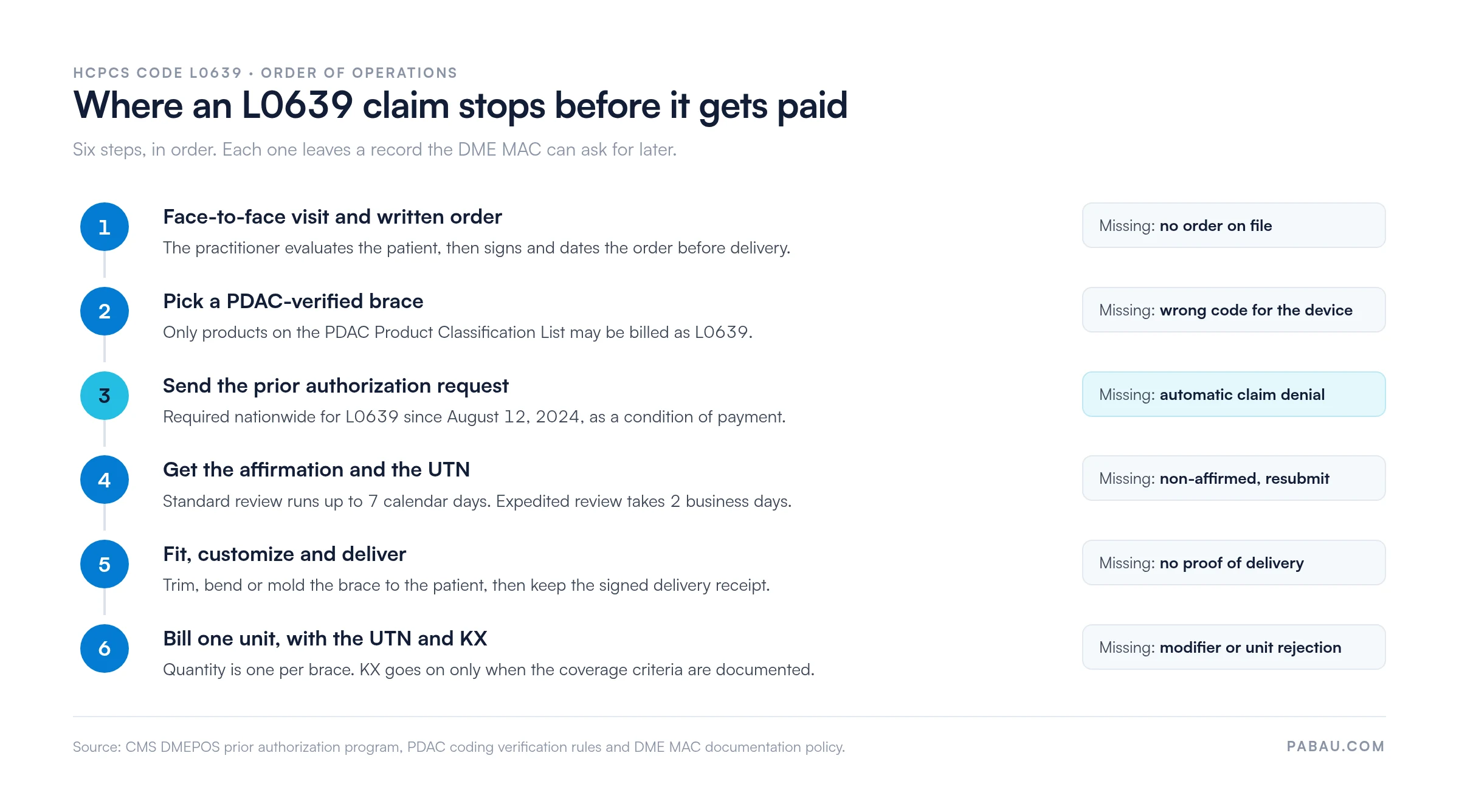
CMS publishes the program rules, the request forms and the current code list on its DMEPOS prior authorization page. The list changes, so check it each year rather than relying on a saved copy.
L0639 is paid from the Medicare DMEPOS fee schedule, which CMS updates every year. There is no single national figure to quote a patient. Pull the current file for the year of service and the beneficiary’s jurisdiction, then work from that.
Four things move the amount that lands in the bank:
Pull the current-year DMEPOS fee schedule file from CMS.gov before you quote a number to a patient or a referring practice. Amounts for L0639 are republished every year and differ by jurisdiction. A figure copied from a third-party site or last year’s spreadsheet is the fastest way to promise a patient something the MAC will not pay.
Medicare covers the brace when it is medically necessary and the DME MAC’s Local Coverage Determination (LCD) is satisfied. Those policies are jurisdiction-specific and they change, so read the current one for your region.
The criteria below are common across the spinal orthosis policies:
One piece of old advice still circulates and it will now cost you money. Certificates of Medical Necessity were discontinued for dates of service on or after January 1, 2023. CMS no longer accepts a CMN or a DME Information Form with a claim, so attaching one triggers a rejection instead of an approval. Leave it out.
Keep these seven items together in one place, filed against the patient and the date of service. Post-payment reviews on L-code orthotic claims are routine, and they are decided on what you can produce.
Those fitting notes carry more weight than people expect. They are the only record that separates a custom-fitted L0639 from an off-the-shelf L0651. Write down the adjustment at the moment it happens. Retain the whole file for at least seven years from the date of service.
Six questions, about five minutes, and they catch most of what comes back. Work through them on every L0639 claim line:
Answer no to any of them and the claim waits. Five minutes at this stage beats a five-week appeal later.
These denials repeat, which also makes them preventable. Almost all of them are decided before the brace leaves the building.
Sound denial management for DME starts at the dispensing bench rather than the billing queue. Put the checklist where the brace is fitted and most of this table stops happening.
Seven LSO codes sit close enough to be confused with each other. They split on two questions: what the brace is built from, and how it reached the patient.
Three codes share the rigid shell build. L0651 comes off the shelf with no fitting work. L0639 is fitted to the patient by a person with expertise. L0640 is fabricated from a mold or impression of that patient. L0637 and L0638 are one step away, built from rigid anterior and posterior frame panels rather than a shell.
Here is how that plays out at the counter. A patient leaves with a stock-size shell brace that the orthotist heat-molded and trimmed at the waist, so the claim is L0639.
Hand the same brace over in its box with no adjustment and the claim is L0651. Other L-codes in the HCPCS code library split along the same lines, so the question stays the same: what did the patient walk out with?
Four coverage modifiers do most of the work on this code, and picking the wrong one is entirely within your control.
The UTN from the prior authorization sits on the claim alongside those modifiers, not in place of them. Place of service is usually the patient’s home, code 12. Your DME MAC’s policy article may call for further modifiers, so read the current version for your jurisdiction before you build the claim template.
Most of the friction in DME billing comes from where the paperwork lives. Four documents have to meet in one file, and they usually arrive from four directions:
By the time a records request arrives, someone spends an afternoon rebuilding that file.
Practice management software like Pabau keeps those pieces against one patient record instead. Orders, clinical notes, authorization letters, fitting notes and signed delivery receipts attach to the same encounter, so the file is assembled as the work happens.
Pabau’s claims management software then carries that record into the claim. HCPCS entry, modifier fields and electronic submission sit alongside the documentation. So a missing order or an empty modifier field shows up before the claim goes out. Fewer claims come back, and the ones that do are easier to answer.
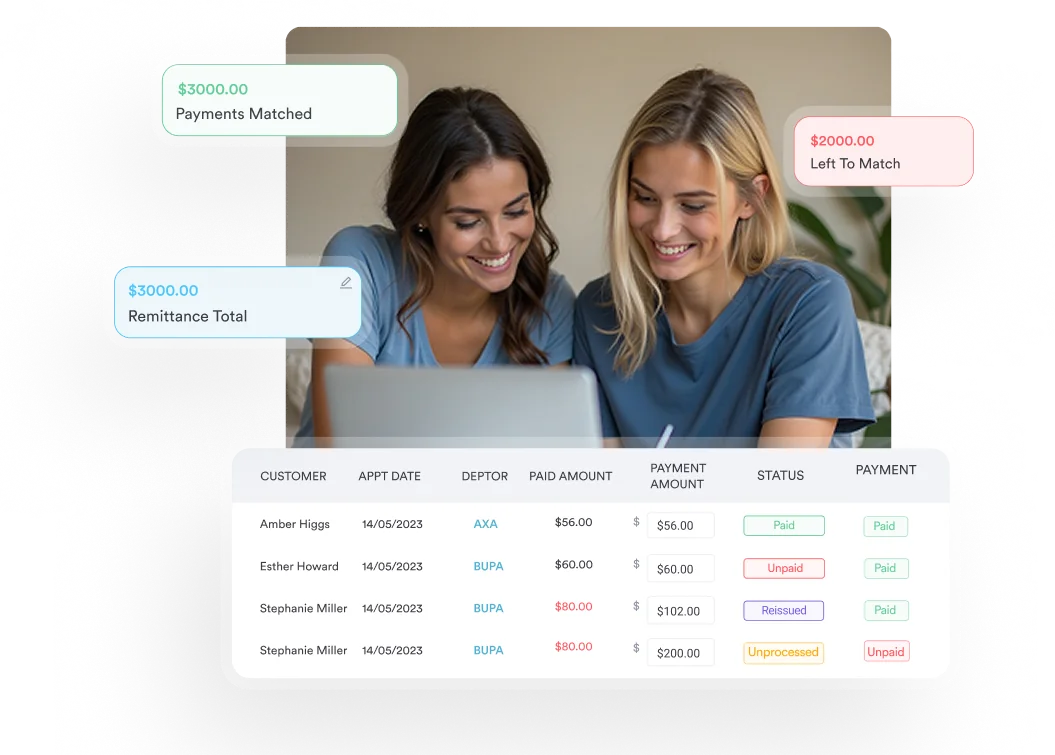

Pabau attaches orders, clinical notes, authorization letters and delivery receipts to the patient record, then submits the claim from the same place. Fewer missing-document denials on L0639 and the rest of your L-codes.

L0639 rewards suppliers who get the order of operations right. The authorization, the PDAC listing and the written order all belong to the days before the patient walks out with the brace. Once it has been delivered, none of them can be fixed retroactively.
Appeals will always be part of DME billing, but they are the expensive way to get paid. Write the fitting note at the bench and check the affirmation before the box opens. Do that and most claims never reach the appeals queue.
If your L0639 documentation currently lives in four places, start there. Book a demo to see how Pabau keeps orders, notes and authorizations with the claim they support.

Need to work a stack of DME denials? Denial management in healthcare covers the common denial types and the workflows that prevent them.
Want fewer claims bounced on technicalities? Clean claim standards and requirements sets out what a payer expects on every submission.
New to the billing side of orthotics? What is medical billing walks through the process end to end and shows where suppliers fit.
Building a document pack for a patient claim? What a superbill is and how to use one explains which fields have to be captured at the point of service.
Checking Part B before you dispense? Insurance eligibility verification shows how to confirm benefits before the device leaves the shelf.
Only a supplier enrolled in Medicare with an active DMEPOS supplier number. That means accreditation by a CMS-approved body and a surety bond on file. The practitioner who writes the order is often not the supplier who bills. Without enrollment, the claim is rejected before anyone reviews the clinical file.
Medicare covers a replacement when the brace is lost, stolen or irreparably damaged. It also covers one when the patient’s condition changes and the current brace no longer works. Document the reason in the record. A replacement runs through the same prior authorization step as the original brace.
Medicare Advantage plans cover at least what Original Medicare covers, but each plan sets its own authorization rules and network requirements. A DME MAC affirmation does not carry across to a plan. Check that plan’s own policy and submit its authorization before dispensing.
Issue an Advance Beneficiary Notice first, have the patient sign it, and append modifier GA to the claim line. That keeps the option of billing the patient open. Delivering without an ABN and without an affirmation leaves the charge with you.