HCPCS Code G0160: OT maintenance program billing guide
What is HCPCS code G0160? HCPCS code G0160 reports skilled occupational therapy ...

Last Updated: Oct 19, 2026
L0637 is the HCPCS Level II code for lumbar-sacral orthosis, sagittal-coronal control, with rigid anterior and posterior frame/panels, posterior extends from sacrococcygeal junction to t-9 vertebra, lateral strength provided by rigid lateral frame/panels, produces intracavitary pressure to reduce load on intervertebral discs, includes straps, closures, may include padding, shoulder straps, pendulous abdomen design, prefabricated item that has been trimmed, bent, molded, assembled, or otherwise customized to fit a specific patient by an individual with expertise.
Most L0637 denials trace back to the coding decision made at delivery. The claim describes a level of fitting the record cannot support, so the reviewer downgrades or denies it.
Let Pabau's smart automation suggest the right codes, reduce claim denials, and keep your practice compliant—effortlessly.
Automate repetitive tasks and focus on what matters most—your patients.
Reduce coding errors and ensure compliance with the latest regulations.
Clean claims, fewer denials, and faster reimbursements.
Powerful insights and reporting to help your practice thrive.
HIPAA compliant SOC 2 certified GDPR-compliant Trusted by 4,000+ clinics worldwide

HCPCS code L0637 describes a prefabricated lumbar-sacral orthosis with sagittal-coronal control, customized to fit a specific patient by an individual with expertise.
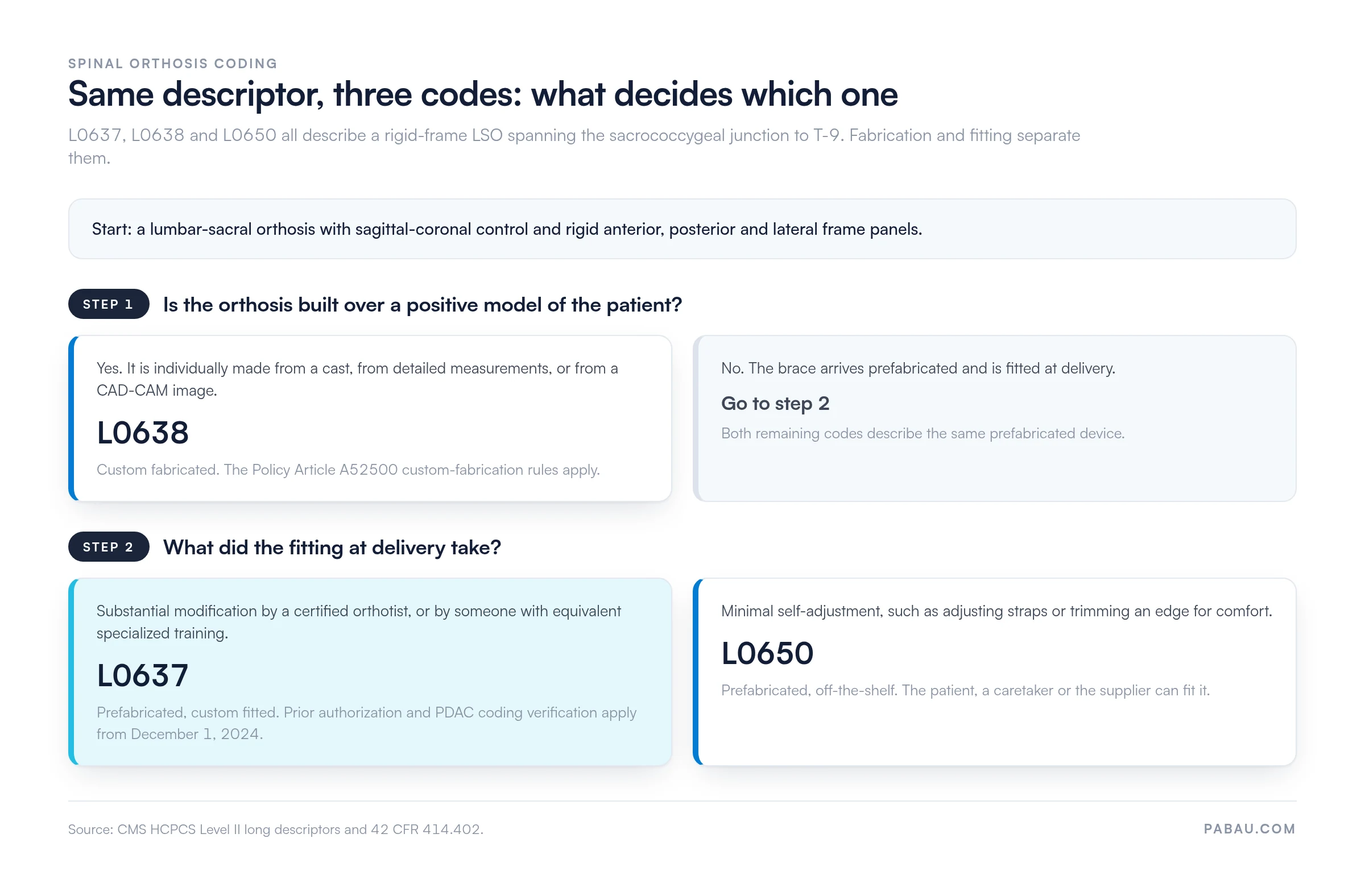
Custom fabrication belongs to a different code. L0638 carries the same structural descriptor as L0637 but is built over a positive model of the patient.
The choice between L0637 and L0650 turns on the fitting performed at delivery. Substantial modification supports L0637. In contrast, minimal self-adjustment means L0650.
L0637 needs prior authorization and PDAC coding verification for dates of service from December 1, 2024. Otherwise, unverified products are denied as incorrectly coded.
Pabau, practice management software for healthcare practices, gives orthotic suppliers one place to hold L0637 records and track each claim through to payment.
HCPCS code L0637 is a Level II HCPCS code maintained by the Centers for Medicare and Medicaid Services (CMS). It describes a lumbar-sacral orthosis (LSO) with a set frame construction and a set level of fitting at delivery. So both halves of that descriptor decide whether the code is correct.
The official CMS long descriptor breaks into six parts:
That last line decides the code. L0637 is a prefabricated brace. In fact, the expertise applied at the final fitting is what separates it from the off-the-shelf version of the same device.
Medicare treats both off-the-shelf and custom-fit braces as prefabricated items. Specifically, the regulation at 42 CFR 414.402 settles the coding question on one point. What matters is how much adjustment the final fitting takes.
Custom fabrication is the one category L0637 does not belong to. Billing a genuinely custom-fabricated LSO under L0637 sells the work short. Likewise, billing an off-the-shelf brace under L0637 makes it look like more work than it was. If that brace has a posterior frame and no rigid anterior panel, the off-the-shelf code is L0649.
That second error carries most of the audit risk on this code. A DME MAC denies an L0637 claim as incorrectly coded when only minimal self-adjustment happened at delivery. Because it is a statutory denial, there is no medical-necessity appeal to fall back on. The diagram below runs the two questions that settle the code, in order.
Medicare covers a spinal orthosis in the L0450 to L0651 range when the prescribing practitioner orders it for one of four indications. Local Coverage Determination L33790 sets them out. It also applies to L0637 like every other code in the range.
A spinal orthosis supplied without one of those indications is denied as not medically necessary. The record supporting that indication starts at the practitioner evaluation, rather than after the brace is delivered.
Coverage alone does not carry the claim. L0637 has to clear two further tests. The first is the level of fitting performed at delivery. The second is whether the exact product is published on the PDAC list.
Incomplete records drive most post-payment findings on spinal orthoses. One item has left the checklist entirely. CMS dropped Certificates of Medical Necessity and DME Information Forms for dates of service from January 1, 2023. As a result, a workflow still waiting on a CMN is holding claims for a form Medicare no longer accepts.
Taking each document at the point of care keeps the rest of the list far easier to finish. The table below covers what the file needs before an L0637 claim is submitted.
DMEPOS supplier standards and the LCD documentation rules apply in parallel, so a steady intake workflow matters here. Records completed at each patient touchpoint hold up far better than records rebuilt after a denial letter arrives.
L0637 sits on the CMS Required Prior Authorization List for DMEPOS items. The DME MACs applied the requirement to L0631, L0637 and L0639 for claims with dates of service on or after December 1, 2024.
Prior authorization must be requested and affirmed before the brace is delivered. A claim submitted without an affirmative decision is denied, and that denial cannot be appealed on medical necessity grounds.
The same announcement added a coding verification review requirement for L0637. Only products the Pricing, Data Analysis and Coding contractor has reviewed and published on the Product Classification List may be billed under this code. Otherwise, a product without that verification is billed as A9270 and treated as statutorily noncovered.
Check the PDAC Product Classification List for the exact brace model before you code it as L0637. The list is sorted by product, not by maker, so two braces from the same supplier can carry different codes. A 30-second lookup before delivery costs far less than a recoupment two years later.
Medicare pays L0637 from the annual CMS DMEPOS fee schedule, not from the physician fee schedule. Allowables are set by state and revised each January. Confirm the current figure in the CMS fee schedule file for your state before you quote a patient or forecast revenue.
The table below covers the payment mechanics that apply to this code. Dollar amounts vary by state and change annually, so treat any third-party figure as a starting point rather than a rate.
Because DMEPOS allowables differ by state, the same brace pays more in some states than others for a multi-state supplier. Pull the figure for your state before you build a patient estimate or a cash-flow forecast.
The Spinal Orthoses policy does not establish a KX requirement for L0637, and no attestation modifier substitutes for prior authorization. Instead, the modifiers that matter here are the purchase modifier and the beneficiary liability modifiers.
A modifier never rescues a coding error. If the fitting at delivery amounted to minimal self-adjustment, the correct answer is L0650 rather than L0637 with something appended.
LCD L33790 does not publish a covered diagnosis list for spinal orthoses. Coverage turns on the four indications above rather than on a code list, so the diagnosis reported has to match what the practitioner recorded.
Those codes are illustrative rather than a covered list. Confirm that the prescribing practitioner note supports one of the four LCD indications before the diagnosis goes on the claim.
L0637 draws review attention because it sits one step above an off-the-shelf brace that pays much less. The denial patterns DME MAC reviewers cite most often are the ones worth building a pre-submission check around.
Robust claims management software gives billers one place to check the file. Confirm the order, the fitting record, the authorization decision and the delivery proof before you submit. Catching a shortfall then is far less disruptive than a post-payment recoupment.
Billing L0637 correctly is a sequence that starts at the practitioner evaluation and can end years later in a records request. In short, each step below either establishes coverage or protects the code selection.
Run a four-point check on every L0637 claim before it leaves your billing system. Confirm the standard written order is on file and the prior authorization tracking number is recorded. Check that the fitting note describes the modifications performed, and that the proof of delivery is signed and dated. Those four checks prevent most L0637 denials.
These L-codes are not interchangeable, and the differences are easy to miss because the descriptors run long. The table below compares the codes most often confused with L0637. For the wider L-code family, see our HCPCS code guides.
L0637 against L0650 is the distinction that decides most claims in this family. Both codes describe the same prefabricated device with the same rigid frame and the same T-9 span. The only variable is the fitting performed at delivery. In other words, the fitting note is what defends the code.
L0638 sits on the other side of L0637 with an identical structural descriptor. Because it is custom fabricated, the custom-fabrication documentation rules in Policy Article A52500 apply to L0638 and not to L0637. Confirm the full descriptor in the CMS HCPCS Level II code set before you substitute any of these codes in your billing system.
Most orthotic suppliers spread L0637 records across three or four systems. The practitioner note sits in one place and the fitting record in another. Meanwhile, the authorization decision lives in an email thread, and the delivery proof in a scanned folder. When a records request arrives, someone loses a day assembling it.
Pabau, our practice management software, keeps the clinical record, the digital forms and the claim in one patient file. Fitting notes and delivery forms are captured at the point of care. As a result, the file that supports your code selection is built as the episode happens.
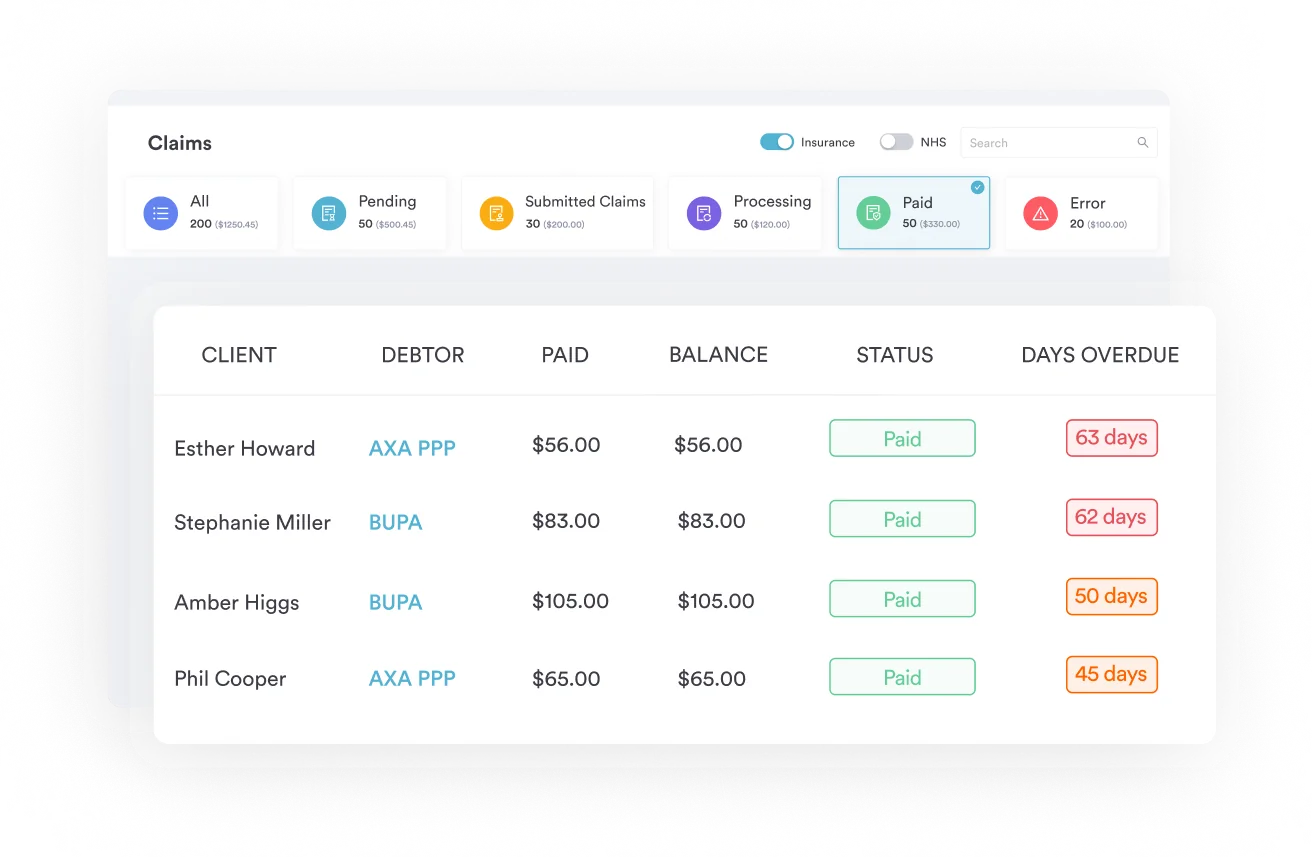
Pabau’s claims management tools then submit each claim and track it through to payment. A claim sitting unpaid shows up on a dashboard rather than surfacing at month end. Your billers spend their time on the claims that need attention.

Pabau keeps the practitioner’s note, the digital fitting form and the signed delivery proof in the same patient file. It then tracks the claim through to payment, so your billers stop hunting for paperwork before every submission.

The compliance weight on L0637 rests on one clause in the descriptor. This is a prefabricated brace, customized to fit a specific patient by someone with expertise, and the fitting note is what proves it. In short, missing the mark in either direction means the claim is denied as incorrectly coded, with no medical-necessity appeal available.
Prior authorization and PDAC coding verification have applied since December 2024. L0637 now has three separate points where a claim can fail before anyone even considers medical necessity. A workflow that captures the order, the authorization, the fitting detail and the delivery proof as they happen removes most of that exposure.
Pabau gives orthotic suppliers and DME practices one place to hold those records and follow claims through to payment. So, to see how it handles DMEPOS billing workflows, book a demo with the team.

Need a process for the denials this code attracts? Denial management in healthcare sets out how to work a denial back to payment and stop it repeating.
Want to reduce claim rejections across your billing team? Medical billing compliance best practices outlines the process controls that reduce denial rates for high-audit codes.
Coding the custom-fabricated articulating LSO instead? L0636 covers the descriptor, coverage rules and documentation for that code.
New to the mechanics behind a clean claim? What is medical billing? walks through the claim lifecycle from encounter to remittance.
HCPCS code L0637 is a Level II HCPCS code for a lumbar-sacral orthosis with sagittal-coronal control and rigid anterior and posterior frame panels. Its posterior section spans the sacrococcygeal junction to the T-9 vertebra. The device arrives prefabricated and is then trimmed, bent, molded or otherwise customized to fit a specific patient by an individual with expertise.
L0637 is a prefabricated code. The CMS descriptor ends with the phrase used for custom-fit braces. That phrase covers a prefabricated item customized to fit a specific patient by an individual with expertise. In short, the brace is not built from raw materials over a model of the patient.
Yes. L0637 sits on the CMS Required Prior Authorization List for DMEPOS. The DME MACs applied the requirement to L0631, L0637 and L0639 for claims with dates of service on or after December 1, 2024. An affirmative decision must be obtained before the brace is delivered, and retroactive authorization is not available.
An L0637 claim needs a standard written order received before submission. The file also needs the practitioner’s record supporting a covered indication and an affirmative prior authorization decision. A fitting note must describe the modifications performed at delivery. A patient-signed proof of delivery completes the file.
Medicare pays L0637 from the annual CMS DMEPOS fee schedule as a lump-sum purchase, and allowables differ by state. A participating supplier receives 80% of the state allowable, with the patient responsible for the remaining 20% after the Part B deductible. Confirm the current figure in the CMS DMEPOS fee schedule file rather than a third-party listing.