CPT Code 62284: Injection procedure for myelography
CPT Code 62284: official descriptor and procedure overview The American Medical ...

Last Updated: Oct 19, 2026
L0640 is the HCPCS Level II code for lumbar-sacral orthosis, sagittal-coronal control, rigid shell(s)/panel(s), posterior extends from sacrococcygeal junction to t-9 vertebra, anterior extends from symphysis pubis to xyphoid, produces intracavitary pressure to reduce load on the intervertebral discs, overall strength is provided by overlapping rigid material and stabilizing closures, includes straps, closures, may include soft interface, pendulous abdomen design, custom fabricated.
HCPCS code L0640 bills a custom-fabricated lumbar-sacral orthosis (LSO) with sagittal-coronal control, built from rigid shells or panels. One fact decides most L0640 claims. The brace has to be made for this patient, from a cast or from a set of measurements.
A stock brace adjusted at delivery is L0639, a different code with different paperwork behind it. Miss that line and the claim either denies or comes back later as a recoupment.
Let Pabau's smart automation suggest the right codes, reduce claim denials, and keep your practice compliant—effortlessly.
Automate repetitive tasks and focus on what matters most—your patients.
Reduce coding errors and ensure compliance with the latest regulations.
Clean claims, fewer denials, and faster reimbursements.
Powerful insights and reporting to help your practice thrive.
HIPAA compliant SOC 2 certified GDPR-compliant Trusted by 4,000+ clinics worldwide

HCPCS code L0640 covers a custom-fabricated LSO with sagittal-coronal control and rigid shells or panels.
The posterior section runs from the sacrococcygeal junction to T-9, and the anterior section from the symphysis pubis to the xyphoid.
L0639 is the same design prefabricated and customized to fit, so how the brace was made picks the code.
Medicare coverage follows LCD L33790, Spinal Orthoses: TLSO and LSO, and the KX modifier attests that its criteria are documented.
Custom-fabricated orthoses sit outside DMEPOS competitive bidding, so rates come from the standard fee schedule for your locality.
L0640 is a billable HCPCS Level II code. It describes a lumbar-sacral orthosis that controls motion in two planes and is fabricated for one named patient.
The code sits in the L-code series for orthotics and prosthetics, inside the CMS HCPCS Level II code set. On the claim line, the short descriptor reads “LSO s/c shell/panel custom.”
CMS publishes the long descriptor as one unbroken run of clauses. Split apart, it says the device must meet all of this:
Two planes of control separate this code from the sagittal-only braces below it. Sagittal control limits bending forward and back. Coronal control limits bending from side to side. A device that only resists forward flexion belongs to another code, whatever it was made from.
Rigid shells are the other half of the description. The strength comes from overlapping rigid material and the closures that hold it, not from stays sewn into a fabric wrap. The landmarks matter too. A brace that stops short of T-9 or the xyphoid does not match the descriptor, so it does not match the code.
Medicare coverage for L0640 is set by LCD L33790, Spinal Orthoses: TLSO and LSO. Plenty of reference tools point billers at L33686 instead. That policy covers ankle-foot and knee-ankle-foot orthoses, and it says nothing about lumbar bracing. Citing it in an appeal letter tells the reviewer you have not read the right policy.
Coverage is never automatic. The treating practitioner documents why this patient needs the device, and the supplier keeps that documentation on file. Criteria are jurisdiction-specific, so pull the current version from your own Medicare Administrative Contractor (MAC). What the policy expects to see comes down to five things.
Read the Local Coverage Article that sits alongside LCD L33790, not just the LCD. The article carries the billing and coding instructions, including modifier use and the documentation a reviewer will ask for. The LCD tells you when the brace is covered. The article tells you how to bill it.
L0640 is paid from the CMS DMEPOS fee schedule, which publishes an allowed amount for every jurisdiction and locality. Looking the code up in the physician fee schedule is a dead end, because orthotics are not paid that way.
Competitive bidding is worth clearing up here. Custom-fabricated orthoses are excluded from the DMEPOS competitive bidding program by statute. Only off-the-shelf orthoses are bid, so an L0640 rate does not change because the patient lives in a bidding area.
Rates also move every year with the CMS update, so this page publishes no dollar figures. Pull the current file for your locality before you quote a price to a patient. Third-party rate lists lag behind, and a quote built on last year’s number becomes a billing dispute at the front desk.
When a review comes, the file is what gets read. A clean claim with a thin file behind it still ends in a refund request. For custom-fabricated orthoses the burden is heavier than usual, because the fabrication itself has to be evidenced. Commercial payers mostly mirror these standards and some add prior authorization on top.
Keep those six items together in one patient file rather than scattered across a scanner folder, a paper chart, and a billing system. Wider medical billing compliance habits apply here too, since a file that satisfies a DME reviewer usually satisfies everyone else.
The sequence matters as much as the contents, because two of the steps have dates that a reviewer will compare. Here is the path a compliant claim takes.
Step three is where most timelines break. If delivery happens before the order is signed, the dates give it away, and no appeal fixes an order written after the fact.
The diagnosis has to sit in the covered list in LCD L33790 and be supported by the physician’s own notes. Clinically appropriate is not the same as covered, and the policy is the one that decides.
Our ICD-10-CM codes library carries the full descriptors if you want to check one of these against its family.
Treat this as a starting point, not a covered list. The categories above are the ones that turn up most on lumbar bracing claims, but the policy’s own table is what a reviewer applies. Check the billed diagnosis against it before submission, every time the policy is revised.
KX does the heavy lifting. It tells the payer that the coverage criteria are met and documented, and Medicare treats a missing KX as a failure to meet them. The rest of the set tells the payer what to do when coverage is doubtful.
One error costs more than the others. Appending KX without the documentation behind it converts a denial into a recoupment, because you have attested to something the file cannot support. Use KX only when you could hand over the whole record that day.
Code selection gets much easier once you see the shape of the range. From L0631 upward, the lumbar-sacral orthosis codes run in pairs. The odd code is a prefabricated device customized to fit.
The even code right after it is the same design, custom fabricated. So the brace’s rigid design picks the pair, and the fabrication method picks which half of it you bill.
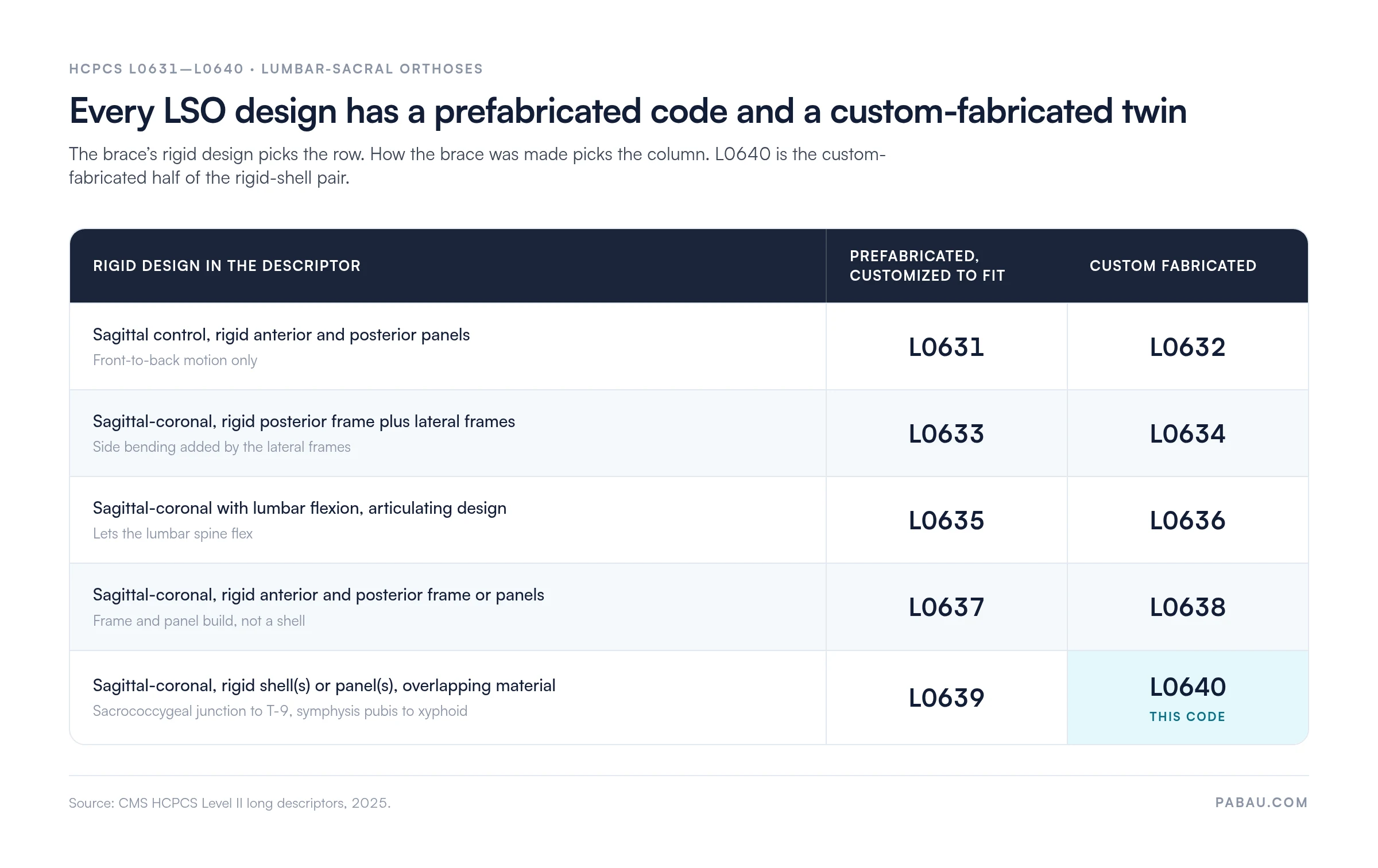
These two share a descriptor almost word for word. Both are sagittal-coronal, both use rigid shells, both reach the same landmarks. The last clause is the whole difference. L0639 is a prefabricated brace that someone trimmed, bent, molded, or assembled to fit this patient. L0640 was built from this patient’s cast or measurements.
That makes the fabrication record the deciding evidence. Bill L0640 for a stock brace and you have upcoded. Bill L0639 for a custom-built one and you have given away part of the payment. Write the method into the fitting note so the choice is auditable later.
L0631 gets confused with L0640 because both braces use rigid front and back components. The control planes are what separate them. L0631 is a sagittal control orthosis, so it resists bending forward and back and nothing more. L0640 adds coronal control, which resists side bending as well.
Fabrication separates them a second time. L0631 is prefabricated and customized to fit, so it is not a custom-fabricated peer of L0640 at all. Its custom-fabricated twin is L0632, one row down in the table above.
L0640 denials are repetitive, which is good news. Six causes account for most of them, and each one is preventable at the desk rather than on appeal.
Two minutes per claim, and it catches almost every item above.
Audit your last 20 L0640 claims against the six-point check before the next billing cycle. Fix what is missing while the patients are still reachable and the orthotist still remembers the fitting. A record repaired now is far cheaper than a recoupment defended in 18 months.
Most of the work above is records work. The order, the measurements, the fitting note, the diagnosis, and the signed delivery receipt all have to travel as one set when a reviewer asks. In many practices they do not. The order sits in a scanned folder, the measurements are on paper, and the note lives in the chart.
Practice management software like Pabau keeps those pieces attached to the patient record instead. Clinical notes, uploaded documents, and digital forms sit on the same timeline as the appointment. When an audit letter arrives, staff open one record rather than rebuilding a file from four places.
On the money side, Pabau’s claims management software covers invoicing, insurer billing, and the patient balance. What was charged and what is still outstanding then sits beside the documentation.
Orthotic code selection stays with your biller, and your DMEPOS supplier workflow stays where it is. What changes is how long it takes to prove what you did.

Pabau brings clinical notes, documents, digital forms, and invoicing into one patient record. The paperwork behind a claim stays together and is easy to produce on request.

Billing L0640 takes a minute. Defending it six months later takes the whole file, and that is when most suppliers find out what is missing.
So the decision gets made before the brace is ordered. Either this patient needs a device fabricated from their own measurements, or a stock brace fitted at delivery will do. The first is L0640. The second is L0639. The rest of the claim follows from that answer, as long as the record says plainly how the device was made.
If documentation is where your orthotic claims keep failing, start with how the record is kept. Book a demo to see how Pabau holds notes, forms, and invoices on one patient record.

Need the wider billing process first? What is medical billing walks through how a charge becomes a paid claim.
Want fewer rejections before they happen? What makes a clean claim lists the elements that keep a claim out of manual review.
Stuck decoding a remittance advice? Denial codes in medical billing explains the common CARC codes and what each one asks you to fix.
Denials piling up across payers? Denial management in healthcare sets out a workflow for reworking and preventing them.
Looking at the whole revenue cycle? What is revenue cycle management covers the path from patient encounter to payment posting.
No. Medicare pays for orthoses as purchases, so rental modifiers do not apply to L0640. The NU modifier signals new purchased equipment on the claim line. A patient who needs only short-term support is a candidate for a different item, not a rented custom brace.
Not immediately. Medicare holds clean electronic claims for a 14-day payment floor, and paper claims for 29 days. That window is fixed. What you can control is what happens after it, so send the claim with the documentation already complete.
An enrolled DMEPOS supplier with a current supplier number. Custom-fabricated orthoses also draw scrutiny on who built the device, and many MACs expect a certified orthotist or an equivalent qualified practitioner. Check your MAC’s supplier standards before the first claim goes out.
The allowance covers the device and the work needed to make it fit at delivery. Adjustments and repairs made later follow your MAC’s repair rules and use separate codes. Read the policy article before billing any of them separately.
Read the remittance advice. The reason code tells you whether the coding failed or the file did. A missing element in the record is corrected and resubmitted. A coverage denial goes to redetermination, the first level of Medicare appeal, which is filed within 120 days.