HCPCS Code E0272: Foam rubber mattress billing guide
HCPCS Code E0272: official descriptor and code overview HCPCS Code E0272 is the ...

Last Updated: Nov 6, 2026
L0480 is the HCPCS Level II code for a custom-fabricated thoracic-lumbar-sacral orthosis (TLSO) with triplanar control. It is a one-piece rigid plastic shell without an interface liner, closed with multiple straps. The code includes the carved plaster or CAD-CAM model the shell is built from, so each shell is made for one patient.
L0480 is one of five closely related TLSO codes. L0482 adds an interface liner, L0484 and L0486 are two-piece custom shells, and L0488 is the prefabricated one-piece shell with a liner.
Let Pabau's smart automation suggest the right codes, reduce claim denials, and keep your practice compliant—effortlessly.
Automate repetitive tasks and focus on what matters most—your patients.
Reduce coding errors and ensure compliance with the latest regulations.
Clean claims, fewer denials, and faster reimbursements.
Powerful insights and reporting to help your practice thrive.
HIPAA compliant SOC 2 certified GDPR-compliant Trusted by 4,000+ clinics worldwide

HCPCS Code L0480 is a custom-fabricated TLSO with triplanar control, made as a one-piece rigid plastic shell without an interface liner.
The code includes the carved plaster or CAD-CAM model the shell is built from, so the file needs a cast, scan, or measurement record.
L0482 adds a liner, L0484 and L0486 are two-piece shells, and L0488 is the prefabricated one-piece shell with a liner.
Medicare covers L0480 under LCD L33790, and the treating practitioner’s records must explain why a custom device is needed over a prefabricated one.
L0480 is not on the CMS Required Prior Authorization List, but its two-piece lined sibling L0486 is from October 28, 2026.
HCPCS Code L0480 describes a custom-fabricated thoracic-lumbar-sacral orthosis (TLSO) with triplanar control, built as a one-piece rigid plastic shell without an interface liner.
Its official Level II descriptor, listed with other HCPCS codes in our reference library, ends with two words that decide every claim: “custom fabricated”.
Each element of that descriptor narrows the code. A device that differs on one of them belongs to a different L-code, and the table below shows what each element means at billing time.
L0480 pays for a body jacket built for one patient. Policy article A52500 defines a custom-fabricated item as one individually made for a specific patient. It is based on clinically derived and rectified castings, tracings, measurements, or other images of the body part.
The fabrication record is what proves the code. Keep the cast or scan date, the measurements taken, and who fabricated the shell. Fabrication should follow the DMEPOS Quality Standards, Appendix C, which the policy article references.
Buying the shell from a central fabrication facility changes one thing. Policy article A52500 allows such an item to be billed with a custom-fabricated code only when it is listed in the Product Classification List. Check the listing before you code the claim.
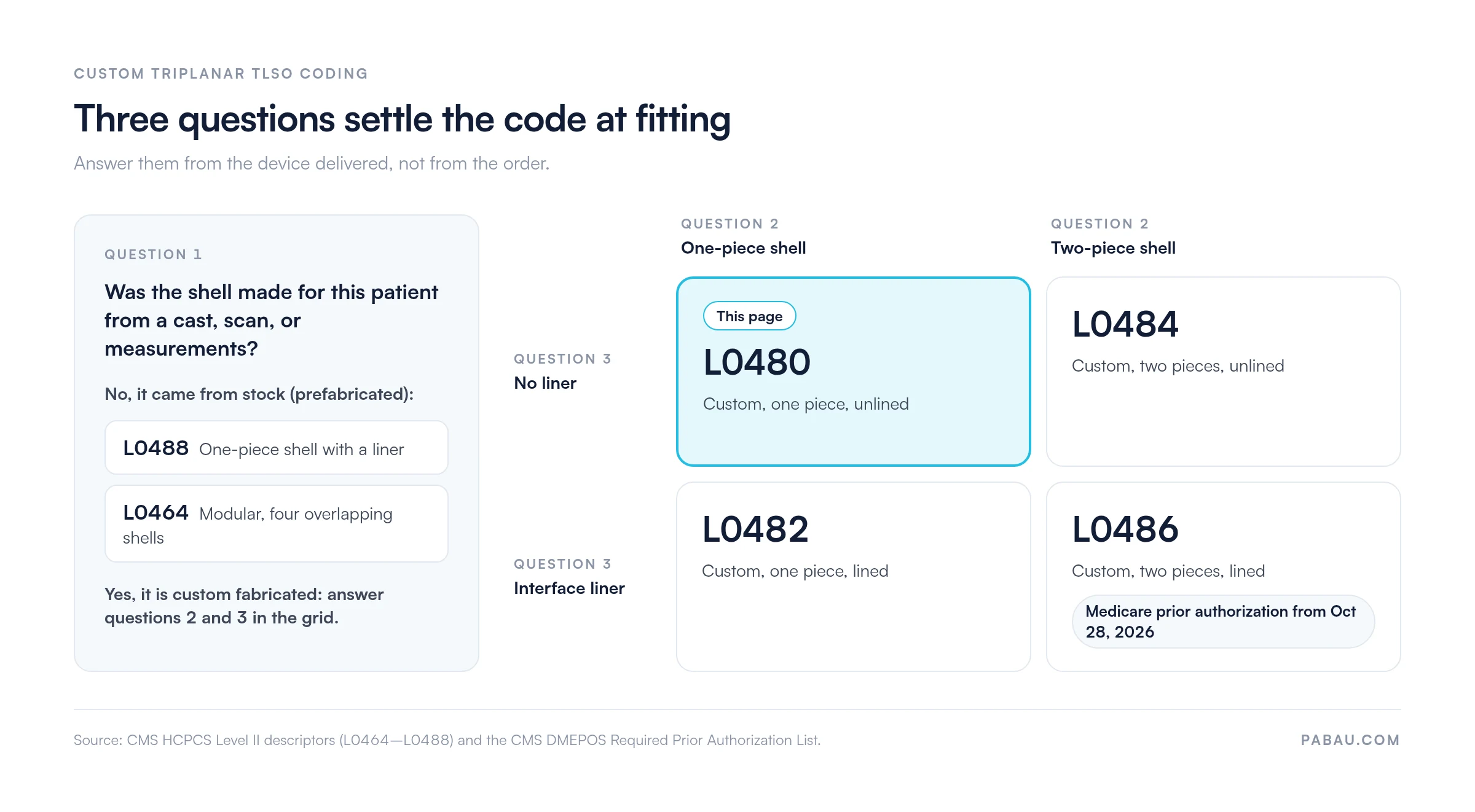
These five codes describe the same triplanar body jacket in different builds. Two questions sort them: how many shell pieces, and is there an interface liner? A third question, custom or prefabricated, separates L0488 from the rest.
The costliest error in this family is billing a custom code for a stock brace. A one-piece lined shell taken from inventory is L0488, not L0480 or L0482.
Liner status is the second trap. If a liner is added before delivery, the device delivered is L0482. Record liner status at fitting, not at the time of the order. On a two-piece build, the unlined shell is L0484 and the lined one is L0486.
The grid below puts the three questions in the order a coder should ask them at fitting.
Medicare covers TLSOs, prefabricated and custom fabricated alike, under Local Coverage Determination L33790 (Spinal Orthoses: TLSO and LSO). The DME Medicare Administrative Contractors (MACs) apply it with policy article A52500. The LCD covers a TLSO when it is ordered for one of four indications:
Custom codes such as L0480 carry an extra test on top of those indications. Policy article A52500 requires detailed documentation in the treating practitioner’s records that supports the medical necessity of a custom device over a prefabricated one. A body habitus or deformity that a stock shell cannot fit is the kind of finding that belongs in that note.
The LCD also requires a standard written order (SWO) before the claim is submitted. Claims that miss the coverage criteria are denied as not reasonable and necessary.
Policy article A52500 publishes no covered-diagnosis list for spinal orthoses; its ICD-10 groups read “N/A”. Coverage rests on the indication and the medical record. The codes below often describe conditions that meet one of the four indications.
Report the most specific diagnosis code the record supports, and check seventh characters on fracture codes against the date of service. A code that is valid but vague invites a records request, and a records request on a custom TLSO always reaches the fabrication file.
L0480 is not on the Medicare DMEPOS Required Prior Authorization List. The July 29, 2026 update added three TLSO codes, L0456, L0457, and L0486, with prior authorization starting nationwide on October 28, 2026. L0480 was not among them.
That puts two codes in this family on different tracks. If the patient’s device changes from a one-piece unlined shell to a two-piece lined one, the claim needs a provisional affirmation before billing. Check the face-to-face and written order prior to delivery list on the same CMS page too.
Commercial insurers and Medicaid plans set their own rules, and many require authorization for custom spinal orthoses. Submit the request before the cast or scan, so the practice is not left holding a shell it cannot bill. For orthotic suppliers and physical therapy practices that bill several payers, a payer-specific checklist prevents most pre-delivery errors.
Every item below should be in the file before the claim goes out, not gathered at appeal. Under medical billing compliance standards for DMEPOS, the supplier carries the burden of proof.
There is no Certificate of Medical Necessity (CMN) for spinal orthoses. The SWO and the medical record carry the claim, so a file built around a CMN is missing the documents a reviewer will ask for.
Billing L0480 follows a fixed sequence. A step taken out of order, such as casting before the written order exists, cannot be put right after delivery. Tracking each step as a checklist in claims management software catches most of these errors before submission.
L0480 has no modifier it must always carry. Policy article A52500 names no KX requirement for spinal orthoses, so add a modifier only when its condition is true.
Medicare pays L0480 from the DMEPOS fee schedule, which sets the allowable for each code by state. CMS updates it each year, with quarterly corrections. Look up the current L0480 allowable for the beneficiary’s state before quoting a patient’s share.
The patient owes the Part B coinsurance, 20% of the allowable once the deductible is met. Competitive bidding covers off-the-shelf orthoses, so a custom-fabricated device like L0480 is paid from the fee schedule rather than a bid price.
Commercial rates for L0480 come from each payer contract and are not public. Pull the contracted rate from the payer portal or provider agreement. For a quick code reference, the AAPC HCPCS codes directory lists the L-code range.
Custom TLSO claims fail on details: the wrong sibling code, a thin medical record, or no proof that the shell was made for the patient. The table lists the usual causes and the fix for each. Our guide to denial management workflows covers the wider review process.
Medicare offers five levels of appeal for denied DMEPOS claims. Complete files give the best chance at the first two levels.
Level 4 is Medicare Appeals Council review and Level 5 is federal district court review; both have their own deadlines and thresholds.
The strongest appeals answer the denial reason directly. Include a practitioner letter that maps the patient’s condition to the LCD indication and explains why a custom shell was needed. Superbill documentation that captures diagnosis codes, modifiers, and dates gives the appeal a complete record.
Audit your L0480 claims each quarter against the fitting notes and fabrication records. Look for two patterns: custom codes billed without a model on file, and liners added after the claim was coded. Either one shows up in a focused review long before it shows up in your denial rate.
Most suppliers keep the pieces of a custom TLSO claim in different places. The order arrives by fax, the scan sits in a fabrication portal, and the POD lives in a paper folder. When a reviewer asks for records, the team spends hours rebuilding the file.
Pabau, the practice management platform we build, keeps those documents in the patient record. Staff attach the SWO, clinical notes, scan files, and signed delivery form to one profile. Pabau’s claims management tracks each claim with its codes and modifiers, so a coder can check the device against L0480 before submission.
The result is a claim that goes out complete and a file that answers a records request on the same day.

Pabau stores orders, notes, scans, and delivery records in the patient profile. It tracks each claim with its codes, so L0480 claims go out right the first time.

L0480 is a custom code, and every claim has to prove it. The order, the medical record, and the fabrication file must all describe a one-piece, unlined shell made from a model of this patient.
Settle the code at fitting, not at the order. A liner, a second shell piece, or a stock brace each moves the claim to a different code, and only the device delivered counts. Build that check into intake and most L0480 denials never happen.
Book a demo to see how Pabau keeps custom orthotic claim files complete for your practice.

Billing the lined two-piece version? HCPCS code L0486 covers the custom two-piece shell with a liner and its new Medicare prior authorization rule.
Seeing high denial rates across your orthotic claims? Denial management workflows explains how to build a systematic review process that catches the most common DMEPOS denial patterns before they repeat.
Want to understand compliance requirements for DMEPOS suppliers? Medical billing compliance outlines the documentation and accreditation obligations that govern HCPCS claims.
Billing the two-piece version? HCPCS code L0484 covers the custom two-piece shell without a liner and how it differs from L0480.
Dispensing a stock lined shell instead? HCPCS code L0488 explains the prefabricated one-piece TLSO and its fitting rules.
HCPCS Code L0480 covers a custom-fabricated TLSO with triplanar control, built as a one-piece rigid plastic shell without an interface liner. The code includes the carved plaster or CAD-CAM model the shell is made from. Medicare pays for it under the DMEPOS benefit when LCD L33790 criteria are met and documented.
L0480 is custom fabricated. The shell is made for one patient from a cast, scan, or measurements. A prefabricated one-piece lined shell fitted from stock is L0488, not L0480.
Both are custom one-piece rigid plastic TLSOs with triplanar control. L0482 has an interface liner, and L0480 does not. If the delivered shell has a liner, bill L0482.
L0484 is a custom two-piece shell without a liner, while L0480 is a custom one-piece shell without a liner. A device with separate front and back shell pieces never codes to L0480. A two-piece shell with a liner is L0486.
No. L0480 is not on the CMS DMEPOS Required Prior Authorization List. Its sibling L0486 was added, with prior authorization starting on October 28, 2026. Commercial and Medicaid plans set their own rules, so check each payer before casting.
No. Spinal orthoses do not use a CMN. Medicare needs a standard written order and medical records that support the LCD indication and the need for a custom device.
The usual causes are an incomplete SWO, records that do not explain why a custom shell is needed, and a missing fabrication record. Billing L0480 for a lined, two-piece, or stock device is another. A pre-casting checklist prevents most of them.