CCSD Code D1010: Radical mastoidectomy including meatoplasty
CCSD Code D1010: Definition and clinical scope CCSD Code D1010 is the UK private...

Last Updated: Nov 25, 2026
L1040 is the HCPCS Level II code for addition to CTLSO or scoliosis orthosis, lumbar or lumbar rib pad.
HCPCS Code L1040 bills a lumbar or lumbar rib pad fitted to a Milwaukee-type CTLSO (L1000), not a standalone device. DME MAC correct-coding guidance denies it as not separately payable without L1000 on the same claim. It also cannot be added to all-inclusive scoliosis braces such as L1005, L1006, L1007, L1300 or L1310.
Let Pabau's smart automation suggest the right codes, reduce claim denials, and keep your practice compliant—effortlessly.
Automate repetitive tasks and focus on what matters most—your patients.
Reduce coding errors and ensure compliance with the latest regulations.
Clean claims, fewer denials, and faster reimbursements.
Powerful insights and reporting to help your practice thrive.
HIPAA compliant SOC 2 certified GDPR-compliant Trusted by 4,000+ clinics worldwide

HCPCS Code L1040 bills a lumbar or lumbar rib pad added to a CTLSO or scoliosis orthosis. It is an addition code, never a standalone device.
DME MAC correct-coding guidance pays L1040 only when base code L1000, the Milwaukee-type CTLSO, is on the same claim.
Never add L1040 to L1005, L1006, L1007, L1300 or L1310. Those scoliosis braces are all-inclusive, so a separate pad is unbundling.
L1040 and L1030 (lumbar bolster pad) describe different pads, so the fitting record must name the pad that was placed.
Covered diagnoses are scoliosis and spinal deformity codes, such as M41.125 for adolescent idiopathic scoliosis of the thoracolumbar region.
Pabau’s claims management software sends US claims as 837P files through the Claim.MD clearinghouse, with eligibility checks and ERA remittances.
HCPCS Code L1040 is the Level II code for an “Addition to CTLSO or scoliosis orthosis, lumbar or lumbar rib pad.”
It is an addition code, and the DME MAC joint coding article denies it as not separately payable without base code L1000.
The Centers for Medicare and Medicaid Services maintains the Level II code set and places L1040 in the scoliosis orthotic devices range, L1000 through L1120. The code describes a pad fitted inside a cervical-thoracic-lumbar-sacral orthosis (CTLSO). The pad applies corrective pressure over the lumbar spine or the lower ribs.
Orthotic procedures fill the L0000-L4999 part of the HCPCS L section, and prosthetic procedures follow from L5000. Within orthotics, L1000-L1120 holds the Milwaukee CTLSO base code, four other scoliosis braces (L1001, L1005, L1006, L1007) and a run of addition codes. Those additions cover pads, slings, outriggers and covers.
L1040 covers one lumbar or lumbar rib pad added to a CTLSO. The pad sits inside the brace frame, against the lumbar curve or the rib prominence that the treating team wants to correct.
Several items fall outside L1040, either because they have their own code or because a base code already pays for them:
Billing L1040 for a pad that a base code already includes is unbundling, and it leads to a CO-97 denial. Check the pad type in the orthotist’s notes before you pick the code, then check the base brace. The two checks below settle both questions.
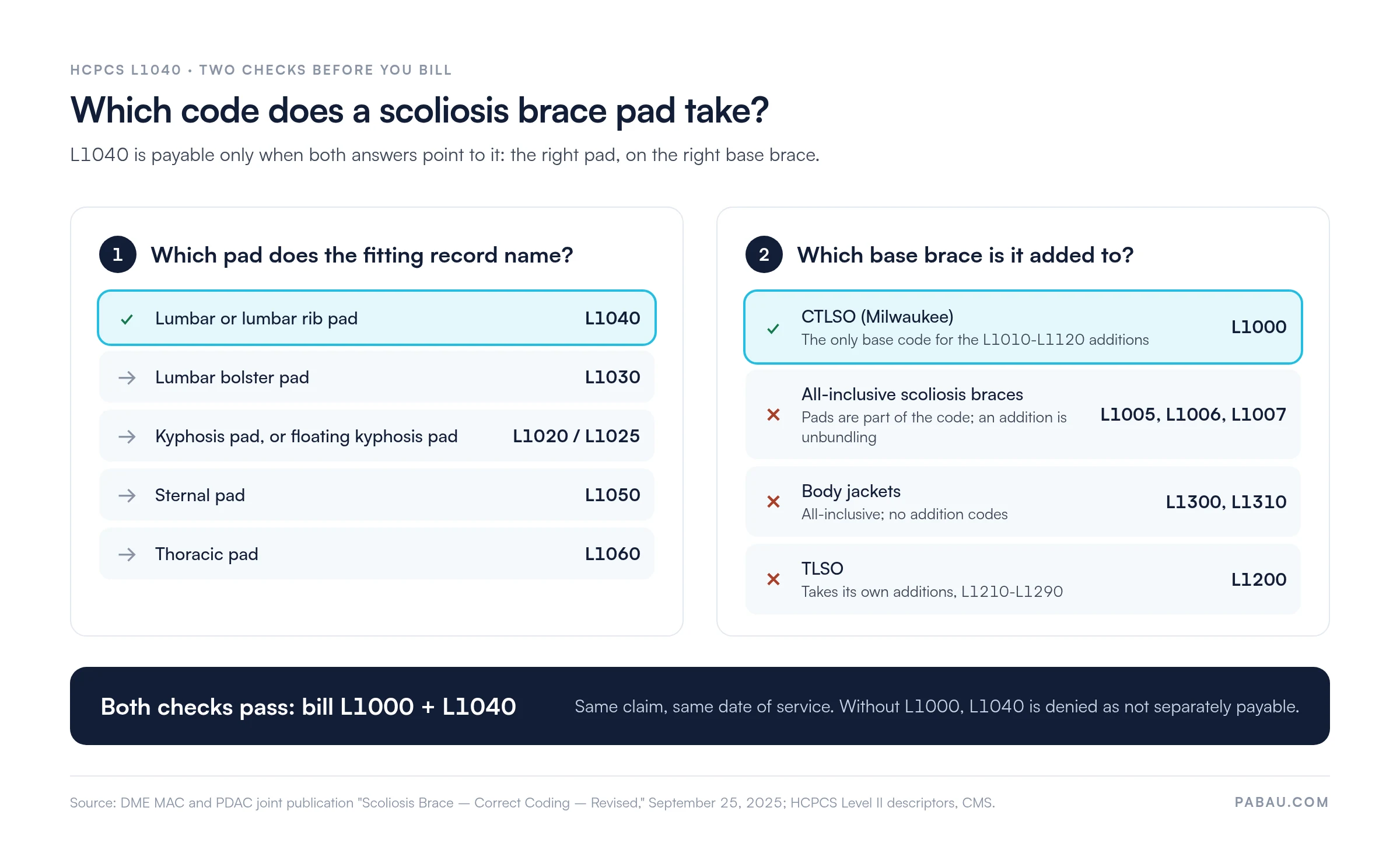
The DME MACs’ scoliosis brace correct coding article names one base code for the L1010-L1120 additions: L1000. Billed without it, L1040 is denied as not separately payable. Put L1000 and L1040 on the same claim, with the same date of service.
Confirm current descriptors in the AAPC HCPCS code lookup. When a brace does not fit a code cleanly, the PDAC HCPCS helpline at (877) 735-1326 can confirm the right one.
Every addition from L1010 to L1120 opens with the same words, “Addition to CTLSO or scoliosis orthosis,” so the last few words decide the code. Picking the wrong pad code is a common source of rejections and post-payment recoupments.
L1030 and L1040 are separate pads, not a first and second unit of the same pad. If the brace carries both a lumbar bolster and a lumbar rib pad, the record must describe each one.
Medicare covers braces under its orthotic benefit when a treating practitioner orders the item and the record shows it is reasonable and necessary. The DME MACs’ Spinal Orthoses LCD (L33790) writes its criteria for TLSO and LSO codes, not for the scoliosis range.
Most CTLSO wearers are children and adolescents who are still growing, so Medicaid and commercial plans pay far more of these claims than Medicare does. Each of those plans publishes its own bracing policy. Key requirements across most payers include:
An L1040 claim needs a diagnosis that explains why the patient needs a corrective spinal brace. That usually means a scoliosis code from ICD-10-CM category M41, or a congenital spine code where the curve is congenital. Each payer keeps its own list, so check its policy before you bill.
These codes are examples, not a covered-diagnosis list. Code to the highest specificity the record supports, including the curve region.
Incomplete records are the main cause of post-payment recoupments for orthotic suppliers. Build the file before the claim goes out, not after a denial. Good medical billing compliance practice means keeping DMEPOS records for at least seven years.
Use digital intake forms to capture orders, consent and delivery sign-offs in a searchable format. Paper records are easy to misplace.
Before you submit an L1040 claim, check two things. The fitting record must name a lumbar or lumbar rib pad, and L1000 must be on the same claim. Those checks prevent the most common L1040 denials.
No Medicare LCD sets a KX requirement for the scoliosis range, so modifier use for L1040 depends on the situation and the payer. Many Medicaid and commercial plans publish their own rules, including whether they want NU on purchased orthoses. Submitting a clean claim means you check those rules before the claim goes out.
Apply KX or GA only when the file supports it. A modifier the documentation cannot back up turns an audit finding into an overpayment demand.
Traditional Medicare requires prior authorization only for items on its DMEPOS Required Prior Authorization List, so check the current list before each order. Medicaid and commercial plans often require it for custom scoliosis bracing, and the request covers L1000 and every addition together.
L1040 denials cluster around a few root causes, and each one needs a different fix. Understanding denial management in healthcare matters for orthotic suppliers, because a Medicare redetermination request must be filed within 120 days of the initial determination.
Reference the full list of common billing denial codes for context on how CO-16, CO-50 and CO-97 apply across orthotic claims.
Track L1040 denials by reason code each month. A cluster of CO-97 denials usually means L1040 is going out with an all-inclusive brace code. That is a charge-entry problem, not a payer problem.
Entering HCPCS Code L1040 correctly in a practice management system or EHR follows a set charge-entry sequence. Getting it wrong is the usual source of the CO-16 and CO-97 denials described above.
Pabau, a practice management platform, runs this sequence through its denial-reducing claims software. US practices send CMS-1500 and 837P claims through the Claim.MD clearinghouse, run eligibility checks before the fitting, and receive ERA remittances back in Pabau. Secondary claims go out from the same place, which matters when Medicaid sits behind a commercial plan.
That keeps the whole revenue cycle management workflow, from charge entry to payment posting, in the same system as the patient record.

Pabau’s claims management software lets orthotic suppliers bill base and addition codes on one claim, check eligibility and send 837P claims through the Claim.MD clearinghouse. See how it works for your practice.

HCPCS Code L1040 looks like a simple pad code, but it pays in only one setting: as an addition to an L1000 Milwaukee CTLSO. Every rule in this guide follows from that. Bill it with L1000, keep it off all-inclusive scoliosis braces, and make the fitting record name the lumbar or lumbar rib pad.
Suppliers who get L1040 paid the first time catch a missing base code before the claim leaves the building. If you want claims, eligibility and remittances in the same system as your patient records, book a demo to see how Pabau handles orthotic billing.

Need a full picture of how clearinghouse billing works? Medical claims clearinghouse guide explains how 837P electronic claims move from practice to payer and where errors are caught.
Confused about which denial code you received? Clean claim requirements walks through the elements every DMEPOS claim must have before it reaches a payer.
Looking for superbill and documentation templates? Superbill guide covers what to include when billing HCPCS codes alongside physician service codes on the same encounter.
Billing a tension-based scoliosis brace instead? HCPCS code L1005 covers an all-inclusive brace whose accessory pads are already part of the code.
Fitting a molded body jacket? HCPCS code L1300 explains the body jacket code that takes no separate pad additions.
HCPCS Code L1040 covers a lumbar or lumbar rib pad added to a CTLSO or scoliosis orthosis. The pad sits inside the brace and applies pressure over the lumbar curve or lower ribs. It is billed alongside base code L1000 on the same claim.
L1040 is an addition code. DME MAC correct-coding guidance denies it as not separately payable unless base code L1000 is on the same claim. It cannot be added to L1005, L1006, L1007, L1300 or L1310, which are all-inclusive.
L1030 is a lumbar bolster pad and L1040 is a lumbar or lumbar rib pad. They are different pads, not a first and second unit of the same pad. Bill each one only when the fitting record describes it.
No Medicare LCD sets a KX rule for the scoliosis range. Use RA or RB for replacements, GA when an ABN is on file and GZ when one is not. Add NU or KX only where the payer’s policy asks for it.
Medicare covers braces under its orthotic benefit when the item is ordered and is reasonable and necessary. L1040 is payable only with L1000 on the same claim. Most scoliosis brace patients are children, so Medicaid and commercial plans pay most L1040 claims.
Use a scoliosis or spinal deformity code, usually from category M41. Examples include M41.125 for adolescent idiopathic scoliosis of the thoracolumbar region and M41.126 for the lumbar region. Always check the payer’s own covered diagnosis list.
Most L1040 denials come from a missing L1000 base code, billing it with an all-inclusive brace, or the wrong pad code. Fix the charge entry, recode the pad from the fitting record, or appeal with curve documentation when necessity is questioned.