

CCSD code XR940: Foreign body retrieval billing guide
CCSD code XR940 is the UK private healthcare code for retrieval of a foreign bod...

Last Updated: Nov 26, 2026
L0482 is the HCPCS Level II code for a custom-fabricated TLSO with triplanar control, built as a one-piece rigid plastic shell with an interface liner. It restricts trunk motion in the sagittal, coronal and transverse planes, and the code includes the carved plaster or CAD-CAM model taken from the patient.
At the back, the shell runs from the sacrococcygeal junction to just below the scapular spine. At the front, it runs from the symphysis pubis to the sternal notch. Medicare covers it under LCD L33790 when one of four indications applies and the treating practitioner records why a prefabricated brace won't work.
Let Pabau's smart automation suggest the right codes, reduce claim denials, and keep your practice compliant—effortlessly.
Automate repetitive tasks and focus on what matters most—your patients.
Reduce coding errors and ensure compliance with the latest regulations.
Clean claims, fewer denials, and faster reimbursements.
Powerful insights and reporting to help your practice thrive.
HIPAA compliant SOC 2 certified GDPR-compliant Trusted by 4,000+ clinics worldwide

HCPCS code L0482 is a custom-fabricated TLSO with triplanar control, built as a one-piece rigid plastic shell with an interface liner.
The patient model, measurement, casting and fitting are part of the L0482 allowance, so none of them is billed on its own line.
Medicare covers it under LCD L33790 for four indications, and the treating practitioner’s notes must explain why a prefabricated brace won’t do.
Shell pieces, liner and fabrication method separate L0482 from L0480, L0484, L0486 and the prefabricated L0488.
L0482 doesn’t appear on the CMS prior authorization list dated October 28, 2026, while L0486 does, so check the current list before you deliver.
HCPCS code L0482 describes a thoracic-lumbar-sacral orthosis (TLSO) made for one patient from a carved plaster or CAD-CAM model of their trunk.
CMS policy article A52500 lists L0482 among the custom fabricated, body jacket type spinal orthoses. The official L0482 descriptor calls it a triplanar-control, one-piece rigid plastic shell with an interface liner, custom fabricated.
That rules out any stock brace, however closely it is fitted at the chair. Medicare pays for it under the Part B braces benefit, through the DME MAC for the patient’s area. The table gives the facts a biller checks first.
Read the descriptor against the brace on the bench, not the manufacturer’s brochure. Each of these details has to be true before L0482 goes on the claim.
Multiple straps and closures complete the description. The CMS policy article adds the practical test for “custom fabricated”. The brace is individually made for one patient, and no other patient could use it.
L0482 sits in a run of rigid plastic body jackets that look alike on paper. Three questions route almost every device in this run.
In the fitting room, the same table turns into three questions. The decision tree after them maps every answer to its code.
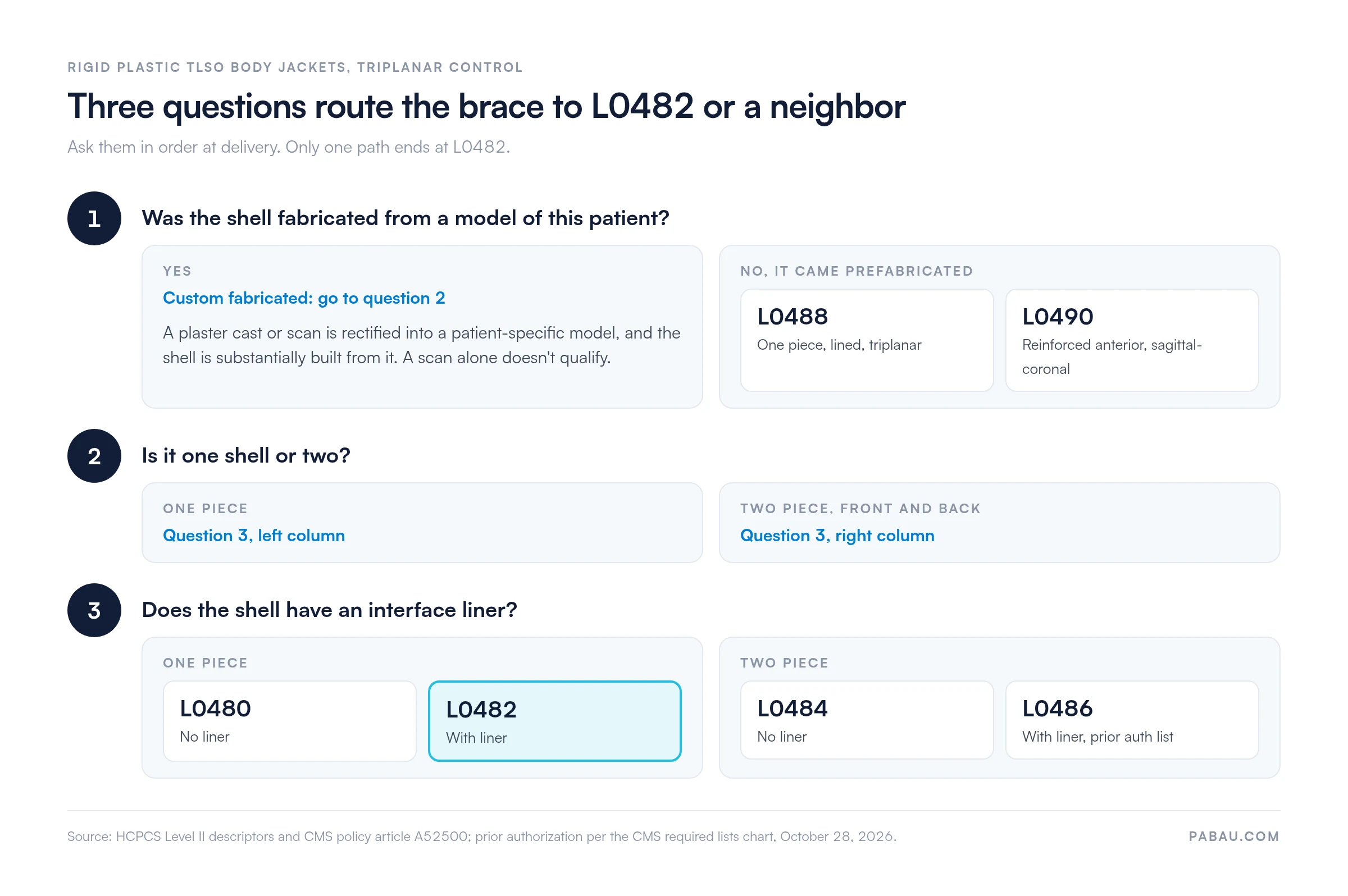
The closest stock equivalent is L0488, a lined one-piece shell that is prefabricated and then fitted. L0462, L0470 and L0472 are also triplanar TLSOs, and all three are prefabricated.
The three are built differently, though. L0462 is a modular system of three rigid shells, L0470 pairs a rigid posterior frame with a soft apron, and L0472 is a hyperextension frame. None of them is a step away from L0482.
Write the fabrication method into the delivery note every time: plaster cast, scan to CAD-CAM model, or stock shell. That one line answers the first question a reviewer asks about an L0482 claim, and it keeps a heat-molded L0488 from being billed as custom.
The governing policy is LCD L33790, Spinal Orthoses: TLSO and LSO, used by all four DME MACs. It covers a spinal orthosis ordered for one of these indications:
A custom code adds one more burden. The policy article A52500 expects the treating practitioner’s records to explain why this patient needs a custom orthosis rather than a prefabricated one. The orthotist’s evaluation should back that up, but it can’t replace it.
The LCD carries no covered ICD-10 list. The diagnosis on the claim still has to be a valid, billable ICD-10-CM diagnostic code that matches the notes. These are the slips we see most often on TLSO claims:
Medicare pays 80% of the DMEPOS fee schedule amount once the Part B deductible is met, and the patient owes the other 20%. Allowed amounts vary by state, so check the current DMEPOS fee schedule rather than a figure from last year.
A custom TLSO passes through more hands than a stock brace, so the order of events matters. This is the sequence that keeps the file clean.
On modifiers, the spinal orthosis policy doesn’t call for KX on L0482. The only modifier it names, CG, applies to six other spinal codes.
The CMS required lists comparison chart dated October 28, 2026 lists L0486 for prior authorization. It also needs a face-to-face encounter and a written order before delivery. L0482 isn’t on it.
A supplier who assumes the two-piece rules apply to the one-piece code will hold devices for no reason. A supplier who assumes the reverse, after a future update, will deliver too early.
CMS changes these lists through Federal Register notices, sometimes with phased start dates by state. Check the DMEPOS order requirements page and the current list before each new L0482 case, not once a year.
Take an illustrative patient recovering from a thoracolumbar fusion. The surgeon wants trunk motion restricted in all three planes while the fusion heals. Her chest-to-waist proportions mean no stock shell sits flat against the trunk, and the surgeon writes that in the operative follow-up note.
The orthotist scans her, rectifies the scan into a CAD-CAM model and forms a one-piece shell with an anterior opening and a foam liner. The trim lines run from the sacrococcygeal junction to below the scapular spine, and from the pubis to the sternal notch. That is L0482, indication three, with the custom reason written by the treating practitioner.
Now change one detail. If the orthotist had added a separate anterior shell, the same patient would get L0486. That brace would also need the prior authorization and order steps the chart lists for L0486.
Most denials on custom TLSOs trace back to a handful of causes. Structured denial management starts with knowing which one you’re looking at.
Commercial plans write their own spinal orthosis policies, and many ask for prior authorization where Medicare doesn’t. Look up each payer’s current policy before you cast the patient. A medical billing compliance routine that rechecks payer rules quarterly saves rework later.
Custom TLSO claims often stall in the hand-off between the clinical record and the billing team. Codes get retyped, a payer ID is missing, and nobody notices until the rejection comes back.
Pabau’s claims management software builds the CMS-1500 from the patient record, so the HCPCS and ICD-10-CM codes you recorded land on the claim. Built-in code libraries let you look up L0482 and the diagnosis without leaving the form. Required fields, such as member numbers and authorization codes, must be complete before the claim can be sent.
US practices submit through Claim.MD, with eligibility checks before the visit and remittances posted back from the ERA. Claim status sits next to the patient, so your team sees what was paid and what needs a resubmission.
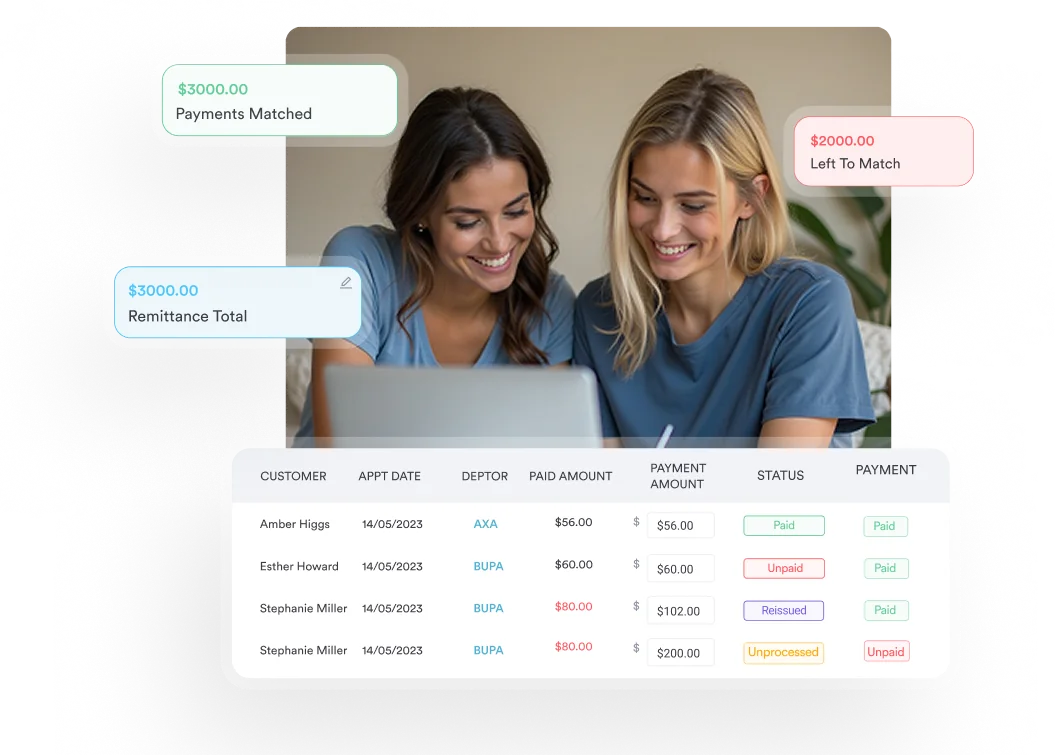

Pabau pre-fills claims from the patient record, checks required fields before sending, and tracks each claim through to remittance.

L0482 rewards precision at the bench. Count the shells, check for a liner, and confirm a model of this patient exists. Get those three right and most coding errors in this family disappear.
The harder work is the reason for going custom. Make sure the treating practitioner writes it in their own notes. Then recheck the CMS lists each time, because L0482 and L0486 don’t follow the same rules today.
Book a demo to see how Pabau pre-fills, checks and tracks your orthotic insurance claims.

Need a foundation for how DMEPOS billing works? What is medical billing explains the claim lifecycle, from patient intake to payment posting.
Struggling with claim rejections across your orthotic practice? Denial management in healthcare covers the frameworks suppliers use to reduce rework and recover revenue faster.
Want an audit-ready billing file? Medical billing compliance outlines the documentation habits that hold up under payer review.
Delivering a custom shell in two pieces without a liner? HCPCS code L0484 covers the custom fabricated two-piece TLSO and its documentation.
Fitting a stock jacket with a reinforced front? HCPCS code L0490 explains the prefabricated sagittal-coronal body jacket.
No. The liner is part of the L0482 descriptor, so it is included in the code. Billing it on a second line duplicates payment for the same orthosis.
No. A TLSO is a single trunk orthosis with no right or left side, so side modifiers don’t apply. Bill one unit of L0482 per brace.
Yes, if the scan is rectified into a patient-specific model and the shell is substantially fabricated from it. A scan or CAD-CAM step alone does not make the item custom fabricated (A52500).
An enrolled, accredited DMEPOS supplier bills the DME MAC for the patient’s area. Some states also require an orthotics license to fabricate and fit the brace, so check your state rules.
Medicare pays 80% of the DMEPOS fee schedule amount for your state after the Part B deductible. The amount changes each year, so look up the current fee schedule before quoting the patient.



