CCSD code H4430: Examination of rectum under anaesthetic
CCSD code H4430 pays for the examination alone CCSD code H4430 is the UK private...

Last Updated: Oct 20, 2026
L0486 is the HCPCS Level II code for tlso, triplanar control, two piece rigid plastic shell with interface liner, multiple straps and closures, posterior extends from sacrococcygeal junction and terminates just inferior to scapular spine, anterior extends from symphysis pubis to sternal notch, lateral strength is enhanced by overlapping plastic, restricts gross trunk motion in the sagittal, coronal, and transverse planes, includes a carved plaster or cad-cam model, custom fabricated.
Two rules then decide whether the claim gets paid. Medicare requires prior authorization on every L0486 claim dated October 28, 2026 or later, and only enrolled DMEPOS suppliers may submit one. Below is the full descriptor, the coverage rules, the modifiers, and the documentation a clean L0486 claim needs.
Let Pabau's smart automation suggest the right codes, reduce claim denials, and keep your practice compliant—effortlessly.
Automate repetitive tasks and focus on what matters most—your patients.
Reduce coding errors and ensure compliance with the latest regulations.
Clean claims, fewer denials, and faster reimbursements.
Powerful insights and reporting to help your practice thrive.
HIPAA compliant SOC 2 certified GDPR-compliant Trusted by 4,000+ clinics worldwide

HCPCS code L0486 describes a custom-fabricated two-piece rigid triplanar TLSO with an interface liner.
The interface liner is the only difference between L0486 and L0484, so record it at device selection.
Prior authorization is mandatory nationwide for L0486 claims dated October 28, 2026 or later.
Only Medicare-enrolled DMEPOS suppliers may bill L0486, whoever fits the brace and writes the clinical notes.
Spinal orthoses carry a five-year reasonable useful lifetime, and a same-or-similar brace on file will deny a new claim.
HCPCS code L0486 describes a thoracic-lumbar-sacral orthosis that controls motion in all three planes. The device is built as a two-piece rigid plastic shell with an interface liner, secured with multiple straps and closures.
It is custom-fabricated for one patient, and the code covers the carved plaster or CAD-CAM model used to build the shell.
The posterior shell extends from the sacrococcygeal junction and terminates just inferior to the scapular spine. The anterior shell runs from the symphysis pubis to the sternal notch.
Because the descriptor classifies the device as custom fabricated, L0486 cannot be used for a prefabricated TLSO. Those devices belong to L0488 or L0490 instead.
The code is maintained by the Centers for Medicare and Medicaid Services (CMS) within the HCPCS Level II orthotic family. It sits in the spinal orthosis group covered by CMS Policy Article A52500 and LCD L33790.
Those two documents set the coverage and documentation rules for every TLSO claim.
The official CMS long descriptor for L0486 runs as a single sentence. Broken into its elements, it reads:
Those last two elements matter more than they look. Overlapping plastic is what a reviewer expects to see described in the fitting notes. Triplanar restriction is the clinical reason a lesser brace will not do.
Most coding errors in this family start with the six codes from L0480 to L0490. Four of them are custom-fabricated, so fabrication method alone will not separate them.
Shell construction and the interface liner do that work instead. Billing a custom-fabricated code for a stock device is upcoding, and it exposes the supplier to audit risk.
Work through the three questions below in order and only one code survives.
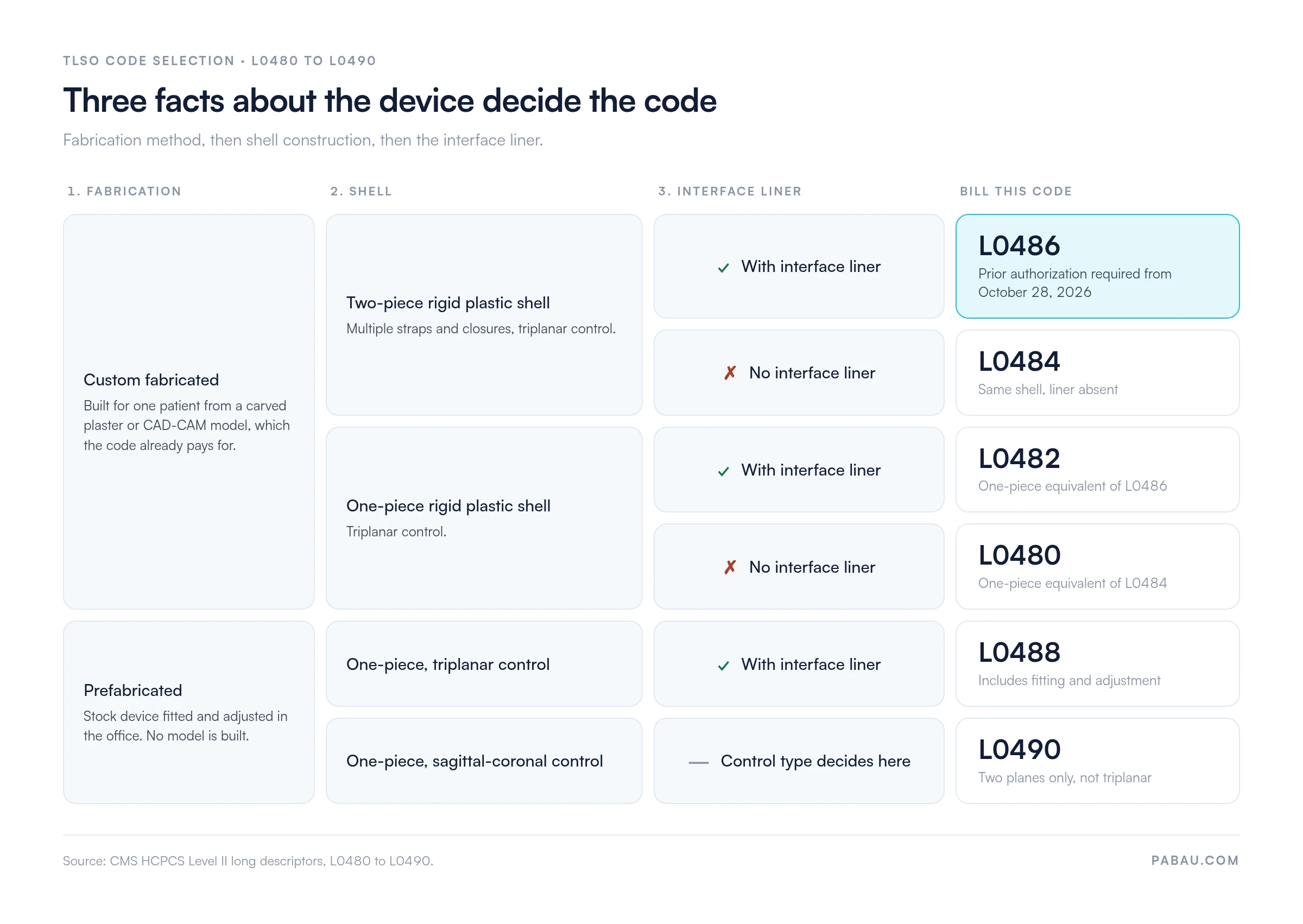
Key distinction: L0484 and L0486 are both custom-fabricated two-piece rigid shells. The interface liner is the only difference between them. L0486 carries the liner along with multiple straps and closures, and L0484 does not. Both include the carved plaster or CAD-CAM model, so neither applies to a stock device fitted in the office.
Medicare reimbursement for L0486 falls under the DMEPOS fee schedule administered by CMS. Rates vary by jurisdiction and are updated annually through the Federal Register.
Check the current figure in the CMS fee schedule lookup tool before you submit, because rates differ by Medicare Administrative Contractor (MAC) region.
The carved plaster or CAD-CAM model is bundled into the L0486 allowed amount, so it cannot go on the claim as a separate line. The phrase includes fitting and adjustment belongs to the prefabricated codes L0488 and L0490.
A stray model or fitting charge is a familiar denial trigger. Someone on the team still has to read the charge lines before the claim leaves. Alongside that review, claims management software tracks whether the required claim fields and supporting documents are complete.
Pull L0486 rates from the CMS DMEPOS fee schedule files rather than a third-party lookup tool, which can lag behind mid-year corrections. Download the annual file from the CMS coding and billing page and filter by L0486 for your MAC region. It takes under five minutes and removes the risk of submitting at a stale rate.
CMS Policy Article A52500 and LCD L33790 govern coverage for all TLSO and LSO codes, L0486 included. Medicare pays only when a treating practitioner has established and documented medical necessity.
Read A52500 alongside your MAC’s local coverage determination, since a MAC can apply rules stricter than the national policy article.
Coverage follows conditions that need external spinal stabilization across the thoracic, lumbar, and sacral segments. Covered indications under CMS Policy Article A52500 generally include:
The clinical record has to answer two questions. First, does the patient’s condition meet the criteria above? Second, why does a custom-fabricated two-piece shell with an interface liner suit this diagnosis? A general prescription for a back brace does not meet that standard.
Medicare does not cover L0486 in the following circumstances, per CMS Policy Article A52500:
Spinal orthoses carry a reasonable useful lifetime of five years. Inside that window Medicare pays for a replacement only when the brace is lost, stolen, irreparably damaged, or the patient’s condition has changed. The clinical note has to say which of those applies.
The trap here is quieter than it looks. Medicare’s same-or-similar check treats any brace worn on the same part of the body as similar, even when its function differs. So an LSO on file from three years ago can deny a new L0486 claim.
Switching to a different L-code does not restart the five-year clock, and replacements billed that way are an approved recovery audit target. Run the same-or-similar check through your MAC portal before the shell is fabricated, not after.
Every L0486 claim needs one or more ICD-10-CM diagnosis codes that establish medical necessity. The codes below reflect commonly covered diagnoses under CMS Policy Article A52500.
Check the current covered diagnosis list in your MAC’s LCD before billing, since that list is updated periodically.
Treat this table as illustrative rather than exhaustive. Cross-reference each code against your MAC’s covered diagnosis list.
Our ICD-10-CM code index confirms a code’s full official title before it goes on the claim. A diagnosis outside that list produces a medical necessity denial, however strong the clinical notes are.
Prior authorization applies to L0486 in every jurisdiction. CMS added the code to the Required Prior Authorization List in the Federal Register notice published on July 30, 2026, alongside L0456, L0457, and L1833.
The requirement covers claims with a date of service on or after October 28, 2026. The same notice added face-to-face encounter and written-order-prior-to-delivery requirements for these items.
From that date, a claim needs a provisional affirmation decision before Medicare will pay it. Claims submitted without one may be denied outright. Here is how the request moves:
Check prior authorization at the point of order intake rather than at claim submission. The most expensive version of this problem is easy to picture. The shell has been fabricated and delivered, the patient is wearing it, and the affirmation never arrives.
Modifiers tell the MAC how to read an L0486 claim. KX carries the most weight, and leaving it off a qualifying claim produces an automatic denial.
The prior authorization decision travels on the claim as a unique tracking number, not as a modifier. Enter that number exactly as the MAC issued it on the provisional affirmation letter. A TLSO has no laterality either, so RT and LT never belong on an L0486 claim.
Medicare expects complete documentation in the patient file before a supplier bills L0486. Incomplete files are the leading reason for post-payment audits and recoupment demands on DMEPOS claims. Every element below belongs in the record at the time of claim submission.
Certificates of medical necessity no longer apply to this code. CMS discontinued CMNs and DME information forms for dates of service on or after January 1, 2023. The clinical detail those forms once carried now has to sit in the medical record itself.
Only suppliers enrolled in Medicare as DMEPOS suppliers may bill HCPCS code L0486. That is an enrollment rule, not a clinical one. A licensed orthotist, physical therapist, chiropractor, or physician may fit the device and document the encounter. The claim for the orthosis still has to come from the DMEPOS-enrolled entity.
Enrolled suppliers also meet the supplier standards set by CMS. Those standards cover maintaining a physical location, carrying appropriate inventory, and employing qualified staff to fit orthotics.
A physical therapy practice billing under its own NPI, without DMEPOS enrollment, cannot bill L0486 directly. It would work with an enrolled supplier or refer the patient to one.
Chiropractic practices face the same split between prescribing and billing. Some run an in-house orthotic dispensary that is enrolled separately as a DMEPOS supplier, and that entity can bill L0486.
The chiropractor’s clinical notes support medical necessity, and the claim still originates with the enrolled supplier.
L0486 claims deny for a predictable set of reasons, and a structured pre-submission review catches nearly all of them. Knowing where spinal orthosis claims fail lets a supplier build a checklist that works before a recoupment demand arrives.
Run these seven questions on every L0486 claim. Any “no” sends the claim back to the file rather than to the MAC.
Suppliers who sort their L0486 denials by reason code usually find two or three categories behind most of them. A short monthly review of denied claims shows which step in the process is failing. Fixing that one step beats appealing the same denial every month.
Run a quarterly audit comparing your L0486 submissions against your MAC’s current covered diagnosis list. If the denial rate runs above 5%, pull the denial reason codes and sort them by category. A missing standard written order and a non-covered diagnosis lead most DMEPOS audits. Repairing those two steps usually recovers more revenue than any other single billing change.
Most orthotic suppliers track an L0486 order across three places at once. The appointment sits in a scheduler, the signed order sits in a scanned folder, and the prior authorization status sits in a spreadsheet. The file only comes together when the biller chases it, which is often after delivery.
Practice management software like Pabau keeps the order, the clinical notes, the consent forms, and the delivery record on one patient timeline. Staff can see whether the standard written order is signed, and whether the affirmation number has arrived, before the claim goes out.
Custom fields and templates hold the custom-fabrication justification that A52500 asks for, so it is written at the fitting rather than reconstructed at audit.
Claims then leave with their supporting documentation already attached. Fewer L0486 submissions come back for a missing element, billing staff spend less time rebuilding files, and payment arrives on the first pass more often.

Pabau holds the order, the fitting notes, the consent forms, and the delivery record against one patient record. Required claim fields are checked for completeness before the claim is sent. See how it works for your practice.

L0486 rewards suppliers who decide the code at the bench rather than at the billing desk. The person who fits the shell knows whether it has a liner, whether it came in two pieces, and what was modified at the fitting. Capture that while the patient is still in the room and the coding question answers itself.
The trade-off worth remembering is timing. Prior authorization, the same-or-similar check, and the signed order all cost time before fabrication starts, and all three become unrecoverable losses after delivery. Front-loading them is the cheaper half of the choice.
If your L0486 paperwork lives in three systems, that is the place to start. Book a demo to see how Pabau keeps the order, the fitting notes, and the delivery proof on one patient record.

Working through a stack of denied claims? Denial management in healthcare sets out how to build a review and prevention process for DMEPOS and other claim types.
Want fewer claims coming back at all? What a clean claim looks like breaks down the fields and checks that decide whether a claim pays on the first pass.
Need a documentation standard your team can follow? Medical billing compliance covers the record-keeping rules that hold up under a pre-payment or post-payment audit.
Building a superbill for orthotic services? Superbill documentation best practices explains what belongs on one and how it supports clean claim submission.
Looking at the wider payment process? What is revenue cycle management walks the path from patient encounter through to payment posting.
A non-affirmed decision names the documentation that fell short. The supplier can correct the file and submit a new request before delivering the device. Check your MAC’s published guidance on resubmission first. Delivering and appealing afterwards leaves the practice holding the cost of a custom brace.
Not always. Medicare Advantage plans set their own prior authorization and coverage rules, and some work from a narrower diagnosis list than fee-for-service Medicare. Read the plan’s orthotics policy before fabrication starts, and get the authorization in writing.
Not separately. A brace supplied during a covered Part A hospital or skilled nursing stay is paid through the facility. The supplier bills the facility, not Medicare.
Spinal orthoses carry a five-year reasonable useful lifetime. Inside those five years Medicare pays again only when the brace is lost, stolen, irreparably damaged, or the patient’s condition has changed. Billing a different L-code does not restart the clock.
Use the date the brace was delivered to the patient, not the date it was ordered or fabricated. That date has to fall on or after the prior authorization affirmation, and it has to match the signed proof of delivery.