CCSD code H4430: Examination of rectum under anaesthetic
CCSD code H4430 pays for the examination alone CCSD code H4430 is the UK private...

Last Updated: Oct 20, 2026
L0484 is the HCPCS Level II code for tlso, triplanar control, two piece rigid plastic shell without interface liner, with multiple straps and closures, posterior extends from sacrococcygeal junction and terminates just inferior to scapular spine, anterior extends from symphysis pubis to sternal notch, lateral strength is enhanced by overlapping plastic, restricts gross trunk motion in the sagittal, coronal, and transverse planes, includes a carved plaster or cad-cam model, custom fabricated.
It is built from the patient's own carved plaster or CAD-CAM model, which separates it from every prefabricated brace in the same range.
Suppliers regularly mistake L0484 for an off-the-shelf code. That misreading produces upcoding findings on audit and denials that never needed to happen.
Let Pabau's smart automation suggest the right codes, reduce claim denials, and keep your practice compliant—effortlessly.
Automate repetitive tasks and focus on what matters most—your patients.
Reduce coding errors and ensure compliance with the latest regulations.
Clean claims, fewer denials, and faster reimbursements.
Powerful insights and reporting to help your practice thrive.
HIPAA compliant SOC 2 certified GDPR-compliant Trusted by 4,000+ clinics worldwide

HCPCS Code L0484 describes a custom-fabricated TLSO with a two-piece rigid plastic shell, triplanar control, multiple straps, and no interface liner.
The official descriptor includes a carved plaster or CAD-CAM model, so a model or scan of the patient must exist in the file.
Coverage requires a standard written order (SWO) and medical necessity documentation, per CMS Policy Article A52500 and LCD L33790.
L0488 is the prefabricated code in this group. Billing L0484 for an off-the-shelf brace is upcoding and a known audit target.
Pabau’s claims management software helps orthotic and DME suppliers track documentation, submit clean claims, and reduce L0484 denial rates.
HCPCS Code L0484 is classified under HCPCS Level II, the CMS-maintained coding system for durable medical equipment, prosthetics, orthotics, and supplies billed outside of CPT. L0484 sits in the thoracic-lumbar-sacral orthosis (TLSO) range. Its official long descriptor is set out below, clause by clause.
Read end to end, those clauses are the CMS long descriptor for L0484 word for word. The last two carry the most weight for coders. The table below breaks down each anatomical and design term and explains why it matters for code selection.
Custom fabrication is the part of the L0484 descriptor that carries the most audit weight. The code covers a device built for one patient from that patient’s own measurements. The descriptor names the method itself, which includes a carved plaster or CAD-CAM model.
Custom fitted is not the same thing. A custom-fitted orthosis starts as a manufactured base that a qualified practitioner then modifies for the individual patient.
L0470 is one of the custom-fitted triplanar codes, a TLSO with a rigid posterior frame and a flexible soft anterior apron. CMS classes it as prefabricated, with fitting and adjustment included.
A custom-fabricated orthosis starts from a model of the patient. If no model, cast, or scan record exists in the file, the device was almost certainly not custom fabricated, and L0484 is the wrong code.
Selecting the wrong TLSO code is the most common L-code billing error. The L0450-L0492 range covers a wide spectrum of TLSO configurations, and several codes are separated only by a single device feature. Billers frequently confuse L0484 with its closest siblings. The comparison below covers the codes most often billed in error.
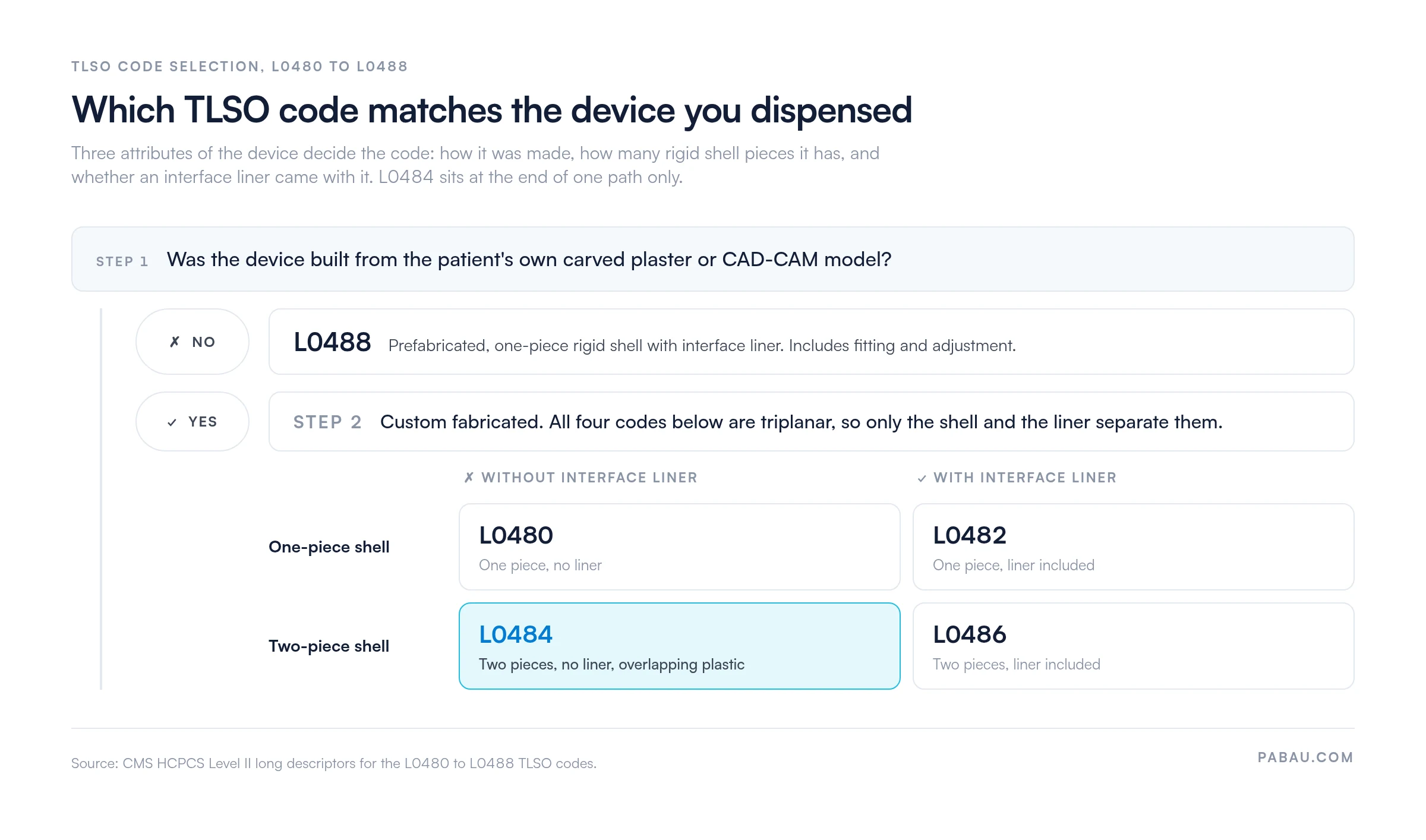
L0486 is L0484’s closest sibling. Both are two-piece custom-fabricated rigid plastic shells with triplanar control, and the interface liner is the only separator. Supply a liner and bill L0484, and the claim describes a device you did not dispense. L0480 and L0482 are one-piece shells, so a two-piece device never maps to either code.
L0488 is the prefabricated code in this group, and it is the one most often confused with L0484. It describes a one-piece shell with an interface liner, and the code includes fitting and adjustment.
Billing L0484 for an off-the-shelf brace is upcoding, and orthotic upcoding is a standing Office of Inspector General (OIG) audit priority. The decision chart below reduces the whole group to two questions about the device in front of you.
Medicare coverage for L0484 is governed by CMS Policy Article A52500 and the associated spinal orthoses LCD L33790. Together they set the coverage indications, documentation standards, and utilization guidelines for TLSO and LSO devices billed under the DME benefit. Coverage may apply when all of the following conditions are met.
Confirm that the ordering practitioner is enrolled in Medicare before the device is dispensed. The clinical rationale also has to be documented in the medical record before the device leaves the facility.
The SWO replaced the detailed written order under the CMS DMEPOS final rule effective January 1, 2020. Any intake checklist still built around a DWO is running on retired terminology. A compliant SWO carries these elements.
A generic order for “back brace” fails the description element. For L0484, the order should name a custom-fabricated two-piece TLSO so a reviewer can match the order to the code without guessing.
L0484 claims require at least one ICD-10 diagnosis code that supports medical necessity under Policy Article A52500. The codes below represent common covered diagnoses. Verify the current covered-diagnosis list with your DME MAC before each claim cycle, as the list is updated annually.
S22 as a whole covers fractures of the ribs, sternum, and thoracic spine, so only the vertebral subset at S22.0- supports TLSO necessity.
Check the current billable status and specificity requirements for any code against the official CMS ICD-10 code files before submission. For spinal fracture codes, the seventh-character extension must be accurate for the date of service. That character records the encounter type as initial, subsequent, or sequela.
Each category above breaks down into more specific billable codes, and the one you report has to match the documentation. Our ICD-10-CM code reference is the place to check a specific diagnosis code before you report it.
The situations below result in non-covered claims under Medicare for L0484. Documenting each dispensing encounter carefully is what confirms none of them apply.
L0484 is priced under the Medicare DME fee schedule, which CMS updates annually. The 2026 rates reflect the allowed amount for a custom-fabricated two-piece TLSO. Rates vary by jurisdiction based on geographic cost adjustments. Confirm all figures against the CMS DMEPOS fee schedule for the current year before billing.
Suppliers processing high volumes of orthotic claims benefit from tracking allowed amounts, patient cost-sharing, and ERA postings in one system. That single view catches shortfalls before they age into write-offs.
Missing or incomplete documentation is the leading cause of L0484 claim denials. CMS requires a specific documentation chain under Policy Article A52500. Every item on this list must be in the supplier’s file before the claim is submitted.
One item is no longer on that list. CMS discontinued certificates of medical necessity (CMNs) and DME information forms (DIFs) for dates of service on or after January 1, 2023. No CMN applies to an L0484 claim today, and a DME MAC will not request one.
The SWO has to be specific enough to identify the device dispensed. A vague order does not tell a reviewer, or the billing system that scrubs the claim, that the device matched the L0484 descriptor.
Flag every TLSO claim file for an SWO and fabrication review before billing. Build a five-point checklist into your intake workflow. Check the order for all six SWO elements, record the model or scan date, and match the device spec to the L0484 descriptor. Then confirm the delivery signature and verify the ICD-10 code on the covered-diagnosis list. A five-minute pre-submission review prevents a 45-day denial and resubmission cycle.
DME MAC audit findings point to a short list of root causes behind TLSO denials. Each has a prevention step that costs less than the appeal it avoids. That trade is what denial management buys an orthotic supplier.
Reading your ERA postings as a batch, rather than one denial at a time, is what makes a systematic billing problem visible. Six L0484 claims denied for the same missing modifier is a workflow defect, not six accidents.
Modifier selection for L0484 directly affects whether a claim pays, pends for review, or denies outright. The table below covers the modifiers most relevant to TLSO billing under Medicare.
KX is the most frequently omitted modifier in TLSO billing. When documentation supports medical necessity and all coverage criteria have been met, KX must appear on the claim. Its absence signals to the DME MAC that documentation may be incomplete, which triggers a pre-payment review or an outright denial.
Medicaid coverage for L0484 varies significantly by state. Some state Medicaid programs follow Medicare coverage criteria closely. Others use independent fee schedules, require prior authorization for every TLSO regardless of diagnosis, or cover only specific device types. Verify prior authorization requirements with the relevant state Medicaid agency before dispensing.
Commercial payer policies for TLSO billing also vary. Many follow Medicare’s covered-diagnosis list but apply different documentation thresholds, reimbursement rates, and billing code preferences.
Several also treat custom-fabricated orthoses as a prior authorization category on their own. Confirming payer-specific rules before filing avoids denials that cannot be appealed on Medicare grounds.
Run a weekly aging report on all open L0484 claims. Investigate any claim past 30 days with no remittance advice. Call the DME MAC to confirm receipt, check for additional information requests (AIRs), and verify the modifier and diagnosis combination you submitted.
Many orthotic suppliers assemble an L0484 file from three or four separate places. The order sits in one folder, the casting or scan notes in another, and the signed delivery receipt arrives by fax. Those records never meet in one place, so a file looks complete until a DME MAC asks for the model date.
Practice management software like Pabau keeps the whole file inside one patient record. The written order, the fabrication notes, the fitting record, and the signed delivery confirmation all attach to the same encounter. Pabau’s claims management software then reviews the claim before it goes out. A missing KX modifier or an uncovered diagnosis gets flagged while you can still fix it.
Catching missing modifiers, non-covered diagnosis codes, and incomplete orders before submission is what keeps a TLSO claim clean. Pre-submission review takes far less time than managing a denial, writing an appeal, and resubmitting 30 to 60 days later. Your team spends its hours dispensing devices instead of chasing paperwork.

Pabau helps DME suppliers and orthotic practices track documentation requirements, submit clean L0484 claims, and reduce denials. See how Pabau’s claims management tools work for your practice.

HCPCS Code L0484 carries more billing complexity than its descriptor suggests. Start from the one fact that decides most L0484 claims. The code is custom fabricated, so a model of the patient has to exist before the code is billable.
From there, the L0486 liner boundary, the six SWO elements, and the KX modifier can each turn a compliant claim into a denial. Getting all of them right consistently takes a structured pre-submission review, not just familiarity with the code.
Build that review into the dispensing workflow rather than the billing week. The fabrication record then gets captured while the patient is still in the room. Book a demo to see how Pabau tracks L0484 documentation and flags an incomplete claim before it reaches the DME MAC.

Need to understand how claim denials are classified? Denial codes in medical billing breaks down the most common CARC and RARC codes used in ERA remittances.
Billing a flexible custom-fabricated TLSO instead? HCPCS Code L0452 covers the descriptor, coverage criteria, and documentation for that code.
Looking for a clearinghouse overview? Medical claims clearinghouse guide explains how electronic claims flow from provider to payer and where scrubbing catches errors.
Want to understand ERA postings? Electronic remittance advice (ERA) covers how to read 835 files and reconcile payments against submitted claims.
HCPCS Code L0484 bills a custom-fabricated thoracic-lumbar-sacral orthosis (TLSO). The device has a two-piece rigid plastic shell, triplanar control, multiple straps and closures, and no interface liner. DME suppliers and orthotic providers use it to bill Medicare and other payers once medical necessity and coverage criteria are documented.
L0484 is custom fabricated. The official descriptor includes a carved plaster or CAD-CAM model, which means the device is built from the individual patient’s measurements or scan. L0488 is the prefabricated code in this group, so an off-the-shelf brace never bills as L0484.
Both L0484 and L0486 are custom-fabricated, two-piece rigid plastic TLSO shells with triplanar control. The interface liner is the only difference between them. L0484 applies when no interface liner is supplied, and L0486 applies when the device includes one. Billing L0484 for a device with a liner is a coding error and a common audit finding.
You need a standard written order (SWO) signed and dated by the treating practitioner. You also need medical records supporting the qualifying diagnosis, plus the custom fabrication record showing the measurements, cast, or CAD-CAM scan. A signed delivery confirmation and fitting notes must also be on file. Add the KX modifier once all coverage criteria are met. No certificate of medical necessity applies, because CMS discontinued CMNs for dates of service on or after January 1, 2023.
Medicare sets the L0484 allowed amount through the DMEPOS fee schedule, which CMS updates annually and which varies by jurisdiction. The beneficiary pays 20% coinsurance after the Part B deductible. Verify the current 2026 amount for your jurisdiction with the CMS fee schedule tool before you bill.
Medicare may cover a TLSO under Policy Article A52500 and LCD L33790. Coverage requires a qualifying ICD-10 diagnosis and a practitioner order issued in writing. The supplier must hold the SWO and all supporting documentation, and must be enrolled in Medicare. The device also has to meet the exact descriptor for the code billed. A non-covered diagnosis, a missing order, or a device mismatch each results in denial.
Medicaid coverage for L0484 varies by state. Some states follow Medicare criteria closely, while others require prior authorization or use independent fee schedules. Commercial payers generally cover custom-fabricated TLSOs for qualifying diagnoses, but documentation thresholds and reimbursement rates differ. Verify coverage, prior authorization, and documentation standards with each non-Medicare payer before dispensing.