

CCSD code G5100: Bypass of duodenum billing guide
CCSD code G5100 bills a bypass that leaves the duodenum in place CCSD code G5100...

Last Updated: Oct 16, 2026
L0488 is the HCPCS Level II code for a prefabricated thoracic-lumbar-sacral orthosis (TLSO) with triplanar control. The brace has a one-piece rigid plastic shell with an interface liner, multiple straps and closures, and an anterior or posterior opening. It runs from the sacrococcygeal junction to just below the scapular spine, and from the symphysis pubis to the sternal notch. The code includes fitting and adjustment.
Certified orthotists and DMEPOS suppliers bill L0488 to Medicare Part B. It is most often confused with its neighbors. L0486 is a custom-fabricated two-piece shell built from a model of the patient, and L0490 is a prefabricated one-piece shell with sagittal-coronal control only. Documenting the shell, the fabrication method, and the planes of control before dispensing keeps claims paid.
Let Pabau's smart automation suggest the right codes, reduce claim denials, and keep your practice compliant—effortlessly.
Automate repetitive tasks and focus on what matters most—your patients.
Reduce coding errors and ensure compliance with the latest regulations.
Clean claims, fewer denials, and faster reimbursements.
Powerful insights and reporting to help your practice thrive.
HIPAA compliant SOC 2 certified GDPR-compliant Trusted by 4,000+ clinics worldwide

HCPCS code L0488 describes a prefabricated TLSO with triplanar control, built as a one-piece rigid plastic shell with an interface liner.
LCD L33790 and Policy Article A52500 govern Medicare coverage, which applies when the treating practitioner orders the brace for one of four indications the LCD lists.
L0488 is most often confused with L0486, a custom-fabricated two-piece shell, and L0490, a one-piece shell with sagittal-coronal control only. Select the code from the device features, never the reimbursement level.
A Standard Written Order (SWO) from the treating practitioner must reach the supplier before the claim goes out. Getting it signed before dispensing keeps the file audit-ready.
Practice management software like Pabau keeps the order, fitting notes, and delivery receipt on one patient record, then submits and tracks the claim.
HCPCS code L0488 describes a prefabricated thoracic-lumbar-sacral orthosis (TLSO) with triplanar control: a one-piece rigid plastic shell with an interface liner, multiple straps, and an anterior or posterior opening that restricts trunk motion in all three planes. The code also includes fitting and adjustment.
Every descriptor element carries a billing consequence, so a two-piece shell, a custom-molded brace, or a two-plane design never qualifies for L0488.
Each element below maps to its billing impact, per HCPCS Level II administered by CMS.
A device made from a cast or mold of the patient’s body instead falls under custom fabrication — a different code, a different audit risk. A custom-fabricated one-piece shell with a liner is L0482; a custom two-piece shell with a liner is L0486.
The TLSO code family is one of the most frequently miscoded areas in orthotic billing. Code choice turns on the brace’s construction method and how many planes it controls. So, billing a higher-paying neighbor when the device doesn’t meet its descriptor is upcoding, which carries fraud and abuse risk.
Orthotists can settle the code with three checks, mapped in the diagram below. First, confirm how the orthotist made the brace. A carved plaster or CAD-CAM model of the patient means custom fabrication, so it is L0482 or L0486 rather than L0488. Next, count the planes of control. A prefabricated one-piece shell that restricts only sagittal and coronal motion is L0490. Last, confirm the shell and liner. A prefabricated one-piece rigid shell with an interface liner and triplanar control is L0488.
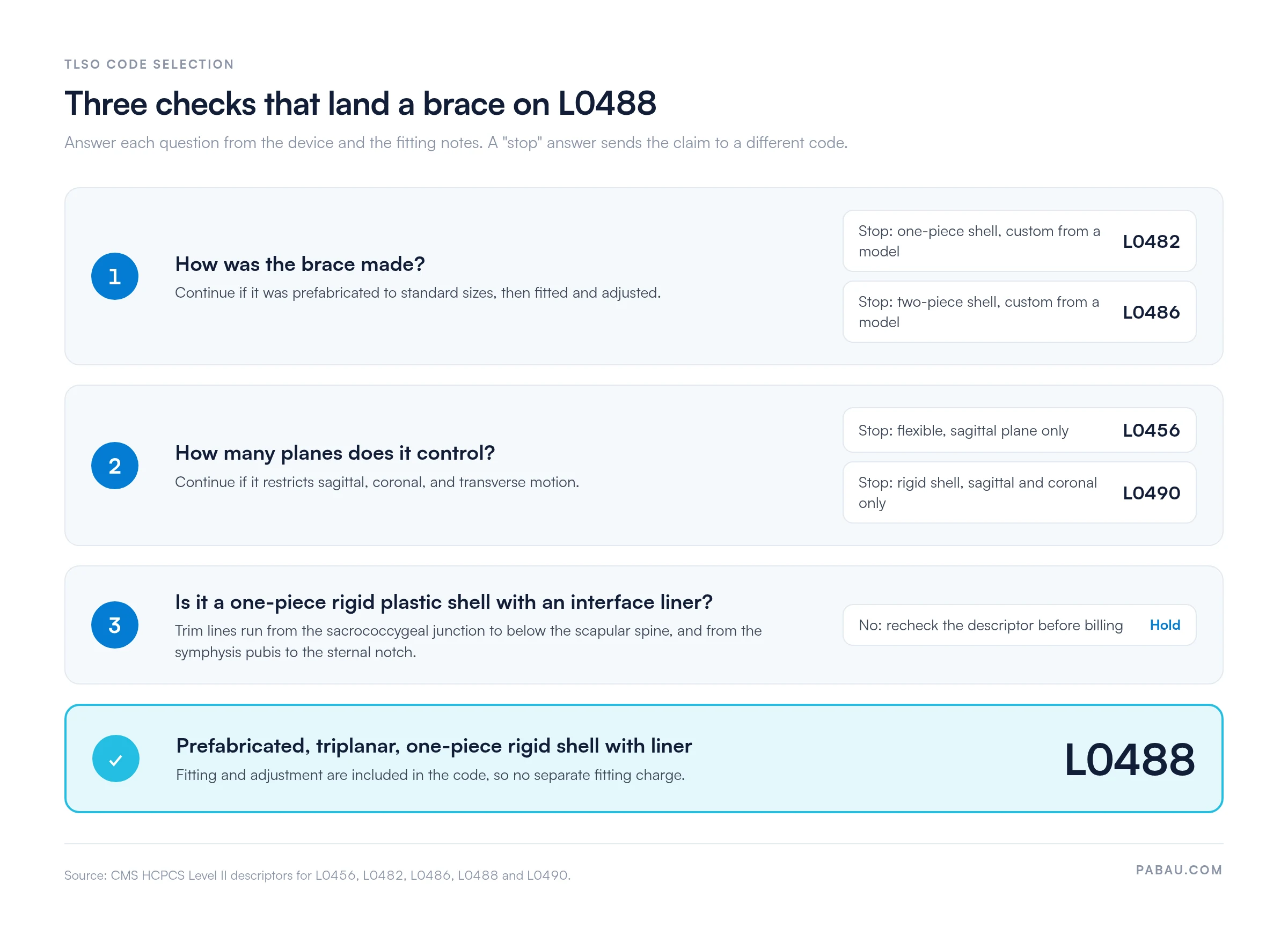
Before dispensing any TLSO, document the shell construction method explicitly in the clinical notes: ‘One-piece rigid plastic shell with interface liner, triplanar control, prefabricated.’ That single sentence directly mirrors the L0488 descriptor and removes ambiguity for auditors reviewing the record months later.
Medicare covers L0488 under the Part B braces benefit in Social Security Act §1861(s)(9). That is its own orthotic benefit category, separate from durable medical equipment, even though DME MACs process the claims. The coverage rules sit in LCD L33790 and its companion Policy Article A52500. Confirm active Part B coverage and any secondary payer before fitting.
LCD L33790 covers a spinal orthosis such as L0488 when the treating practitioner orders it for one of these four indications:
CMS publishes no list of covered ICD-10-CM codes for spinal orthoses. Instead, code the diagnosis to full specificity, and make sure the medical record ties it to one of the four indications.
A diagnosis on its own does not establish coverage. The treating practitioner’s notes have to explain why the patient needs a rigid brace with triplanar control. For example, healing after a vertebral fracture or spinal surgery typically qualifies. By contrast, nonspecific low back pain with no documented reason for rigid support is hard to defend on review.
Documentation is where L0488 claims most often fail on audit. The order, the medical records, and the delivery proof should be complete before you dispense the brace. Even so, a file assembled after a records request rarely holds up. As a result, medical billing compliance checklists built into dispensing, before the patient leaves, keep post-payment recovery demands down.
Required documentation elements for L0488:
The SWO replaced the older Detailed Written Order under CMS’s 2020 DMEPOS order rule (42 CFR §410.38). L0488 is not on the CMS list of items that need a Written Order Prior to Delivery (WOPD), although L0486 is. Even so, getting the SWO signed before dispensing is the safer habit. A brace delivered on a verbal order leaves the claim exposed if the signed order never arrives. For instance, a physician note that says “needs back brace” is not an SWO.
Modifiers tell Medicare how the supplier obtained the device, whether the claim meets coverage criteria, and how Medicare should process the claim. Applying the wrong modifier to an L0488 claim is a compliance risk, not a clerical one. So, the table below covers the modifiers most relevant to L0488 billing.
The KX modifier deserves particular attention. It is an attestation, not a request. By appending KX, the supplier certifies that the claim meets Medicare coverage criteria and that supporting documentation exists in the file at the time of billing. Suppliers must complete documentation before appending KX, not assemble it during a post-payment audit. As a result, practices that treat KX as a default modifier and document afterward create the conditions for both denial and overpayment recovery.
Medicare pays L0488 from the DMEPOS fee schedule, which CMS updates each year. Rates vary by state; CMS publishes them in the CMS DMEPOS fee schedule files. Any rate in this article is general guidance, so verify the current allowed amount for your state before submitting claims or quoting patients.
Key reimbursement facts for L0488:
Practices with several payer contracts should keep Medicare DMEPOS claims separate from commercial claims. That split reduces posting errors and makes each payer’s allowed amount for L0488 easier to reconcile. Tracking allowed amounts by payer also catches commercial underpayments, which go unnoticed when practices never check claims against the fee schedule.
Most L0488 denials are preventable. They cluster around four root causes: wrong code selection, a missing modifier, an incomplete order or record, and undocumented medical necessity. In short, understanding the pattern prevents the claim from failing in the first place, rather than requiring an appeal. Reviewing your practice’s denial codes by claim type shows whether L0488 denials trend toward documentation failures or code selection errors.
An appeal for a denied L0488 claim needs the complete documentation set. That means the SWO, the practitioner’s notes, the proof of delivery, and the fitting records. Send it to the DME MAC within the redetermination window, generally 120 days from the date of the denial notice. Overall, a clean first submission is always faster and cheaper than the appeals pathway.
Run a quarterly audit of your L0488 claims against the denial table above. Sort denied claims by denial reason code. If more than 20% of denials share a single root cause, the intake or documentation process is the problem. Fix that process and the individual claims follow.
A successful L0488 claim follows a defined sequence. A skipped or reordered step usually surfaces later, at pre-payment review or audit.
For chiropractic and spinal care practices that occasionally dispense TLSOs, supplier enrollment is the most commonly overlooked step. A practice not enrolled as a Medicare DMEPOS supplier cannot submit L0488 claims under its NPI. In fact, DMEPOS supplier enrollment is separate from general Medicare enrollment and uses its own application, Form CMS-855S.
Most L0488 denials start before the claim exists, when the order, fitting notes, and delivery receipt sit in different places. As a result, when an auditor asks for the file months later, staff have to rebuild it from email, paper, and the billing system.
Practice management software like Pabau keeps that file on one patient record. Digital forms capture the fitting notes and the signed delivery confirmation, and store the signed SWO on the same record. Pabau’s claims management software then submits the claim and tracks its status, so billing staff can review a rejection next to the documents behind it.
The result is a documentation set complete before the claim goes out — the moment that decides L0488 compliance.
HCPCS code L0488 is narrow by design. A brace qualifies only when it is prefabricated, controls all three planes, and uses a one-piece rigid shell with an interface liner. So, anything short of that belongs to a neighboring code.
So write those features into the fitting notes, and get the SWO signed before the brace leaves the room. It costs a few minutes at fitting, which is far cheaper than a redetermination. To see how Pabau keeps orthotic claim files complete, book a demo with the team.
HCPCS code L0488 covers a prefabricated thoracic-lumbar-sacral orthosis (TLSO) with triplanar control. It uses a one-piece rigid plastic shell with an interface liner, and the code includes fitting and adjustment. In turn, Medicare Part B pays for it as a purchased item once the medical record documents necessity and a Standard Written Order is on file.
Medicare does not currently require prior authorization for L0488 as a standard condition of coverage. Pre-claim review programs run by DME MACs may still apply to high-utilization suppliers. However, commercial payers and state Medicaid programs frequently do require prior authorization for TLSOs. Always verify prior auth requirements with the specific payer before dispensing the device, not after.
The most common modifiers for L0488 are NU for a new purchased item and KX when the claim meets coverage criteria. GA shows that an advance beneficiary notice is on file when coverage is uncertain. The KX modifier is an attestation – suppliers may append it only when all required documentation exists in the supplier’s file at the time of billing. Therefore, applying KX without complete documentation is a compliance violation.
The leading denial reasons for L0488 are wrong code selection, a missing KX modifier, a late or incomplete Standard Written Order, and undocumented medical necessity. Code selection fails when a supplier bills a custom-fabricated brace (L0482 or L0486) or a two-plane brace (L0490) as L0488. So, completing the documentation set before dispensing prevents most of these denials.



