Pabau Engage inbox

Pabau Engage is here: every patient conversation in one inbox.

Learn more
Book a demo Book a demo
☰
HCPCS Code

HCPCS code K0900 – Customized DME billing and coding guide


Code Definition

K0900 is the HCPCS Level II code for customized durable medical equipment, other than wheelchair. It covers items uniquely built or substantially modified for one beneficiary when no specific code describes them.

The code has been active since July 1, 2013, and the DME MAC prices each claim individually. Billing it well means knowing what distinguishes K0900 from E1399 (miscellaneous DME), what documentation the DME MAC requires, and which modifiers apply to the claim.

Level
Level II
Category
K Temporary codes assigned to DME regional carriers
Status
Active, effective 1 July 2013; Medicare contractor-priced custom DME
Billable
No
Code also known as
custom durable medical equipment, custom-fabricated DME, individually fabricated medical equipment
Save time. Improve accuracy. Get paid faster.
Automate coding with Pabau

Let Pabau's smart automation suggest the right codes, reduce claim denials, and keep your practice compliant—effortlessly.

  • AI-powered code suggestions
  • Real-time compliance checks
  • Faster claims, fewer denials
Why practices choose Pabau
Save hours every week

Automate repetitive tasks and focus on what matters most—your patients.

Improve accuracy

Reduce coding errors and ensure compliance with the latest regulations.

Get paid faster

Clean claims, fewer denials, and faster reimbursements.

Grow with confidence

Powerful insights and reporting to help your practice thrive.

HIPAA compliant SOC 2 certified GDPR-compliant Trusted by 4,000+ clinics worldwide

Key takeaways

Key takeaways

HCPCS code K0900 covers DME, other than wheelchairs, that is uniquely built or substantially modified for one beneficiary when no specific code fits.

Custom-fitted items, and items assembled from customized options, don’t meet the federal definition and can’t be billed as K0900.

Miscellaneous DME with no specific code goes under E1399, while K0108 is only for wheelchair components or accessories not otherwise specified.

K0900 has no fee schedule amount, so the DME MAC prices each claim as a lump sum from your documented labor and material costs.

Add KX only where a DME MAC medical policy applies, and keep the written order, product description and proof of delivery on file.

HCPCS code K0900 covers custom DME that no other code describes

HCPCS code K0900 is the Level II code for customized durable medical equipment, other than wheelchair. CMS Transmittal 1239 created it on July 1, 2013, for items meeting the customized-item definition in 42 CFR 414.224. It sits in the temporary K series of HCPCS Level II codes, and the DME MAC prices each claim individually.

Wheelchairs have their own custom base codes, K0008 for manual and K0013 for power. That leaves K0900 for every other customized item that no specific code describes.

FieldDetail
HCPCS codeK0900
Official descriptorCustomized durable medical equipment, other than wheelchair
Code typeHCPCS Level II (K-code range)
Maintained byCenters for Medicare & Medicaid Services (CMS)
Primary payerMedicare Part B (DMEPOS benefit)
StatusActive since July 1, 2013, and individually priced by the DME MAC
Billing formCMS-1500 or 837P electronic claim

You can confirm the current descriptor on the CMS HCPCS code set page.

What qualifies as customized, and what doesn’t

Federal regulation sets the bar. Under 42 CFR 414.224, the item must be uniquely constructed or substantially modified for one beneficiary, following the physician’s description and orders.

It also has to be so different from similar items that the two can’t be grouped together for pricing. The item must still be durable, used in the home and medically necessary.

  • Included: custom-fabricated seating systems mounted to non-wheelchair bases, and positioning or adaptive equipment built from scratch for one beneficiary.
  • Also included: other non-wheelchair DME that is built or substantially modified for the patient, where no specific HCPCS code exists.
  • Excluded: off-the-shelf items, wheelchairs and wheelchair parts, items with a named HCPCS code, and comfort or convenience items.
  • Also excluded: items that are custom-fitted, or assembled from customized options and components a manufacturer offers.

The test is construction, not fitting. Measuring, adjusting or assembling an item around a patient’s size, weight or disability doesn’t make it customized. If the item had to be built or substantially modified for this patient, and no specific code describes it, K0900 is the code.

K0900 vs E1399 and K0108: Choose by what the item is

E1399 is the miscellaneous code for DME that no other code describes, while K0900 is reserved for customized items. K0108 is narrower still. It covers a wheelchair component or accessory not otherwise specified.

FactorK0900E1399K0108
DescriptorCustomized DME, other than wheelchairDurable medical equipment, miscellaneousWheelchair component or accessory, not otherwise specified
Item must be customized?Yes, built or substantially modified for one beneficiaryNo, the item simply lacks a specific codeNo, the part simply lacks a specific code
Use whenThe item meets 42 CFR 414.224 and no specific code fitsNon-wheelchair DME with no specific codeWheelchair parts or accessories with no specific code
Documentation emphasisWhy a standard item fails, plus fabrication costsItem description and why no specific code existsPart description and the wheelchair it fits

Ask whether the item was built for this patient, or is a stock product without a named code. If it’s a wheelchair part, the answer is K0108, not either of the other two. Run the three questions below before you choose.
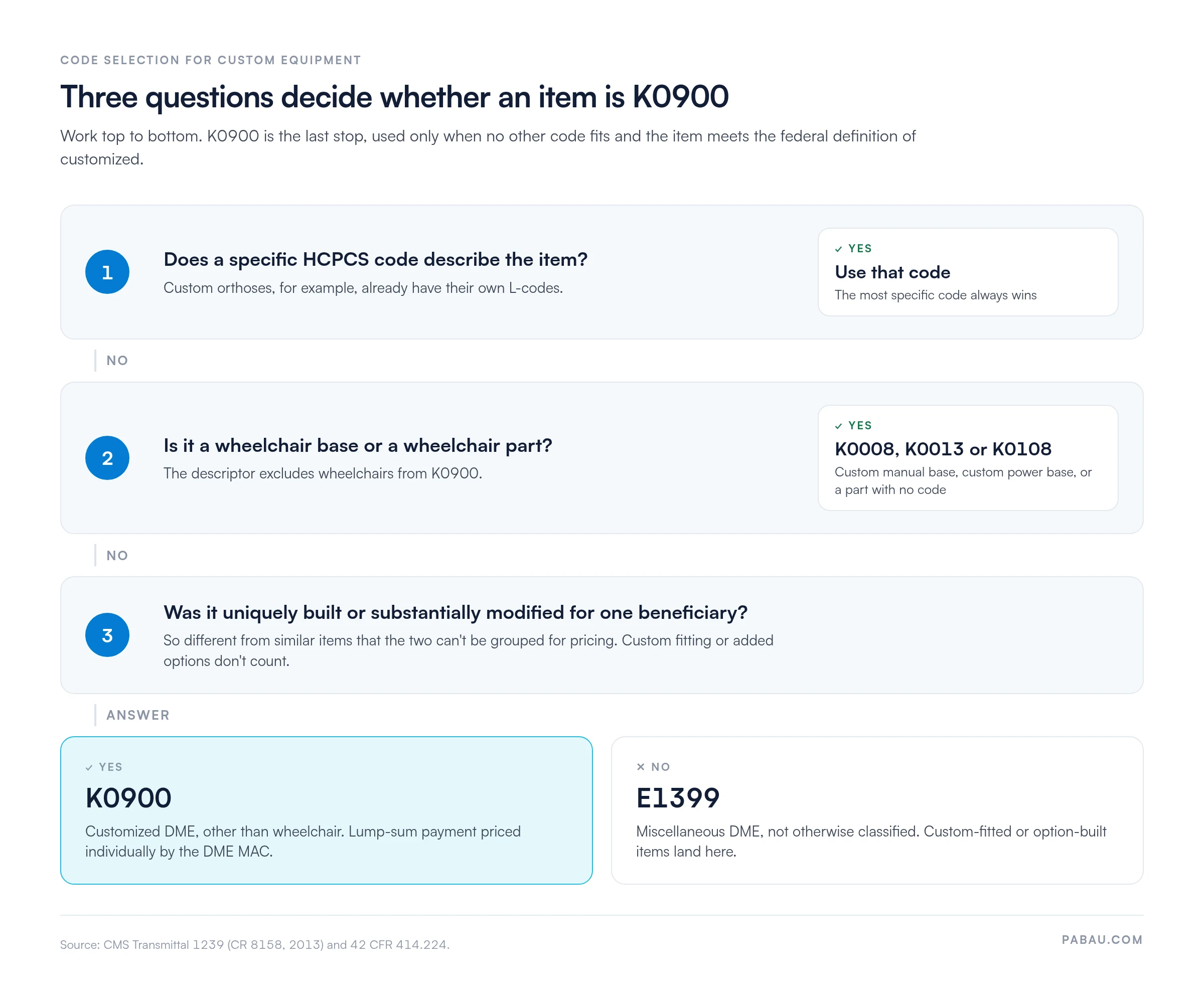
Decision flow for HCPCS code K0900
K0900 is the last stop, reached only after a specific code and the wheelchair codes are ruled out. Based on CMS Transmittal 1239 and 42 CFR 414.224.

Documentation the DME MAC needs to price the claim

Incomplete paperwork is a common denial reason on K0900, so build the file before the claim goes out. The medical billing compliance guide covers how to structure those workflows.

  • Detailed written order: signed and dated by the treating practitioner before delivery, naming the item and the patient’s clinical need.
  • Detailed product description: what was fabricated or modified, the materials, and how the item addresses the functional limitation.
  • Cost records: design, fabrication and assembly labor and the materials used, since the DME MAC prices the item from them.
  • Proof of delivery: signed acknowledgment from the patient or their representative, with the delivery date.
  • Diagnosis codes: one or more ICD-10-CM codes for the condition that makes the custom item necessary.
  • Clinical notes: the functional deficit, why standard equipment falls short, and the expected benefit.
  • No CMN: K0900 doesn’t use a Certificate of Medical Necessity, so the order and notes carry the weight.

Keep the file in the patient record for at least seven years. Medicare audits on customized DME start with a records request, and missing records can lead to the payment being recouped.

Pro Tip

Before fabrication starts, get a written order that states why standard DME can’t meet the patient’s needs. That one line is often what an auditor checks first.

Diagnosis codes that support medical necessity

Every K0900 claim needs at least one ICD-10-CM code that explains why the custom item is medically necessary. There’s no K0900 diagnosis list to match against, so the notes have to make the link clear.

ICD-10-CM codeDescriptionClinical relevance
G80.0Spastic quadriplegic cerebral palsyCustom positioning and adaptive equipment
G35.DMultiple sclerosis, unspecifiedCustom-built functional and positioning aids
G12.21Amyotrophic lateral sclerosisCustom communication and adaptive devices
M41.00Infantile idiopathic scoliosis, site unspecifiedCustom-fabricated positioning support (spinal orthoses use L-codes)
S14.109AUnspecified injury at unspecified level of cervical spinal cord, initial encounterCustom positioning and adaptive seating
G82.50Quadriplegia, unspecifiedCustom-fabricated supportive and adaptive equipment

These are examples, not a coverage list. Pick the code that matches the documented condition, and use the most specific one the record supports.

Modifiers on a K0900 claim depend on the item and the payer

Modifiers on K0900 signal equipment status, liability and, where a policy applies, coverage criteria. KX isn’t automatic on this code.

ModifierDescriptionWhen it applies
KXRequirements specified in the medical policy have been metOnly where a DME MAC medical policy applies to the item and its criteria are documented
NUNew equipmentA new item purchased for the patient
RRRentalNot used on K0900, which Medicare pays as a lump-sum purchase
RAReplacement of a DME itemThe item replaces equipment the patient already had
GAWaiver of liability statement issued as required by payer policyCoverage is uncertain and a signed ABN is on file
GZItem or service expected to be denied, no ABN on fileCoverage is unlikely, no ABN was issued, and the supplier carries the liability

KX carries legal weight where it applies. By adding it, the supplier attests that the records support every criterion in that medical policy. Adding it without that support exposes the supplier to improper-billing findings.

Prior authorization depends on the payer

For Medicare, prior auth applies only if CMS places the item in an active DMEPOS prior authorization program. Check current CMS program lists when the order comes in. Use insurance eligibility verification to confirm coverage before fabrication begins.

  • Medicare: check the CMS prior authorization program list for the item. A claim without a required authorization may be denied, so check appeal rights with your DME MAC.
  • Medicaid: many states require prior authorization for customized DME. Timelines vary, so check the state billing manual.
  • Commercial plans: many may require pre-authorization for custom-fabricated DME. Send the order, clinical notes and product description before fabrication.

Once approved, record the authorization number and put it on the claim. A claim for service dates outside the authorization period is treated as unauthorized, however good the clinical file.

How K0900 is priced: There’s no fee schedule amount

K0900 carries no fee schedule amount, because each item is different. The DME MAC pays a lump sum based on its judgment of a reasonable cost. It weighs documented design, fabrication and assembly labor and the materials used.

The CMS DMEPOS fee schedule lists items with set amounts, and K0900 isn’t priced there. Your cost records do the work instead. A thin description of labor and materials gives the DME MAC little to price from.

Payment factorDetail
Payment methodologyLump-sum purchase, priced by the DME MAC on individual consideration
What the DME MAC weighsDocumented design, fabrication and assembly labor, plus the materials used
Beneficiary cost-sharingMedicare Part B coinsurance: 20% after the deductible
Annual updateNo fee schedule amount to update, so each claim is priced on its own records
Published rateNone for K0900
Code lookupAAPC HCPCS code lookup

How a K0900 claim moves from order to payment

Each step below depends on the one before it, so the order matters.

  1. Get the detailed written order. It names the equipment, the diagnosis and why a custom item is needed. It must be dated before delivery.
  2. Check the coding guideline and coverage. Read the DME MAC’s K0900 coding guideline, and confirm whether any medical policy or prior auth applies.
  3. Build the documentation file. Collect the order, product description, clinical notes, diagnosis codes and cost records before fabrication.
  4. Get prior authorization if the payer requires it. Send the request with the supporting records, and keep the authorization number.
  5. Fabricate or modify the item. Start once coverage is confirmed and any authorization is in hand. Log labor and materials as you go.
  6. Deliver and get proof of delivery. The patient or their representative signs and dates the delivery record.
  7. Add modifiers and submit. Use NU, RA, GA or GZ as they apply, and KX only where a medical policy requires it. Then run the clean claim checks before you submit.

Before you submit: A six-point check

  • The written order is signed and dated earlier than the delivery date.
  • The product description explains what was built or modified, not just the item’s name.
  • Labor and material costs are written down and add up.
  • No specific HCPCS code, E1399 or K0108 fits the item better.
  • Any prior authorization number is on the claim, and the service date falls inside it.
  • Modifiers match the item, and KX appears only where a medical policy applies.

Common K0900 denials and how to prevent them

Most K0900 denials trace back to a few recurring causes. Strong denial management starts with fixing each one before the claim goes out.

Denial reasonCommon CARCPrevention action
KX missing where a medical policy appliesCARC 4Check whether a DME MAC medical policy covers the item, and add KX only when its criteria are documented
No prior authorizationCARC 15Confirm the payer’s prior auth rules before fabrication, and send the request with full supporting records
Insufficient medical necessity documentationCARC 50Include clinical notes explaining why standard DME can’t meet the patient’s needs
Wrong code (K0900 used where E1399, K0108 or a specific code fits)CARC 4Run the three-question test, and use a specific code, E1399 or K0108 wherever one fits
Unsupported diagnosis linkageCARC 11Link a diagnosis that shows why the custom item is medically necessary
Non-covered item typeCARC 96Confirm the item is DME under the Medicare benefit, and issue an ABN if coverage is uncertain
Missing or incomplete written orderCARC 16Get the written order signed and dated before the item is delivered

Pro Tip

Before each K0900 claim goes out, check that no specific code fits, that the order predates delivery, and that the cost records are attached. Those three checks catch the denials that are hardest to appeal.

DME MAC coding guidelines for K0900

No LCD governs K0900. The DME MACs publish a K0900 coding guideline instead. Noridian, the contractor for Jurisdictions A and D, is one example. The DME PDAC, which rules on DME coding questions, publishes one too.

The guideline restates the customized-item definition and the documentation the contractor expects. Expect requests for the detailed written order, the detailed product description and proof of delivery.

Where a separate DME MAC medical policy applies to the type of item you built, its criteria apply as well. That is the only case where KX belongs on the claim.

Medicaid and commercial payers handle K0900 differently

Medicaid coverage of customized DME varies by state. Each state sets its own fee schedule, prior authorization rules and coverage criteria. Some mirror Medicare closely, while others apply stricter standards or lower rates.

Commercial plans recognize HCPCS Level II codes but apply their own coverage policies. Some accept K0900 as filed, and others want extra documentation in their own format. Check the plan’s DME policy or call provider relations before you bill.

  • Medicaid: check the state fee schedule and billing manual for how the item should be coded and priced, and confirm prior auth thresholds.
  • Commercial: confirm the plan accepts K0900, and check prior auth rules and filing deadlines, which may differ from Medicare’s.
  • Secondary billing: when Medicare is primary, bill it first and send the Medicare remittance with the secondary claim.

How Pabau keeps K0900 claims complete before they go out

On a K0900 claim, the order, cost records, authorization number and claim form often sit in different places. A missing field only shows up when the remittance comes back.

Pabau, the practice management platform we build, keeps those pieces on the patient record. Its claims management software fills the CMS-1500 from that record, and HCPCS and ICD-10-CM lookups sit in the claim screen.
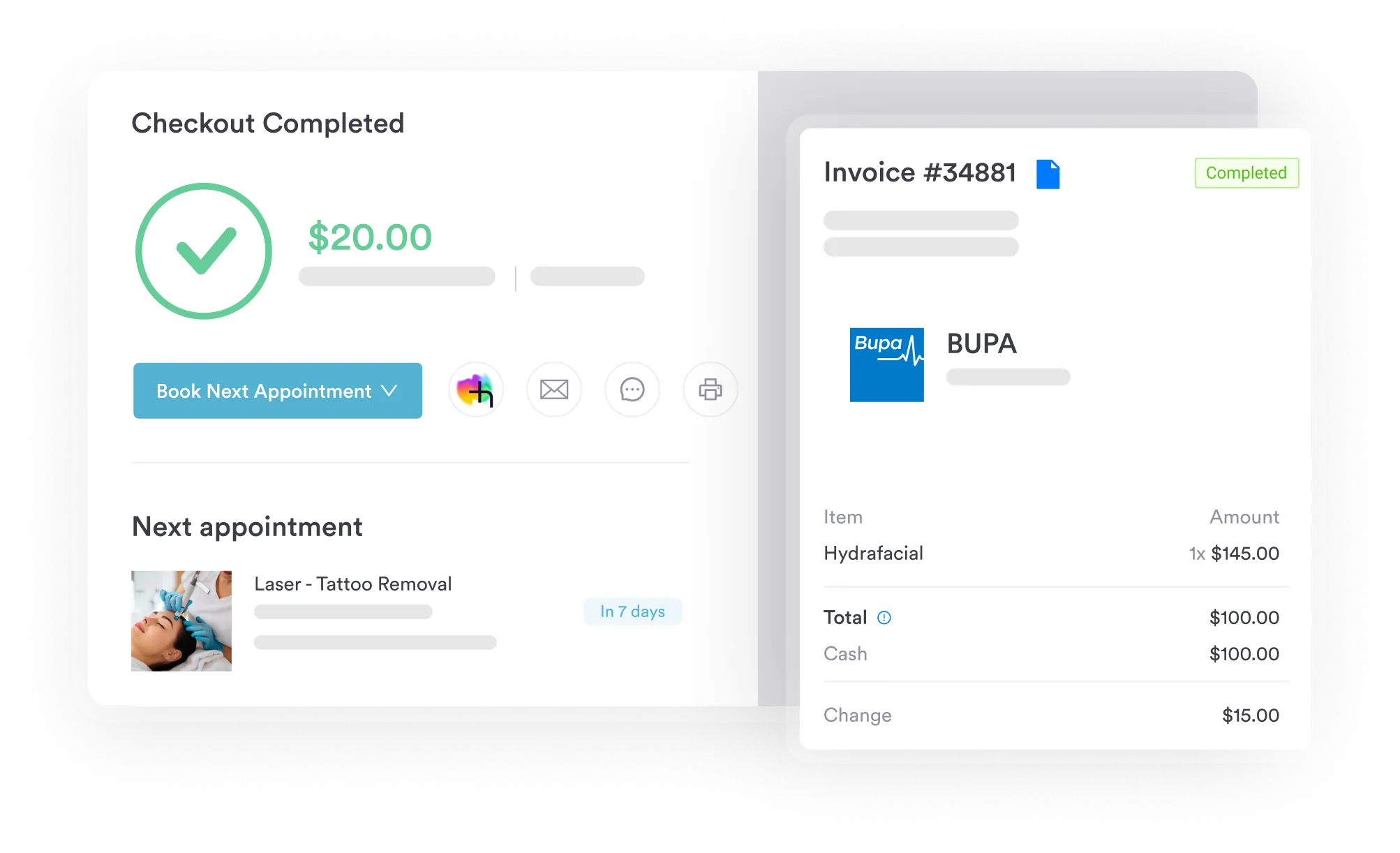
Pabau claims management screen for building and sending an insurance claim
Pabau’s claims screen fills the claim form from the patient record and holds it until required fields, such as the authorization number, are complete.

In the US, claims go out through Claim.MD, with eligibility checks before the visit and electronic remittances after it. Pabau holds the claim until required fields, such as the authorization number, are filled in. Your team then tracks each claim’s status in one list.

Send complete DME claims the first time

Pabau fills the claim form from the patient record, checks required fields before it sends, and tracks each claim through to payment.

Pabau claims management dashboard

Conclusion

K0900 rewards suppliers who code from the item, not from the price. Before you reach for it, rule out a specific code, the wheelchair codes and E1399. Most errors on this code start with skipping that step.

When an item does qualify, the claim stands on your records. A tight written order, a detailed product description and honest cost records give the DME MAC something to price. Without them, a well-built item can still be paid poorly or not at all.

Book a demo to see how Pabau keeps the order, authorization and claim together, so K0900 claims go out complete.

Continue your research

Continue your research

Need a foundation in DME billing workflows? Medical billing fundamentals covers the end-to-end claims process from encounter through payment posting.

Struggling with claim rejections on DME codes? Denial codes in medical billing explains common CARC and RARC codes and how to respond to each.

Want to reduce prior-auth delays on customized equipment? Insurance eligibility verification workflows outlines how to confirm coverage and authorization status before fabrication begins.

Billing a custom wheelchair base instead? HCPCS code K0008 covers the custom manual wheelchair base that K0900 excludes.

Frequently asked questions

Can K0900 be billed as a rental?

No. Medicare pays for a customized item as a lump-sum purchase under 42 CFR 414.224(b). Bill it with NU for a new item, not RR.

Is K0900 a not otherwise classified code?

No. It’s reserved for items that meet the federal definition of customized. The not otherwise classified code for DME is E1399.

When did K0900 take effect?

July 1, 2013. CMS added it through Change Request 8158, alongside K0008 for custom manual wheelchair bases and K0013 for custom power bases.

Should a custom wheelchair seat cushion be billed as K0900?

No. The descriptor excludes wheelchairs, and a custom-fabricated wheelchair seat cushion has its own code, E2609.

Do custom-molded orthotics go under K0900?

No. Custom orthoses already have specific L-codes, and K0900 only applies when no specific code describes the item.
Avatar photo
Monika Lazarevska
Content Writer

Monika Lazarevska writes content for owners and healthcare professionals who want clear, no-fluff content that actually helps them run their practice better. With a background in storytelling and SEO, she knows how to make even the driest topics worth reading. Off the clock, you'll find her in a café somewhere in Europe, probably with a good book and an even better coffee.
×