HCPCS Code Q4175: Billing, coverage, and documentation guide
HCPCS Code Q4175: Code Description and Product Identity HCPCS Code Q4175 is the ...

Last Updated: Nov 20, 2026
L1085 is the HCPCS Level II code for a bilateral outrigger with vertical extensions added to a cervical-thoracic-lumbar-sacral orthosis (CTLSO) or scoliosis orthosis. It is one of the L1010 to L1120 additions to the Milwaukee-type brace billed as L1000.
The outrigger is only payable when L1000 is on the same claim, and the fitting note has to say bilateral with vertical extensions. A single outrigger is coded as L1080, and L1085 is never a knee orthosis code.
Let Pabau's smart automation suggest the right codes, reduce claim denials, and keep your practice compliant—effortlessly.
Automate repetitive tasks and focus on what matters most—your patients.
Reduce coding errors and ensure compliance with the latest regulations.
Clean claims, fewer denials, and faster reimbursements.
Powerful insights and reporting to help your practice thrive.
HIPAA compliant SOC 2 certified GDPR-compliant Trusted by 4,000+ clinics worldwide

HCPCS code L1085 bills a bilateral outrigger with vertical extensions added to a cervical-thoracic-lumbar-sacral orthosis (CTLSO), the Milwaukee-type scoliosis brace.
It is not a knee orthosis code, so a knee brace billed as L1085 will not match the device or the claim.
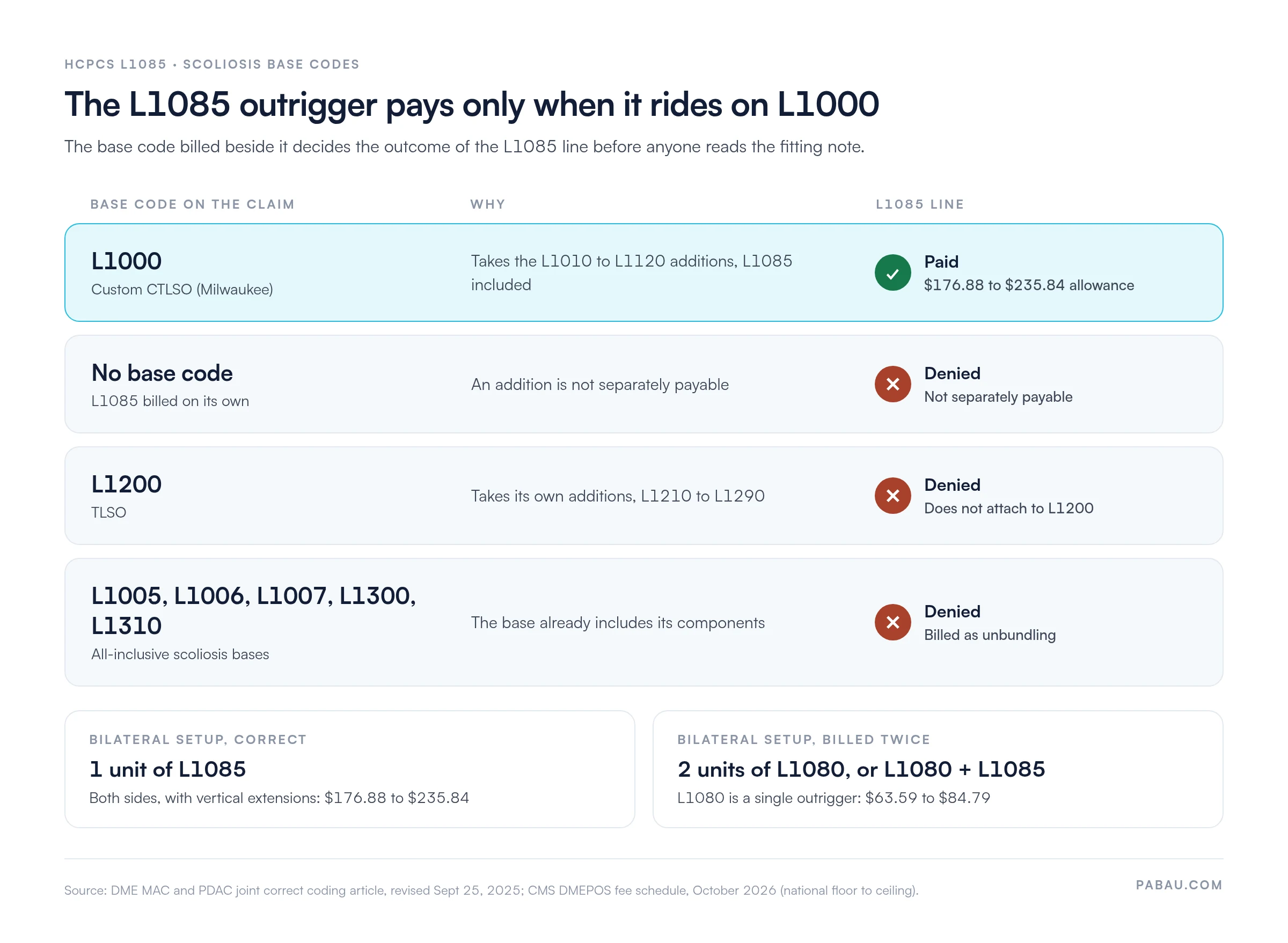
L1085 is an addition, so the DME MAC denies it as not separately payable unless base code L1000 is on the same claim.
The descriptor already covers both sides, so the line takes no RT or LT, and no LCD applies, so it takes no KX.
The October 2026 DMEPOS fee schedule sets the L1085 allowance between a $176.88 floor and a $235.84 ceiling.
HCPCS code L1085 bills a bilateral outrigger with vertical extensions added to a Milwaukee-type CTLSO or scoliosis orthosis.
The DME MAC and PDAC coding article lists it among the L1000 additions as “Addition to CTLSO or scoliosis orthosis, outrigger, bilateral with vertical extensions.” It describes one component of a brace, never a brace on its own.
The code sits in the L1010 to L1120 group of additions to the L1000 Milwaukee brace. The Centers for Medicare and Medicaid Services (CMS) maintains it in the HCPCS Level II set. Orthotists and DMEPOS suppliers bill it to the DME Medicare Administrative Contractor (MAC) for the patient’s home state.
The descriptor names the component, its two sides and its vertical extensions, but not how it is built. That detail has to come from the orthotist’s fitting note. It is also what separates L1085 from L1080, the single outrigger one code below it.
Descriptor wording from AAPC Codify, which files L1085 under Scoliosis Orthotic Devices, L1000 to L1120. Allowances from the CMS DMEPOS fee schedule for October 2026.
Some coding references describe L1085 as a prefabricated rigid knee orthosis without joints. That description is wrong, and a claim built on it will not match the device.
Knee orthoses are coded from their own range, L1810 to L1860. If the order describes a knee brace, L1085 is the wrong code, and the line has no L1000 to attach to. The DME MAC denies it, and the knee brace goes unpaid until it is recoded.
The same mix-up spreads to the neighbors. L1080 is a single outrigger, not a custom knee orthosis. L1090 is a lumbar sling, and L1100 and L1110 are ring flanges for the neck ring.
Two codes describe outriggers on a Milwaukee brace. They are the pair most often swapped on an L1085 line, and they do not pay the same.
The descriptor decides the code. L1085 already covers both sides, so it bills as one unit. Two units of L1080 for a bilateral setup, or L1080 beside L1085 for the same outriggers, bills the component twice. Confirm unusual configurations with the PDAC HCPCS helpline before you submit.
The rest of the L1010 to L1120 group sits elsewhere on the brace:
L1085 shares the frame with the L1080 outrigger and the L1120 upright cover, so the fitting note decides between them.
The DME MACs and the Pricing, Data Analysis and Coding (PDAC) contractor recognize seven scoliosis base codes. Their joint correct coding article, revised September 25, 2025, splits them three ways:
Billed without L1000, the L1085 line is denied as not separately payable. The same article bars L0999 and L1499 for any component with its own code. An outrigger never goes out as a not otherwise specified line. The chart below maps each base code to what happens to the L1085 line.
Our L1000 guide covers the base brace and its allowance.
On a clean claim, the outrigger travels with the brace at every step. Here is the order of events a biller should expect:
Here is how that looks on one claim. A teenager with an adolescent thoracic curve, M41.124, is fitted with a Milwaukee brace and bilateral outriggers. The claim carries two lines, L1000 and L1085, both dated the fitting day and both pointing to M41.124.
Two contractors handle all four DME jurisdictions. Noridian runs Jurisdiction A in the Northeast and Jurisdiction D in the West. CGS runs Jurisdiction B in the Midwest and Jurisdiction C in the South.
L1085 is covered under the brace benefit in section 1861(s)(9) of the Social Security Act. The DME MAC processes the claim, and the DMEPOS fee schedule sets the allowance.
No Local Coverage Determination names L1085. The spinal orthosis LCD, L33790, covers prefabricated and custom TLSOs and LSOs, not scoliosis brace additions. So the DME MAC reviews the claim against the general reasonable and necessary standard, and the medical record carries the case.
L1085 is not on the CMS Required Prior Authorization List either, as of its July 29, 2026 update. The orthoses on that list are spinal, knee and ankle-foot braces, not scoliosis brace additions. Medicaid plans and commercial payers set their own rules, so check each plan’s orthotics policy at intake.
The October 2026 DMEPOS file lists L1085 in the prosthetics and orthotics (PO) category. Most state amounts sit between the national floor and ceiling, with three exceptions.
Medicare pays 80% of the lower of the billed charge or the allowance once the Part B deductible is met. The patient or a secondary payer covers the 20% coinsurance. CMS reissues the DMEPOS fee schedule each quarter, so check the current file before you quote a patient.
For scale, L1000 runs from a $2,332.97 floor to a $3,110.63 ceiling in the same file. The L1085 line is worth less than a tenth of the brace, which is why it is so often dropped or miscoded.
Most of the modifiers on a knee orthosis claim have no place here. A habit carried over from knee brace billing is the usual reason an L1085 line fails.
Look for a stray RT, LT or KX first. They usually arrive from a knee orthosis claim template, and on an L1085 line they describe a device that is not there.
The ICD-10 code supports the L1000 brace and its additions together, so every line on the claim points to it. No diagnosis is tied to the outrigger itself. The code has to name the curve type and the region the radiograph shows.
Code to the region the radiograph shows. Knee codes such as M17.11 describe no spinal curve, so they cannot support a scoliosis brace. Back pain codes describe no curve either. An unspecified code such as M41.9 names no region, which leaves the reviewer guessing.
Certificates of Medical Necessity and DME Information Forms were retired for dates of service from January 1, 2023. Two documents now make the case, the standard written order and the medical record behind it.
A standard written order (SWO) has to be on file before the claim is submitted. It includes:
The order does not prove medical necessity on its own. The treating practitioner’s record has to support it, and that record is what a MAC reviewer asks for.
Ask the orthotist to use the descriptor’s own words in the fitting note: bilateral outrigger with vertical extensions. A note that just says outrigger points a reviewer to L1080, and the L1085 line then looks overcoded.
Each check below maps to a common denial on scoliosis brace claims. Hold the claim on any failed check, because a fix before submission is quicker than a redetermination.
L1085 denials usually trace back to how the claim was built. These are the six patterns to watch for.
A Medicare redetermination goes to the DME MAC within 120 days of the initial determination. A reconsideration follows with the Qualified Independent Contractor within 180 days. Send the order, clinical notes, imaging report and fitting note at each level. Our guide to denial management in healthcare covers the wider appeal workflow.
An L1085 line usually fails because its paperwork is scattered. The order arrives by fax, the radiograph report sits with the referring practice, and the fitting note stays with the orthotist.
Pabau, the practice management software we build, holds the order, the fitting note, the imaging report and the signed delivery record on one patient file. Its claims management software lets your team build the claim from that patient record, with Claim.MD electronic submission and remittance posting in the US.
The order and the fitting note sit beside the claim, so your team can check the order signature and modifiers before the claim goes out. After submission, your team tracks each claim’s status in the same system.

Pabau keeps the order, the fitting note and the proof of delivery on one patient file. L1000 and its L1085 outrigger then go out on the same claim.

HCPCS code L1085 is a scoliosis brace line, and treating it as a knee brace is the costliest mistake a biller can make with it. It pays when three facts line up: L1000 beside it, a fitting note that says bilateral with vertical extensions, and no KX, RT or LT.
So build the outriggers into the brace order at the first visit rather than adding them at billing. Our HCPCS code library covers the other L-codes a DMEPOS supplier bills. To see how Pabau keeps the order, the fitting note and the claim on one file, book a demo.

Fitting a single outrigger instead? HCPCS code L1080 covers the one-sided outrigger addition.
Billing the brace the outrigger attaches to? HCPCS code L1000 covers the Milwaukee CTLSO base code and its allowance.
Adding a lumbar sling to the same brace? HCPCS code L1090 covers the lumbar sling addition.
Billing an axilla sling on the same CTLSO? HCPCS code L1010 explains how that addition is coded.
Working a run of denied L-code claims? Denial management in healthcare covers root-cause analysis and appeal workflows.
No. L1085 is an addition to a cervical-thoracic-lumbar-sacral orthosis (CTLSO) or scoliosis orthosis: a bilateral outrigger with vertical extensions. Knee orthoses are coded from L1810 to L1860, so a knee brace billed as L1085 is miscoded.
L1080 is a single outrigger on a Milwaukee-type brace. L1085 is a bilateral outrigger with vertical extensions, so it already covers both sides. A bilateral setup bills as one unit of L1085, not two units of L1080.
No. The DME MACs deny L1010 to L1120 additions as not separately payable unless the L1000 base brace is on the same claim. L1085 does not attach to L1200 or to the all-inclusive scoliosis base codes.
No. The descriptor already says bilateral, and a CTLSO is one midline device, so laterality does not apply. No LCD covers L1085, so KX has no criteria to attest to.
The October 2026 DMEPOS fee schedule sets L1085 between a $176.88 floor and a $235.84 ceiling. Alaska, Hawaii and Puerto Rico have their own amounts. Medicare pays 80% of the allowance once the Part B deductible is met.
Not from Medicare. L1085 is not on the CMS Required Prior Authorization List as of its July 29, 2026 update. Medicaid plans and commercial payers set their own rules, so check each plan at intake.