CPT Code 62284: Injection procedure for myelography
CPT Code 62284: official descriptor and procedure overview The American Medical ...

Last Updated: Oct 19, 2026
K0553 is the HCPCS Level II code for supply allowance for therapeutic continuous glucose monitor (cgm), includes all supplies and accessories, 1 month supply = 1 unit of service. CMS terminated it with effect from 31 December 2022, so it is no longer valid for claims after that date.
HCPCS code K0553 described a monthly supply allowance for a therapeutic continuous glucose monitor (CGM) that was non-adjunctive and non-implanted. The code bundled every supply and accessory into a single monthly billing unit, where one unit of service equaled one month of supply. CMS discontinued K0553 effective December 31, 2022.
The code fell under the K-series of HCPCS Level II, which CMS uses for DME items not classified elsewhere. The restructuring did not retire the whole series, and codes such as K0744 are still active. The CMS HCPCS program maintains the Level II code set and publishes quarterly updates that list every addition, revision, and deletion.
Let Pabau's smart automation suggest the right codes, reduce claim denials, and keep your practice compliant—effortlessly.
Automate repetitive tasks and focus on what matters most—your patients.
Reduce coding errors and ensure compliance with the latest regulations.
Clean claims, fewer denials, and faster reimbursements.
Powerful insights and reporting to help your practice thrive.
HIPAA compliant SOC 2 certified GDPR-compliant Trusted by 4,000+ clinics worldwide

HCPCS code K0553 covered the monthly supply allowance for a therapeutic, non-adjunctive, non-implanted CGM under the Medicare Part B DME benefit. CMS discontinued it effective 12/31/2022.
For dates of service on or after 1/1/2023, bill E2103 for the non-adjunctive monitor or receiver and A4239 for the monthly supply allowance.
E2103 is the non-adjunctive code, not an adjunctive one. Adjunctive devices use a separate set, E2102 for the monitor and A4238 for supplies, and both require the KF modifier.
K0554, the dedicated receiver code for therapeutic CGM systems, was discontinued alongside K0553. It is deleted, not active, and E2103 replaced it.
Only enrolled DMEPOS suppliers may bill CGM supply allowances. A written order from the treating practitioner and a supporting diabetes diagnosis code are required on every claim.
Pabau’s claims management software helps DMEPOS billing teams track active HCPCS codes, flag deleted codes before submission, and maintain compliant documentation records.
CMS restructured CGM supply coding to separate therapeutic (non-adjunctive) devices from adjunctive ones. A non-adjunctive CGM is FDA-cleared for insulin dosing without a confirmatory fingerstick, which changes its coverage classification under the Medicare Part B DME benefit. The K-series codes did not carry that distinction, so CMS retired them and issued replacements in the A and E series.
K0553 did not go alone. Its companion code K0554, “Receiver (monitor), dedicated, for use with therapeutic glucose continuous monitor system,” was discontinued on the same date. Both described therapeutic, non-adjunctive equipment, and neither ever applied to an adjunctive device.
The transition runs on dates of service, not submission dates. K0553 and K0554 are valid only for dates of service through December 31, 2022. For dates of service on or after January 1, 2023, suppliers bill E2103 and A4239 instead. Submission timing is a separate deadline, because timely filing limits also run from the date of service.
Claims that still carry K0553 are denied automatically. There is no appeal pathway for a code CMS has discontinued, so the fix is a code-master update rather than a redetermination request.
Choosing the right replacement depends on two variables. The first is whether the device is adjunctive or non-adjunctive. The second is whether you are billing the monitor itself or the monthly supplies. The table below maps each scenario to the correct active code. Descriptors come from the CMS HCPCS file and the DME MAC Glucose Monitor policy article.
E2103 and A4239 are the non-adjunctive pair, and that is where most former K0553 claims land. Non-adjunctive devices such as the Dexcom G6 and G7 and the FreeStyle Libre 3 are FDA-cleared to replace fingerstick testing for treatment decisions. That clearance is what puts them on the therapeutic CGM coverage pathway under Medicare Part B.
A4239 is an all-inclusive allowance, and that scope decides what else you can bill. One unit covers the sensor, the transmitter, the batteries, and the home glucose meter supplies the patient still uses. Billing A4253 or E0607 alongside it duplicates what the allowance already pays for.
E2102 and A4238 cover the other side. An adjunctive CGM still requires a confirmatory fingerstick before an insulin dose, and the FDA classifies these devices as Class III. Every claim for E2102 or A4238 needs the KF modifier. Systems that fall outside the DME benefit entirely are coded under A9278.
Contact the PDAC (Pricing, Data Analysis and Coding contractor) before you bill any CGM supply code. Do this whenever you are unsure whether the device is adjunctive or non-adjunctive. PDAC issues coding verification letters that protect suppliers from post-payment audits. The CGS Medicare Coding Verification page lists current verification guidance for DME suppliers.
Medicare Part B covers therapeutic CGM supplies under the DME benefit, governed by Local Coverage Determination L33822 (Glucose Monitors). Coverage for the active replacement codes, E2103 and A4239, requires all of the following conditions to be met before the first claim is submitted.
Practices treating diabetes carry the documentation load these coverage rules create. That is the workflow metabolic health EMR software is built around. Weight management programs that add CGM monitoring face the same order and delivery record-keeping, so weight loss clinic software has to store both.
Every CGM supply claim requires a diabetes mellitus ICD-10-CM code that establishes medical necessity. The table below lists commonly used codes. Note that only specific codes are accepted under LCD L33822; submitting an unspecified or unsupported code is a common denial trigger.
Cross-reference your patient’s specific diabetes code against LCD L33822 before you submit. An unspecified diabetes code is one of the most preventable denials in CGM billing, so it belongs on your denial management checklist.
Every CGM claim carries at least one modifier, and the DME MACs reject claims that arrive without one. Which modifier you append depends on the beneficiary’s insulin status and on the FDA class of the device.
KX and KS are mutually exclusive on the same claim line. Pick the one that matches the documented treatment plan, then update it whenever the patient’s insulin status changes. A stale KX on a patient who has come off insulin is a recoupment risk on audit. The same KX logic runs through other DMEPOS policies, including orthotic codes such as L0636.
Medicare pays E2103 and A4239 from the DMEPOS fee schedule, not the physician fee schedule. There is no single national rate. Allowables are set by state and jurisdiction, and CMS revises them through quarterly update files.
Do not quote a rate from a third-party lookup site. The CMS fee schedule file is the only source that reflects the current quarter, and it is free to download.
These guidelines applied to K0553 when it was active and continue to apply to its replacement codes. The core billing rules did not change with the restructuring, only the codes themselves.
Missing or incomplete documentation is the second most common denial reason after billing a deleted code. The practitioner order and delivery records must be in the supplier’s file before the claim is submitted, not after a denial triggers a records request.
Using digital intake forms helps DMEPOS suppliers build a timestamped, auditable paper trail for every order element listed above. Storage and access controls matter just as much. An audit request asks for records on a deadline, and a paper file in a back office rarely meets it.
The Noridian MAC published billing articles specifically on CGM supply coding before K0553 was retired. The denial patterns they identified continue to recur with the replacement codes, which is why they belong in your medical billing compliance review. Here are the most frequent errors, verified across multiple MAC sources.
An HCPCS lookup tool lets billers confirm active code status before submission, which avoids the deleted-code denial entirely. When a claim does come back rejected, the remittance carries a reason code, and our guide to denial codes explains how to read it.
HCPCS codes like E2103 and A4239 handle the equipment side of CGM billing. The clinical services associated with CGM, including sensor placement, patient training, and data interpretation, are billed using CPT codes. These are typically billed by the treating physician or practitioner, not the DMEPOS supplier.
CPT 95250 covers the sensor placement, calibration, and training service. CPT 95251 covers analysis of the CGM data, billed once per calendar month. Both are distinct from the HCPCS supply codes and cannot be billed by the DMEPOS supplier in most cases. Practices billing both sides of CGM need the physician component and the supply component on separate claims, under the correct NPI and benefit category.
Diabetes self-management training is a third billing lane again. Individual sessions are reported under reported under G0108, which sits outside both the CPT interpretation codes and the DMEPOS supply codes. It carries its own coverage rules and its own frequency limits, so it never rides along on a CGM supply claim.
Denial prevention in CGM billing comes down to three things. You need the correct active code, the documentation in place before the claim goes out, and payer-specific requirements checked before submission. Billing teams already know these rules. The failures happen when the system does not enforce them at the point of claim creation.
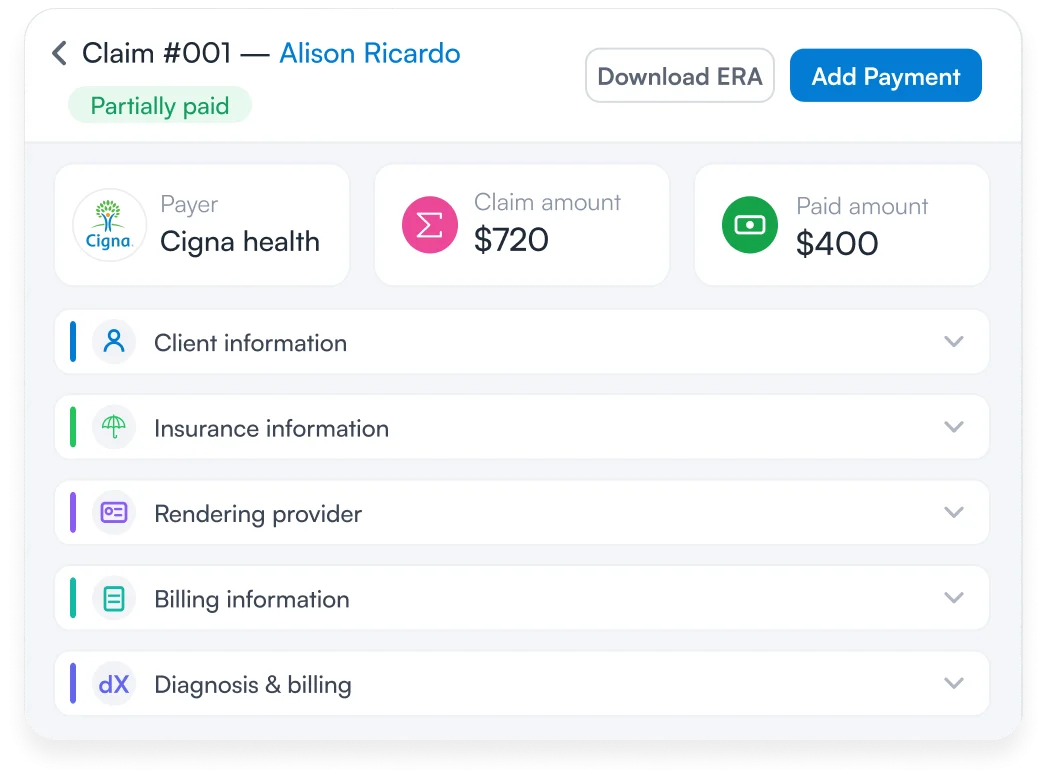
Practice management software like Pabau gives billing teams a structured environment for this work. Our claims management software tracks claim status, holds documentation checklists against each order, and flags problems before submission. A deleted code such as K0553 then gets caught in your own system, rather than by a payer rejection three weeks later.
The Claim.MD integration submits those claims electronically and returns the payer response into the same record. Connecting the clinical note to the billing workflow also shortens the distance between the practitioner order and the supplier claim. That handoff is where CGM documentation usually falls down.
The practice management software layer ties scheduling, clinical notes, and billing into one auditable workflow. That matters when a practice bills both CPT service codes and DMEPOS supply codes for the same patients. Recurring monthly claims also benefit from automated refill-confirmation prompts, which is one of the most common CGM audit findings.
Run a monthly audit of your active HCPCS codes against the CMS quarterly update files. CMS publishes additions, revisions, and deletions four times a year. A deleted code that stays in your billing system is a claim denial waiting to happen. Set a calendar reminder to cross-reference your code master list against each CMS HCPCS quarterly release.

Pabau’s claims management tools help DMEPOS billing teams flag deleted HCPCS codes, maintain compliant documentation workflows, and track claim status across payers. See how it works for your practice.

HCPCS code K0553 is no longer billable. CMS discontinued it effective December 31, 2022, along with its companion receiver code K0554. For dates of service on or after January 1, 2023, a non-adjunctive CGM uses two codes. E2103 covers the monitor or receiver, and A4239 covers the monthly supply allowance.
Adjunctive devices are a different code set entirely. Those claims use E2102 for the monitor and A4238 for the supply allowance, and both require the KF modifier. Neither E2103 nor K0554 ever described an adjunctive device.
Getting CGM billing right comes down to three habits. Match the device’s classification to the correct code. Keep the order and delivery file complete before submission. Confirm DMEPOS enrollment for every billing NPI, every quarter. Book a demo to see how Pabau keeps claim documentation and code status in one auditable place.

Billing the fingerstick supplies alongside a CGM? HCPCS code A4259 explains when lancets and related diabetic testing supplies are separately payable and when an allowance already covers them.
Billing a CGM that falls outside the DME benefit? HCPCS code A9278 explains how external CGM receiver billing works when the system does not meet Medicare’s durable medical equipment definition.
Billing diabetes education alongside the supplies? HCPCS code G0109 covers group self-management training, its frequency limits, and how it stays separate from the DMEPOS claim.
Coding a drowning sequela case instead? Drowning sequela coding guide covers the sequela code for drowning after a fall or jump from a burning passenger ship.
Coding an unusual sequela injury instead? Hang-glider crash coding guide covers the sequela code for treating a residual condition after a hang-glider crash has already healed.
HCPCS code K0553 was a HCPCS Level II code for the monthly supply allowance for a therapeutic, non-adjunctive, non-implanted continuous glucose monitor (CGM). One unit of service equaled one month of supply. CMS discontinued the code effective December 31, 2022, and claims submitted under it are now denied.
K0553 was discontinued effective December 31, 2022, which is its last valid date of service. For dates of service on or after January 1, 2023, suppliers must bill E2103 and A4239 instead. The companion receiver code K0554 was discontinued on the same date.
E2103 and A4239 replaced K0553 for non-adjunctive CGM. E2103 covers the non-adjunctive, non-implanted monitor or receiver, and A4239 covers the monthly supply allowance at one unit per 30 days. Adjunctive devices are billed separately under E2102 and A4238, and both of those codes require the KF modifier.
E2103 is the non-adjunctive code. Its official long descriptor is “Non-adjunctive, non-implanted continuous glucose monitor or receiver,” so it applies to devices cleared for insulin dosing without a confirmatory fingerstick. The adjunctive equivalent is E2102, and its matching supply allowance is A4238.
No. K0554 described a dedicated receiver for a therapeutic, meaning non-adjunctive, glucose continuous monitor system. It was discontinued effective December 31, 2022, at the same time as K0553. E2103 is the replacement code for dates of service on or after January 1, 2023.
A4239 is the active replacement for the deleted K0553. Both codes describe a monthly supply allowance for a non-adjunctive CGM, with one unit of service per month. The functional difference is billability. A4239 is payable for dates of service on or after January 1, 2023, and K0553 is not payable at all.
Medicare no longer covers claims billed under K0553 because the code was discontinued on December 31, 2022. Part B covers CGM under E2103 and A4239 through the DME benefit, subject to LCD L33822 criteria. Those criteria include a diabetes diagnosis, a written practitioner order, non-adjunctive device classification, and DMEPOS supplier enrollment.
A non-adjunctive CGM is an FDA-cleared device that patients can use to make insulin dosing decisions without a confirmatory fingerstick blood glucose test. Devices like the Dexcom G6, G7, and FreeStyle Libre 3 meet this classification. Adjunctive CGMs still require a fingerstick to confirm readings before an insulin dose.