CCSD Code E1920: Partial pharyngectomy billing guide
CCSD Code E1920: definition and clinical scope CCSD Code E1920 is the billable p...

Last Updated: Oct 19, 2026
G0109 is the HCPCS Level II code for diabetes outpatient self-management training services, group session (2 or more), per 30 minutes.
Coverage rests on three things. The program must hold ADA recognition or ADCES accreditation, a signed physician referral must be on file, and the beneficiary must have training hours left.
Let Pabau's smart automation suggest the right codes, reduce claim denials, and keep your practice compliant—effortlessly.
Automate repetitive tasks and focus on what matters most—your patients.
Reduce coding errors and ensure compliance with the latest regulations.
Clean claims, fewer denials, and faster reimbursements.
Powerful insights and reporting to help your practice thrive.
HIPAA compliant SOC 2 certified GDPR-compliant Trusted by 4,000+ clinics worldwide

HCPCS Code G0109 covers diabetes outpatient self-management training, or DSMT, for a group of 2 or more Medicare beneficiaries.
One unit of G0109 is one 30-minute increment of group instruction, billed to Medicare Part B.
Providers must work through an ADA-recognized or ADCES-accredited DSMT program. Billing without accreditation results in an automatic denial.
Medicare Part B covers 10 hours of initial DSMT, then 2 hours of follow-up training each year after that.
Practice management software like Pabau keeps referrals, attendance, and session notes in one client record, so DSMT hours are easy to total before billing.
G0109 describes diabetes outpatient self-management training provided in a group setting of 2 or more beneficiaries. It is a G-code maintained by the Centers for Medicare and Medicaid Services (CMS) under the HCPCS Level II classification. One unit equals one 30-minute increment of group instruction time.
Coverage authority comes from Section 1861(qq) of the Social Security Act and is governed by National Coverage Determination 40.1. The code became effective alongside NCD 40.1 and applies to Medicare Part B claims across all settings where accredited DSMT programs operate.
G0108 and G0109 and G0109 are the two codes used to bill Medicare for all DSMT services. G0108 covers individual sessions with one patient and one educator. G0109 covers group sessions with at least 2 beneficiaries present at the same time. Patient attendance patterns and scheduling usually decide which code applies on a given date of service.
G0108 and G0109 are not billed on the same date of service for the same beneficiary. If a patient joins a group session and also receives individual instruction, document both. Bill the format that accounts for most of the time. Check your Medicare Administrative Contractor (MAC) policy before splitting one day across both codes.
CMS covers G0109 under Medicare Part B when all four eligibility criteria are met. One missing element is enough for a full claim denial. An unsigned referral, an expired accreditation, or a non-covered diagnosis code will each do it. Metabolic health programs and endocrinology practices run most DSMT groups, so they absorb most of these denials.
Part B cost-sharing applies. Medicare pays 80% of the approved amount after the beneficiary meets the Part B deductible. The remaining 20% falls to the patient unless they carry a supplemental policy. An eligibility check before the first session tells you which of those applies.
Accreditation is the hardest requirement to fix after the fact. Billing G0109 through an unrecognized program results in denial no matter how complete the documentation is. CMS requires the furnishing entity to hold valid recognition, not just the educator who teaches the session. ADCES was formerly the American Association of Diabetes Educators, so older certificates may still carry that name.
Both pathways require program-level applications, educator credential verification, and periodic renewal. Compliance documentation for the accreditation itself, including the approval certificate and expiration date, must be available during claims audits. Calendar your renewal dates at least six months ahead. If recognition lapses, every DSMT claim dated during the lapse becomes unbillable.
Each unit of G0109 represents one 30-minute increment. A 60-minute group session bills as 2 units, and a 90-minute session bills as 3 units. At least 2 beneficiaries must be present for the entire claimed duration. Weight management practices running group education tend to schedule 60- or 90-minute blocks, which keeps unit counting simple but demands careful attendance records.
Place of service codes matter for payment. Use POS 22 (Outpatient Hospital) or POS 11 (Office) for in-person group sessions. For telehealth delivery, use POS 02 (Telehealth, other than patient’s home) or POS 10 (Telehealth, patient’s home). Claims submitted with an incorrect POS code often process with a lower allowed amount or reject outright.
CMS and MACs expect a specific documentation package for every G0109 claim. Missing any element creates an audit liability even when the claim initially pays. Digital intake forms and session-specific chart templates help practices capture every required element at the point of service, rather than rebuilding it at billing time.
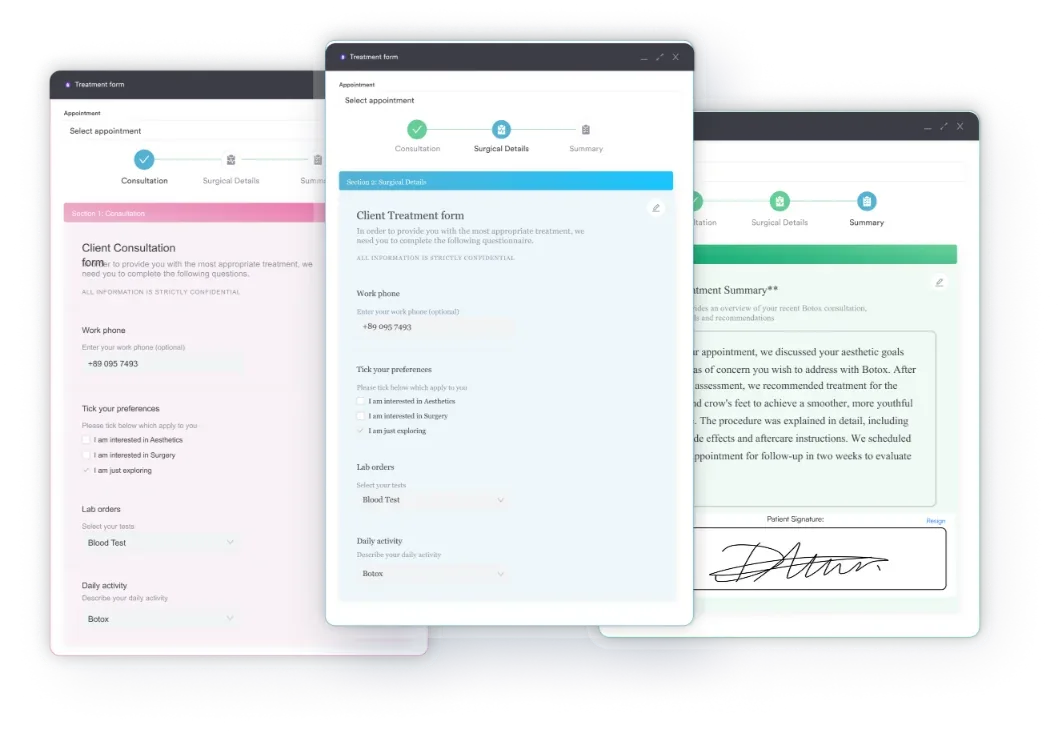
Standardized session documentation templates reduce the risk of incomplete records during retrospective audits. Keep all G0109 documentation for a minimum of seven years to satisfy CMS record retention requirements.
Track each beneficiary’s cumulative DSMT hours across their initial 12-month period, counted from the first session. A patient who has attended 8 hours of group sessions has only 2 hours of initial coverage left. Billing a 2-unit session when 1 unit remains produces a partial denial and a manual adjustment.
G0109 claims require a covered ICD-10 diagnosis code. Medicare will deny claims submitted with a non-covered diagnosis, even when every other criterion is met. The covered codes fall primarily in the E10-E13 range. Practices billing DSMT codes should verify covered diagnoses against their MAC’s local coverage policies, which may be more specific than the NCD.
Always code to the highest level of specificity. Diabetes codes carry no 7th character, so code to the full subcategory that names the complication, such as E11.65 for Type 2 with hyperglycemia. Unspecified codes like E11.9 are acceptable but may draw extra scrutiny during audits. Verify the covered diagnosis list against your MAC’s current local coverage determination before submitting.
Modifiers for G0109 matter mostly in telehealth contexts. In-person group sessions usually need no modifier, unless a specific MAC or payer policy asks for one. The table below covers the modifiers applied most often.
G0109 is eligible for telehealth delivery under Medicare when the session runs synchronously, with real-time two-way audio and video. Asynchronous delivery is rarely covered without specific MAC authorization. Telehealth platforms used for DSMT groups must support multi-participant video, not just one-to-one calls.
Telehealth coverage for DSMT expanded during the COVID-19 Public Health Emergency (PHE) and has been extended by later legislation. Verify current coverage with your MAC or CMS guidance for the date of service, because post-PHE extensions carry specific effective dates. The core billing requirements for telehealth G0109 claims are:
Medicare Part B pays 80% of the approved amount for G0109 after the Part B deductible. The group rate is lower than the individual rate under G0108, reflecting the shared delivery model. Payment varies by location, because CMS adjusts fee schedule rates using Geographic Practice Cost Indices (GPCIs).
Use the CMS Physician Fee Schedule lookup tool to find the current approved amount for G0109 in your locality. Enter the HCPCS code, select your MAC jurisdiction, and choose the current fee schedule year. Rates update annually on January 1. Cross-reference your MAC’s posted fee schedule, which may differ slightly from the national file. For a broader search of HCPCS Level II codes, the AAPC HCPCS code lookup pairs code descriptions with billing context.
G0109 denials cluster around six predictable mistakes. Each one comes back as a denial code you could have prevented, and an appeal costs more staff time than a pre-submission check. Billing compliance programs in practices that run DSMT groups should build a check around each error type. Denial management then means tracking which error type recurs, not treating each rejection as new.
The billing rules for G0109 are not complex on their own. The work is tracking several requirements at once, across a group of patients who each sit at a different point in their 10-hour initial training. Manual spreadsheets break down once a practice runs four to six group sessions a week.
Practice management software like Pabau keeps the whole record in one place. Each group session is a booked appointment with a service and a duration. The signed referral is stored on the patient’s file, and the session note sits alongside both.
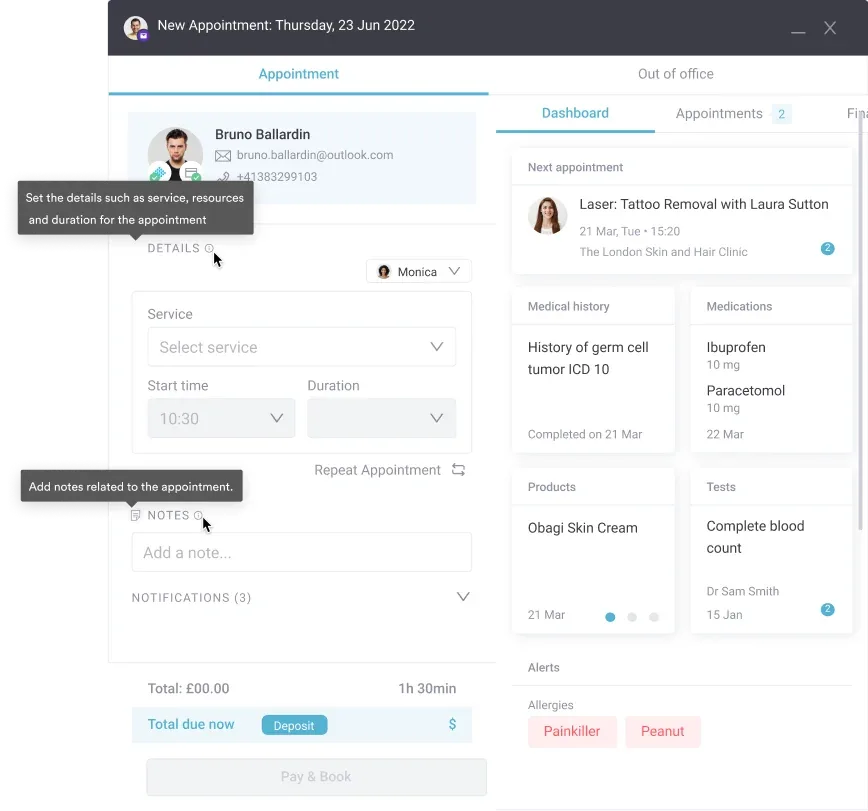
From there, Pabau’s claims management software carries the HCPCS code and the stored documentation from the patient record into the claim. Automated billing workflows handle the repetitive steps around it, so nobody is retyping session details at submission time.
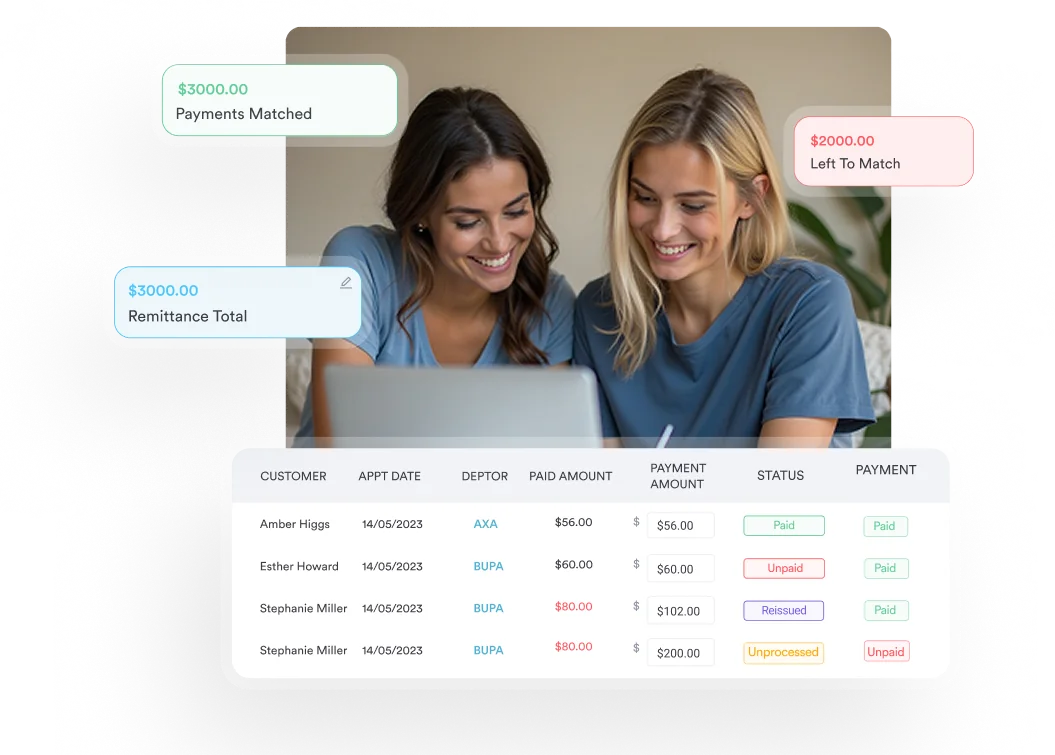
The outcome is a shorter distance between the session and the claim. Attendance, referral, and hour totals sit in the record your biller is already reading. That is most of what it takes to send a clean claim first time.
Set a recurring calendar alert 90 days before your ADA or ADCES accreditation renewal deadline. A lapse in program recognition makes every G0109 claim unbillable while it lasts, including claims for sessions that were compliant in every other respect.

Pabau keeps referrals, attendance, and session notes in one client record, so your billing team can check DSMT hours and submit cleaner claims. See how it works for your practice.

The rules that sink a G0109 claim are administrative rather than clinical. Keep the accreditation current, file the referral before the first session, and know each patient’s remaining hours. Do those three things and you will rarely lose a claim on this code.
So the work is front-loaded. Put the checks where the session is booked and the patient is charted, and billing becomes a formality instead of a monthly cleanup. The alternative is finding out at the appeal stage, which costs more staff time than the payment is worth.
Pabau keeps DSMT referrals, attendance, and hour totals in the client record your billing team already works from. Book a demo to see how that shortens the path from a group session to a paid claim.

Also billing foot care for the same patients? G0247 covers routine foot care for diabetic patients with a documented loss of protective sensation.
Billing a sternum fracture treatment? CPT code 21820 covers closed treatment of a sternum fracture without manipulation.
Billing a back or flank tumor excision? CPT code 21931 covers subcutaneous excision of a back or flank tumor at 3 cm or greater.
Billing an extra vertebra treated? CPT code 22328 is the add-on code for each extra vertebra treated in a posterior fracture repair.
Billing an extra vertebroplasty level? CPT code 22512 is the add-on code for each additional vertebroplasty level, billed alongside 22510 or 22511.
HCPCS Code G0109 covers group diabetes outpatient self-management training (DSMT) for 2 or more Medicare beneficiaries, billed per 30-minute increment under Medicare Part B. An ADA-recognized or ADCES-accredited program must furnish it, following a physician referral.
G0108 covers individual DSMT sessions; G0109 covers group sessions of 2 or more beneficiaries. Both require accreditation and a physician referral, and count toward the same 10-hour initial and 2-hour follow-up limits. The individual code pays a higher rate.
Medicare covers up to 10 hours (20 units) of initial DSMT in the first 12 months, then 2 hours (4 units) of follow-up training each year after. G0108 and G0109 hours share the same limit; billing beyond it is denied regardless of medical necessity.
The furnishing entity must hold active recognition from the American Diabetes Association (ADA) or ADCES accreditation; individual educator credentials alone are not enough. Claims from a non-accredited program are denied and may trigger recoupment of prior payments.
Yes. G0109 is eligible for telehealth when delivered synchronously via real-time audio and video. Append modifier 95 and use POS 02 (not patient’s home) or POS 10 (patient’s home) based on the beneficiary’s location, and confirm current rules with your MAC.
Covered diagnoses include Type 1 (E10.x), Type 2 (E11.x), and other specified diabetes mellitus (E13.x), plus gestational diabetes (O24.x) and diabetes due to underlying conditions (E08.x, E09.x). Prediabetes codes like R73.03 do not qualify; always code to the highest specificity and confirm against your MAC’s coverage policy.