HCPCS Code E0272: Foam rubber mattress billing guide
HCPCS Code E0272: official descriptor and code overview HCPCS Code E0272 is the ...

Last Updated: Nov 6, 2026
J0120 is the HCPCS Level II code for injection, tetracycline, up to 250 mg. It remains active in the October 2026 CMS HCPCS file.
One billed unit covers up to 250 mg, so a 500 mg dose is two units. No injectable tetracycline is currently marketed in the US, and CMS lists no ASP payment limit for the code. Confirm which drug was given before you bill it.
Let Pabau's smart automation suggest the right codes, reduce claim denials, and keep your practice compliant—effortlessly.
Automate repetitive tasks and focus on what matters most—your patients.
Reduce coding errors and ensure compliance with the latest regulations.
Clean claims, fewer denials, and faster reimbursements.
Powerful insights and reporting to help your practice thrive.
HIPAA compliant SOC 2 certified GDPR-compliant Trusted by 4,000+ clinics worldwide

HCPCS Code J0120 covers injection, tetracycline, up to 250 mg, and is still active in the October 2026 CMS HCPCS file.
One unit covers up to 250 mg, so a 500 mg dose is two units and a 300 mg dose is also two.
Every injectable tetracycline product in the FDA’s approval database is listed as discontinued, so a J0120 claim line is rare.
J0120 has no payment limit in the October 2026 ASP file, so your Medicare contractor prices any claim that uses it.
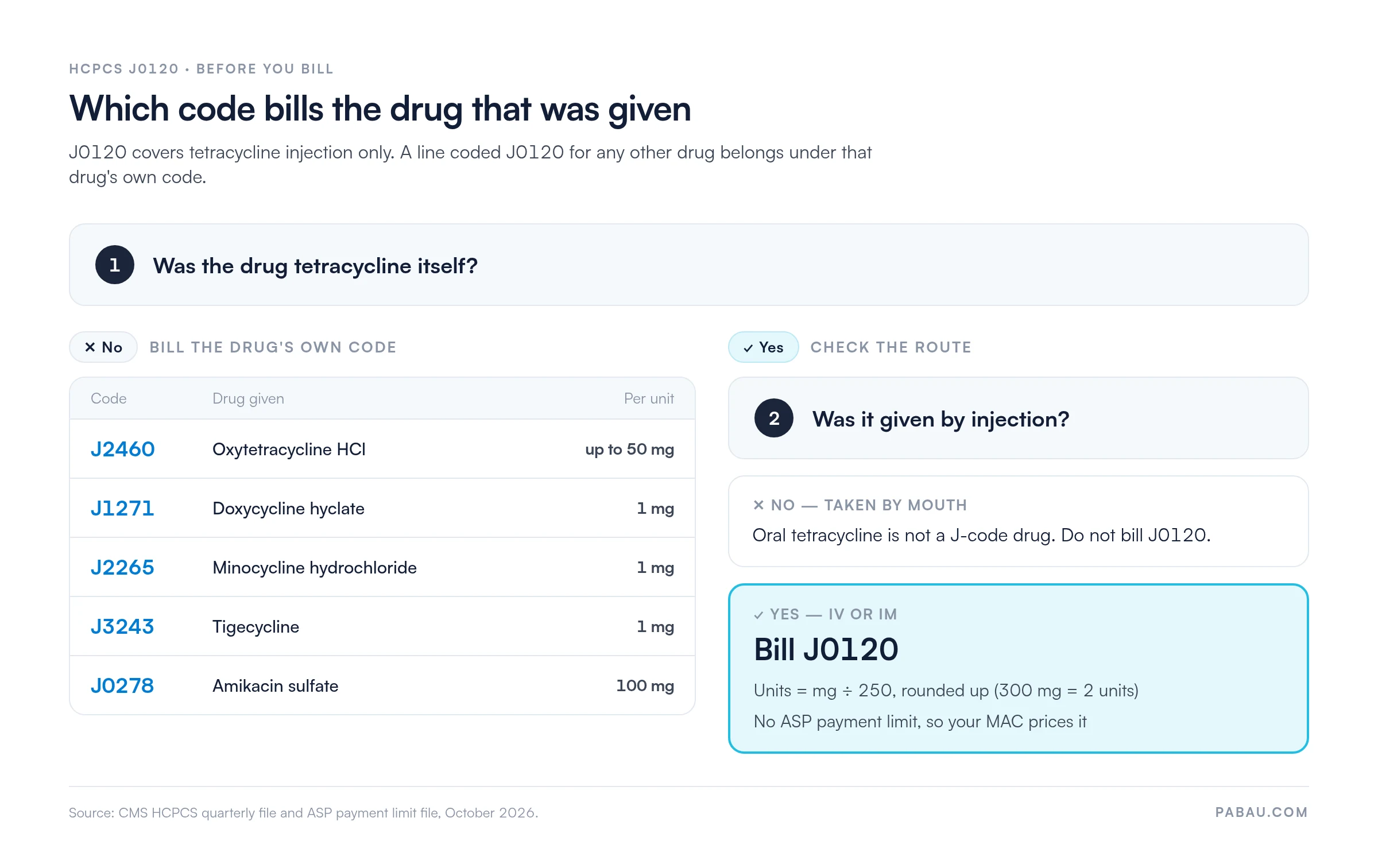
Before you bill J0120, confirm the drug given was not doxycycline, minocycline, oxytetracycline or amikacin, which each have their own codes.
HCPCS Code J0120 is the Level II code for injection, tetracycline, up to 250 mg per billed unit. Its one descriptor names tetracycline and no other drug.
Some older billing references pair J0120 with amikacin, which is wrong. Amikacin has its own code, J0278.
CMS added J0120 to the code set in 1986 and last changed its record in 2018.
The CMS HCPCS quarterly update page holds the current file, so recheck the status each quarter before you rely on it.
Tetracycline is a broad-spectrum antibiotic that US practices now give almost entirely by mouth. The injectable form has largely left the market.
The FDA’s Drugs@FDA database lists every tetracycline injection product it holds, including Achromycin and Tetracyn, as discontinued. The CMS crosswalk for October 2026 maps no NDC to J0120 either.
So the code survives in the file, but there is little to bill it for. That changes how you treat a J0120 line when one appears:
The billing mechanics are simple once the code fits. Those checks come down to two questions: was the drug tetracycline, and was it injected? The decision path below routes each drug to the code that bills it.
One unit of J0120 covers up to 250 mg of tetracycline. Payers do not accept fractional units, so any part of a 250 mg block counts as a whole unit.
Record the exact milligrams given in the note, then work out units from that figure. A note that only says “one vial” leaves a reviewer no way to check the units.
Medicare pays most Part B drugs from the quarterly average sales price (ASP) file. J0120 does not appear in the October 2026 payment limit file, so there is no national ASP amount to look up.
When a code is missing from that file, the Medicare Administrative Contractor (MAC) sets the payment. Ask your MAC how it prices J0120 before you schedule the dose. Some contractors want the invoice for the drug sent with the claim.
Check the current CMS ASP pricing files each quarter, as a code can be added in a later release. The injection service itself, such as 96372 for an intramuscular injection, is a separate line on the physician fee schedule.
Keep a note of which quarter’s ASP file you checked for J0120 and what your MAC told you. If a payment looks wrong later, you have the reference point in one place.
Because injectable tetracycline is so rare, a J0120 claim draws more scrutiny than most drug lines. The note has to show exactly what was given and why.
A complete superbill carries the code, units, diagnosis and NPI together. That keeps the claim line matched to the record behind it.
Modifiers on a J0120 line describe drug wastage or the coverage expectation. Use only the ones that match the situation.
JZ and JW only apply when the drug came from a single-dose container. Confirm how your product was supplied, then follow your MAC’s current guidance.
Most claims that land on J0120 by mistake belong under another code. Oxytetracycline bills under J2460 in units of up to 50 mg, and minocycline under J2265 per milligram. The table lists the codes coders most often confuse with J0120.
Other aminoglycosides have their own codes too. Gentamicin is J1580 and tobramycin is J3260, each billed per unit of up to 80 mg.
J3490, for unclassified drugs, is not a fallback for tetracycline. J0120 is the specific code, so use it only when tetracycline itself was given.
J0120 denials usually start with the code choice or the note. The denial codes reference explains each returned reason code.
If J0120 shows up in your claims history at all, pull those encounters and check the drug name in each note. A J0120 line on a doxycycline or amikacin dose is a coding error, not a coverage problem.
A rare code like J0120 is easy to pick by mistake. The note names one drug, and the claim codes another. Nobody spots it until the denial arrives.
In Pabau, the treatment note and the invoice sit in the same patient record. Your billing team can read the drug and dose the clinician recorded before choosing the code. Pabau’s claims management for practices then sends the insurance claim and tracks what comes back.
The outcome is fewer lines coded from memory, and a quicker answer when a payer asks what was given.

Pabau keeps treatment notes, invoices and insurance claims in one patient record. Your billing team codes from what was documented, not from memory.

J0120 is a valid code with almost no product left to bill under it. The units and modifiers are simple, so the code choice carries most of the risk.
When J0120 appears on a claim, treat it as a prompt to check the note. Most of the time, the drug given has a code of its own. Book a demo to see how Pabau keeps the treatment note and the claim line in step.

Billing the tetracycline-class drug that is still on the market? HCPCS Code J2460 covers oxytetracycline injection, its units and its pricing.
Was the antibiotic amikacin? HCPCS Code J0278 explains how to bill amikacin sulfate in 100 mg units.
Want fewer drug-line rejections overall? Clean claim best practices walks through what every claim needs before it reaches the payer.
Tracking denials across your billing workflow? Denial management in healthcare covers how to categorize and resolve them.
HCPCS Code J0120 covers injection, tetracycline, up to 250 mg per billed unit. It is a HCPCS Level II J-code for tetracycline given by injection. It does not cover amikacin, which is J0278.
Yes. J0120 is active in the October 2026 CMS HCPCS file and has no termination date. Recheck the quarterly file before billing, as codes can change.
Bill one unit for each 250 mg or part of 250 mg given. A 250 mg dose is one unit, and a 300 mg or 500 mg dose is two units.
J0120 has no payment limit in the October 2026 ASP file. Your Medicare Administrative Contractor sets the payment, so ask it before you bill.
No. Amikacin sulfate injection is J0278, billed per 100 mg. J0120 is tetracycline only, and older references that link it to amikacin are wrong.