

HCPCS code E0198: Water pressure pad billing guide
HCPCS code E0198 is a water pad for a standard mattress HCPCS code E0198 is the ...

Last Updated: Oct 13, 2026
J1580 is the HCPCS Level II code for injection, garamycin, gentamicin, up to 80 mg.
Unlike CPT codes, which the AMA maintains, HCPCS Level II J-codes come from CMS and are updated annually. J1580 sits in the J1000-J8999 drug injection series. It applies to physician-administered gentamicin in outpatient and office settings.
Let Pabau's smart automation suggest the right codes, reduce claim denials, and keep your practice compliant—effortlessly.
Automate repetitive tasks and focus on what matters most—your patients.
Reduce coding errors and ensure compliance with the latest regulations.
Clean claims, fewer denials, and faster reimbursements.
Powerful insights and reporting to help your practice thrive.
HIPAA compliant SOC 2 certified GDPR-compliant Trusted by 4,000+ clinics worldwide

HCPCS code J1580 covers injectable gentamicin sulfate up to 80 mg per unit, billed as a Level II J-code under Medicare Part B.
Medicare pays J1580 on Average Sales Price (ASP) methodology, and the ASP file changes quarterly. Check the current rate before each billing cycle.
Medicare requires the 11-digit NDC on most Part B drug claims, and a missing or wrongly padded NDC is a leading denial trigger.
Practice management software like Pabau links drug administration records to billing codes in one workflow, so dose and NDC data reach the claim unchanged.
Gentamicin sulfate is a broad-spectrum aminoglycoside antibiotic active against gram-negative organisms. Those include Pseudomonas aeruginosa, Escherichia coli, and Klebsiella species. Garamycin is the most widely recognized brand name. The drug is given parenterally, by intravenous infusion or intramuscular injection. Clinicians reserve it for serious bacterial infections where oral antibiotics fall short.
Gentamicin is physician-administered rather than self-administered, so Medicare Part B covers it under the buy-and-bill model. That applies when the drug is dispensed in an eligible outpatient setting.
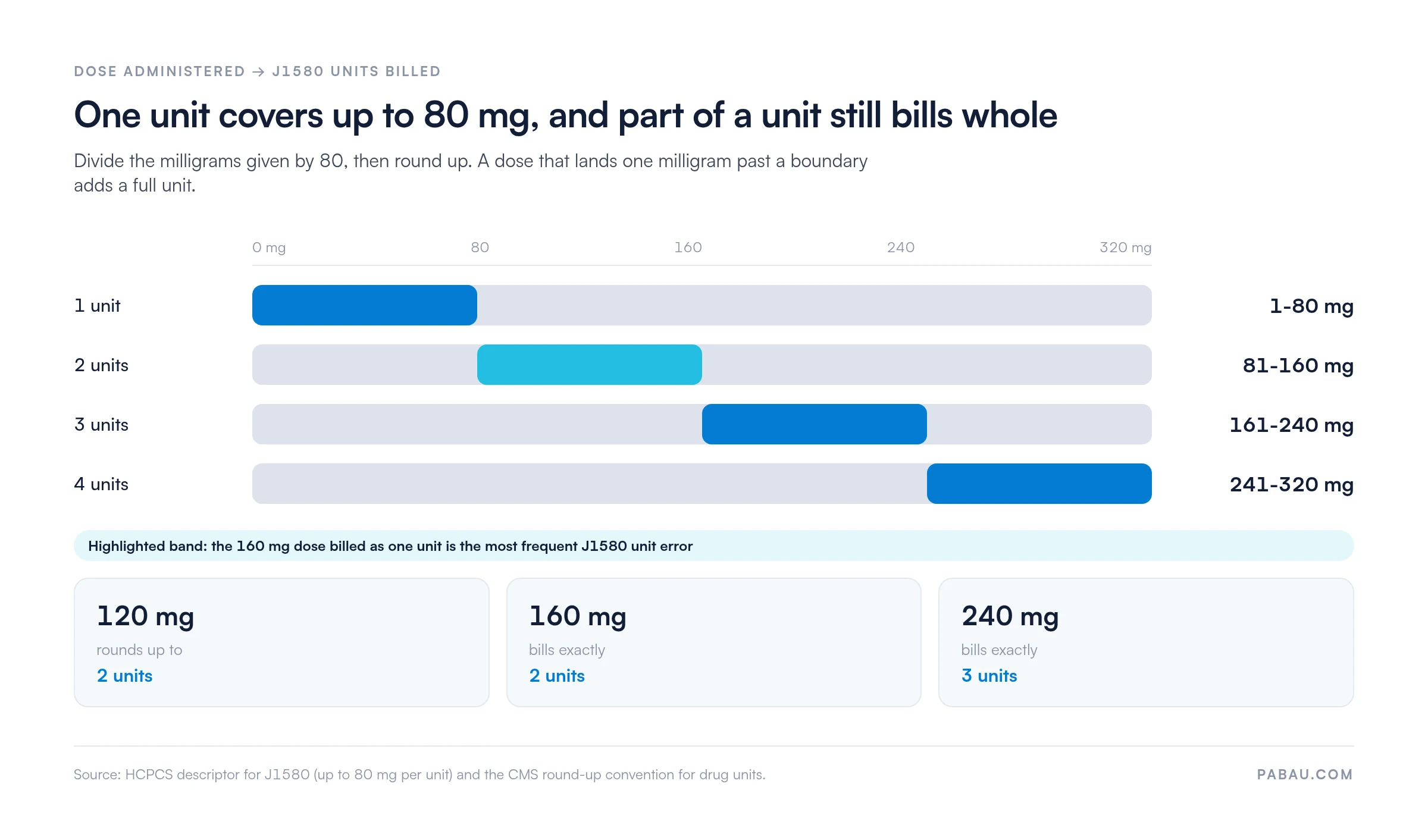
Accurate gentamicin billing starts with the unit structure. One billing unit of J1580 covers up to 80 mg. A 160 mg dose bills two units, and a 240 mg dose bills three. Always round up to the next complete unit when the dose passes a multiple of 80 mg. The bands below show where each boundary falls.
Commercial payer rules can differ from Medicare on modifier requirements, prior authorization, and covered diagnoses. Verify payer-specific policy before you submit.
Medicare Part B reimburses J1580 using Average Sales Price (ASP) methodology. In a physician office the payment rate equals ASP plus 6%. CMS refreshes ASP-based drug prices quarterly, so the allowable amount for J1580 changes four times a year. Never quote a fixed dollar amount without checking the current quarter’s CMS ASP file. Verify the rate in the CMS fee schedule lookup and the quarterly ASP drug pricing file.
Revenue cycle work on J-code drugs means tracking ASP movement quarterly and renegotiating commercial rates to match. Practices that set a drug rate once and forget it lose margin as ASP drifts. That risk is sharpest in IV therapy programs, where one drug drives most of the claim value.
Medicare Part B covers physician-administered injectable drugs that a patient cannot self-administer. Gentamicin meets that test, so it is eligible under buy-and-bill in an office or qualifying outpatient setting.
Strong medical billing compliance for J1580 comes down to one habit. Every claim links to a diagnosis that explains why the antibiotic was clinically necessary. Medicare Advantage plans may also impose prior authorization that traditional Medicare does not, so check the plan first.
The ICD-10-CM codes below are commonly paired with J1580 claims. This list is not exhaustive, and coverage depends on Local Coverage Determinations (LCDs) and payer policy. Always pick the most specific code the documentation supports.
CMS publishes no universal LCD for J1580, so coverage falls to the Medicare Administrative Contractor (MAC) in your jurisdiction. Review your MAC’s LCD for injectable antibiotics to confirm the covered indications.
The National Drug Code (NDC) crosswalk maps commercial gentamicin sulfate products to HCPCS code J1580. Medicare requires NDC data on drug claims filed on the CMS-1500 form or the electronic 837P transaction. Report the NDC in 11-digit format with the N4 qualifier, the unit of measure, and the quantity. Use ML for milliliters and UN for units.
Labelers print NDCs in three different segment layouts, and Medicare wants a single 11-digit string. Pad the short segment with a leading zero to reach the 5-4-2 pattern. A four-digit labeler code gains a zero. So does a three-digit product code, or a one-digit package code.
NDC assignments change when manufacturers alter packaging or labeling. Verify current NDC-to-HCPCS mapping against the FDA NDC Directory or the CMS NDC crosswalk file before you submit. An invalid NDC is a leading reason J1580 claims are rejected at the clearinghouse before adjudication.
Flag J1580 NDC entries in your billing system for quarterly review. CMS releases updated ASP pricing and NDC crosswalk files in January, April, July, and October. Set a calendar reminder so your team checks for changes before the new quarter’s claims go out.
Billing staff working with J1580 also need the administration codes and the unclassified-drug fallback. The table below covers the codes most often cross-referenced with J1580.
A frequent mistake is reaching for J3490 because the biller has not met J1580. Unclassified drug codes attract extra documentation requests and closer scrutiny. Use J1580 for gentamicin sulfate up to 80 mg per unit.
For programmatic lookup, the NLM Clinical Tables API offers free access to HCPCS Level II codes.
Gentamicin claims fail in a predictable pattern, and most of it is fixable at submission. Six errors account for the bulk of J1580 rework.
Weekly review of J-code denials clears them faster than a monthly batch. Steady denial management catches these six errors before they age into write-offs.
The hard part of J1580 is that accurate billing depends on data captured during the clinical encounter. That means the exact dose, the NDC from the vial administered, and the supporting diagnosis. When clinical notes live in one system and billing in another, transcription errors follow.
Practice management software like Pabau connects the drug administration record to the billing workflow in one platform. The practitioner logs the drug, dose, and NDC at the point of care. The billing team opens that same record when preparing the claim, so nothing gets retyped.
Pabau’s claims management software sends the finished claim through our Claim.MD integration, which carries the NDC and unit fields the payer expects. For practices with recurring outpatient infusion patients, the reporting tools show claim acceptance rates and reimbursement trends over time.

Pabau links drug administration records to billing codes in one platform, so dose and NDC data reach the claim unedited. See how it handles claims for physician-administered drugs.

The reimbursement figure is the part of J1580 that will not stay still. ASP moves every quarter, so any dollar amount you write down has a shelf life of three months. Build the quarterly check into your billing calendar and the rate stops being a surprise.
The rest of J1580 is unit math and an 11-digit string, and both are decided at the point of care rather than at submission. Capture the dose and the NDC while the vial is still in someone’s hand. Medical billing accuracy on drug codes depends on that timing.
To see how Pabau handles J1580 claims end to end, book a demo with our team.

Billing another Part B injectable this quarter? J1556 runs the same unit math and NDC reporting for immune globulin.
Collecting the coinsurance after Medicare pays its share? Patient payment plans shows how to stage the balance without chasing invoices.
Need the per-unit rules for a blood product instead? P9010 covers whole blood transfusion billing and the denials it attracts.
HCPCS code J1580 is used to bill for the injection of garamycin (gentamicin sulfate) up to 80 mg per unit. It is a Level II HCPCS J-code administered by CMS, and Medicare Part B covers physician-administered gentamicin in outpatient settings. Providers use it under buy-and-bill when they dispense and administer the drug in an office or qualifying outpatient facility.
Bill two units of J1580 for a 160 mg dose. Each unit covers up to 80 mg, so divide the total dose by 80 and round up to the nearest whole number. A 120 mg dose bills as two units. A 240 mg dose bills as three units. Always document the exact dose in the clinical note to support the units billed.
Medicare reimburses J1580 at ASP plus 6% in physician office settings, where ASP is the Average Sales Price of gentamicin sulfate for that quarter. CMS updates this rate quarterly in January, April, July, and October. Always check the current CMS ASP drug pricing file or the Physician Fee Schedule lookup before billing.
Yes. Medicare requires the 11-digit National Drug Code (NDC) on most Part B drug claims, including J1580. Report the NDC using the N4 qualifier, the unit of measure (ML or UN), and the quantity administered. Missing or invalid NDC data is one of the most common reasons J1580 claims are rejected before they reach adjudication.
The specific J code for gentamicin sulfate up to 80 mg is J1580. J3490 is for unclassified drugs and should not be used when a specific J-code exists for the drug being administered. Using J3490 for gentamicin is a billing error that typically results in additional documentation requests, slower adjudication, and lower or denied reimbursement.
Garamycin is the brand name for gentamicin sulfate, an aminoglycoside antibiotic originally marketed by Schering-Plough. The active ingredient is gentamicin sulfate either way. HCPCS code J1580 names both in its descriptor precisely to avoid confusion between the brand and generic versions. For billing purposes, both the brand and any generic gentamicin sulfate product are billed using J1580.



