CCSD code H4430: Examination of rectum under anaesthetic
CCSD code H4430 pays for the examination alone CCSD code H4430 is the UK private...

Last Updated: Oct 20, 2026
J2265 is the HCPCS Level II code for injection, minocycline hydrochloride, 1 mg.
The full official descriptor for J2265 is:
Minocycline hydrochloride is a tetracycline-class antibiotic given by injection for rosacea, other inflammatory skin conditions, and pleurodesis in pleural effusion. The brand Minocin has been used in IV formulations. Confirm its current FDA approval status with DailyMed before putting brand references on a claim.
Let Pabau's smart automation suggest the right codes, reduce claim denials, and keep your practice compliant—effortlessly.
Automate repetitive tasks and focus on what matters most—your patients.
Reduce coding errors and ensure compliance with the latest regulations.
Clean claims, fewer denials, and faster reimbursements.
Powerful insights and reporting to help your practice thrive.
HIPAA compliant SOC 2 certified GDPR-compliant Trusted by 4,000+ clinics worldwide

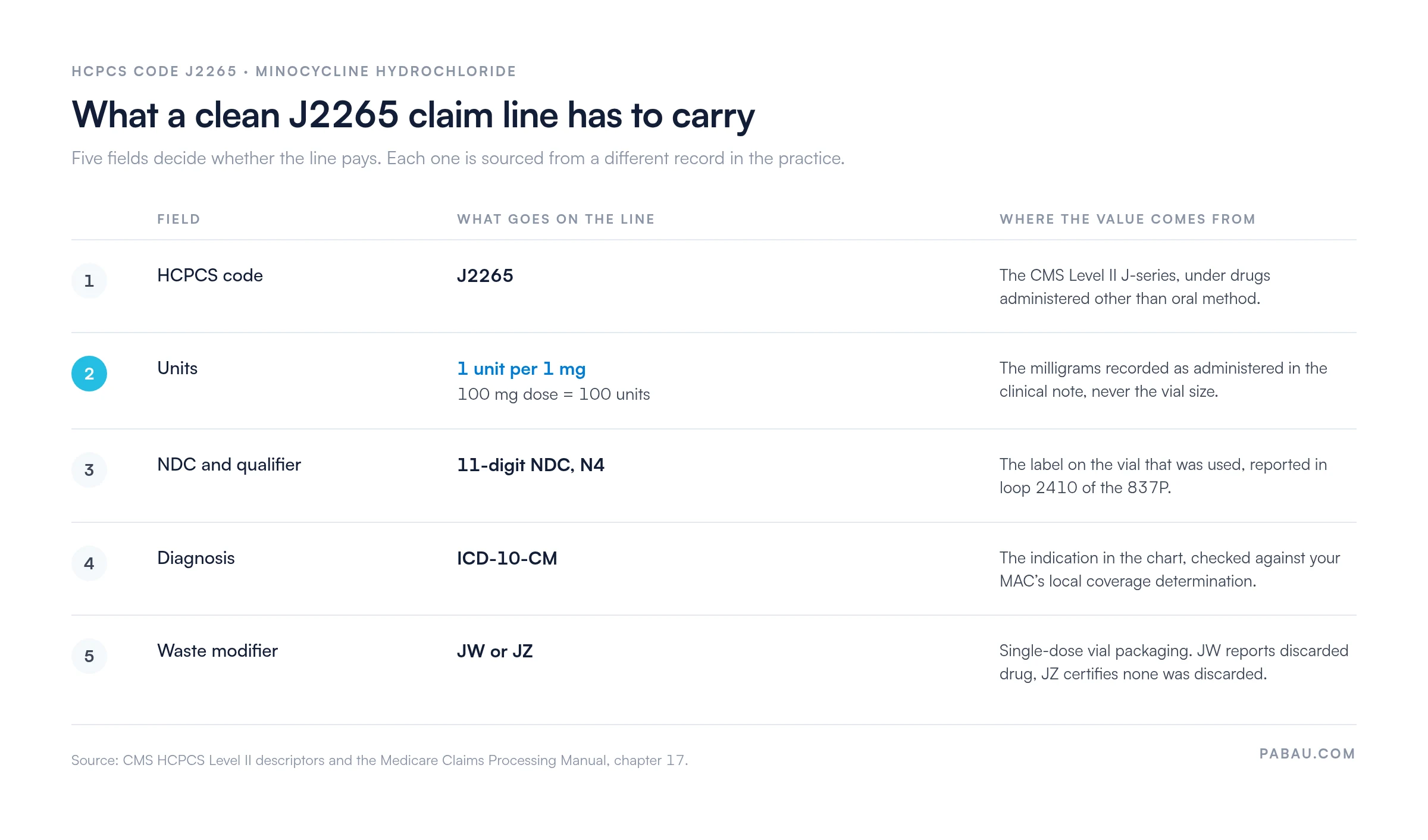
HCPCS code J2265 describes injection of minocycline hydrochloride, billed per 1 mg administered.
Units reported must equal the exact milligrams given: a 100 mg dose requires 100 units on the claim line.
Medicare pays J2265 from the quarterly ASP drug pricing files, not from the Physician Fee Schedule.
Every single-dose vial claim line needs either modifier JW for discarded drug or JZ for none.
Practice management software like Pabau automates unit calculation and NDC reporting for J-code injections.
The single most common J2265 billing error is reporting the wrong number of units. The descriptor says “per 1 mg,” which means every milligram administered equals one billable unit. Do not round the figure, and do not bundle it up to a convenient vial size.
Document the exact dose administered in the clinical record before building the claim. If the dose is drawn from a multi-dose vial and only part of it is used, bill only what reached the patient. Wasted drug from a single-dose vial is handled separately through modifier JW, covered below. Recording administered milligrams accurately is the first line of defense against unit-count denials.
Medicare does not price J2265 through the Physician Fee Schedule. Separately payable Part B drugs, J-codes included, are paid from the average sales price files that CMS publishes every quarter. Payment is set at the drug’s average sales price plus 6 percent. The amount is reset four times a year rather than once each January.
Pull the current per-unit amount from the ASP drug pricing files for the quarter the date of service falls in. The administration service billed alongside the drug is a separate claim line. That line does come from the Physician Fee Schedule, with the usual adjustment for your locality.
Because J2265 is a per-milligram code, payment on any claim scales directly with the units billed. A 100 mg infusion returns roughly 100 times the per-unit amount. That makes dose documentation a revenue question as much as a clinical one. Practices that under-document administered doses systematically underbill.
Medicare Part B covers injectable minocycline hydrochloride when three conditions hold. The drug must be medically necessary for the patient’s condition. It must be administered incident to a physician’s service or by a qualified provider. The claim must also carry an appropriate ICD-10-CM diagnosis. No National Coverage Determination (NCD) applies specifically to J2265, so coverage is governed by Local Coverage Determinations (LCDs) from the applicable Medicare Administrative Contractor (MAC).
Verify the patient’s Part B status and any prior authorization requirement before the appointment rather than after it. Confirm the applicable LCD for your MAC jurisdiction at the same time, since coverage criteria for antibiotic injections vary by region.
No single universal list of approved ICD-10 codes applies to J2265 across all payers. Medical necessity is established by pairing J2265 with a diagnosis that clinically justifies injectable minocycline. The table below shows commonly paired ICD-10-CM codes drawn from established clinical use. Always confirm against your MAC’s LCD and the individual payer’s coverage policy.
Pair the most specific ICD-10-CM code available. “Rosacea, unspecified” (L71.9) works where documentation does not differentiate a subtype. Avoid an other-or-unspecified code where a more precise one exists, because payers flag those as insufficient support for medical necessity. Our ICD-10-CM code index carries the full descriptors if you want to check a candidate before it goes on the claim.
Many payers require an NDC (National Drug Code) on the claim line alongside J2265. The NDC is a unique 11-digit identifier for the drug product dispensed, and it tells the payer the manufacturer, product, and package size. Pharmacy staff usually manage NDC reporting, but medical billers need to understand the crosswalk to avoid rejections.
NDC codes for minocycline injectable products change when manufacturers update packaging or when product rights transfer between labelers. Never hardcode an NDC into a claim template without checking it periodically against the current FDA DailyMed database. A stale NDC is a common cause of commercial payer rejections, even where the J2265 unit count is correct.
Modifiers tell the payer about billing circumstances that change how a claim is adjudicated. For J-code drug injections including J2265, the four below come up most often. Apply one only where the clinical situation genuinely warrants it. Review the rules on submitting a clean claim before adding a modifier that does not match the documented encounter.
CMS governs the JW and JZ modifiers in the Medicare Claims Processing Manual, chapter 17. Single-dose vials require one of the two on every J-code claim line. Practices that omit both may face post-payment audits. Check whether the minocycline HCl product you use is packaged as a single-dose or multi-dose vial before deciding which one applies.
Between the code, the units, the drug identifier, the diagnosis and the modifier, a single J2265 line carries five values. Each one is sourced from a different record.
Audit your J2265 claims quarterly: filter by modifier JW and compare wasted drug units to your vial inventory records. A mismatch between reported waste and vials used is one of the top signals that triggers a MAC pre-payment review. Run this check before any payer audit window opens.
The ASC payment indicator CMS assigns to J2265 decides how the code is paid in an ambulatory surgical center. It is either separately payable or packaged into the procedure payment. Those indicators are published in the CMS ASC Payment System addenda files.
Check the ASC indicator before assuming J2265 is separately billable in a surgical center. Packaging denials are among the hardest to overturn, because they reflect a CMS payment policy decision rather than a documentation problem.
Commercial payers do not uniformly follow CMS payment rules for J2265. Coverage criteria, prior authorization requirements, and reimbursement rates vary by payer and plan type. The table below summarizes typical policy patterns. Verify with the payer’s provider portal or coverage policy document before submitting claims.
Practices treating patients under both Medicare and commercial plans need a separate claim workflow for each. Do not assume a commercial payer mirrors Medicare. Some plans exclude J2265 in outpatient settings, and others limit covered diagnoses to a narrower list than the MAC’s LCD allows.
Understanding adjacent J-codes helps billers pick the right one when a drug order changes, or when several antibiotic injectables sit on the formulary. The AAPC HCPCS code lookup carries a full J-series reference with current descriptors.
Do not reach for J3490 (unclassified drugs) when J2265 exists as the specific code for minocycline hydrochloride. Billing a catch-all code for a drug that already has an assigned J-code sends the line to manual review and delays payment. The specific code clears the payer’s automated edits instead.
Manual J-code billing carries three error risks that compound each other. Unit counts get retyped by hand from the dose record, NDC data goes stale, and modifiers get misapplied on single-dose vials. In a practice billing several drug injection codes across high patient volumes, one of those errors tends to travel with the others.
Practice management software like Pabau closes that loop. Our claims software for practices reads the administered milligram dose straight from the clinical record. It calculates the unit count, pulls the current NDC, and flags whether JW or JZ applies. The claim is then scrubbed against payer rules before it reaches the clearinghouse.
The same record feeds reporting on J2265 acceptance rates, average days to payment, and denial patterns by payer. That turns a run of individual claims into a picture the practice can act on. A unit-count habit gets caught in weeks rather than at the next audit.

Pabau’s claims management software tracks drug units, automates NDC reporting, and flags claim errors before submission. Your team spends less time correcting denials and more time on patient care.

J2265 has one precision requirement that outranks the rest: every milligram administered becomes exactly one reported unit. Pair the line with a diagnosis that supports the indication, and apply JW or JZ to single-dose vial claims. Check the NDC against the vial your team actually opened.
None of that is difficult on any single claim. It gets expensive at volume, when one unit-count habit repeats across hundreds of injections and surfaces months later as a pre-payment review. Automating the path from clinical record to submission is what stops the small error from compounding. Book a demo to see how Pabau builds J-code claim lines from the dose your team already documents.

Need to see where drug injection billing sits in the wider revenue cycle? Revenue cycle management explained covers the claims lifecycle from eligibility verification through to ERA posting.
Getting denials on J-code submissions? Denial management in healthcare walks through the common denial patterns and how to resolve them before they reach accounts receivable.
Building the documentation that supports a drug claim? What a superbill includes shows which fields have to be captured at the encounter for the claim to survive review.
Worried about audit exposure on single-dose vial claims? Medical billing compliance sets out the record-keeping standards that hold up when a payer asks for support.
HCPCS code J2265 is used to bill for the injection of minocycline hydrochloride, a tetracycline-class antibiotic. It is given by a non-oral route such as intravenous or intrapleural injection. It is a Medicare Part B Level II J-code, billed per 1 mg of drug administered.
Bill one unit of J2265 for every 1 mg of minocycline hydrochloride administered. A 100 mg injection equals 100 units. Always base units on the documented administered dose, not the vial size.
The two that matter most are JW, for drug discarded from a single-dose vial, and JZ, which certifies that none was discarded. Modifier 59 may also apply where J2265 is billed alongside another service that would otherwise be bundled by the payer.
Commonly paired ICD-10-CM codes include L71.9 (rosacea, unspecified), L70.0 (acne vulgaris), J90 (pleural effusion), and A69.20 (Lyme disease, unspecified). The right code depends on the clinical indication. Confirm it against your MAC’s Local Coverage Determination for injectable antibiotics.
Yes, J2265 is payable under Medicare Part B where the drug is medically necessary and documented with a supported ICD-10-CM diagnosis. No National Coverage Determination applies, so check your MAC’s LCD for the coverage criteria and diagnosis requirements.
Medicare pays J2265 at the drug’s average sales price plus 6 percent, per 1 mg unit. The amount comes from the quarterly ASP drug pricing files on the CMS site, not from the Physician Fee Schedule. It is reset every quarter.
Commercial payer policies vary widely. Some plans require prior authorization for high-unit minocycline claims, or step-therapy documentation showing that oral alternatives failed. Most require an NDC on the claim and reimburse at WAC or an ASP-based contracted rate rather than the Medicare amount.